TL;DR
- Collective bargaining is the process in which employees, usually through a trade union, negotiate as a group with their employer over pay and working conditions.
- Three terms go with it: the bargaining unit, which is the group of workers covered, recognition, which is the employer's agreement to negotiate with the union, and the collective agreement, which is the result.
- UK guidance says that employers must give a recognised union certain information for bargaining. US law defines bargaining as a mutual obligation to meet and confer in good faith, which does not compel either side to agree.
One employee who asks for a pay rise is making a request. Five hundred employees who ask together, through people they have chosen to speak for them, are doing something different. They are bargaining collectively, and in many countries the law gives that process a shape.
This article gives the meaning of collective bargaining, the terms that go with it, what it usually covers, how it is organised, and how the UK and the United States define it. It ends with habits that make bargaining constructive, for managers on either side of the table.
Bargaining covers pay and terms. Day-to-day concerns still need a day-to-day channel. See how New Dynamics continuous feedback gives every employee a regular voice.
What does collective bargaining mean?
The Cambridge Dictionary defines collective bargaining as “the system in which employees talk as a group with their employers to try to agree on matters such as pay and working conditions”.
The UK government's guidance for employers on collective bargaining puts it from the employer's side: “You'll need to work with unions to discuss changes to your workers' terms and conditions. This is called ‘collective bargaining’.”
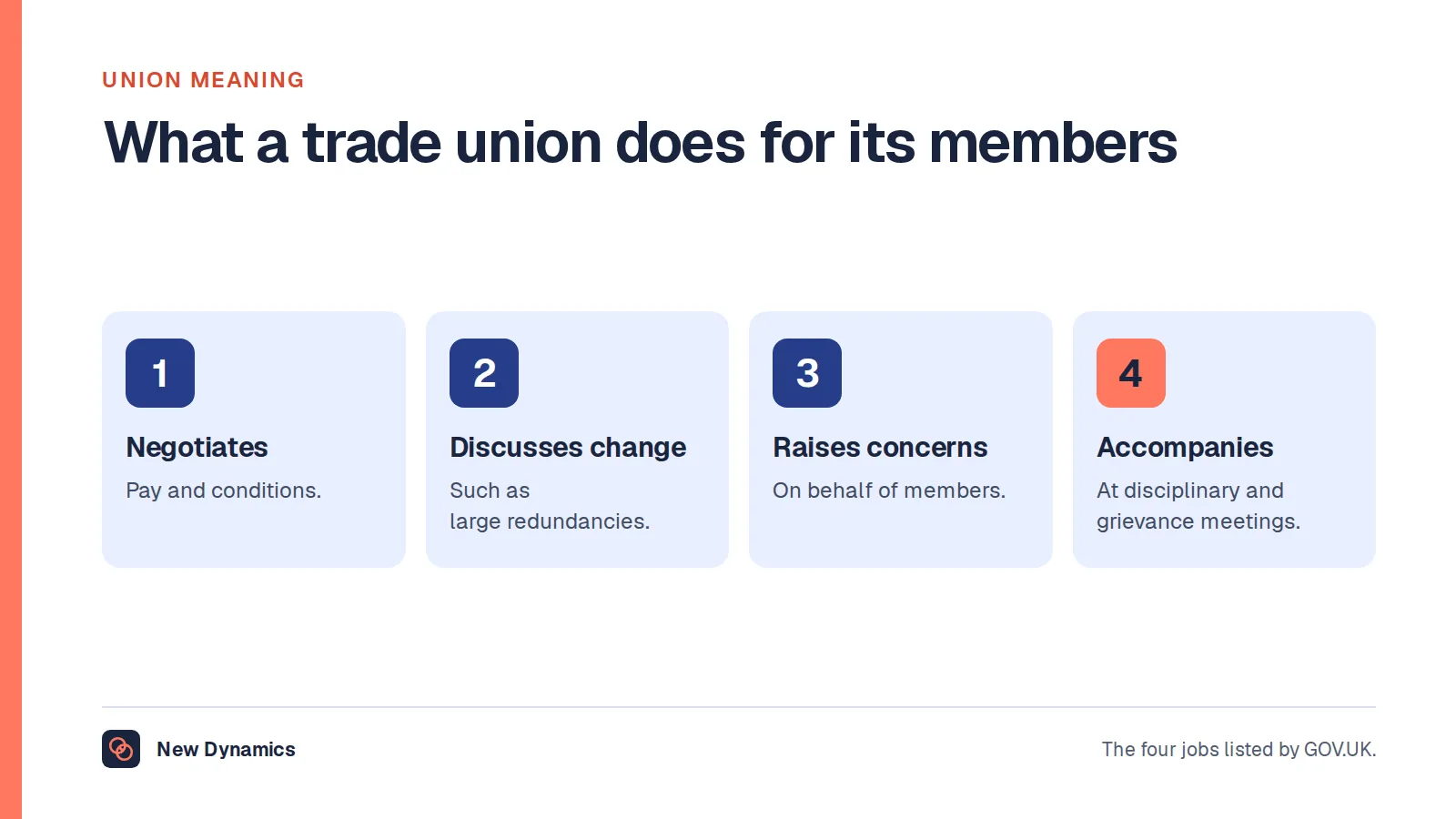
The word collective is the point. The employees speak with one voice, through representatives, and the result applies to a group. The representatives are usually officials and members of a trade union. Our guide to the meaning of union explains what unions are and what else they do.
Three terms to know
- Bargaining unit. The group of workers whose terms are being negotiated. GOV.UK says that it “can include all employees in a workplace or just certain groups of workers, for example technicians”.
- Collective bargaining. The negotiation itself, between the employer and the union that the employer recognises.
- Collective agreement. The result. GOV.UK: “If collective bargaining leads to an agreement, for example about a pay increase or change in working conditions, it's called a ‘collective agreement’.”
A fourth term comes before all three. Recognition is the employer's agreement to negotiate with a union. GOV.UK's guide to trade union recognition tells employers: “You need to recognise the trade union before they can negotiate with you.” A union must first ask for voluntary recognition. If the employer refuses, and has more than 21 employees, the union can apply for statutory recognition from the Central Arbitration Committee.

What does collective bargaining cover?
GOV.UK says that it is up to the employer and the union to agree which terms and conditions are covered, “but it's usually things like pay, holiday, and working hours”.
In practice the agenda can include:
- basic pay, pay scales and allowances;
- working hours, shifts and overtime;
- holiday and other leave;
- sick pay and pensions;
- procedures for discipline, grievances and redundancy;
- health and safety arrangements;
- training and time off for it.
Collective agreements can reach beyond union members. GOV.UK's page on collective agreements explains that an employer may have an agreement with employees' representatives “that allows negotiations of terms and conditions like pay or working hours”, and that the agreement could set out which employees are covered. An employee's contract may say that some of its terms come from such an agreement, so check your contract or staff handbook if you are unsure.
Six things to agree before talks begin
GOV.UK advises that employers and unions should work out how to run collective bargaining. It lists six questions.
- Who will represent the workers?
- Who is included in the bargaining unit?
- When, and how often, will meetings happen?
- What happens if more than one union is recognised?
- What will be discussed?
- What happens if the union and the employer cannot come to an agreement?
The sixth question deserves the most care. Agree the steps for a deadlock while relations are good: further meetings, more senior people, conciliation by a third party. It is far harder to design a process in the middle of a dispute.

The duty to share information
Bargaining is only real if both sides can see the facts. GOV.UK states: “Employers must give certain information to the union to help it with the bargaining process, for example the company's pay and benefits structure or information about its profits, assets and liabilities.” It points employers to the Acas Code of Practice on disclosure of information to trade unions for collective bargaining purposes.
How the United States defines it
American law defines the activity itself. The National Labor Relations Act, at 29 U.S.C. 158(d), says that to bargain collectively is “the performance of the mutual obligation of the employer and the representative of the employees to meet at reasonable times and confer in good faith with respect to wages, hours, and other terms and conditions of employment”.
Two phrases in that sentence carry a great deal of weight.
- “In good faith”. The phrase asks both sides for a genuine attempt to reach agreement.
- The limit that follows. The statute adds that the obligation “does not compel either party to agree to a proposal or require the making of a concession”. There is a duty to bargain. There is no duty to agree.
The same subsection provides for “the execution of a written contract incorporating any agreement reached if requested by either party”.
The two systems differ in many ways, including how unions gain recognition and what happens when talks fail, and other countries differ again. This article is general information, not legal advice. Take advice on the law where you operate.
Five habits of constructive bargaining
Bargaining is a negotiation between parties who will still be working together the day after. That makes it different from buying a car.
- Prepare. Know your figures, your priorities and your limits, and try to work out the other side's.
- Share information early. It is a legal duty for UK employers with a recognised union, and it is also good tactics. People bargain more realistically when they trust the numbers.
- Ask about interests. A demand for a 6% rise may be about the cost of living, about differentials between grades or about feeling overlooked. The answer changes what might settle it.
- Write it down. Record what was agreed, in plain words, and have both sides confirm it.
- Communicate the outcome together, where you can. Employees who hear two versions of a deal trust neither.

What collective bargaining does not replace
Bargaining sets the frame: pay scales, hours, procedures. It does not manage anyone. Setting goals, giving feedback, developing people and dealing with individual concerns remain the work of line managers, in unionised workplaces as much as anywhere else.
Individual complaints also have their own route. Our guide to the meaning of grievance explains the procedure, and the role that a union representative can play in it.
Common mistakes
Treating the union as the enemy. You will meet again next year. Behave accordingly.
Hoarding information. It breaches a duty in the UK, and it breeds suspicion everywhere.
No agreed process for deadlock. See the sixth question above.
Sending someone without authority. If your negotiator must check every point with someone else, send someone else.
Vague agreements. “We will review allowances” settles nothing. Say what, by when and by whom.
Letting line managers hear the outcome from their teams. Brief them first.
Frequently asked questions
What is the meaning of collective bargaining?
Collective bargaining is the process in which employees negotiate as a group, usually through a trade union, with their employer over matters such as pay, holiday and working hours. An agreement that results is called a collective agreement.
What is a bargaining unit?
A bargaining unit is the group of workers whose terms and conditions are covered by collective bargaining. GOV.UK says that it can include all employees in a workplace, or just certain groups of workers, such as technicians.
What is a collective agreement?
A collective agreement is what collective bargaining produces: an agreement between an employer and employees' representatives, for example about a pay increase or a change in working conditions. It can also set out how negotiations will be organised and who is covered.
What does collective bargaining usually cover?
GOV.UK says that it is up to the employer and the union to agree what is covered, but that it is usually things like pay, holiday and working hours. Agreements can also cover procedures for discipline, grievances and redundancy.
Does an employer have to agree to the union's proposals?
No. In the United States, the statute says that the obligation to bargain in good faith does not compel either party to agree to a proposal or to make a concession. In the UK, a recognised union must be given information and consulted, but agreement is reached by negotiation.
What is the difference between collective bargaining and consultation?
In collective bargaining the parties negotiate, with the aim of reaching an agreement. In consultation, the employer asks for views and considers them before it decides. Both can involve union representatives.
Your next step: know your own arrangements
- Find out whether your organisation recognises a union, and for which bargaining units.
- Read the collective agreement, or agreements, that apply.
- Check what your contracts say about terms that come from those agreements.
- If you manage people, ask HR to brief you before the next round of talks, and again when it ends.
If pay is on the agenda, a clear pay policy helps both sides. Read and download our compensation policy guide. The guide is free to read, and the PDF uses our short download form.
Want a regular channel for the concerns that never reach the bargaining table? Book a New Dynamics demo and bring your current approach. You can also email contact@new-dynamics.com.