TL;DR
- A floating holiday is a paid day off that the employee chooses, in place of, or in addition to, the fixed public holidays on which the whole organisation closes.
- Employers offer floating holidays to include people of different faiths and cultures, to give choice, to keep the business open on days when some would rather work, and to deal with holidays that fall on a weekend.
- A clear policy settles six things: how many days, who is eligible, when they are granted, how to book them, whether they carry over and what happens when someone leaves.
The company calendar says that the office closes on 25 December. For some of your colleagues, that is the most important day of the year. For others, it is a quiet Thursday, and the day that matters to them is Eid, Diwali, Yom Kippur, Lunar New Year or a family occasion that no calendar lists.
A floating holiday is one answer. This article explains what a floating holiday is, how it differs from fixed holidays and from vacation or PTO, why employers offer it, how it works in practice, the six decisions that a policy must make, and the mistakes that cause arguments. The term is mainly American, and we note how the same idea works in the UK.
Holiday policies go wrong when nobody asks people what they need. See how New Dynamics continuous feedback gives every employee a regular voice.
What is a floating holiday?
A floating holiday is a paid day off that an employee can take on a date of their choice. It “floats” because it is not tied to a date in the calendar. Policies usually grant a small number, such as one or two a year, on top of a list of fixed holidays.
Employers also call it a personal holiday, an optional holiday or a personal day, although “personal day” can mean something looser in some policies.
Three kinds of paid day off are worth keeping apart.
- Fixed holiday. The employer names the date, and everyone is off: New Year's Day, Thanksgiving, Christmas Day.
- Floating holiday. The employer grants the day, and the employee chooses the date.
- Vacation or PTO. Leave that the employee builds up and uses for any purpose, usually in larger amounts and under different rules.
A floating holiday sits between the other two. It is granted like a holiday and booked like vacation.

An example from the statute book
Most floating holidays are a matter of employer policy. One clear example is written into law, for public employees in Washington State. The state's statute on legal holidays lists the fixed state holidays, and then says that employees of the state and its political subdivisions, with some exceptions, “are entitled to one paid holiday per calendar year in addition to those specified in this section”. The employee “may select the day on which the employee desires to take the additional holiday”, after consultation with the employer.
The same statute gives those employees “two unpaid holidays per calendar year for a reason of faith or conscience”, again on days that the employee selects. The employer must allow the chosen days unless the absence “would impose an undue hardship on the employer”, or the employee is needed to maintain public safety.
That is a floating holiday in its plainest form: the entitlement is fixed, and the date is the employee's choice. The statute covers public employees in one state. It does not bind private employers.
Why employers offer floating holidays
- Inclusion. A fixed list of holidays reflects one tradition. Floating days let people observe their own. The US Equal Employment Opportunity Commission lists “floating or optional holidays” among the common ways of accommodating religious practice, in its questions and answers on religious discrimination in the workplace.
- Choice. People value a day that they pick: a birthday, a child's first day at school, the day after a big event.
- Coverage. Some businesses cannot close. If those who want to work on a public holiday can do so, and take another day instead, the rota is easier to fill.
- Calendar problems. When a fixed holiday falls on a weekend, or the office closes on a day that some employees do not normally work, a floating day is a simple way to even things out.
- Hiring. A floating holiday costs the same as any other paid day. It can say more about how you treat people.

How does a floating holiday work?
In practice the steps are simple.
- The policy grants a number of floating days, usually at the start of the calendar year or on a work anniversary.
- The employee asks for a date, in the same way as for vacation, with the notice that the policy requires.
- The manager approves it, unless there is a real operational reason to refuse, and suggests another date if so.
- The day is paid at the employee's normal rate, and recorded as a floating holiday.
- If it is not used by the end of the year, the policy says what happens. In many policies it is lost.
One point needs care. A request that is made for religious reasons is more than a scheduling preference. The EEOC's guidance explains that an employer should accommodate religious practice unless doing so would cause undue hardship. If you must refuse a date, look hard for an alternative, and record your reasons.
Six decisions for a floating holiday policy
- How many days? Decide the number, and whether they are extra days, or whether you are converting some fixed holidays.
- Who is eligible? Full-time and part-time employees, from which date. Part-time employees should normally receive a proportionate amount.
- When are they granted? On 1 January, on the anniversary of joining, or after a period of service. Say what a mid-year starter receives.
- How are they booked? How much notice, who approves, and whether days can be taken in halves. Say that requests for religious observance will be accommodated wherever possible.
- Do they carry over? Many policies say no, which keeps floating holidays distinct from vacation. Check that the rule is lawful where you operate.
- What happens on leaving? Whether an unused floating holiday is paid out. Local law may decide this for you, and it sometimes depends on how the policy is worded. Take advice.

Sample policy wording
Adapt this to your organisation, and have it checked against the law where you operate.
Floating holidays. In addition to the fixed holidays listed above, each employee receives two paid floating holidays in each calendar year. Part-time employees receive a proportionate amount. Employees who join after 30 June receive one floating holiday in their first calendar year.
Floating holidays may be taken on any working day, for any reason. Please request them through the usual leave process, with at least two weeks' notice where possible. Managers will approve requests unless there is a serious operational reason not to, and will make every effort to accommodate requests for religious or cultural observance.
Floating holidays must be taken in the calendar year in which they are granted. They cannot be carried over. [State what happens to unused floating holidays when employment ends, in line with local law.]
Floating holiday, PTO and time off in lieu
| Type | What it is | Who picks the date |
|---|---|---|
| Fixed holiday | A named day on which the organisation closes | The employer |
| Floating holiday | A granted paid day, not tied to a date | The employee, with approval |
| Vacation or PTO | Leave that builds up, for any purpose | The employee, with approval |
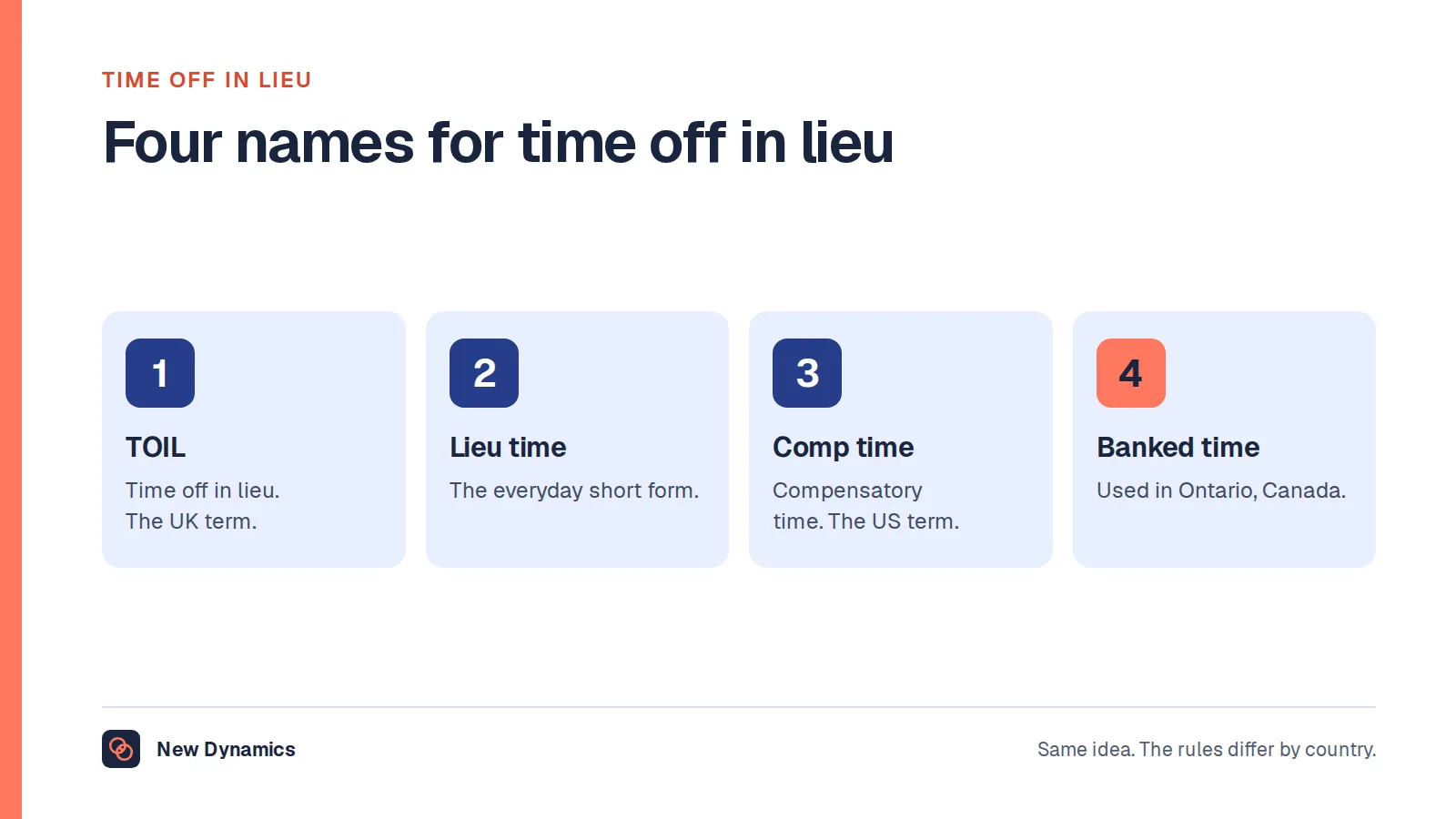
| Time off in lieu | Time off given in exchange for extra hours already worked | Agreed between the two |
Employers with a single PTO bank sometimes ask whether they need floating holidays at all. Often they do not: the days are already in the bank. Floating holidays suit employers who keep a list of fixed holidays and want to add choice to it. For the last row of the table, see our guide to time off in lieu.
The same idea in the UK
The term floating holiday is less common in the UK, but the idea translates. GOV.UK's guidance on holiday entitlement says that most workers who work a five-day week must receive at least 28 days' paid annual leave a year. It adds: “Bank or public holidays do not have to be given as paid leave.” An employer can choose to include bank holidays as part of a worker's statutory annual leave.
That leaves room for a flexible approach. An employer could, for example, let people work on a bank holiday that means little to them, and take the day at another time. The floor is the statutory minimum, and the contract must say clearly how bank holidays are treated. This is general information, not legal advice.
Common mistakes
No written rule on carry-over or leaving. These are the two questions that end in a dispute.
Refusing a religious date without looking for an alternative. Treat these requests with particular care.
Forgetting part-time staff. Give a proportionate amount, and say how it is calculated.
Asking people to justify the date. The point of a floating holiday is that the reason is theirs. Do not ask for one.
Floating days that nobody can take. If workload or managers make it impossible to use the day, the benefit is not real. Track how many are used.
Inconsistent approval. One manager always says yes, and another never does. Set a standard.
Frequently asked questions
What is a floating holiday?
A floating holiday is a paid day off that an employee can take on a date of their choice, instead of, or in addition to, the fixed public holidays on which the whole organisation closes. Policies usually grant a small number of days a year.
How does a floating holiday work?
The employer grants the days, usually at the start of the year. The employee requests a date through the normal leave process, the manager approves it, and the day is paid at the normal rate. Unused days are often lost at the end of the year.
What is the difference between a floating holiday and PTO?
PTO or vacation is leave that builds up and can be used for any purpose, usually in larger amounts. A floating holiday is a small, fixed number of days that are granted like a holiday. It often cannot be carried over, and may be treated differently when someone leaves.
Do floating holidays carry over?
It depends on the policy and on local law. Many policies say that floating holidays must be used in the year in which they are granted. Check the rules where you operate before you write that in.
Are floating holidays paid out when you leave?
It depends on the law where you work, and on how the policy is worded. A policy should state the rule, and employers should take local advice.
Can an employer refuse a floating holiday request?
An employer can usually refuse a date for a real operational reason, and should offer another. Requests made for religious observance need more care: in the United States, the EEOC expects employers to accommodate religious practice unless it would cause undue hardship.
Your next step: check your holiday list
- Look at your list of fixed holidays, and ask whose calendar it reflects.
- Ask your team which days matter to them. You may be surprised.
- Make the six decisions above, and write them down in plain words.
- At the end of the year, check how many floating days were used, and by whom.
To set out time off and your other policies clearly, read and download our employee handbook guide. The guide is free to read, and the PDF uses our short download form.
Want to hear what your people need before you write the policy? Book a New Dynamics demo and bring your current approach. You can also email contact@new-dynamics.com.