TL;DR
- Nobody invented the 40-hour week single-handedly. In the United States it became the legal standard through the Fair Labor Standards Act of 1938, which first set the maximum workweek at 44 hours. Today the Act requires overtime pay for hours over 40.
- The UK works differently. There is no 40-hour rule for adults. The law limits the average working week to 48 hours, normally averaged over 17 weeks, and workers can opt out.
- Eight hours is a convention, and a ceiling worth respecting. Very long hours are linked to worse health. What matters most is how the hours are used: clear priorities, protected focus time and real rest.
Eight hours a day, five days a week. It is so familiar that it feels like a law of nature. It is closer to a truce: a standard that was argued over for decades, written into law in some countries and never quite fixed in others.
This article explains where the pattern of working 8 hours a day comes from, what the law says in the US and the UK, what the evidence says about long hours, and how to make a normal working day count.
How well people work matters more than how long they sit at a desk. See how New Dynamics Goals & OKRs keeps attention on results, with goals and progress visible to everyone.
This is general information, not legal advice. Working time rules vary by country, sector and contract.
Who invented the 40-hour work week?
No single person did. The 40-hour week is the result of a long argument about how much of a person's life an employer may claim. What can be dated precisely is when it entered the law.
In the United States, the key step was the Fair Labor Standards Act. The US Department of Labor's history of the Act, Maximum Struggle for a Minimum Wage by Jonathan Grossman, records that President Roosevelt signed it on 25 June 1938. For the industries that it covered, it “banned oppressive child labor and set the minimum hourly wage at 25 cents, and the maximum workweek at 44 hours”.
The same history shows that the 40-hour figure was already in circulation. It describes earlier industry codes that provided for a 40-hour workweek, a law that required most government contractors “to adopt an 8-hour day and a 40-hour week”, and early drafts of the bill that proposed “a 40-hour maximum workweek”.
So the honest answer to “who created the 40-hour work week?” is: legislators, unions, employers and campaigners, over many years. If you need one date for the US, 1938 is when a federal standard for the working week first became law, at 44 hours.
What the law says in the US today
The Fair Labor Standards Act does not ban working more than 40 hours. It makes those hours more expensive. The Department of Labor's Wage and Hour Division puts it this way: “Unless exempt, employees covered by the Act must receive overtime pay for hours worked over 40 in a workweek at a rate not less than time and one-half their regular rates of pay.”
Two details matter. The rule is weekly, so the Act itself sets no daily limit. And many employees are exempt, which is why salaried professionals often work longer without overtime pay. Some states add their own rules.
What the law says in the UK
The UK has no 40-hour rule for adults. GOV.UK's guide to maximum weekly working hours says: “You cannot work more than 48 hours a week on average - normally averaged over 17 weeks.” It adds that workers can choose to work more by opting out of the 48-hour week.
Young workers are treated differently: “If you're under 18, you cannot work more than 8 hours a day or 40 hours a week.”
Many full-time contracts specify somewhere between 35 and 40 hours. That is a matter of contract and custom. The legal limit is the 48-hour average.

Is working 8 hours a day healthy?
For most people, a working day of about eight hours, with breaks, is sustainable. The evidence of harm concerns much longer hours.
In 2021 the World Health Organization and the International Labour Organization published estimates on long working hours, heart disease and stroke. The study concluded that “working 55 or more hours per week is associated with an estimated 35% higher risk of a stroke and a 17% higher risk of dying from ischemic heart disease, compared to working 35-40 hours a week”.
Note the comparison group: 35 to 40 hours. The standard week is the healthy baseline in that study, and the risk lies in routinely going far beyond it.
Length is not the only thing that matters. In Great Britain, the Health and Safety Executive's Management Standards say that employers should provide “adequate and achievable demands in relation to the agreed hours of work”. Eight calm, well-organised hours are very different from eight hours of constant interruption and impossible targets.
Are all eight hours productive?
Few people do eight hours of concentrated work in an eight-hour day. Time goes on meetings, messages, switching between tasks, waiting for others and the ordinary business of being human.
That is normal. It also explains why adding hours rarely adds much output. Tired people tend to work more slowly and make more mistakes, and the extra hours are often spent fixing what the earlier ones got wrong.
A more useful question than “How many hours?” is “What did the hours produce?” That shift, from presence to results, is what makes flexible and shorter working patterns possible.
How to make an 8-hour day count
For individuals
- Decide the day's most important task the afternoon before, and do it first.
- Protect two blocks of focus time, with notifications off.
- Batch email and chat into a few set times.
- Take real breaks, including lunch away from your desk.
- Set a finishing time, and keep it on most days.
- Plan tomorrow before you leave. It makes it easier to switch off.
For managers
- Manage results, not presence. Agree clear goals, and judge by them. Our performance goals examples can help.
- Review the workload when people regularly work late. It is a planning problem, not a commitment problem.
- Cut meeting time. Keep at least one afternoon a week free of internal meetings.
- Set norms for messages outside working hours. No reply expected until the next working day.
- Model it. If you send emails at midnight, your team will assume that they should too.
- Never praise long hours. Praise outcomes and care.
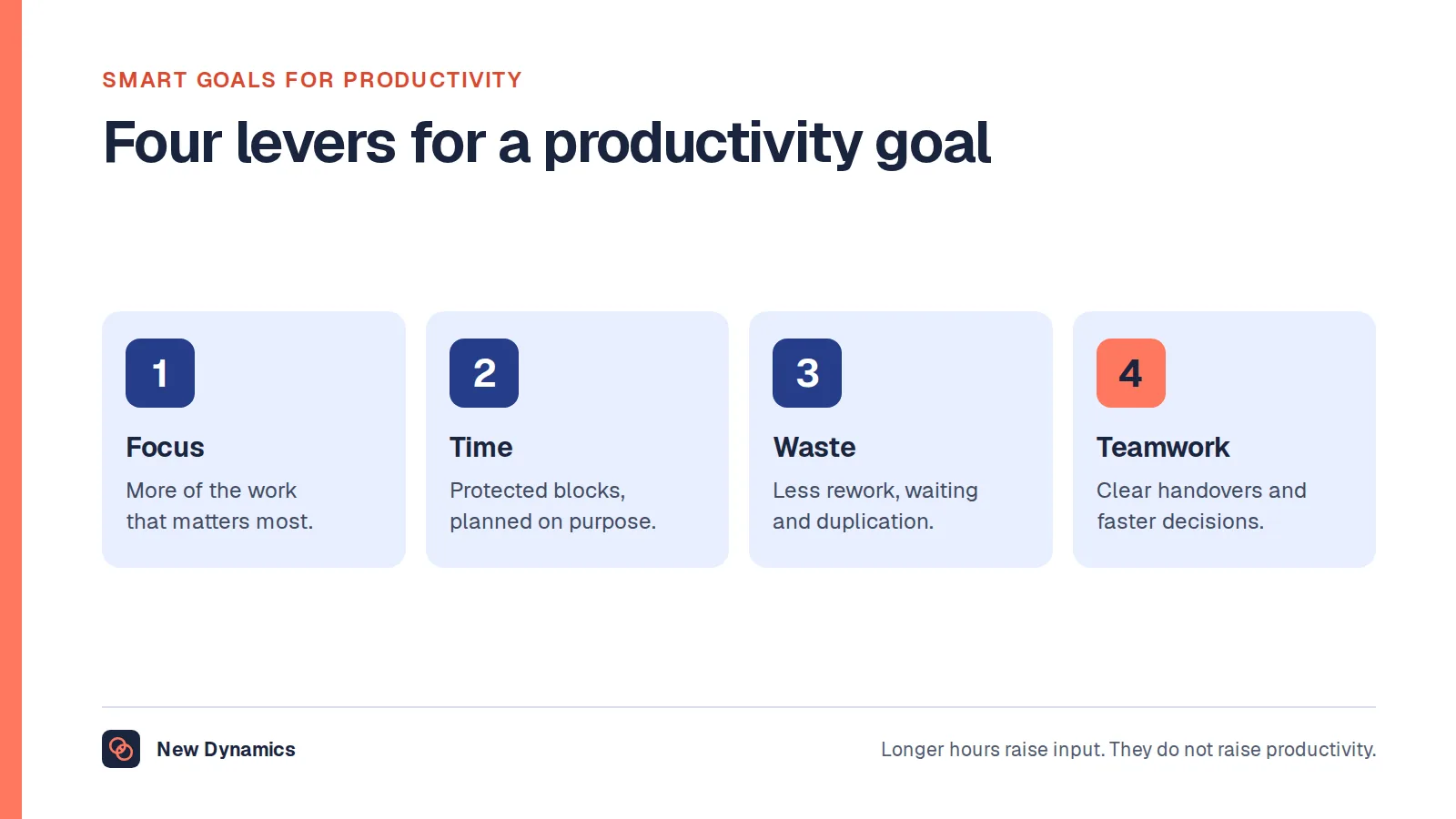
Our SMART goals for productivity offer 30 examples that raise output without raising hours.

Alternatives to the standard 8-hour day
The five-day, eight-hour pattern suits some work and some lives better than others. Common alternatives include:
- flexible hours, with core hours in the middle of the day;
- compressed hours, such as four longer days or a nine-day fortnight;
- part-time work and job sharing;
- a four-day week with reduced hours, which some organisations have tested;
- shift patterns designed around the work, with proper rest between shifts;
- remote and hybrid working, which removes the commute from the day. See our remote work guide.
Whichever pattern you choose, the same principles apply. Be clear about results, keep total hours within healthy limits, protect rest and treat people fairly whatever pattern they work.
Working hours and wellbeing: what employers should do
- Know your legal limits, and record hours where the law requires it.
- Watch for patterns: regular late working, unused holiday and messages at all hours.
- Ask about workload in every one-to-one.
- Treat persistent overtime as a signal that priorities, staffing or processes need to change.
- Make rest normal. Encourage people to take their leave, and cover their work while they are away.
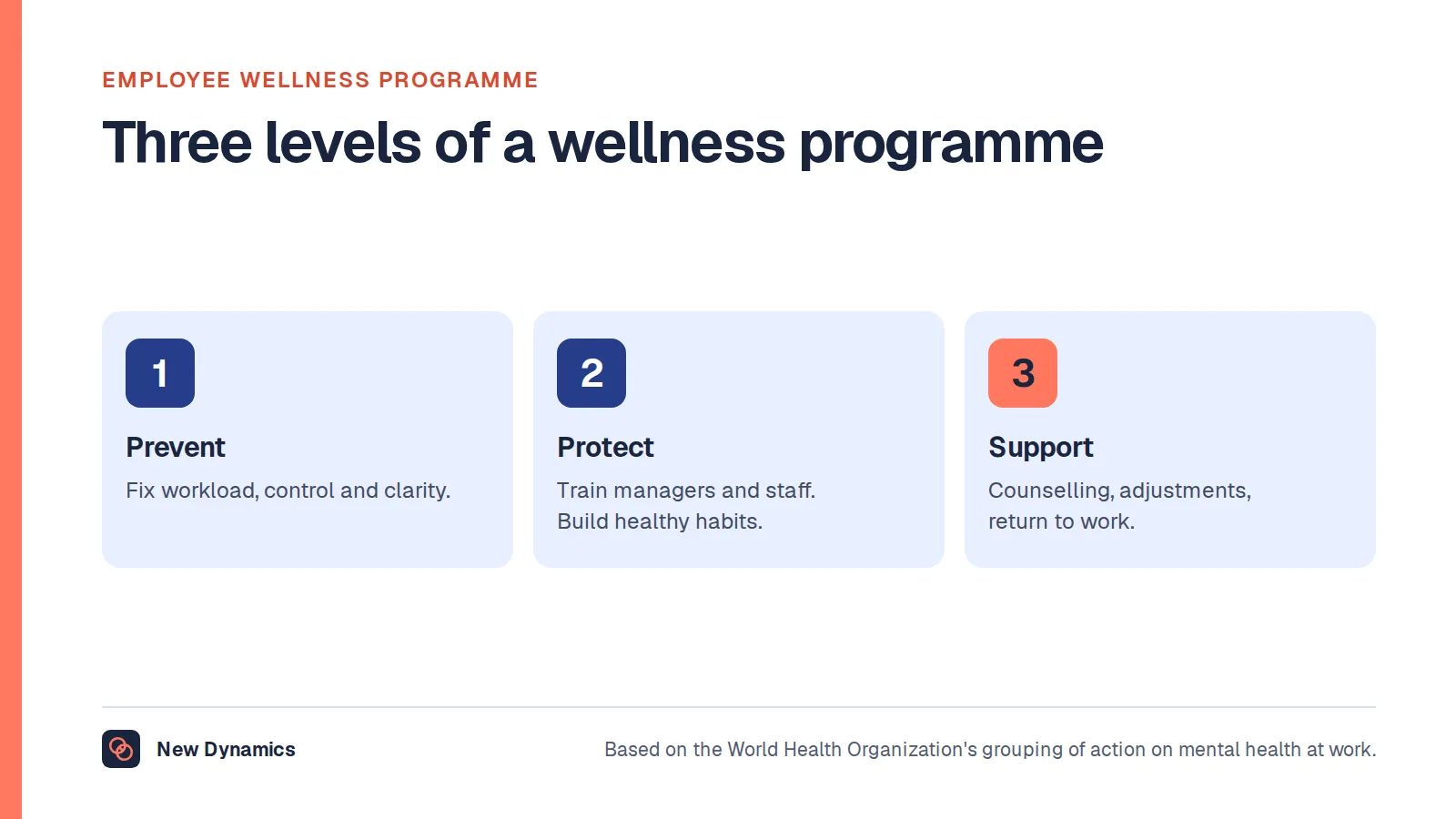
Our employee wellness programme ideas start with exactly these points about how work is designed.

Frequently asked questions
Why do we work 8 hours a day?
The eight-hour day is a convention that grew out of long campaigns to limit working time. In the United States it was reinforced by the Fair Labor Standards Act of 1938, which set a maximum workweek, first at 44 hours. Five eight-hour days became the usual way to arrange a 40-hour week.
Who invented the 40-hour work week?
No single person invented it. It emerged from decades of pressure from workers, unions, employers and legislators. In US law, the Fair Labor Standards Act of 1938 established a federal maximum workweek, initially at 44 hours. Today the Act requires overtime pay for hours worked over 40.
When did the 40-hour work week start?
In the United States, the Fair Labor Standards Act was signed on 25 June 1938 and first set the maximum workweek at 44 hours. The Department of Labor now describes the standard as overtime pay for hours over 40 in a workweek. Forty-hour codes existed in some industries earlier in the 1930s.
Is it legal to work more than 8 hours a day?
In many places, yes. US federal law sets no daily limit for adults, but it requires overtime pay after 40 hours a week for covered, non-exempt employees. In the UK, adults cannot work more than 48 hours a week on average unless they opt out. Check local rules.
Is working 8 hours a day healthy?
For most people, about eight hours with proper breaks is sustainable. The health risk is linked to much longer hours. WHO and ILO estimates associate working 55 or more hours a week with a higher risk of stroke and heart disease, compared with working 35 to 40 hours.
How many hours of an 8-hour day are productive?
It varies by person and job, and few people concentrate for all eight. Meetings, messages and switching between tasks take a large share. Protecting focus time, batching communication and reducing meetings usually do more for output than adding hours.
Your next step: look at one week
- For one week, note when you start, when you stop and what you finished each day.
- Mark the hours of real focus. Most people are surprised.
- Choose one change: a protected focus block, fewer meetings or a fixed finishing time.
- If you manage people, ask in your next one-to-ones whether the workload fits the hours.
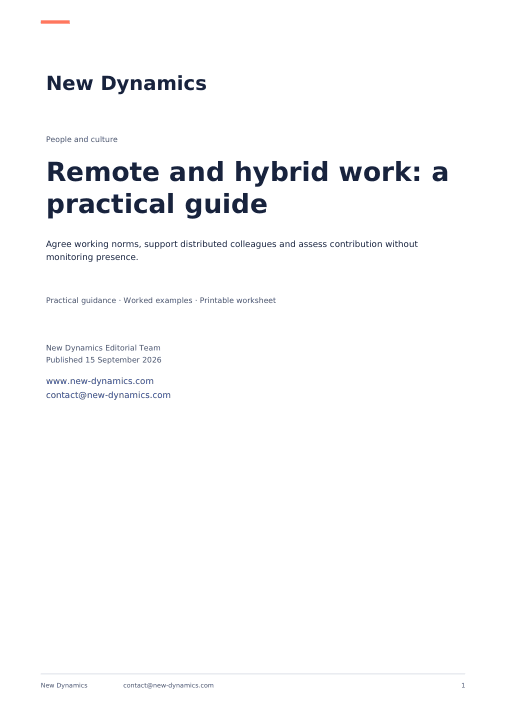
For practical ways to manage flexible and remote working patterns, read and download our remote work guide. The guide is free to read, and the PDF uses our short download form.
Want goals and progress visible, so that results matter more than hours? Book a New Dynamics demo and bring your current approach. You can also email contact@new-dynamics.com.