TL;DR
- A whistleblower is a person who reports wrongdoing, usually something they have seen at work, to someone in authority. In UK law the report must be in the public interest, which means that it affects others.
- Whistleblowers are protected by law. They should not be treated unfairly or lose their job because they blew the whistle. A personal complaint is normally a grievance, not whistleblowing.
- Employers should make it easy and safe to report, act on what they hear, keep the person's identity confidential and never tolerate retaliation.
Most serious wrongdoing at work is first noticed by an employee. Whether anyone else finds out in time depends on whether that person feels safe to say so. That is why the law protects whistleblowers, and why every employer needs to understand the word.
This article explains the meaning of whistleblower, what counts as whistleblowing in UK law, how it differs from a grievance, who a whistleblower can tell, and how employers should respond. It also notes the position in the European Union and the United States.
It describes the law in Great Britain unless it says otherwise. It is general information, not legal advice. If you are thinking of blowing the whistle, get independent advice first.
People speak up more readily where speaking up is normal. See how New Dynamics continuous feedback makes raising concerns a routine part of work.
What does whistleblower mean?
The Cambridge Dictionary defines a whistleblower as “a person who tells someone in authority about something illegal that is happening, especially in a government department or a company”.
The UK government's guide to whistleblowing for employees gives the legal version: “You're a whistleblower if you're a worker and you report certain types of wrongdoing. This will usually be something you've seen at work - though not always.”
Acas describes the act itself in its guidance on whistleblowing at work: “Whistleblowing is the action someone takes to report wrongdoing at work that affects others.” Legally, it adds, this is known as “making a disclosure in the public interest”.
The phrase is usually explained as the image of blowing a whistle to stop play and draw attention to a foul. You will see it written as one word, two words or with a hyphen. The Cambridge Dictionary lists it as one word.
The public interest test
Not every complaint is whistleblowing. GOV.UK sets the test: “The wrongdoing you disclose must be in the public interest. This means it must affect others, for example the general public.”
According to GOV.UK, you are protected by law if you report any of the following:
- a criminal offence, for example fraud;
- someone's health and safety is in danger;
- risk or actual damage to the environment;
- a miscarriage of justice;
- the company is breaking the law, for example it does not have the right insurance;
- you believe someone is covering up wrongdoing;
- sexual harassment.
The concern can be about something that happened in the past, is happening now or that you believe will happen in the near future.
Whistleblowing or grievance?
This is the distinction that matters most in practice. GOV.UK states: “Personal grievances are not covered by whistleblowing law, unless your particular case is in the public interest.” A dispute about your own pay, workload or appraisal is a typical example. GOV.UK says to report these under your employer's grievance policy.
| Grievance | Whistleblowing | |
|---|---|---|
| About | How you have been treated | Wrongdoing that affects others |
| Example | “My manager refused my leave unfairly” | “Safety checks are being signed off without being done” |
| Test | A personal concern, problem or complaint | In the public interest |
| Route | The grievance procedure | The whistleblowing policy, or a prescribed body |
| Protection | Fair procedure, and no victimisation for raising it | Specific legal protection against unfair treatment and dismissal |
Some concerns are both. If you are being pressured to falsify records, you have a complaint about your own treatment and a disclosure about wrongdoing. Our guide to the meaning of grievance explains the other route.

Who is protected
GOV.UK says that you are protected if you are a worker, for example an employee, a trainee, an agency worker or a member of a limited liability partnership. Acas adds that protection “starts from the beginning of employment”, and that people are still protected after they have left the employer that they make a disclosure about.
Acas lists people who are not usually protected in law, including the genuinely self-employed, volunteers with no enforceable employment contract and non-executive directors. An employer's own policy can choose to cover them.
The protection is this, in GOV.UK's words: “you should not be treated unfairly or lose your job because you ‘blow the whistle’”. Someone who is treated unfairly can take a case to an employment tribunal. GOV.UK notes that a claim of unfair dismissal must be raised within three months of employment ending.
Confidentiality clauses. GOV.UK states that confidentiality or “gagging” clauses are not valid if they try to prevent a worker from making a whistleblowing disclosure.
Anonymity. You can report anonymously, but GOV.UK warns that you may then “find it harder to argue that your unfair treatment was as a result of your whistleblowing”. Asking for confidentiality, where your name is known to the person handling the report but not shared, is often the better choice.
Who a whistleblower can tell
GOV.UK says that a disclosure might be made to “a lawyer, your employer or a prescribed person or body”. A prescribed body is an official organisation, such as a regulator, that is designated to receive reports about a particular kind of wrongdoing.
In most cases the employer is the first and best place, if you trust the route. Check whether there is a whistleblowing policy, and use the contact that it names. If the concern involves your own managers, or you fear a cover-up, the prescribed body for your sector is the alternative. Get advice before you go to the press, because the rules for wider disclosure are stricter.
How employers should respond: six steps
- Have a policy, and make it findable. Say what counts, whom to tell, including a route that avoids line management, and what will happen next.
- Thank the person, and take it seriously. The first reaction decides whether anyone reports again.
- Protect their identity. Share the name only with those who must know, and say who that will be.
- Investigate properly. Appoint someone independent of the area concerned, and keep a record.
- Report back. Tell the person what you can about the outcome. Silence looks like a cover-up.
- Prevent retaliation. Watch for subtle forms: exclusion, poor reviews, blocked moves. Act on them as misconduct.

The European Union and the United States
European Union. The Whistleblower Protection Directive uses the term “reporting person”, defined as “a natural person who reports or publicly discloses information on breaches acquired in the context of his or her work-related activities”. One of its recitals states: “All enterprises having 50 or more workers should be subject to the obligation to establish internal reporting channels”. Article 19 requires Member States to prohibit “any form of retaliation”, including dismissal, demotion and the withholding of training. Each Member State has its own implementing law.
United States. There is no single whistleblower law. Protection comes from many federal and state statutes, each covering a subject such as workplace safety, securities or transport. The Occupational Safety and Health Administration runs a Whistleblower Protection Program that handles retaliation complaints under a number of them. Check the statute that applies to your situation, because time limits can be short.
Building a culture where people speak up
A policy is the minimum. What decides whether people use it is what they have seen happen to others.
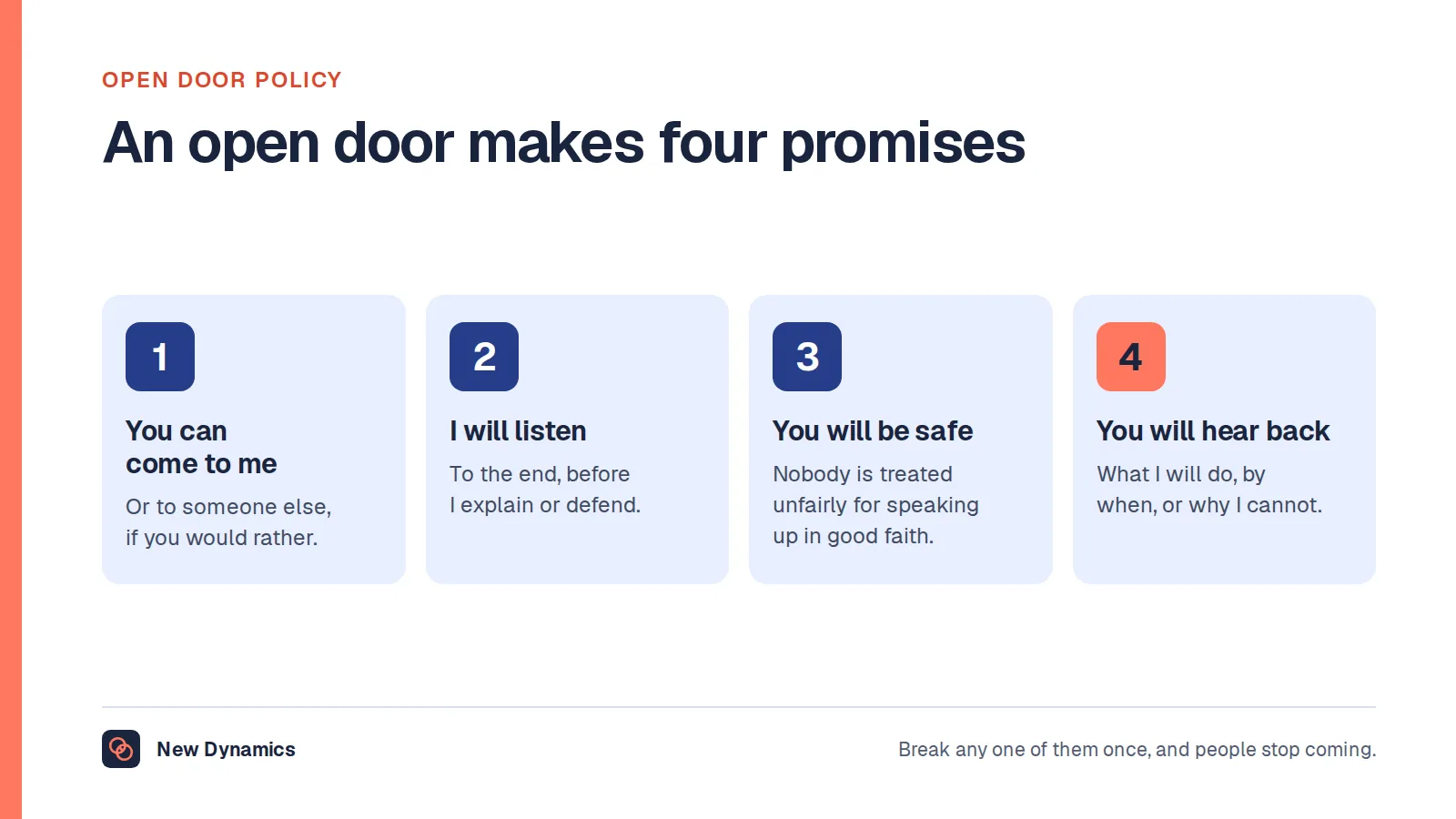
- Leaders ask for bad news, and thank people for it. Our guide to a genuine open door policy shows how.
- Managers are trained to recognise a disclosure, even when nobody uses the word whistleblowing.
- Concerns are tracked, and leaders see the numbers: how many, how quickly handled, and what changed.
- The code of conduct says it plainly. Our code of conduct guide explains how to write one that people will read.
- Retaliation has consequences, whoever does it.
An organisation that receives no concerns at all is rarely one with no problems. More often, it is one where people have stopped telling anyone.

Frequently asked questions
What is the meaning of whistleblower?
A whistleblower is a person who reports wrongdoing to someone in authority. GOV.UK says that you are a whistleblower if you are a worker and you report certain types of wrongdoing, usually something you have seen at work, that is in the public interest.
What counts as whistleblowing?
In UK law, protected reports include a criminal offence such as fraud, danger to someone's health and safety, risk or actual damage to the environment, a miscarriage of justice, the company breaking the law, a belief that someone is covering up wrongdoing, and sexual harassment.
What is the difference between whistleblowing and a grievance?
A grievance is about how you personally have been treated. Whistleblowing is about wrongdoing that affects others. GOV.UK says that personal grievances are not covered by whistleblowing law unless the particular case is in the public interest.
Are whistleblowers protected by law?
In Great Britain, yes. GOV.UK says that whistleblowers should not be treated unfairly or lose their job because they blew the whistle, and that they can take a case to an employment tribunal. The EU and the United States have their own protections.
Can I blow the whistle anonymously?
Yes, but GOV.UK warns that if you report anonymously you may find it harder to argue later that unfair treatment was a result of your whistleblowing. Asking for your identity to be kept confidential is often a better option.
Who should I report wrongdoing to?
GOV.UK says that a disclosure might be made to a lawyer, your employer or a prescribed person or body, such as a regulator. Start with your employer's whistleblowing policy if you trust the route, and get independent advice if you are unsure.
Your next step: test your own route
- Find your whistleblowing policy. Time how long it takes.
- Check that it names a contact outside line management.
- Ask three managers what they would do if someone raised a safety or fraud concern with them.
- Look at how many concerns were raised last year, and what happened to each.
For wording on speaking up, reporting routes and protection from retaliation, read and download our code of conduct guide. The guide is free to read, and the PDF uses our short download form.
Want regular, honest conversations to be part of everyday work? Book a New Dynamics demo and bring your current approach. You can also email contact@new-dynamics.com.