TL;DR
- An open door policy is a commitment that employees can raise questions, ideas and concerns with managers, including senior ones, without fear of reprisal.
- Most open door policies fail because a sentence in a handbook does not make speaking up feel safe. People stay silent when the risk looks bigger than the benefit.
- Make it real with set times, more than one route, a promise about what happens next, visible action and a manager who asks before being asked.
Many managers say “my door is always open”. Fewer can name the last time someone walked through it with bad news. The gap between the two is the difference between having an open door policy and having an open door.
This article explains what an open door policy is at work, why so many fail, how to write one and what managers can do to make people feel safe to use it. It includes a short sample policy you can adapt.
An open door works best alongside regular conversations. See how New Dynamics continuous feedback keeps questions and concerns flowing between people who work together.
A note on the name: “Open Door Policy” is also the name of a historic United States foreign policy towards China. This article is about the workplace practice.
What is an open door policy?
An open door policy is a commitment by an organisation that employees may raise questions, ideas and concerns with their managers, and with more senior managers, without going through formal channels and without fear of being punished for it.
The “door” is symbolic. In offices with no doors, and in remote teams, the policy means that leaders are reachable and willing to listen.
It is one form of what HR professionals call employee voice. The CIPD factsheet on employee voice defines voice as “the ability of employees to express their views, opinions, concerns and suggestions, and for these to influence decisions at work”. Notice the second half. Being heard is only the start. What people say should be able to change something.

What an open door policy is for
- Early warning. Problems with customers, safety, workload or behaviour reach managers while they are still small.
- Ideas. People closest to the work often see improvements that nobody else can.
- Trust. Employees who know they can speak to a senior person are less likely to feel trapped by a poor relationship with one manager.
- Informal resolution. Many problems can be settled by a conversation. Acas advises that if an employee has a problem at work, “it's usually a good idea for them to raise it informally first”, in its guide to the grievance procedure.
An open door does not replace formal procedures. Serious matters, such as harassment, discrimination or safety breaches, need a clear formal route as well. Acas notes that an employee may raise a formal grievance when raising the problem informally has not worked, when they do not want it dealt with informally or when it is a very serious issue.
Why most open door policies fail
The CIPD puts the central problem plainly: “employees remain silent if they perceive the risks of speaking up outweigh the benefits”. It adds that power dynamics strongly influence whether people speak up. A sentence in a handbook does not change that calculation. These are the usual reasons an open door goes unused.
It puts the burden on the employee. The junior person has to find the courage, choose the moment and walk in. The manager simply waits.
The door is open, but the diary is full. Managers who are always in meetings are not reachable, whatever the policy says.
Nothing happens afterwards. People try once. If they hear nothing back, they do not try again.
The messenger is punished. It may be subtle: a sigh, a defensive reply, a cooler relationship. Colleagues notice, and they learn.
Going over a manager's head has consequences. If skipping a level is treated as disloyalty, the policy only works for people with good managers, who need it least.
Remote and shift workers are left out. A literal open door helps those who happen to sit nearby.
How to write an open door policy
Keep it short. A useful policy answers six questions.
- What can be raised? Questions, ideas, concerns and complaints about work.
- With whom? The line manager first where possible, and any more senior manager or HR where it is not.
- How? In person, by message, by video call or through a named alternative route.
- What happens next? A commitment to listen, to reply within a stated time and to explain the outcome.
- What protection is there? A clear statement that nobody will be treated unfairly for raising a concern in good faith.
- When is a formal route needed? A pointer to the grievance, whistleblowing and harassment procedures for serious matters.
Sample open door policy
We want to hear questions, ideas and concerns early. You can raise any work matter with your manager at any time. If you would rather not speak to your manager, or you have done so and the matter is not resolved, you may speak to any more senior manager or to HR. You do not need permission to do this.
Whoever you speak to will listen, tell you what they will do and reply within five working days. If they cannot act, they will explain why.
Nobody will be treated less favourably for raising a concern in good faith. If you believe you have been, tell HR.
This policy does not replace our grievance, whistleblowing or anti-harassment procedures, which you may use at any time.
Adapt the wording, the timescale and the named routes to your organisation, and take advice on how it fits with your formal procedures and local law.
Eight ways to make an open door real
- Go through the door yourself. Do not wait. Ask each person regularly: what is getting in your way, and what should I know that I do not?
- Set visible times. A weekly hour with no meetings, advertised to the team, makes the door easier to use. Remote managers can hold the same hour on a call.
- Offer more than one route. Some people will never raise a concern face to face. Provide a named alternative, such as a skip-level manager, HR or a written channel. The CIPD lists formal and informal channels, from consultation groups and surveys to team meetings and digital platforms.
- Say thank you first. Your first reaction decides whether the person, and everyone they talk to, will come again.
- Say what will happen next, and do it. Even “I cannot change this, and here is why” is better than silence.
- Show the results. Tell the team what changed because someone spoke up, with their permission.
- Hold skip-level conversations. Senior managers should meet people two levels down a few times a year, so that going above a manager is normal and carries no stigma.
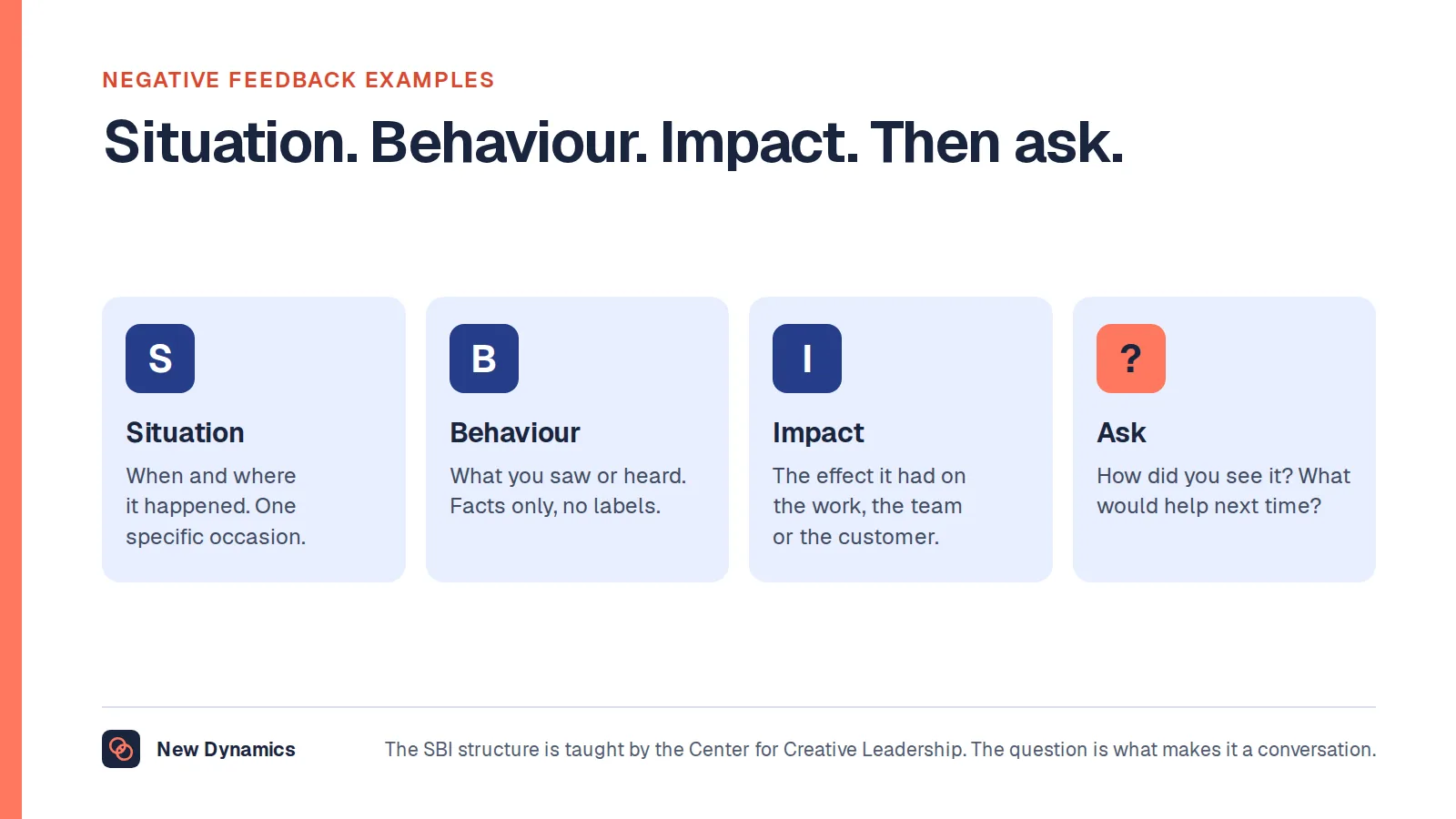
- Train managers. The CIPD recommends that organisations “train line managers to handle sensitive conversations confidently”. Our negative feedback examples can help with the wording.

What to do when someone walks through the door
- Stop what you are doing, or agree a time within the day.
- Listen to the end. Do not defend, explain or solve yet.
- Check that you have understood. “So the issue is that the rota changes at short notice, and it is affecting your childcare?”
- Ask what they would like to happen. Sometimes people only want to be heard.
- Be honest about confidentiality. Some matters, such as safety or harassment, may have to be passed on. Say so early.
- Agree the next step and a date.
- Follow up, even if there is nothing new to report.
If the concern is about you, thank the person, take time to think and consider involving someone neutral.
Open door policy in remote and hybrid teams
- Publish office hours when anyone can drop into a call.
- Keep a channel where questions to leaders are answered in public.
- Ask quieter team members directly, in one-to-ones.
- Use short surveys to catch what people will not say aloud. See our guide to running a workplace engagement survey.
- Make sure shift workers and people in the field have the same access as head office staff.
How to tell whether your open door is working
- People bring you bad news early, and you are rarely surprised.
- Concerns come from across the team, and from more than the confident few.
- Employees can name something that changed because a colleague spoke up.
- Survey items about speaking up and being listened to score well.
- Formal grievances are rare, and when they happen you usually knew about the issue already.
If months pass and nobody has raised anything difficult, do not conclude that all is well. Ask.

Frequently asked questions
What is an open door policy?
An open door policy is an organisation's commitment that employees can raise questions, ideas and concerns with their managers, including more senior managers, informally and without fear of being treated unfairly for doing so.
What is an example of an open door policy?
A simple example: “You can raise any work matter with your manager at any time. If you would rather not, or the matter is not resolved, you may speak to any more senior manager or to HR. They will listen, reply within five working days and explain the outcome.”
What are the benefits of an open door policy?
It gives managers early warning of problems, brings forward ideas from people close to the work, builds trust and allows many issues to be settled informally. These benefits only appear if people believe that speaking up is safe and leads somewhere.
What are the disadvantages of an open door policy?
It can put the burden on employees to speak up, encourage people to bypass their manager, take up managers' time and create false reassurance when nobody uses it. Clear routes, set times and managers who ask first reduce these problems.
Does an open door policy replace a grievance procedure?
No. An open door supports informal resolution. Serious matters, such as harassment, discrimination or safety concerns, also need formal procedures. Employees should be free to use the formal route whenever they choose.
How do I make employees feel safe to speak up?
Ask before you are asked, thank people for raising issues, never punish the messenger, say what will happen next and then do it. Offer more than one route, and show the team what changed because someone spoke up.
Your next step: open the door from your side
- In your next three one-to-ones, ask: what should I know that I do not?
- Block one visible hour a week when anyone can reach you.
- Tell your team who else they can speak to if they would rather not come to you.
- Report back on one thing you changed because of what you heard.
For a fuller method of listening and acting, read and download our employee engagement guide. The guide is free to read, and the PDF uses our short download form.
Want feedback and check-ins to be part of everyday work? Book a New Dynamics demo and bring your current approach. You can also email contact@new-dynamics.com.