TL;DR
- A PEO, or professional employer organization, is a United States firm that takes on payroll, employment tax filing, benefits administration and HR compliance support for its client businesses, usually small and mid-sized ones.
- It works through co-employment: a contract that divides employer responsibilities between the PEO and the client. The client still directs the work, supervises people, reviews them and sets their pay.
- The IRS runs a voluntary certification programme. With a certified PEO, responsibility for federal employment taxes generally passes to the PEO. With others, the IRS says that employers remain ultimately responsible.
A company of thirty people rarely has a payroll department, a benefits specialist and an employment lawyer. It still has to pay people correctly, file employment taxes, offer benefits that can compete and keep up with the rules in every state where it has staff. In the United States, one answer to that problem is a PEO.
This article explains what a PEO is, how the arrangement works, who does what, what IRS certification means, how a PEO differs from a payroll provider or a staffing agency, and the questions to ask before you sign. PEOs are an American arrangement, and this article describes the United States. It is general information, not tax or legal advice, and it does not recommend any provider.
A PEO can take the administration. It cannot take the conversations between your managers and your people. See how New Dynamics performance reviews bring goals, feedback and development into one fair discussion.
What is a PEO?
PEO stands for professional employer organization.
The Internal Revenue Service describes PEOs in its pages on the certified professional employer organization programme: “Professional employer organizations (PEOs) handle various payroll administration and tax reporting responsibilities for their business clients and are typically paid a fee based on payroll costs.”
The industry's trade body, the National Association of Professional Employer Organizations (NAPEO), gives a wider description in its frequently asked questions. PEOs, it says, “provide human resource services to small and mid-size businesses”, which include paying wages and taxes under the PEO's own employer identification number, offering workers' compensation and risk management services, and helping clients to comply with employment rules. It adds that PEOs provide HR technology and access to retirement plans, health insurance and other benefits.
NAPEO says that most businesses that use a PEO have between 10 and 150 employees. It also reports that there are about 500 PEOs in the United States, serving more than 233,000 businesses. Those are the industry's own figures, and we have not checked them against another source.
How a PEO works: co-employment
The idea that makes a PEO different from an ordinary supplier is co-employment. NAPEO defines it: “Co-employment is a contractual agreement between a company and a PEO that allocates and divides employer responsibilities.” The contract is often called a client service agreement.
Under that agreement, NAPEO explains, the client's employees, who are called worksite employees, are employed by two separate entities: the client company and the PEO.
- The PEO provides services related to employment. NAPEO lists payroll processing, payroll tax administration, employee benefits, HR services, workers' compensation coverage and claims management, compliance assistance and HR technology.
- The client keeps the direct relationship with the employee. NAPEO says that the client is responsible for “all business decisions, operations, day-to-day supervision of employees, job assignments, employee reviews and assessments, and determining the employee's salary and benefits offerings”.
- The agreement divides everything else. NAPEO says that the PEO and the client “will share certain responsibilities”, as set out in the client service agreement. Read that document closely, because it decides who is liable for what.
Employees usually notice two changes: the PEO's name appears on their pay documents, and their benefits come through the PEO's plans. Their job, their manager and their workplace stay the same.

What IRS certification means
The IRS runs a voluntary certification programme, which was required by the Tax Increase Prevention Act of 2014. A PEO that meets its requirements becomes a certified professional employer organization, or CPEO. According to the IRS's page about the programme, certification means that a PEO has met “the background, experience, business location, financial reporting, tax compliance, and bonding requirements” of the programme.
For a client, the difference is about federal employment tax liability. There are two cases.
- With a certified PEO. The IRS's guidance for CPEO customers says: “Generally, the CPEO is solely liable for paying the customer's employment taxes, filing returns, and making deposits and payments for the taxes reported with regard to remuneration it pays to work site employees”. It adds that a CPEO and its customer may both be liable with regard to non-worksite employees.
- Without certification. The IRS's page on outsourcing payroll and third-party payers reminds employers that they “are ultimately responsible for the payment of income tax withheld and both the employer and employee portions of social security and Medicare taxes”, with an exception in certain situations for customers of a CPEO. If a third party fails to make the deposits, the employer remains responsible.

Three practical points follow from the IRS pages.
- The IRS publishes a list of certified CPEOs, and of those whose certification has been suspended or revoked. Check it.
- The IRS warns that the names of many CPEOs are similar, and that one brand name can cover more than one business entity. The contract must contain the exact name and employer identification number of the CPEO.
- Certification is voluntary. A PEO does not have to be certified. If yours is not, the IRS's general rule applies, and you remain ultimately responsible for the taxes.
State rules on PEO registration and licensing vary, so check the requirements in each state where you have employees.
PEO compared with other arrangements
| Arrangement | What it does | Who employs the people |
|---|---|---|
| PEO | Payroll, tax filing, benefits, HR and compliance support under a co-employment agreement | The client and the PEO, as co-employers |
| Payroll service provider | Runs payroll and files returns on the client's behalf | The client alone |
| HR outsourcing | Takes on chosen HR tasks under a service contract | The client alone |
| Staffing agency | Recruits workers and assigns them to clients | The agency, for the workers it supplies |
NAPEO draws the last distinction firmly: “PEOs do not supply labor to worksites.” A PEO co-employs the workforce that you already have. A temporary staffing service recruits people and assigns them to you. NAPEO also notes that the older term “employee leasing” described what has become the PEO industry, and that some state laws still use it.
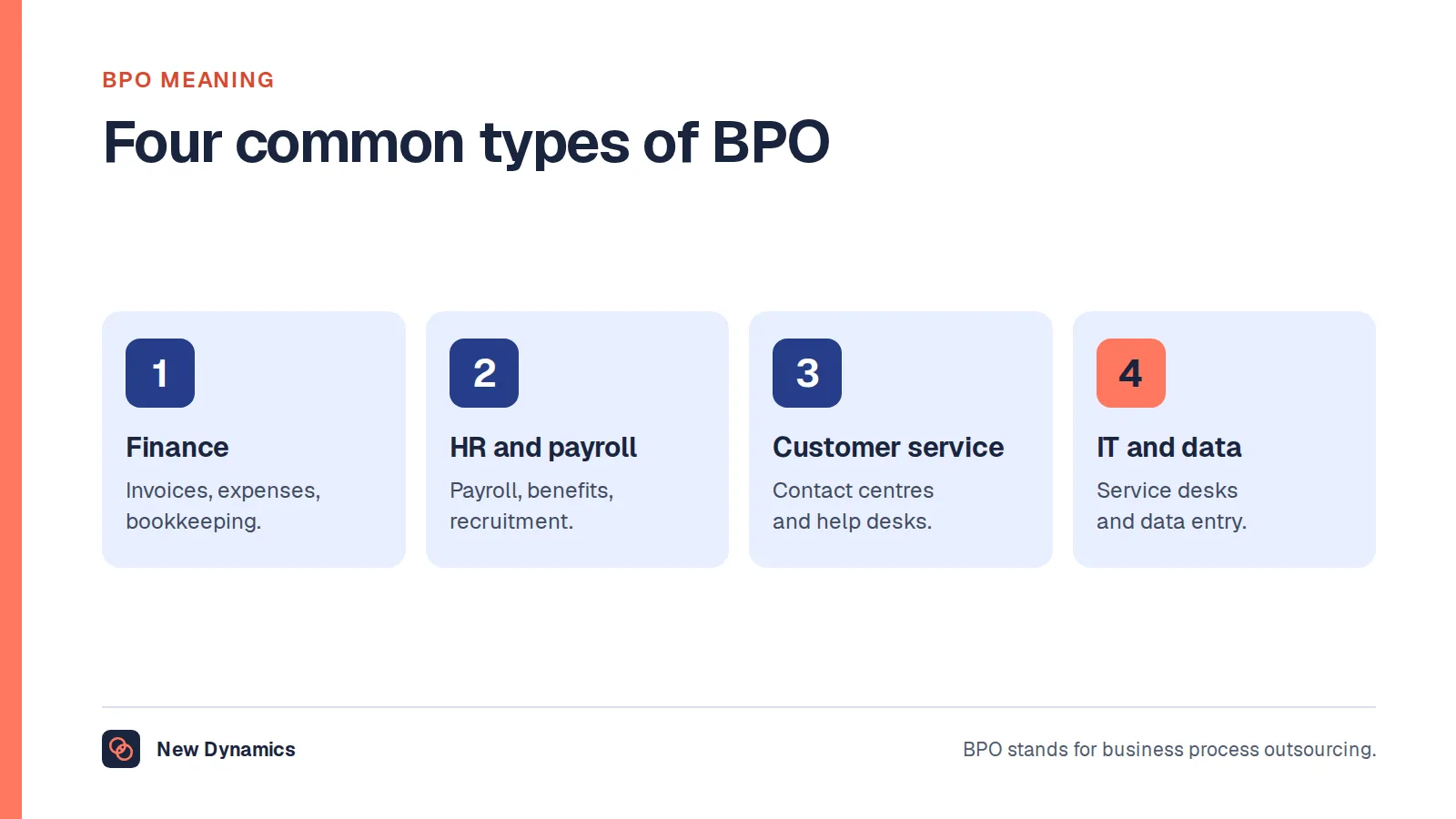
You will also meet the term employer of record, or EOR, mostly where a company wants to employ someone in a country in which it has no legal entity. That is a different arrangement, and outside the scope of this article. For the wider family of outsourcing, see our guide to the meaning of BPO.
Why businesses use a PEO, and the trade-offs
The case for.
- Benefits. NAPEO says that, through a PEO, the employees of small businesses gain access to benefits that they might not typically receive.
- Administration. Payroll, tax filings and benefits enrolment move to a specialist.
- Compliance support. Helpful for employers with staff in several states.
- Access to HR expertise without hiring a full HR team.
The trade-offs.
- Cost. The IRS notes that PEOs are typically paid a fee based on payroll costs. Compare the whole cost with the alternatives.
- Less choice. You generally take the PEO's benefit plans, its technology and its processes.
- Shared responsibility is not no responsibility. You remain an employer. Discrimination, harassment, safety and day-to-day management are still yours to get right.
- Leaving takes work. Moving payroll, benefits and records to a new arrangement needs planning, and the timing affects employees.
- Your people's experience. Employees may be confused about who employs them. Explain it before it happens.

The trade body quotes research which suggests that businesses using a PEO do better than those that do not. Treat claims of that kind with care, because businesses that choose a PEO may differ from others in ways that also affect growth.
What a PEO does not do
NAPEO's own definition of co-employment leaves “employee reviews and assessments” with the client, along with supervision, job assignments and pay decisions. In other words, a PEO does not manage your people.
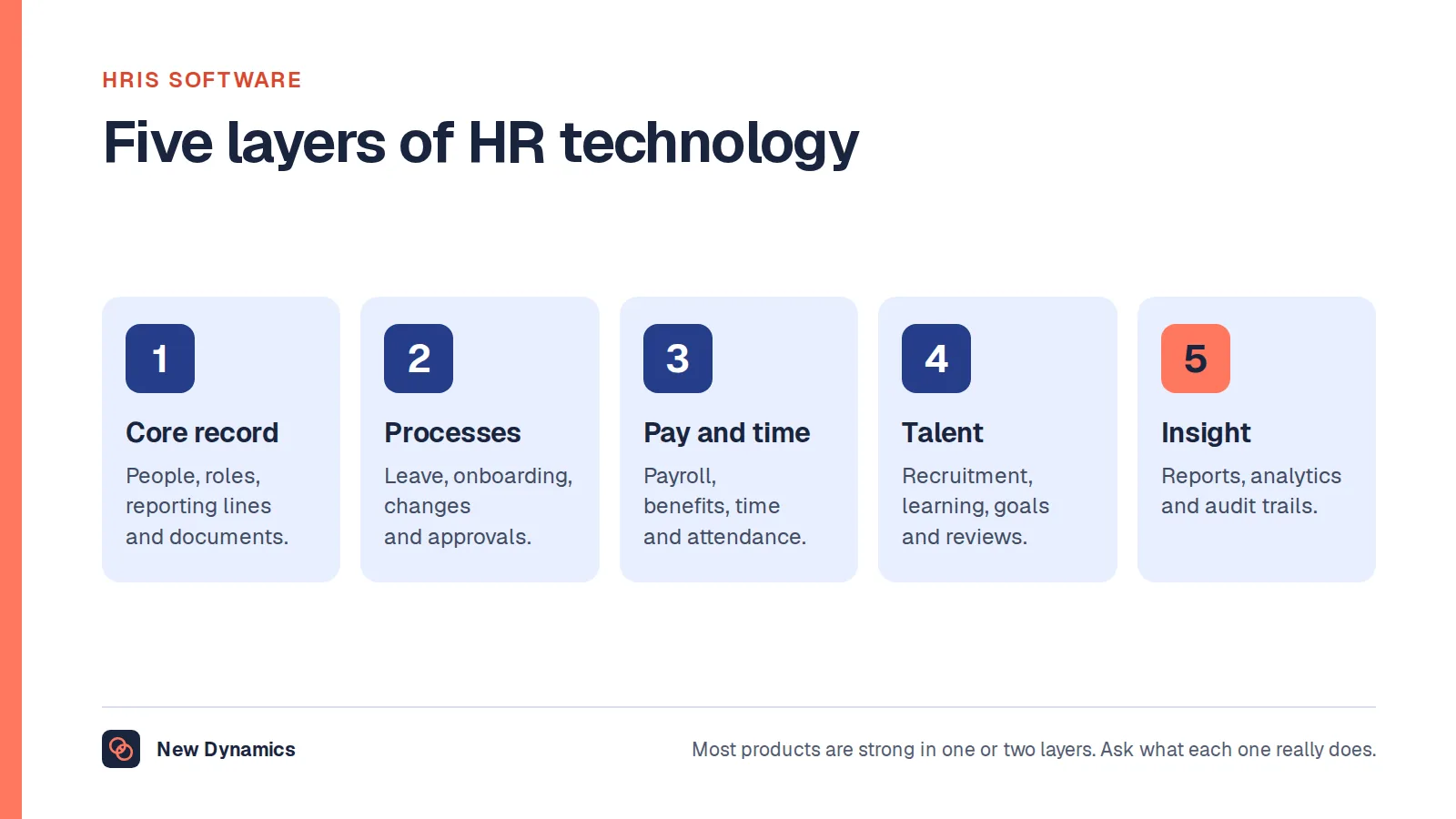
Setting goals, giving feedback, holding one-to-ones, reviewing performance, developing people and building the culture remain your managers' work. A PEO may offer software or templates for some of it. The conversations are still yours. Our article on HRIS software explains the systems that sit around those conversations.
Eight questions to ask before you sign
- Is the PEO certified by the IRS, and does the exact legal name and employer identification number in the contract match the IRS list?
- Is it registered or licensed in every state where we have employees?
- What exactly does the client service agreement make us responsible for, and what does it make the PEO responsible for?
- What are all the fees, and how do they change as our payroll grows?
- Which benefit plans would our employees move to, and what would change for them?
- Who owns our employee data, and how do we get it back if we leave?
- What notice is needed to end the agreement, and what happens to benefits on the way out?
- Whom do our employees call with a pay or benefits question, and how quickly are they answered?
Take the agreement to an employment lawyer and a tax adviser before you sign it.
Frequently asked questions
What is a PEO?
A PEO, or professional employer organization, is a United States firm that handles payroll, employment tax reporting, benefits administration and HR compliance support for client businesses, under a co-employment agreement. Clients are usually small and mid-sized businesses.
What does PEO stand for?
PEO stands for professional employer organization. A PEO that has been certified by the Internal Revenue Service under its voluntary programme is called a certified professional employer organization, or CPEO.
What is co-employment?
Co-employment is a contractual arrangement in which a PEO and its client divide employer responsibilities. The PEO handles payroll, taxes and benefits. The client directs the work, supervises and reviews employees, and decides their pay.
What is the difference between a PEO and a payroll provider?
A payroll provider processes payroll and files returns on your behalf, and you remain the only employer. A PEO becomes a co-employer, pays wages and taxes under its own employer identification number, and usually provides benefits and HR support as well.
What is a certified PEO?
A certified PEO, or CPEO, has met the IRS's requirements on background, experience, financial reporting, tax compliance and bonding. The IRS says that a CPEO is generally solely liable for the federal employment taxes on wages that it pays to worksite employees.
Does a PEO manage my employees?
No. Under co-employment the client keeps day-to-day supervision, job assignments, reviews and pay decisions. The PEO handles employment administration. Managing, developing and reviewing people remains the client's responsibility.
Your next step: list what you want to hand over
- Write down the employment tasks that cost you the most time or carry the most risk.
- Decide which of them you want to outsource, and which you want to keep.
- If a PEO fits, shortlist providers, check the IRS list and ask the eight questions above.
- Whatever you decide, keep goals, feedback and reviews with your managers.
If you are choosing an HR system or provider, read and download our HRIS selection guide. The guide is free to read, and the PDF uses our short download form.
Want the part that cannot be outsourced to work well? Book a New Dynamics demo and bring your current review process. You can also email contact@new-dynamics.com.