TL;DR
- BPO stands for business process outsourcing: paying another company to run a business process for you, such as payroll, accounts, customer service or recruitment.
- HR administration is commonly outsourced. The CIPD reports that payroll is the HR activity outsourced most often. Recruitment process outsourcing, or RPO, hands some or all of hiring to a provider.
- Outsourcing moves the work, but it does not move the accountability. You stay responsible for your employees' data, for the people whose jobs transfer and for the quality of the result.
Somebody else probably runs your payroll. Another firm may answer your customers' calls, process your invoices or screen your job applicants. Each of those arrangements is an example of BPO.
This article explains the meaning of BPO, the main types, where HR outsourcing and RPO fit, the benefits and the risks, a six-step process for doing it well, and the part that is easiest to forget: what happens to your own people.
Some work is hard to hand to anyone else. Goals, feedback and reviews are conversations between your managers and your people. See how New Dynamics performance reviews support them.
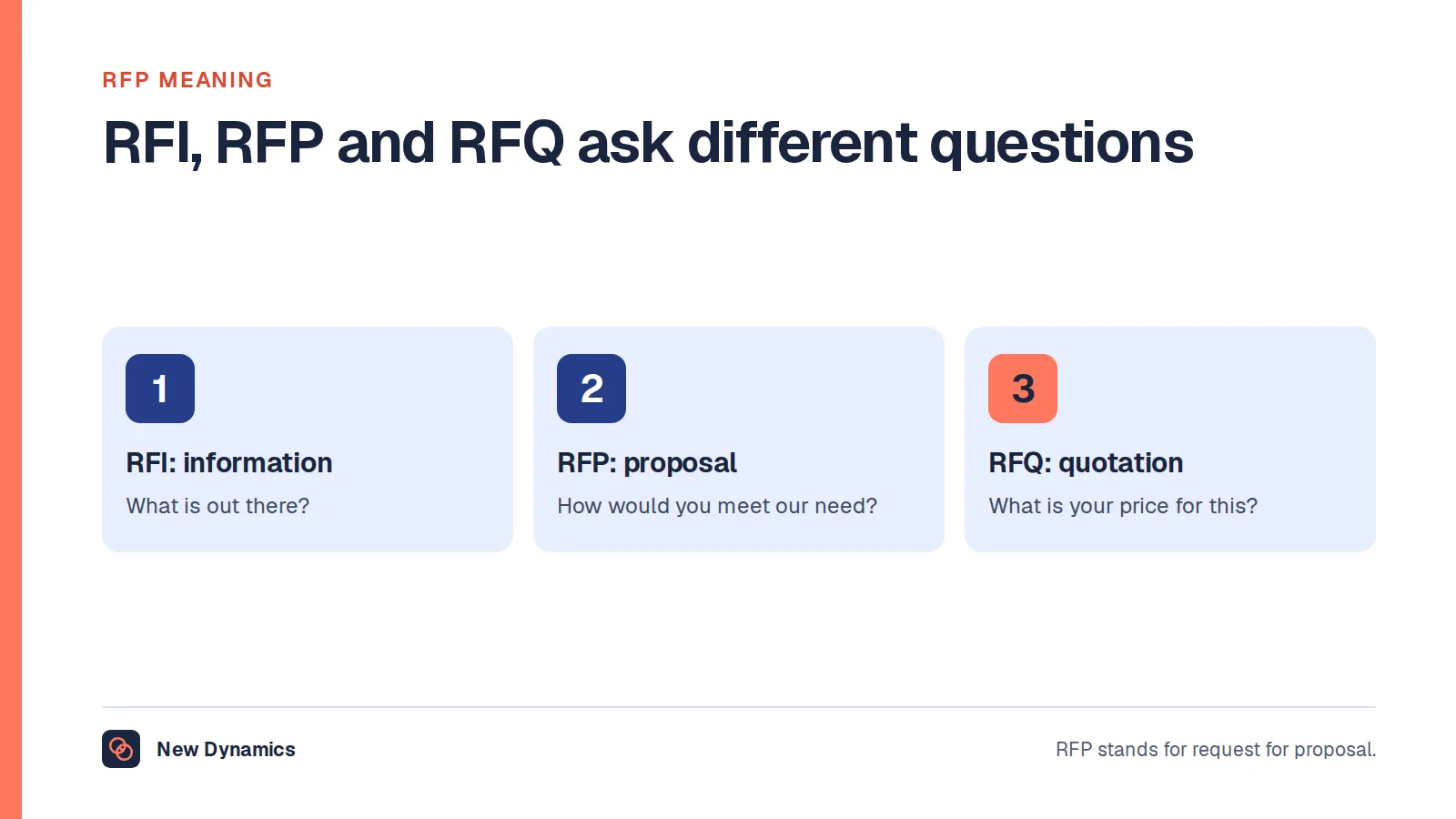
Most outsourcing decisions end in a purchase, and our guide to RFP meaning explains the document used to choose a provider.
What does BPO mean?
BPO stands for business process outsourcing. The Cambridge Dictionary defines business process outsourcing as “the activity of paying another company to deal with tasks such as keeping accounts and paying employees”. It labels the term as belonging to HR and accounting, the two areas most associated with it.
Outsourcing in general, in Cambridge's words, is “the process of paying to have part of a company's work done by another company”. BPO is the version that covers a whole process, run to an agreed standard over a period of years, as opposed to a single project or a temporary pair of hands.
Three related words are worth knowing.
- Offshoring means moving work to another country. It may be outsourced or kept within the company.
- Shared services means one internal team doing a process for every part of the organisation. Nothing leaves the company.
- The BPO industry is the collective name for the firms that provide these services.
Types of BPO
| Type | Typical processes |
|---|---|
| Finance and accounting | Invoices, expenses, bookkeeping, credit control |
| HR and payroll | Payroll, benefits administration, recruitment, HR advice |
| Customer service | Contact centres, help desks, complaints handling |
| IT and data processing | Service desks, data entry, document handling |
People also divide BPO into back-office work, which customers never see, and front-office work, which deals with customers directly.

HR outsourcing and RPO
HR administration is a common candidate for outsourcing.
The open textbook Introduction to Business, published by OpenStax, explains the reasoning in its section on trends in human resource management: “HR outsourcing is done when another firm can perform a task better and more efficiently, thus saving costs.” It adds that HR activities are frequently outsourced “simply because a provider has greater expertise”.
The CIPD's factsheet on HR outsourcing reports which activities go first: “Payroll is the most commonly outsourced HR activity, followed by providing advice on specialist topics.”
Recruitment process outsourcing (RPO) is BPO applied to hiring. A provider typically takes over some or all of the recruitment process, from advertising and screening to arranging interviews and sometimes onboarding. The provider usually works under your brand and to your standards. It differs from a recruitment agency, which fills individual vacancies for a fee each time.
Some HR work is better kept close. Decisions about performance, pay, promotion and discipline depend on knowing the people and the context. A provider can administer the process. It cannot hold the conversation.
Benefits and risks
The CIPD summarises both sides in a sentence each. Outsourcing “can offer benefits, such as increased efficiency and access to expertise”. It can also present challenges, “such as loss of in-house knowledge and processes, and fragmented HR services”.
| Benefits | Risks |
|---|---|
| Lower cost for routine, high-volume work | Hidden costs of managing the contract and fixing errors |
| Access to expertise and technology you could not justify alone | Loss of in-house knowledge, which is hard to rebuild |
| Capacity that scales up and down | Fragmented service, with employees unsure whom to ask |
| Management time freed for other work | Less control over quality, and slower change |
| Clear service levels in a contract | Data protection and security exposure |
The CIPD points to alternatives that are worth considering first: shared services, employee self-service and buying in consultancy for specialist questions.
The BPO process in six steps
- Decide what and why. Choose a process that is well defined, measurable and not a source of competitive advantage. Write down the problem you are solving: cost, quality, capacity or expertise.
- Document the process and its current performance. You cannot hold a provider to a standard that you have never measured. Our workflow examples show how to map a process.
- Build the business case. Compare the full cost of each option, including the transition and the cost of managing the contract.
- Choose the provider. Run a fair selection, usually with a request for proposal, and check references, security and data protection.
- Plan the transition. Agree who does what on day one, how knowledge transfers, and how affected employees will be informed, consulted and supported.
- Manage the contract. Review service levels regularly, keep someone in-house who understands the process, and plan what happens at the end of the contract.

What outsourcing means for your people
Outsourcing a process usually affects the employees who run it today. In the UK, they may be protected by the Transfer of Undertakings (Protection of Employment) regulations, known as TUPE.
GOV.UK's guide to business transfers and takeovers lists “service provision changes” as one of the two types of transfer that TUPE protects. A service provision change includes the situation where “a service provided in-house (for example cleaning, workplace catering) is awarded to a contractor”. It also covers a contract that moves to a new contractor, and work that is brought back in-house.
When TUPE applies, GOV.UK says that the employees' jobs usually transfer to the new company, their employment terms and conditions transfer, and continuity of employment is maintained. Only employees who can be clearly identified as providing the service are protected. Acas adds that both the new and the old employer “must follow the TUPE regulations”.
This is general information about the UK, not legal advice. Take advice early, because the duties to inform and consult begin well before the transfer date. If roles will go, our guide to the definition of redundancy explains the terms.
Data protection and security
An HR or payroll provider handles personal data about every employee. Under the UK GDPR that usually makes the provider a processor acting for you, the controller. The Information Commissioner's Office says in its guidance on contracts that, whenever a controller uses a processor, “there must be a written contract (or other legal act) in place”.
Ask providers where data is stored, who their sub-processors are, how they would tell you about a breach and how you get your data back when the contract ends. Our employee data protection guide covers the wider duties.
Five rules for outsourcing well
- Keep the accountability. Employees and regulators will hold you responsible, whoever does the work.
- Keep the knowledge. Retain at least one person who understands the process well enough to challenge the provider.
- Measure before and after. Agree a small number of service levels that reflect what users care about, such as accuracy and response time.
- Tell employees whom to ask. Fragmented service is the CIPD's warning. One clear route for queries prevents it.
- Plan the exit. Contracts end. Decide at the start how data, documents and people would move back, or on to the next provider.

Frequently asked questions
What does BPO stand for?
BPO stands for business process outsourcing. It means paying another company to run a business process for you, such as payroll, accounts, customer service or recruitment, usually under a contract with agreed service levels.
What is BPO in business?
In business, BPO is a way of getting a routine process done by a specialist provider. Common examples are payroll, invoice processing, contact centres and IT service desks. The company keeps responsibility for the result, and manages the provider through a contract.
What is the BPO process?
A typical process has six steps: decide what to outsource and why, document the current process and its performance, build the business case, choose a provider, plan the transition, including the effect on employees, and manage the contract.
What is recruitment process outsourcing (RPO)?
RPO is a form of BPO in which a provider runs some or all of an employer's recruitment process, such as advertising, screening and arranging interviews, usually under the employer's brand. A recruitment agency, by contrast, fills individual vacancies for a fee.
What are the risks of BPO?
The CIPD names loss of in-house knowledge and processes, and fragmented HR services. Other risks are hidden contract management costs, less control over quality, slower change and greater exposure on data protection and security.
What happens to employees when work is outsourced?
In the UK, employees who clearly provide the service that is being outsourced may be protected by TUPE. GOV.UK says that their jobs usually transfer to the new company, with their terms and conditions and their continuity of employment.
Your next step: list what you already outsource
- List the processes that another company already runs for you, starting with payroll.
- For each, name the person in-house who understands it and manages the contract.
- Check that a written data processing contract is in place.
- Ask employees whether they know whom to contact about each service.
If you are choosing an HR system or provider, read and download our HRIS selection guide. The guide is free to read, and the PDF uses our short download form.
Want to keep performance conversations in-house and make them easier? Book a New Dynamics demo and bring your current process. You can also email contact@new-dynamics.com.