TL;DR
- Affirmative action means deliberate steps to improve opportunities for groups that have been treated unfairly. In everyday use it often means giving preference. In US contracting rules it meant analysis, outreach and monitoring.
- The US picture has changed. In 2023 the Supreme Court held that two universities' race-conscious admissions programmes were unlawful, and in January 2025 an executive order revoked the 1965 order behind affirmative action for federal contractors.
- In Great Britain the equivalent idea is positive action, which is voluntary and limited. Positive discrimination is unlawful. Employers everywhere can still widen their talent pools and make selection fairer.
Few phrases in employment carry as much history, or as much disagreement, as affirmative action. People use it to mean quite different things, and the rules around it in the United States have changed substantially since 2023.
This article gives a definition of affirmative action, shows where the term came from, sets out what has changed, explains the British idea of positive action, and ends with what employers can do that does not depend on preferences. It reports what official sources say. It does not argue for or against the policy.
This is general information, correct to the sources we read on 20 September 2026. The law in this area is changing and is being tested in the courts, so it is not legal advice. Take advice before you act.
Fair decisions about people depend on consistent evidence. See how New Dynamics performance reviews bring goals, feedback and ratings together in one process.
What does affirmative action mean?
The Cambridge Dictionary gives the everyday meaning of affirmative action: “If a government or an organization takes affirmative action, it gives preference to women, black people, or other groups that are often treated unfairly, when it is choosing people for a job.”
In US employment regulation the phrase had a wider, more procedural meaning. The federal regulations for government contractors, at 41 CFR 60-2.10, describe an affirmative action program as “a management tool designed to ensure equal employment opportunity”. It included analysis of the workforce, “action-oriented programs” and “internal auditing and reporting systems”.
So the phrase covers a range. At one end are outreach, training and monitoring, which change who applies and how fairly they are assessed. At the other end are preferences and quotas, which change who is chosen. Much of the argument about affirmative action comes from people meaning different points on that range.
Where the term comes from
The phrase entered employment practice through presidential orders about government contracts. Executive Order 11246, signed in 1965, required every government contract to include this promise:
The contractor will take affirmative action to ensure that applicants are employed, and that employees are treated during employment, without regard to their race, color, religion, sex or national origin.
Read closely, the original wording is about acting to make sure that people are treated without regard to those characteristics. The regulations that followed turned it into written programmes. Their stated premise was that, “absent discrimination, over time a contractor's workforce, generally, will reflect the gender, racial and ethnic profile of the labor pools from which the contractor recruits and selects”.
What has changed in the United States
Two events matter most.
June 2023: university admissions. In Students for Fair Admissions v. Harvard, the Supreme Court considered admissions systems in which, as the syllabus puts it, admission could depend on a student's grades and recommendations, and “can also depend on their race”. It held that the two universities' admissions programmes “violate the Equal Protection Clause of the Fourteenth Amendment”. The case concerned university admissions, not employment.
January 2025: federal contractors. Executive Order 14173, Ending Illegal Discrimination and Restoring Merit-Based Opportunity, states: “Executive Order 11246 of September 24, 1965 (Equal Employment Opportunity), is hereby revoked.” It directs the Office of Federal Contract Compliance Programs to cease several activities immediately. One of them reads: “Holding Federal contractors and subcontractors responsible for taking ‘affirmative action’”. The order gave contractors 90 days in which they could continue to comply with the previous scheme.
Two qualifications are worth knowing.
- The same order says that it “does not apply to lawful Federal or private-sector employment and contracting preferences for veterans of the U.S. armed forces”.
- Separate regulations on affirmative action for individuals with disabilities, at 41 CFR 60-741.40, were still in the Code of Federal Regulations when we checked. They describe a programme that applies to “every Government contractor that has 50 or more employees and a contract of $50,000 or more”.
Anti-discrimination law continues to apply. The Equal Employment Opportunity Commission states: “Title VII's protections apply equally to all workers.” It adds that different treatment based on race, sex or another protected characteristic “can be unlawful discrimination, no matter which employees or applicants are harmed”. The Commission's page on DEI-related discrimination notes that the Commission has not taken a position on whether a diversity rationale could justify voluntary affirmative action under Title VII. It also cites its earlier guidance that “Title VII permits diversity efforts designed to open up opportunities to everyone”.
If you are a US employer or federal contractor, check the current position with counsel. This summary will date.
Positive action in Great Britain
British law uses a different term, and a narrower idea. The government's guidance on positive action in the workplace explains that the Equality Act 2010 allows employers to take action that may involve treating one group more favourably, “where this is a proportionate way to enable or encourage members of that group to”:
- overcome or minimise a disadvantage;
- have their different needs met;
- participate in a particular activity.
Three points define it.
- It is voluntary. “Positive action is entirely voluntary. There is no requirement for an employer to use positive action.”
- It allows a tie-breaker, and no more. In recruitment and promotion, an employer may choose a candidate from an underrepresented or disadvantaged group only where candidates are of equal merit. Positive action “does not allow an employer to appoint a less suitable candidate”.
- Positive discrimination is unlawful. The guidance states: “Positive action is not positive discrimination. Positive discrimination is unlawful in Great Britain.”
The guidance also separates positive action from the American term. It says that affirmative action “can be more prescriptive than positive action and often involves the use of quotas”, and that introducing such quotas in Britain could amount to positive discrimination.
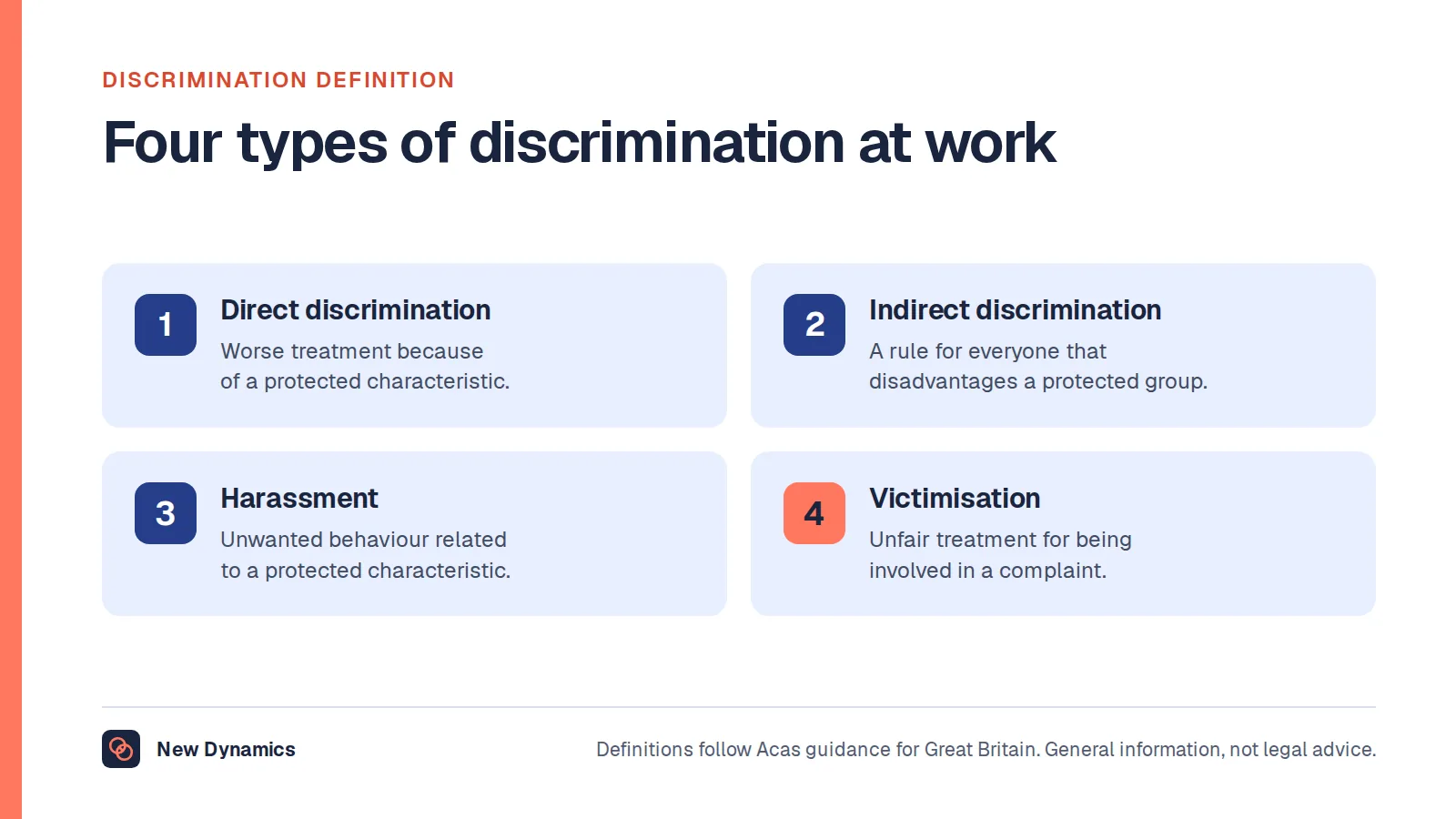
The guidance's examples of positive action include open days, internships, tailored training, and mentoring or shadowing schemes for the target group. Our guide to the definition of discrimination at work explains the underlying law.

Affirmative action, equal opportunity and diversity
| Term | What it means |
|---|---|
| Equal employment opportunity | The legal principle that employment decisions must not be based on protected characteristics |
| Affirmative action | Deliberate steps to improve opportunities for groups treated unfairly, ranging from outreach to preferences |
| Positive action | The British version: voluntary, proportionate and limited to a tie-breaker in selection |
| Diversity and inclusion | An organisation's wider effort to attract a varied workforce and to make everyone able to contribute |
Equal opportunity is the rule. The other three are ways in which organisations have tried to make the rule real. Our article on diversity in the workplace covers the last of them.
The arguments, in brief
Supporters say that removing formal barriers is not enough when disadvantage has built up over generations, and that active steps are needed to reach capable people who would otherwise be missed.
Critics say that any preference based on a characteristic is itself discrimination, that it can stigmatise the people it aims to help, and that selection should rest on individual merit alone.
Both sides usually agree on more than the debate suggests: that talent is widely spread, that many selection processes are less fair than they look, and that better processes help everyone.
Five things employers can do without preferences
These practices aim to make selection fairer for every candidate. They do not depend on preferring anyone. As always, check the law where you operate.
- Widen the pool. Advertise where different people will see the vacancy, and check that the requirements you list are truly needed.
- Structure selection. Use the same job-related questions and scoring criteria for every candidate. Our guide to unconscious bias examples shows where unstructured decisions go wrong.
- Look at your data. Compare who applies, who is shortlisted, who is hired and who is promoted. Ask about any gap that you cannot explain.
- Remove barriers. Inflexible hours, inaccessible buildings and word-of-mouth hiring exclude capable people without anyone intending it.
- Develop everyone. Make stretch work, mentoring and feedback available on clear criteria, and check who is getting them.

Questions to ask before you act
- Which country's law applies, and what does it say today?
- What problem are we trying to solve, and what is the evidence for it?
- Does the action open opportunity to more people, or does it decide the outcome for some?
- Is it proportionate, and when will we review it?
- Has someone qualified checked it?

Frequently asked questions
What is the definition of affirmative action?
Affirmative action means deliberate steps to improve opportunities for groups that have often been treated unfairly. The Cambridge Dictionary describes it as giving preference to such groups when choosing people for a job. In US contracting rules it meant analysis, outreach and monitoring programmes.
Where does the term affirmative action come from?
It entered employment practice through US presidential orders on government contracts. Executive Order 11246 of 1965 required contractors to take affirmative action to ensure that applicants and employees were treated without regard to race, colour, religion, sex or national origin.
Is affirmative action still legal in the United States?
The position has changed and is still developing. In 2023 the Supreme Court held that two universities' race-conscious admissions programmes were unlawful. In January 2025, Executive Order 14173 revoked Executive Order 11246. Anti-discrimination law still applies to everyone. Take current legal advice.
What is the difference between affirmative action and positive action?
Positive action is the British term. It is voluntary, must be proportionate, and in recruitment allows a preference only between candidates of equal merit. UK government guidance says that affirmative action can be more prescriptive and often involves quotas, which could be unlawful in Britain.
Is positive discrimination legal in the UK?
No. UK government guidance states that positive discrimination is unlawful in Great Britain. Treating a group more favourably is lawful only where it meets the Equality Act's requirements for positive action, or another specific exception applies.
What can employers do to improve fairness without preferences?
They can advertise more widely, remove unnecessary job requirements, use structured interviews with set criteria, compare outcomes across groups at each stage, remove practical barriers such as inflexible hours, and make development opportunities available on clear criteria.
Your next step: check one selection process
- Pick one recent vacancy or promotion round.
- Write down where it was advertised, which criteria were used and who made the decision.
- Ask whether every candidate was asked the same questions and scored in the same way.
- Fix the weakest point before the next round.
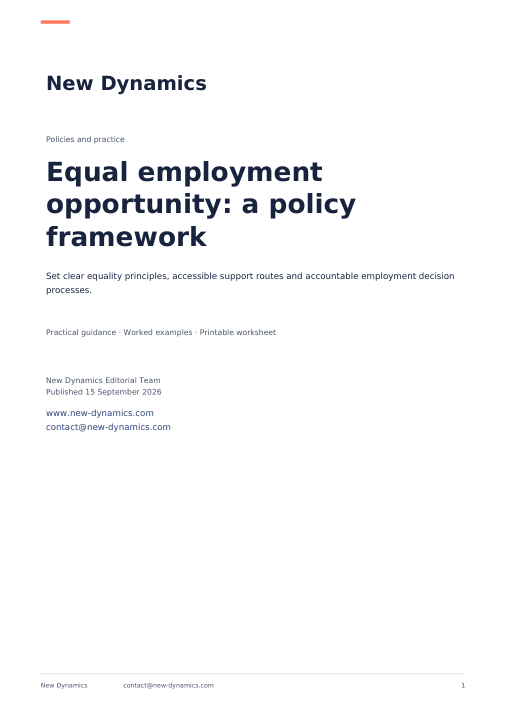
For a fuller framework, read and download our equal employment opportunity guide. The guide is free to read, and the PDF uses our short download form.
Want promotion and pay decisions to rest on consistent evidence? Book a New Dynamics demo and bring your current review process. You can also email contact@new-dynamics.com.