TL;DR
- Unconscious bias is the influence of beliefs and assumptions that we are not aware of on our judgements about people. Acas notes that everyone can think this way at some point.
- At work it shows most in hiring, in who gets the interesting assignments and in performance reviews. Twelve common types, such as affinity, halo, recency and leniency bias, explain most of the distortion.
- Awareness alone changes little. What helps is changing how decisions are made: clear criteria, evidence from the whole period, several decision-makers, time to decide and a written record of reasons.
A manager ignores an idea from a woman in the team. Ten minutes later, the manager welcomes the same idea from a man. The manager does not notice. The rest of the room does.
That is the example Acas uses to explain unconscious bias, and its power lies in how ordinary it is. This article gives you unconscious bias examples for 12 common types, shows how they distort hiring and performance reviews, and sets out the process changes that do most to reduce them.
Fairer reviews start with better evidence. See how New Dynamics performance reviews bring goals, feedback from several people and notes from the whole year into one conversation.
What is unconscious bias?
Acas explains it in plain terms in its guidance on unconscious bias: “How a person thinks can depend on their life experiences. Sometimes they have beliefs and views about other people that might not be right or reasonable.” It says that unconscious bias includes when a person thinks better of someone because they believe they are alike, or less of someone because that person is different from them, for example in race, religion or age. As a result, “they could make a decision influenced by false beliefs or assumptions”.
Two further points from Acas are worth keeping in mind.
- “Everyone can think in a way that involves unconscious bias at some point.” It is a feature of how minds take shortcuts. It is not an accusation.
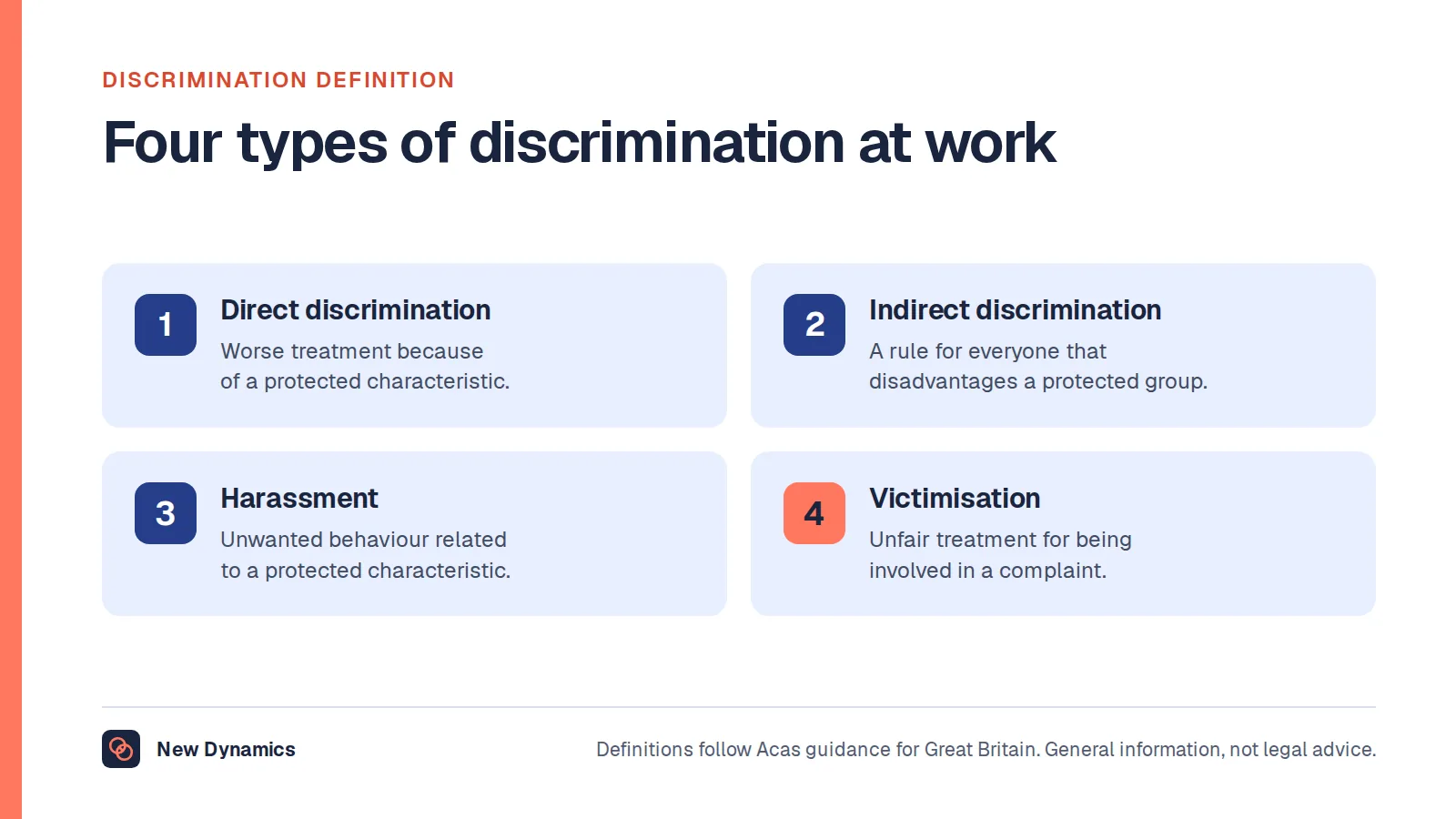
- Employers and employees must not make decisions about applicants or staff based on a protected characteristic, apart from very limited circumstances allowed in law. Doing so “could lead to a discrimination claim to an employment tribunal”. Our plain guide to the definition of discrimination at work explains the terms.
This is general information, not legal advice.

12 types of unconscious bias, with examples
1. Affinity bias
Favouring people who are like us.
Example: an interviewer warms to a candidate who went to the same university, and scores the whole interview more generously.
2. Halo effect
Letting one positive trait colour our view of everything else.
Example: an employee who presents brilliantly is assumed to be just as strong at planning, although their projects often run late.
3. Horns effect
The reverse: one negative trait colours everything.
Example: someone who made a visible mistake in their first month is still seen as careless two years later.
4. Confirmation bias
Noticing evidence that supports what we already believe, and overlooking the rest.
Example: a manager who has decided that a team member lacks commitment notices every early departure, and none of the late evenings.
5. Recency bias
Giving too much weight to recent events.
Example: a strong year is rated “meets expectations” because of a difficult final month. Or a weak year is rescued by a good December.
6. Primacy bias, or first impressions
Giving too much weight to early information.
Example: a nervous first five minutes of an interview overshadows forty minutes of good answers.
7. Leniency and severity bias
Rating everyone high, or everyone low.
Example: one manager gives the whole team top ratings to avoid difficult conversations. Another believes that nobody deserves the top rating. Employees' outcomes depend on which manager they happen to have.
8. Central tendency bias
Rating everyone in the middle.
Example: faced with a five-point scale, a manager gives every person a three. Strong performers feel unrecognised, and weak performance goes unaddressed.
9. Attribution bias
Explaining other people's failures by their character, and our own by circumstances.
Example: when a colleague misses a deadline, “they are disorganised”. When we miss one, “the brief changed”. The pattern can also run along group lines: one person's success is put down to talent, and another's to luck or help.
10. Contrast effect
Judging people against each other, and not against the standard.
Example: an average candidate seems excellent after two weak ones. A strong employee seems ordinary in a team of stars.
11. Proximity bias
Favouring people we see more often.
Example: colleagues who come into the office get the interesting projects and the better ratings. Equally productive remote colleagues are overlooked.
12. Stereotyping and assumptions about groups
Assuming things about a person because of a group they belong to: their sex, age, ethnicity, disability, accent, parental status and so on.
Example: a manager does not offer a stretch project to a new mother, “because she will not want the travel”, without asking her. An older employee is not considered for training in a new technology.
This last type underlies many of the others, and it is where bias shades into unlawful discrimination.
Bias in performance reviews
Reviews are especially exposed, because they rest on one person's memory and judgement of another over many months.
| Bias | How it shows in a review | What helps |
|---|---|---|
| Recency | The last six weeks decide the rating | Notes and feedback collected through the year |
| Halo and horns | One trait or incident colours every section | Rate each goal and behaviour separately, with evidence |
| Leniency, severity | Ratings depend on which manager you have | Calibration between managers, against shared standards |
| Central tendency | Everyone is “meets expectations” | Clear descriptions of each level, with examples |
| Affinity, proximity | People like the manager, or near them, do better | Feedback from several people, and checks on outcomes by group |
| Attribution | The same result is explained differently for different people | Record the context for every goal, for everyone |
| Vague language | Some people get feedback on personality, others on results | Describe behaviour and outcomes, and avoid labels |
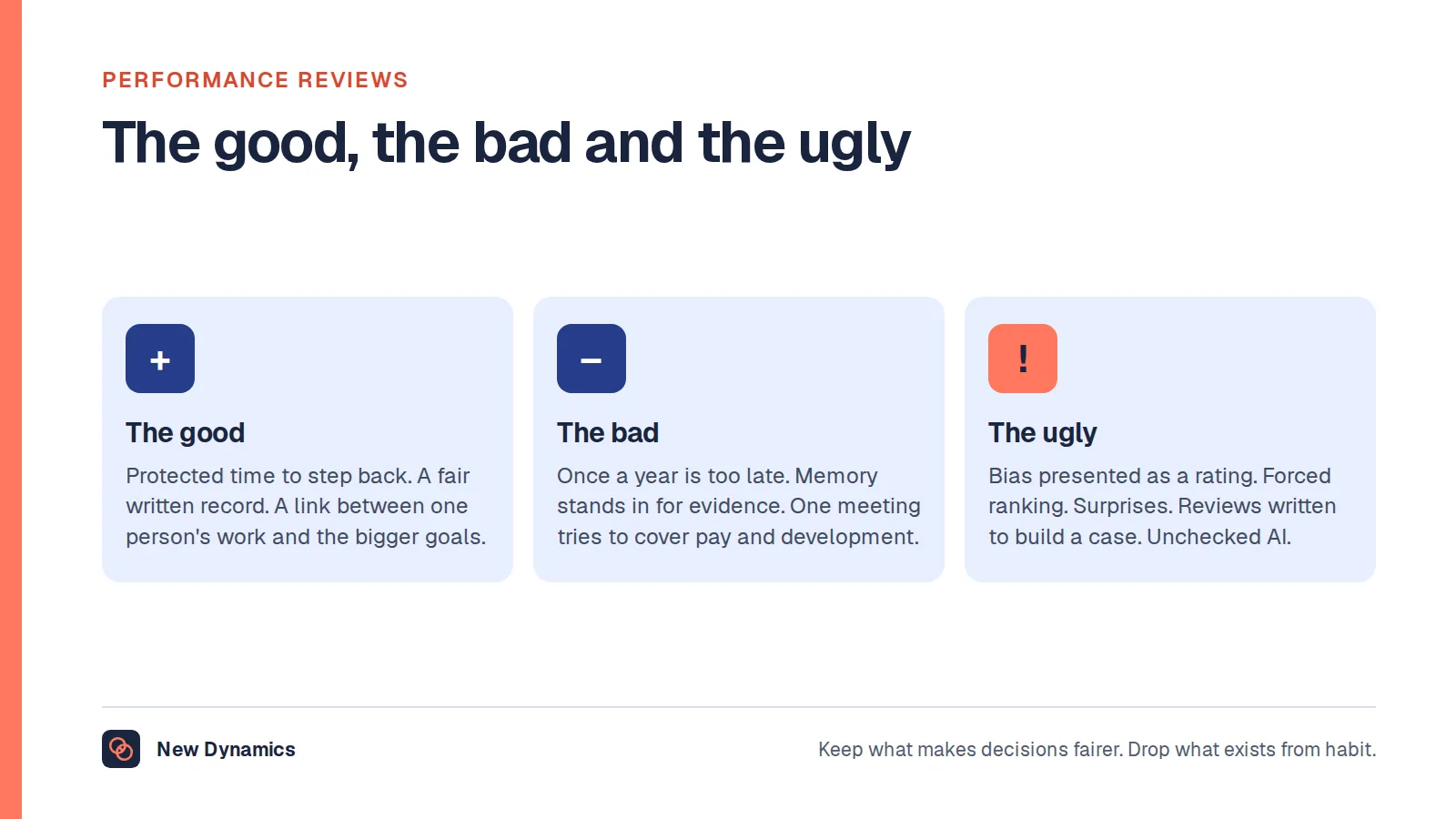
Our performance review phrases show how to write comments about behaviour and evidence, and performance reviews: the good, the bad and the ugly covers the wider process.

Bias in hiring, promotion and everyday work
Hiring. A name at the top of a CV can influence how the rest is read, which is why Acas suggests blind sifting. Unstructured interviews can reward confidence and similarity. Referral schemes tend to reproduce the existing workforce.
Promotion and assignments. Stretch work goes to the people a manager already knows and trusts, which builds their record for the next promotion. Potential is judged more generously in some people than in others.
Everyday interactions. Who gets interrupted. Whose idea is credited. Who is asked to take the notes or organise the leaving card. Whose mistakes are remembered.
Pay. Small differences in starting salaries and rises accumulate over a career.
Each example is minor on its own. Together they shape careers.
How to reduce unconscious bias
Acas lists practical ways to avoid unconscious bias. They include:
- being aware that everyone can be affected without realising it;
- advertising vacancies in at least two different places, to reach a wide range of people;
- getting recruiting managers to tell each other if they notice any signs of bias;
- holding back details on application forms, such as the applicant's name or sex, which Acas calls “blind sifting”;
- having more than one person sift applications, interview and decide;
- “allowing time to make decisions, for example on recruitment, promotions or grievance and disciplinary outcomes”;
- “keeping a written record of why decisions were made”.
Notice that almost all of these are changes to the process, not to people's minds. The same logic applies elsewhere.
- Define the criteria before you look at the people. Decide what good looks like for the role, the goal or the promotion.
- Use the same questions and the same scale for everyone. See our manager interview questions for a scorecard.
- Collect evidence through the year, from several sources.
- Score separately, then discuss. Independent judgements, compared afterwards, are less prone to one loud voice.
- Calibrate between managers. Our performance calibration guide explains how.
- Slow down. Acas advises allowing time for decisions. Rushed judgements lean on shortcuts.
- Record your reasons. Writing down why forces the question “what is my evidence?”
- Check the outcomes. Look at ratings, promotions, pay and assignments by group. Patterns that individual managers cannot see become visible in the data.
- Make it normal to challenge. “What is the evidence for that?” should be a routine question in any decision about people.
Does unconscious bias training work?
Training is a common response, and the evidence for it is weak. In December 2020, a UK government written ministerial statement summarised a review of the evidence, commissioned from the Behavioural Insights Team. It quotes the report's finding that “there is currently no evidence that this training changes behaviour in the long term or improves workplace equality in terms of representation of women, ethnic minorities or other minority groups”. It adds that there is emerging evidence of unintended negative consequences.
That does not mean that awareness is worthless. Knowing the types of bias gives people a vocabulary for challenging decisions. It means that a workshop on its own will not fix a biased process. Spend most of your effort on how decisions are made, and on checking the results.
Common mistakes
Treating bias as a character flaw. People who feel accused become defensive. Present it as a normal risk that good processes manage.
Relying on awareness alone. “I know about bias, so I am not biased” is itself a bias.
A workshop, and nothing else.
Unstructured interviews and reviews. The more a decision rests on general impressions, the more room bias has.
Never checking the data. Without it, you are guessing.
Dismissing concerns. When someone says that a pattern looks unfair, look at the evidence before you reassure them.

Frequently asked questions
What is an example of unconscious bias?
Acas gives this example: a manager ignores an idea from a woman, and later accepts the same idea from a man, without realising it until others point it out. Other examples include favouring a candidate from your own university, or rating a year's work on the last few weeks.
What are the main types of unconscious bias?
Common types include affinity bias, the halo and horns effects, confirmation bias, recency bias, first-impression bias, leniency and severity bias, central tendency, attribution bias, the contrast effect, proximity bias and stereotyping based on group membership.
What is bias in a performance review?
It is any systematic distortion in how performance is judged, such as letting recent events or one trait dominate, rating everyone high, low or in the middle, favouring people who are similar or nearby, or explaining the same result differently for different people.
How can you reduce bias in performance reviews?
Set clear criteria, collect evidence through the whole period from several people, rate each goal separately, write comments about behaviour and results, calibrate ratings between managers, record reasons and check the distribution of ratings by group.
Does unconscious bias training work?
A review of the evidence for the UK government found no evidence that such training changes behaviour in the long term or improves workplace equality. Awareness can help people to challenge decisions, but changing how decisions are made does more than training alone.
Is unconscious bias the same as discrimination?
No. Unconscious bias is a pattern of thinking. Discrimination is unfair treatment, which in many countries is unlawful when it relates to a protected characteristic. Bias can lead to discrimination, whether or not anyone intended it. Take legal advice on specific cases.
Your next step: check one decision process
- Choose one decision that matters, such as review ratings or shortlisting.
- Ask: are the criteria written down? Is there evidence from the whole period? Does more than one person decide? Are reasons recorded?
- Fix the weakest of the four.
- After the next round, look at the outcomes by group, and ask what they tell you.
For a fair way to compare ratings between managers, read and download our performance calibration guide. The guide is free to read, and the PDF uses our short download form.
Want reviews that rest on goals, feedback from several people and notes from the whole year? Book a New Dynamics demo and bring your current review process. You can also email contact@new-dynamics.com.