TL;DR
- Discrimination means treating someone less favourably, or putting them at a disadvantage, because of a characteristic the law protects, such as age, disability, race or sex.
- UK guidance describes four main types: direct discrimination, indirect discrimination, harassment and victimisation. United States law uses similar ideas under different names.
- Discrimination often hides in ordinary decisions about hiring, pay, reviews and promotion. Clear criteria, written evidence and checks across groups make it easier to spot.
Most managers would say they never discriminate, and most of them mean it. Good intentions do not settle the question, though. The word covers far more than open hostility. It includes rules that look neutral, jokes that were “only banter” and the quiet sidelining of someone who raised a concern.
This article gives a plain discrimination definition for the workplace, explains the main types with simple examples and shows where discrimination tends to hide in everyday people decisions. It draws on official guidance from Great Britain and the United States.
Please note: this is general information to help managers and People teams understand the terms. It is not legal advice. The law differs between countries and changes over time, so check the official guidance linked below and take professional advice on any real case.
Many of the riskiest decisions happen in appraisals, pay and promotion. If you want those decisions to rest on recorded evidence, see how New Dynamics performance reviews keep goals, feedback and ratings in one reviewable record.
Discrimination definition: the simple version
Discrimination means treating someone less favourably, or putting them at a disadvantage, because of a characteristic that the law protects.
Three points make that definition easier to use:
- It is about the reason. Treating people differently is not always discrimination. Paying a higher salary for a more senior job is lawful. Paying a lower salary because of someone's sex is not.
- Intention does not settle it. A rule can discriminate even when nobody meant it to.
- The protected characteristics are set by law. They differ from country to country.
To discriminate against someone is simply the verb form: to treat that person worse for one of those protected reasons.
Who is protected from discrimination at work?
In Great Britain
The Equality Act 2010 applies in England, Scotland and Wales. Northern Ireland has its own equality laws, so check the guidance that applies there. The GOV.UK guide Discrimination: your rights lists nine protected characteristics:
- age
- gender reassignment
- being married or in a civil partnership
- being pregnant or on maternity leave
- disability
- race, including colour, nationality, ethnic or national origin
- religion or belief
- sex
- sexual orientation
Acas explains that the law protects employees, contractors, some self-employed people, job applicants and former workers.
In the United States
Federal law is enforced by the Equal Employment Opportunity Commission. Its guidance on prohibited employment policies and practices covers discrimination because of race, colour, religion, sex, national origin, age (40 or older), disability and genetic information. The EEOC states that “the law forbids discrimination in every aspect of employment”. State and local laws often add further protections. For another area of United States employment law that managers often misread, see exempt vs non-exempt employees.
Other countries have their own lists. If you employ people in more than one country, check each one.
The four main types of discrimination at work
The definitions below come from Acas guidance on discrimination and the Equality Act 2010, which applies in Great Britain. The examples are simple illustrations. Real cases depend on their facts.

Direct discrimination
Acas defines direct discrimination as when someone is “put at a disadvantage or treated less favourably because of a ‘protected characteristic’”.
Illustration: a manager does not shortlist a well-qualified candidate because she mentions that she is pregnant.
Direct discrimination can also happen by association, where a person is treated worse because of someone they are connected to, and by perception, where a person is treated worse because others believe they have a characteristic, whether or not they do.
Indirect discrimination
Acas describes this as a working practice, policy or rule that “is the same for everyone but has a worse effect on someone because of a ‘protected characteristic’”.
Acas gives this example: a job advert for a salesperson says applicants must have spent ten years working in retail. That could put younger applicants at a disadvantage.
Indirect discrimination can sometimes be lawful in Great Britain. Acas explains that the employer would need to show a legitimate aim, such as a genuine business need, and that the rule is proportionate, appropriate and necessary. It adds that financial reasons alone are unlikely to be enough. The practical lesson is to ask of every blanket rule: whom does this exclude, and do we really need it?
Harassment
Acas defines harassment as “unwanted or offensive behaviour related to a protected characteristic”.
Illustration: colleagues repeatedly mimic a team member's accent. They call it a joke. He finds it humiliating. The effect on the person matters, whatever the intention was.
Victimisation
Acas defines victimisation as “negative treatment as a result of being involved with a discrimination or harassment complaint”.
Illustration: an employee gives evidence supporting a colleague's complaint. Afterwards she is left off the project she was due to lead.
The United States uses a closely related idea. The EEOC says it is unlawful to retaliate against a person because they “complained about discrimination, filed a charge of discrimination, or participated in an employment discrimination investigation or lawsuit”.
How UK and US terms compare
| Idea | Great Britain (Acas) | United States (EEOC) |
|---|---|---|
| Worse treatment because of a characteristic | Direct discrimination | Disparate treatment |
| A neutral rule with an unequal effect | Indirect discrimination | Disparate impact |
| Unwanted conduct linked to a characteristic | Harassment | Harassment |
| Punishing someone for complaining or helping | Victimisation | Retaliation |
The EEOC describes disparate impact as neutral policies and practices that have “a disproportionately negative effect on applicants or employees”, unless they are job-related and necessary to the operation of the business. The legal tests differ between the two countries, so treat this table as a vocabulary aid only. For the United States terms in more depth, see disparate treatment vs disparate impact.
Where discrimination hides in everyday people decisions
Open prejudice is rare in most workplaces. Unequal outcomes are common. They build up through ordinary decisions:
- Hiring criteria. Requirements such as “ten years' experience” or “must be available at short notice” can exclude groups without improving the quality of hires.
- Who gets the stretching work. Promotions follow visible projects. If the same people are always offered them, the gap widens every year.
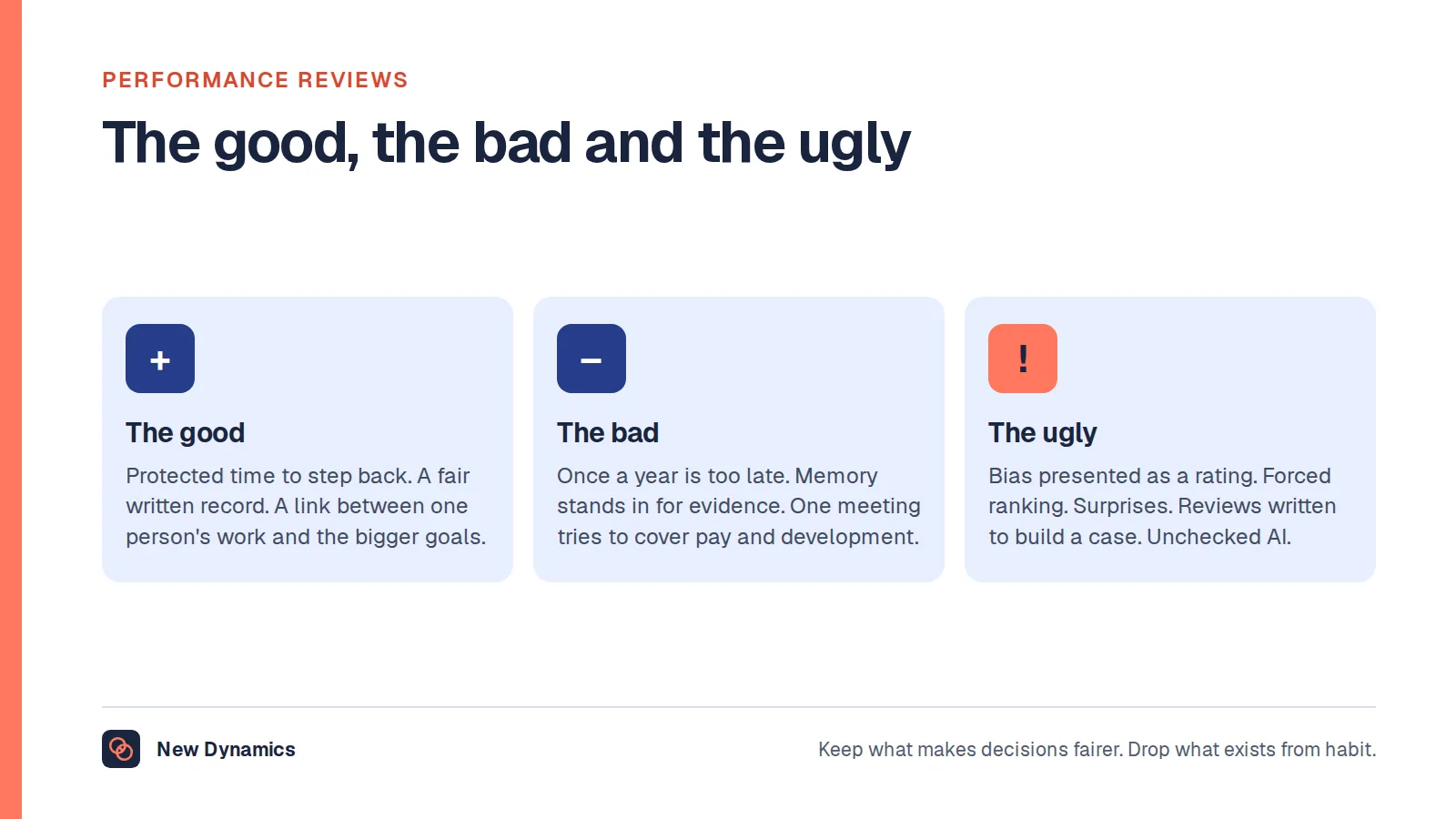
- Performance ratings. Ratings based on impressions favour people who resemble the manager. We cover the common patterns in performance reviews: the good, the bad and the ugly.
- Pay decisions. Starting salaries based on previous pay can carry old inequalities into a new employer.
- Flexible working and leave. Penalising people for part-time hours or parental leave can affect one sex far more than the other.
- Reasonable adjustments. In Great Britain, Acas states that employers must make reasonable adjustments when they know, or could reasonably be expected to know, that someone is disabled, or when a disabled person asks for them.
- Banter. Jokes about age, accent, religion or sexuality can amount to harassment, however they were meant.
- What happens after a complaint. Treating someone unfairly because they raised a concern or acted as a witness can be victimisation. Acas notes that people remain protected when a complaint turns out to be wrong, provided they acted in good faith.

How employers can reduce the risk
Acas is clear that employers must take steps to prevent discrimination, and that an employer can be held responsible for the actions of its workers. Good intentions are not enough. These habits help:
- Write the criteria before the decision. Decide what good looks like for the role, the rating or the pay rise before you look at the people.
- Record the evidence. A short written reason for each decision lets you, and others, check it later.
- Hear more than one voice. Decisions made by one person in private are the hardest to test. Multi-manager reviews bring in the people who saw the work.
- Check outcomes by group. Look at ratings, pay and promotions across sex, age, ethnicity and working pattern where your data and local law allow it. Our performance calibration guide explains how.
- Test blanket rules. For each requirement, ask whom it excludes and whether there is a less restrictive way to meet the same need.
- Make it safe to speak up. Offer more than one reporting route, act on concerns promptly and protect the people who raise them.
- Train managers on the basics. Most managers have never been shown the four definitions above.
Our diversity and inclusion guide turns these habits into an action plan.

Frequently asked questions
What is the simple definition of discrimination?
Discrimination means treating someone less favourably, or putting them at a disadvantage, because of a characteristic that the law protects, such as age, disability, race, religion, sex or sexual orientation. The exact list depends on the country.
What does it mean to discriminate against someone?
To discriminate against someone is to treat them worse than others for a protected reason. It can be a single decision, such as refusing a promotion, or a pattern, such as repeatedly leaving someone out of opportunities.
What is discrimination in the workplace?
Workplace discrimination is unfair treatment connected to a protected characteristic in any part of employment. That includes recruitment, pay, training, promotion, discipline, dismissal and everyday behaviour at work.
What are the four types of discrimination?
UK guidance from Acas describes four main types: direct discrimination, indirect discrimination, harassment and victimisation. United States law uses the related terms disparate treatment, disparate impact, harassment and retaliation.
Can discrimination be unintentional?
Yes. A rule applied to everyone can still put a protected group at a disadvantage, and behaviour meant as a joke can still be harassment. The effect matters as well as the intention.
Is treating people differently always discrimination?
No. Employers treat people differently for lawful reasons all the time, such as skills, performance and seniority. It becomes discrimination when the reason, or the effect of a rule, is linked to a protected characteristic and cannot be lawfully justified.
Your next step: test one decision process
- Pick one process: shortlisting, performance ratings or pay reviews.
- Check whether the criteria are written down before decisions are made.
- Look at the last round of outcomes by group, where your data and local law allow.
- Ask whom each blanket rule excludes, and whether you still need it.
For a policy structure you can adapt, read and download our equal employment opportunity guide. The guide is free to read, and the PDF uses our short download form.
Want review and promotion decisions to rest on recorded evidence? Book a New Dynamics demo and bring your current process. You can also email contact@new-dynamics.com.