TL;DR
- Disparate treatment is intentional discrimination: treating someone differently because of a protected characteristic such as race, colour, religion, sex or national origin.
- Disparate impact is a neutral rule or test that disproportionately excludes a protected group and is not job-related and consistent with business necessity. No intent is needed.
- Guard against both by applying criteria consistently, recording reasons, testing blanket rules for their effect and checking outcomes by group where the law allows.
Two phrases sit at the centre of United States employment discrimination law: disparate treatment and disparate impact. They sound alike, and they describe very different problems. One concerns how a person was treated. The other concerns what a rule does to a group.
This article explains both in plain English, using the Equal Employment Opportunity Commission's own definitions, with examples and practical checks for managers and HR teams.
Please note: this article covers United States federal law in general terms. It is not legal advice. State and local laws add further protections, the law changes, and every case depends on its facts. Take professional advice on any real situation.
Many discrimination risks arise in appraisal, pay and promotion decisions. See how New Dynamics performance reviews keep goals, feedback and ratings in one reviewable record.
Disparate treatment: the definition
The EEOC's fact sheet on employment tests and selection procedures describes disparate treatment under Title VII of the Civil Rights Act as intentional discrimination based on race, colour, religion, sex or national origin.
In short, disparate treatment means treating a person differently, and worse, because of who they are.
The EEOC gives this example: Title VII forbids a covered employer from testing the reading ability of African American applicants or employees but not testing the reading ability of their white counterparts. The test itself might be reasonable. Applying it to one group only is the discrimination.
Other federal laws extend similar protection to age (40 or older), disability and genetic information, as the EEOC's page on prohibited employment policies and practices explains.
Examples of disparate treatment
These are simple illustrations. Real cases depend on their facts and on evidence of the reason for the decision.
- A manager interviews every candidate for a supervisor role but asks only the women how they would manage childcare.
- Two employees break the same attendance rule. One receives a quiet word, and the other, who is of a different national origin, receives a written warning.
- A company requires older applicants to take a fitness test that younger applicants are not asked to take.
- An employee who mentions their religious observance stops being offered client-facing projects.
- A manager gives a lower rating to an employee after learning of a disability, with no change in the person's work.
The common thread is a different standard, applied because of a protected characteristic.

Disparate impact: the definition
The same EEOC fact sheet explains that Title VII also prohibits employers from using neutral tests or selection procedures that have the effect of disproportionately excluding people based on race, colour, religion, sex or national origin, where the tests or procedures are not “job-related and consistent with business necessity”.
Notice what is missing: intent. A rule can be applied to everyone in exactly the same way and still be unlawful if it screens out a protected group without a sound business reason. The EEOC notes that this principle follows the Supreme Court's decision in Griggs v. Duke Power Co. in 1971.
Examples of disparate impact
Again, these are illustrations. Whether a practice is unlawful depends on the evidence and on the three-step analysis below.
- A strength test for a warehouse job may exclude far more women than men, where the required level is well above what the job demands.
- A rule that all applicants must hold a degree may screen out one racial group at a much higher rate, for a role where a degree is not needed to do the work.
- A blanket policy of rejecting anyone with any criminal record may exclude some groups disproportionately, whatever the offence, however long ago it was and whatever the job.
- A minimum height requirement may exclude more women and more people of some national origins, with no link to the duties.
Disparate impact vs disparate treatment: the difference
| Question | Disparate treatment | Disparate impact |
|---|---|---|
| What is it? | Different treatment because of a protected characteristic | A neutral practice with a disproportionate effect on a protected group |
| Is intent required? | Yes. It is intentional discrimination | No. The effect is what matters |
| Who is affected? | Usually an individual, or people singled out | A group, often shown through statistics |
| Typical evidence | Comparisons with how others were treated, comments, inconsistent reasons | Data on who passes and who fails the rule or test |
| Employer's usual answer | A genuine, job-related reason for the decision | The practice is job-related and consistent with business necessity |
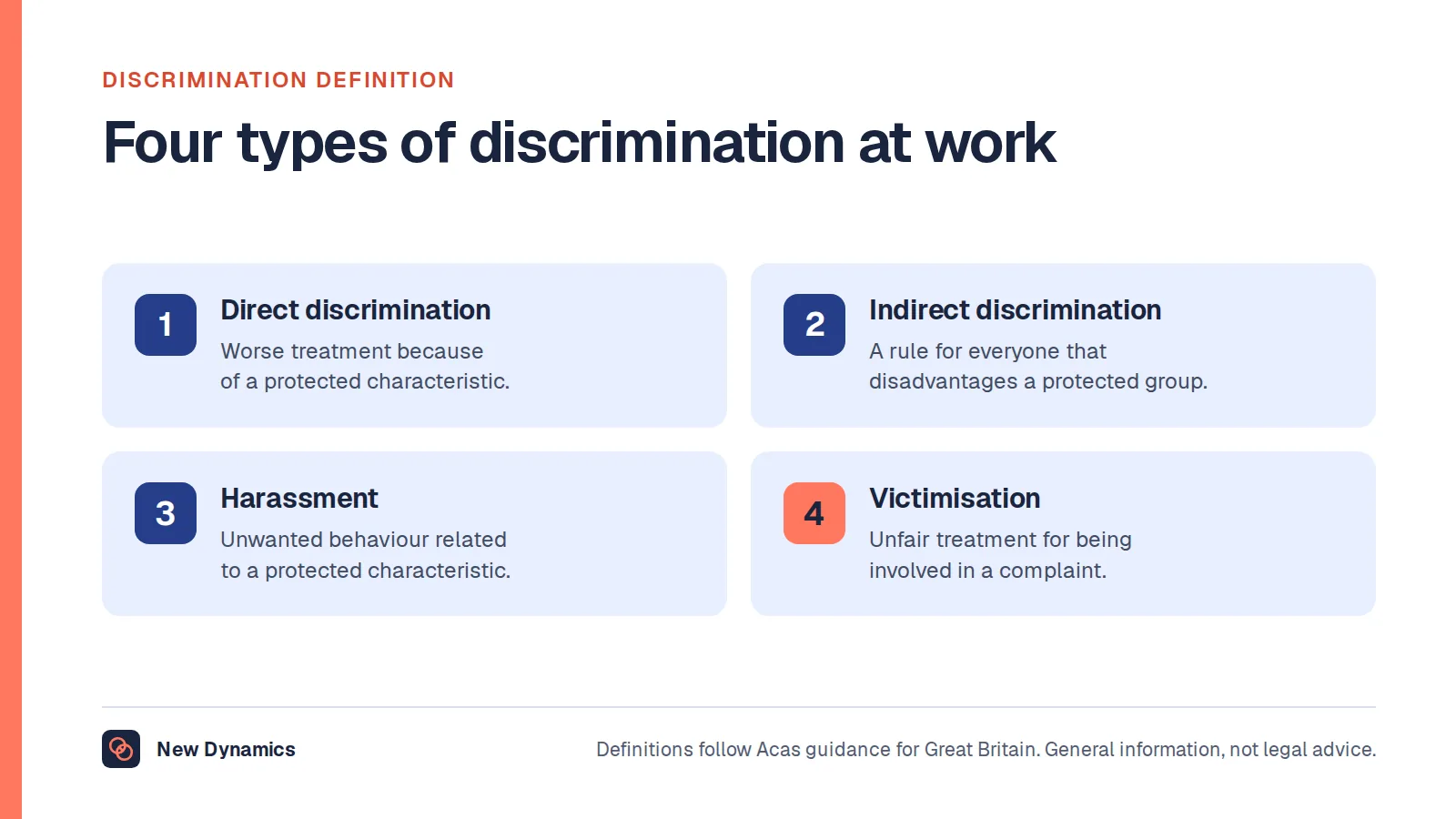
| Closest UK term | Direct discrimination | Indirect discrimination |
For the UK terms, see our plain guide to the definition of discrimination at work. The legal tests differ between the two countries, so treat the last row as a vocabulary aid.
How a disparate impact claim is analysed
The EEOC fact sheet sets out three questions.
- Is there a disparate impact? Does the employer use a particular employment practice that has a disproportionate effect on a protected group? This usually needs statistical analysis.
- Is the practice justified? Can the employer show that the selection procedure is job-related and consistent with business necessity?
- Is there a less discriminatory alternative? Can the person challenging the procedure show that another approach would serve the employer's need with less adverse effect?
The practical lesson for employers is to ask these questions of your own rules before anyone else does.

Where both risks appear in people decisions
- Hiring. Unstructured interviews invite disparate treatment. Blanket requirements, such as degrees, tests or unbroken work history, can create disparate impact.
- Performance ratings. Ratings based on impressions can vary with who the manager is comfortable with. We cover the common biases in performance reviews: the good, the bad and the ugly.
- Pay and promotion. Informal sponsorship and negotiation-based pay can both produce unexplained gaps between groups.
- Discipline. Inconsistent enforcement of the same rule is a classic source of disparate treatment claims.
- Layoffs. Selection criteria that look neutral, such as recent ratings or salary level, can fall unevenly on older workers or other groups.
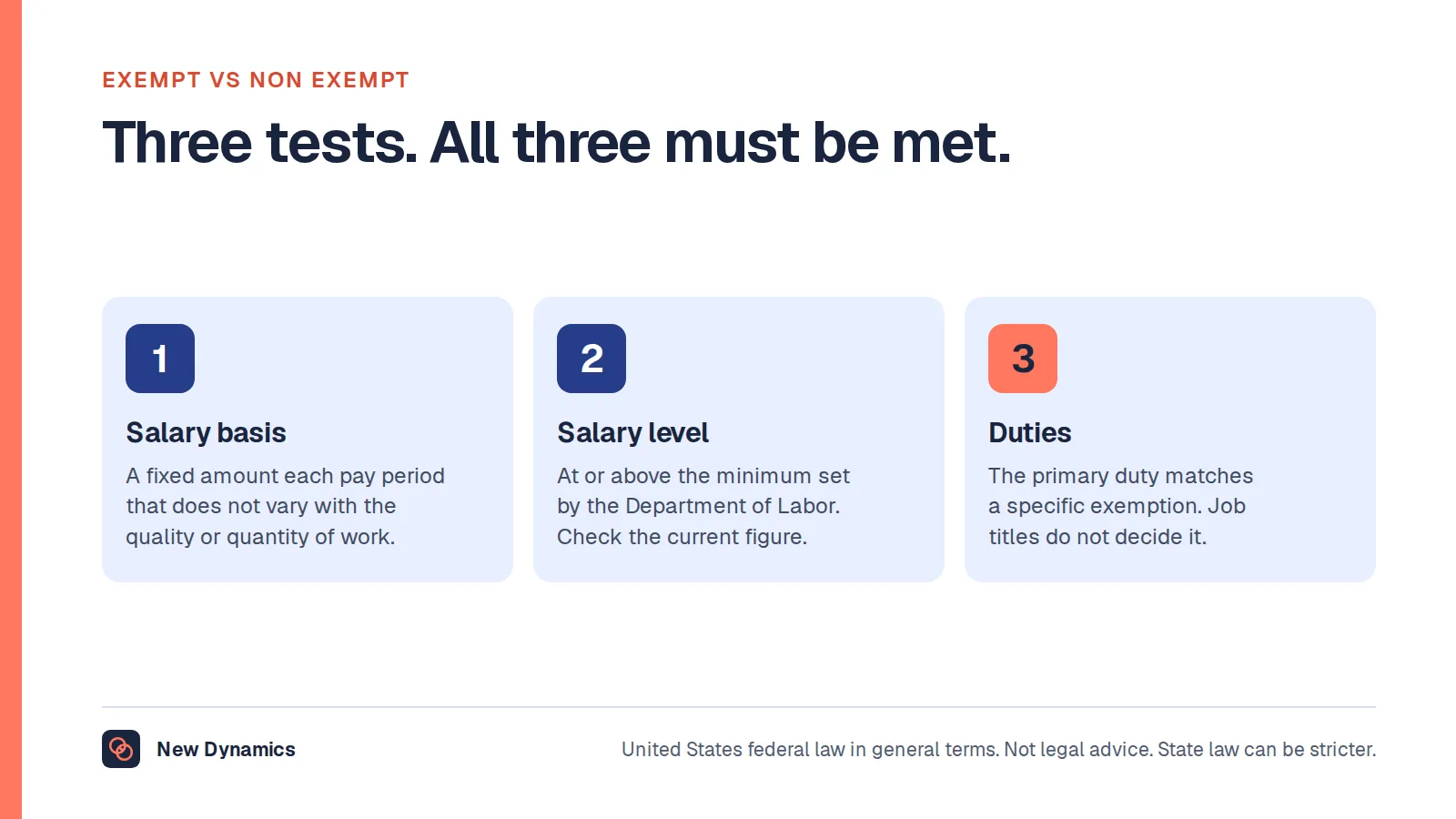
- Classification. Apply rules such as overtime status consistently. See exempt vs non-exempt employees.
How to reduce the risk
- Set criteria before you see the candidates. Decide what the job requires, and score everyone against the same list.
- Use structured interviews. Ask every candidate the same core questions.
- Test each blanket rule. What is it for? Whom does it exclude? Is there a fairer way to meet the same need?
- Validate tests. Make sure a test measures something the job really needs, at the level the job needs it.
- Record reasons. A short, written, job-related reason for each decision is the best protection against a claim of disparate treatment, provided it is true.
- Enforce rules consistently, and document exceptions.
- Check outcomes by group, where your data and the law allow. Look at hiring, ratings, pay, promotion and exits. Our performance calibration guide explains how to review ratings across managers.
- Train managers on both concepts. Most have never heard of disparate impact.

Frequently asked questions
What is disparate treatment?
Disparate treatment is intentional discrimination. It means treating an applicant or employee differently because of a protected characteristic such as race, colour, religion, sex or national origin. Applying a test or a rule to one group only is a typical example.
What is an example of disparate treatment?
The EEOC gives this example: an employer tests the reading ability of African American applicants or employees but does not test their white counterparts. Another illustration is giving a written warning to one employee and a quiet word to another for the same offence, because of national origin.
What is the difference between disparate impact and disparate treatment?
Disparate treatment is about intent: a person is treated differently because of a protected characteristic. Disparate impact is about effect: a neutral rule applied to everyone disproportionately excludes a protected group and is not job-related and consistent with business necessity.
Does disparate impact require intent?
No. A practice can create unlawful disparate impact even if the employer had no intention to discriminate. What matters is the effect on a protected group and whether the practice is job-related and consistent with business necessity.
How do employers defend a disparate impact claim?
Under the EEOC's three-step analysis, the employer must show that the practice is job-related and consistent with business necessity. The person challenging it may still succeed by showing that a less discriminatory alternative was available.
Is disparate treatment the same as direct discrimination?
They are close equivalents in different legal systems. Disparate treatment is the United States term. Direct discrimination is the term used in Great Britain. Likewise, disparate impact corresponds roughly to indirect discrimination. The legal tests are not identical.
Your next step: check one rule and one process
- Pick one blanket rule you use in hiring, such as a qualification or a test. Ask what it is for and whom it excludes.
- Pick one decision process, such as discipline or promotion. Check whether similar cases were handled the same way.
- Write down what you find, and fix the weakest point.
- Take legal advice where the answer is unclear.
For a policy structure you can adapt, read and download our equal employment opportunity guide. The guide is free to read, and the PDF uses our short download form.
Want review and promotion decisions to rest on recorded evidence? Book a New Dynamics demo and bring your current process. You can also email contact@new-dynamics.com.