TL;DR
- The good: performance reviews protect time to step back, create a fair written record and connect one person's work to the organisation's goals.
- The bad: a once-a-year meeting that relies on memory and mixes pay with development wastes effort and rarely helps anyone improve.
- The ugly: bias presented as a rating, forced ranking, surprises and unchecked AI damage trust. Fix them with evidence gathered all year, more than one voice and calibration.
Few workplace rituals are as widely used and as widely disliked as performance reviews. Managers dread writing them. Employees dread reading them. HR teams spend weeks chasing forms that few people open again.
Yet most organisations keep them, and for sound reasons. People want to know where they stand. Pay and promotion decisions need a fair basis. Development needs a moment when it gets proper attention.
This article sorts performance reviews into the good, the bad and the ugly, then shows what a better review looks like in 2026. If you want reviews that draw on goals, feedback and recognition from the whole year, see how New Dynamics performance reviews bring that evidence into one conversation.
What performance reviews are for in 2026
A performance review is a structured conversation about how someone's work has gone and what should happen next. The CIPD performance management factsheet, reviewed in January 2026, describes a shift “away from annual appraisals towards ongoing, flexible review systems”, with more weight on the quality of the conversation and less on process.
Most reviews are asked to do three jobs:
- Look back fairly. What was achieved, how, and with what evidence?
- Look forward. What should this person focus on, learn or change next?
- Inform decisions. Pay, promotion, development budgets and succession all lean on review outcomes.
Trouble starts when one meeting tries to do all three at once. People cannot think openly about their development while waiting to hear their pay rise. Keep that tension in mind through the rest of this article.

The good: what performance reviews still do well
They protect time to step back
Daily work crowds out reflection. A review puts an appointment in the diary that is about the person, rather than the project. For many employees it is the longest uninterrupted conversation they have with their manager all year. That has value, even when the form around it is clumsy.
They create a fair, written record
Decisions about people should rest on more than a manager's mood in budget week. Acas advises employers to “keep a written record of what is discussed” in a review and to share it with the employee afterwards, in its guidance on reviews and appraisals. A shared record protects both sides. It also makes it easier to spot patterns, such as one team whose ratings always run lower.
They connect one person's work to the bigger picture
The CIPD says managers should help employees “see the connections between organisational and individual objectives”. A good review is where that link is tested. Did the goals set earlier still matter by the end of the period? Which work made the biggest difference? Employees who can answer those questions make better decisions about their own time.
They give development a seat at the table
Left to chance, development conversations happen mostly with confident people who ask for them. A review gives everyone the same opening to talk about skills, ambitions and support. Our career development guide has questions that help. For a clearer view of what you are looking for, see what talent means at work.
The bad: where performance reviews waste effort
Once a year is too late
Feedback works best close to the event. In Gallup's 2019 research on performance reviews, nearly half of employees said they received feedback from their manager only a few times a year or less. An issue raised ten months later cannot be fixed. Praise delivered ten months later has lost most of its warmth.
Memory stands in for evidence
Ask a manager in December to assess a whole year and they will mostly recall the autumn. Work from the spring fades. A single visible mistake outweighs months of steady delivery. Without notes, goals and feedback gathered along the way, the review measures what the manager remembers.
One meeting tries to do three jobs
When the rating, the pay outcome and the development plan all arrive in one hour, the pay outcome wins. People stop listening once they hear the number. Many organisations now hold the development conversation and the pay conversation on different days, so that each gets a fair hearing.
The form serves HR, not the conversation
Long forms with a dozen competencies and a comment box for each produce tired, copied text. They prove that a review happened. They rarely help two people talk honestly. The same Gallup research found that only 14% of employees strongly agreed their performance reviews inspired them to improve. The figure dates from 2019 and comes from a United States sample, but the complaint will sound familiar to most HR teams.
The ugly: when performance reviews do harm
Bias presented as a rating
A number looks objective. It is often a judgement shaped by who the manager sees most, who resembles them and what happened most recently. Common patterns include:
- Recency bias: the last few weeks outweigh the rest of the period.
- Halo and horns: one strong or weak trait colours every other score.
- Similarity bias: people like us seem more capable.
- Leniency and severity: some managers rate everyone high, others rate everyone low.
Unchecked, these patterns affect pay and promotion. They also fall unevenly across groups, which creates legal as well as ethical risk. Our plain guide to the definition of discrimination at work explains the terms. Our performance calibration guide explains how to test ratings across managers before they become decisions.
Forced ranking and quota curves
Requiring every team to fit a fixed curve guarantees that some good performers are labelled poor ones. It sets colleagues against each other and punishes managers who hire well. The CIPD notes that organisations are moving towards “less focus on process, such as forced ranking or guided distribution ratings”.
Surprises
Nothing damages trust faster than hearing about a problem for the first time in a formal review. Acas is plain on this point: alongside formal reviews, managers “should still talk to employees informally about their performance on a regular basis”. If the review contains news, the process failed months earlier.
Reviews used to build a case
Sometimes a review is written mainly to justify a decision already made, such as a dismissal or a withheld pay rise. Employees can tell. It teaches everyone that the record is a weapon rather than a shared account, and people respond by hiding problems.
Unchecked AI
AI can now draft a review in seconds. Used well, it summarises a year of goals and feedback so that nothing is forgotten. Used badly, it produces fluent text about work the manager never looked at, or repeats bias that is already in the data. The manager stays accountable for every word and every rating. Tell employees where AI is used, check its summaries against the source material and keep judgement with people. We set out that approach in AI performance management.
What good performance reviews look like in 2026
The fix is rarely a new form. It is a change in where the evidence comes from and how often people talk.
- Gather evidence all year. Record progress against goals, capture feedback close to the work and note recognition when it happens. The review then summarises a record rather than reconstructing one.
- Hold shorter conversations more often. A quarterly check-in plus regular one-to-ones means nothing in the formal review is a surprise.
- Hear more than one voice. Many people work for a line manager and a project lead at the same time. Multi-manager reviews bring in those who saw the work.
- Separate development from pay. Hold two conversations with two purposes, ideally weeks apart.
- Calibrate before you decide. Compare ratings across managers, look for patterns by team and group, and challenge outliers.
- Write less, and make it specific. Three well-evidenced points are worth more than twelve vague ones.
- Use AI as an assistant. Let it collect and summarise evidence. People make the judgement and own the message.

Should you scrap performance reviews altogether?
Some organisations have dropped ratings or the annual review itself. The results are mixed. Judgements about pay and promotion still get made. When the formal process disappears, those judgements move into private conversations that are harder to question and easier to bias.
A better test is whether each part of your process earns its place:
- If nobody uses the rating for a decision, remove the rating.
- If the rating drives pay, keep it, explain it and calibrate it.
- If the annual meeting is the only feedback people get, add regular check-ins before you remove anything.
Keep the parts that make decisions fairer and the conversation better. Drop the parts that exist only because they always have.
A performance review checklist for managers
Before the review
- Read the whole period's goals, feedback and notes, not just the last month.
- Ask the employee for a short self-review and read it before you write your own.
- Collect views from others who worked closely with them.
- Draft three specific points: one strength to keep, one thing to change and one opportunity.
During the review
- Start with the employee's view of the period.
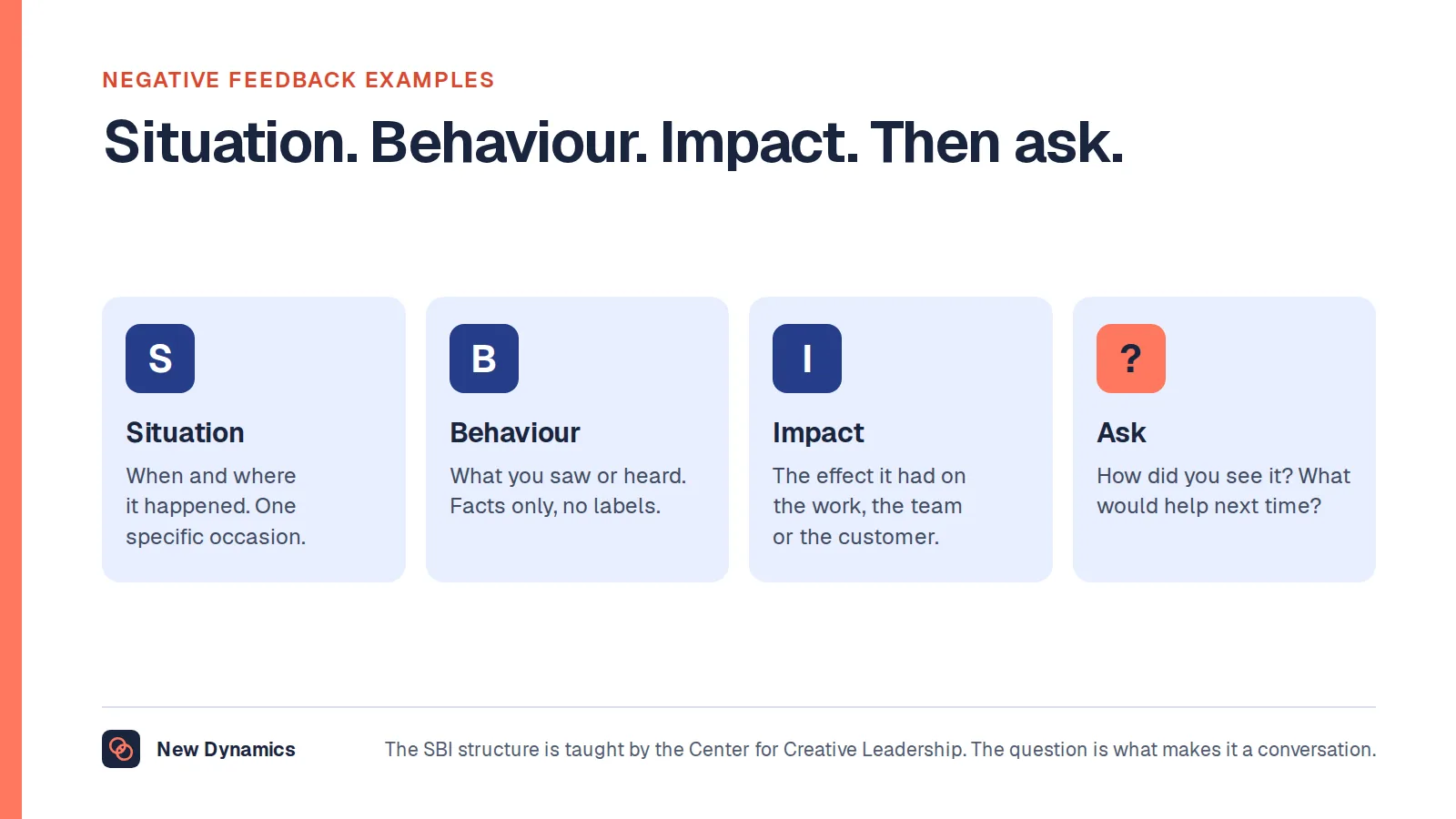
- Describe what you observed and the effect it had, rather than labelling the person.
- Agree what happens next, who owns it and when you will check in.
- Ask what you could do differently as their manager.
After the review
- Share the written record promptly and invite corrections.
- Put the first follow-up in the diary.
- Turn development actions into goals so they do not disappear.
Our performance review template gives you an editable structure, and 100 performance review questions will help with wording.

How to tell whether your performance reviews are working
Completion rates show that forms were submitted. They say nothing about whether the reviews helped. Look for these signs:
- No surprises. Employees say the review matched what they had already heard during the year.
- Clear priorities. A week later, people can name what they are working towards.
- Fair patterns. Ratings and outcomes do not differ by team, manager or group in ways you cannot explain.
- Actions that survive. Development actions agreed in the review are still alive three months later.
- Time well spent. Managers report that preparing took hours, not days, because the evidence already existed.
A two-question pulse after each cycle is enough: “Was your review fair?” and “Do you know what to focus on next?” Track the answers over time and by team. For a fuller question bank, see our workplace engagement survey questions.
Frequently asked questions
What is the purpose of a performance review?
A performance review looks back at how someone's work has gone, agrees what should happen next and informs decisions about pay, promotion and development. It works best as a summary of regular conversations during the year, supported by a written record that both people can see.
How often should performance reviews happen?
There is no single right answer. Many organisations hold a formal review once or twice a year, supported by quarterly check-ins and regular one-to-ones. The principle matters more than the calendar: feedback should arrive close to the work, and nothing in the formal review should be a surprise.
Are annual performance reviews outdated?
The annual review as the only source of feedback is outdated. A yearly summary still has value for fair pay and promotion decisions, provided it draws on evidence gathered through the year. The CIPD describes a shift away from annual appraisals towards ongoing, flexible review systems.
How do you reduce bias in performance reviews?
Use evidence collected across the whole period, gather views from more than one person, describe behaviour and results rather than personality, and calibrate ratings across managers before decisions are made. Check outcomes by team and group, and ask managers to explain any outliers.
Should performance reviews be linked to pay?
They can be, but hold the pay conversation apart from the development conversation. People find it hard to discuss learning openly while waiting to hear a pay outcome. Explain how ratings affect pay so that the link is understood in advance.
Can AI write performance reviews?
AI can summarise goals, feedback and notes so that a manager sees the whole period. It should not decide a rating or send a message that nobody has checked. The manager remains accountable, and employees should be told where AI is used.
Your next step: fix one thing before the next review cycle
You do not need to redesign everything at once. Choose the problem that costs you most:
- If reviews contain surprises, introduce a regular check-in before the next cycle.
- If ratings feel unfair, run a calibration session before outcomes are confirmed.
- If preparation takes days, start capturing goals and feedback during the year.
- If the pay outcome drowns out everything else, split the conversations.
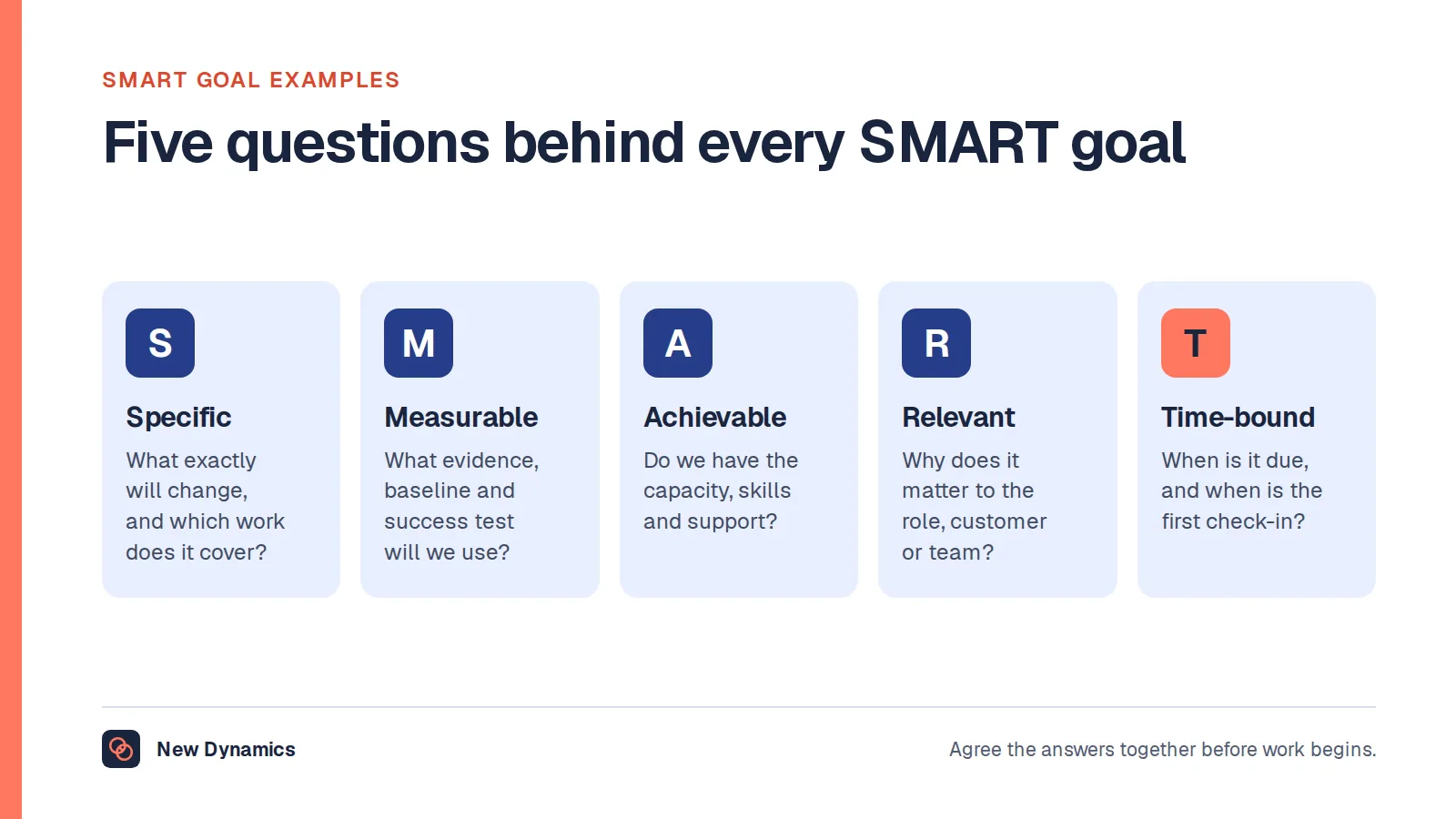
For a step-by-step process, read and download our performance review guide. The guide is free to read, and the PDF uses our short download form. Clear goals make reviews easier, so you may also find our 50 SMART goal examples useful.
Want to see reviews that draw on a full year of goals, feedback and recognition? Book a New Dynamics demo and bring your current review form. You can also email contact@new-dynamics.com.