TL;DR
- In the United States, non-exempt employees must be paid at least the federal minimum wage and overtime at time and a half for hours over 40 in a workweek. Exempt employees are not entitled to overtime.
- For the main white-collar exemptions, an employee must usually pass three tests: paid on a salary basis, paid at least the minimum salary level and doing exempt duties.
- Job titles do not decide the matter. Classify by the real work, keep accurate time records for non-exempt staff and check state law, which can be stricter.
Calling someone a “manager” and paying them a salary does not make them exempt from overtime. It is one of the easiest classification mistakes to make in the United States, and one of the easiest to avoid once you know how the rules work.
This article explains exempt vs non exempt status under the federal Fair Labor Standards Act (FLSA) in plain English. It covers the three tests, the main exemption categories, common mistakes and what the distinction means for managers who set goals and review performance.
Please note: this article covers United States federal law in general terms. It is not legal advice. State and local laws can be stricter, the figures change, and classification depends on the facts of each job. Check the Department of Labor pages linked below and take professional advice before you classify a role.
Classification depends on what people really do, so an accurate, current picture of each role matters. See how New Dynamics Goals & OKRs keep responsibilities and priorities visible.
Exempt vs non-exempt: the short answer
The FLSA sets a federal minimum wage and overtime rules. According to the Department of Labor, covered employees “must receive overtime pay for hours worked over 40 in a workweek at a rate not less than time and one-half their regular rates of pay”.
- Non-exempt employees are protected by those rules. They must receive at least the minimum wage and overtime pay.
- Exempt employees are excluded from the overtime rules, and in most cases the minimum wage rules, because they meet specific tests in the law.
Non-exempt is the default. An employee is exempt only if the job fits one of the exemptions.
| Question | Non-exempt | Exempt |
|---|---|---|
| Overtime pay over 40 hours | Yes, at time and a half or more | Not required by the FLSA |
| Federal minimum wage applies | Yes | Generally not |
| How they are usually paid | Hourly, though a salary is possible | A fixed salary that meets the legal minimum |
| Hours records needed for pay | Yes, every workday and workweek | Not needed to calculate overtime |
| What decides the status | The default unless an exemption applies | Passing the tests for a specific exemption |
The Department of Labor defines a workweek as “a fixed and regularly recurring period of 168 hours”, which means seven consecutive 24-hour periods. Overtime is worked out one workweek at a time. Hours cannot be averaged over two weeks.
The three tests for exempt status
The best-known exemptions cover executive, administrative and professional employees. The Department of Labor's Fact Sheet 17A explains that, to qualify, an employee must generally meet three tests.

1. The salary basis test
The employee must regularly receive a predetermined amount of pay each pay period. The Department's Fact Sheet 17G adds that the amount “cannot be reduced because of variations in the quality or quantity of the employee's work”.
Some deductions are allowed, such as for full-day absences for personal reasons. An employer with an actual practice of making improper deductions can lose the exemption.
2. The salary level test
The salary must be at least the minimum level set by the Department of Labor. When we last updated this article, the Department's fact sheets gave that level as $684 per week, which is $35,568 a year. A separate test applies to highly compensated employees, for whom the same fact sheets give total annual compensation of $107,432 or more.
These amounts change from time to time. Always confirm the current figure on the Department of Labor's website before you rely on it. State law may set a higher threshold.
3. The duties test
The employee's primary duty must match one of the exemption categories. The fact sheet is blunt about this: “Job titles do not determine exempt status.” What counts is the work the person really does. For how titles are normally structured, see our list of job titles by level and department.
All three tests must be met. A well-paid employee on a salary is still non-exempt if the job does not involve exempt duties.
The main exemption categories
These short descriptions follow Fact Sheet 17A. Each category has detailed criteria, so read the Department's fact sheet for the one you are considering.
- Executive. The primary duty is managing the enterprise or a recognised department. The employee customarily and regularly directs the work of at least two other full-time employees, and has real influence over hiring and firing.
- Administrative. The primary duty is office or non-manual work related to management or general business operations, and it includes the exercise of discretion and independent judgment on matters of significance.
- Professional. The primary duty requires advanced knowledge in a field of science or learning, usually gained through prolonged specialised study, or it requires invention, imagination or talent in a recognised creative field.
- Computer employees. Certain systems analysts, programmers and software engineers can qualify, on a salary or an hourly basis, if they meet the pay and duties criteria.
- Outside sales. The primary duty is making sales or obtaining orders, and the employee customarily works away from the employer's place of business. The salary tests do not apply to this category.
The fact sheet also states who is not covered by these exemptions. They “do not apply to manual laborers or other ‘blue-collar’ workers”, and they do not apply to police officers, firefighters, paramedics and similar first responders, however highly paid.
A simple way to check a role

Work through the questions in order:
- Is the employee paid a fixed salary that does not vary with the quality or quantity of work?
- Is that salary at or above the current federal level, and any higher state level?
- Does the person's primary duty match the criteria for a specific exemption?
- Is the role free of the exclusions, such as manual work or first-responder duties?
If any answer is no, treat the role as non-exempt unless a different exemption clearly applies. When in doubt, non-exempt is the safer classification, because it guarantees overtime.
Common mistakes with exempt and non-exempt status
Classifying by job title. “Assistant manager” means nothing on its own. If the person spends most of the day serving customers and has no real authority over staff, the executive exemption is unlikely to fit.
Assuming a salary means exempt. Salaried employees can be non-exempt. If they are, they are still owed overtime.
Letting a role drift. A job that met the duties test when it was designed may not meet it after a restructure. Review classifications when duties change.
Not recording hours for non-exempt staff. The Department's reference guide to the FLSA lists the records employers must keep, including total hours worked each workday and each workweek.
Forgetting state law. The same guide states that the FLSA “does not preempt State or local laws that provide greater protections to employees”. Where two standards apply, follow the one that protects the employee more.
Mistakes are expensive to unwind. The reference guide notes that a two-year limitation period generally applies to the recovery of back wages, and three years for wilful violations.
What the FLSA does not require
People often assume that exempt or non-exempt status affects benefits. The Department's reference guide says the FLSA does not require vacation, holiday, severance or sick pay, and does not require meal or rest periods. Those come from employer policy, contracts or state law. Classification is about minimum wage and overtime only.
What exempt status means for managers
The legal label should not change how you manage performance, but it does change some practical habits.
- Goals and workload. Exempt employees have no overtime to signal overload, so heavy hours stay invisible. Ask about workload in one-to-ones. Our one-to-one meeting guide has prompts.
- After-hours work. The Department's Fact Sheet 22 on hours worked states that work “not requested but suffered or permitted to be performed is work time that must be paid for”. If non-exempt staff answer messages or finish tasks in the evening, set clear expectations and record the time.
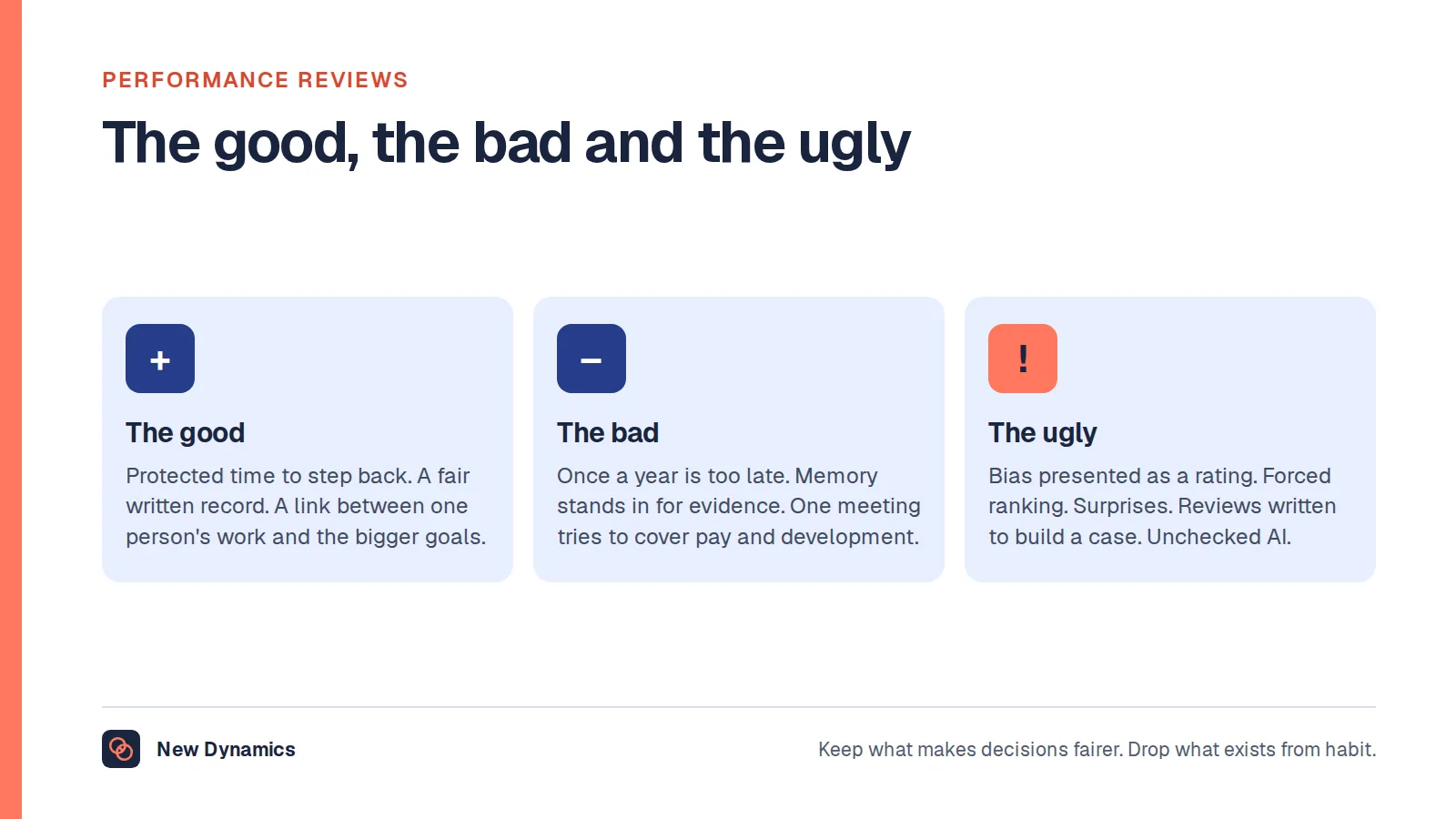
- Performance reviews. Judge both groups on results and behaviour. Hours alone are a poor measure for either. See performance reviews: the good, the bad and the ugly.
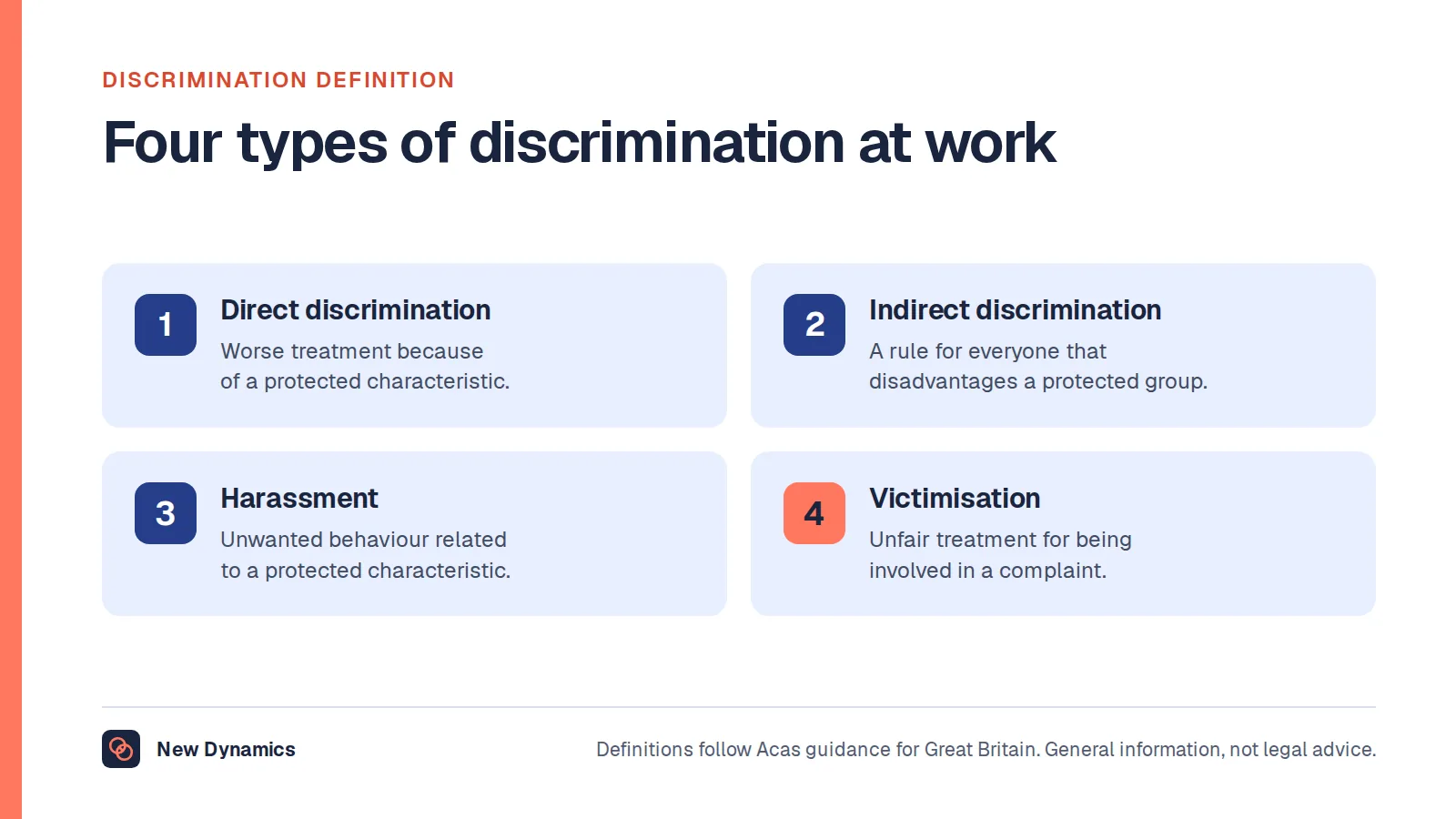
- Fairness. Apply classification rules consistently. Inconsistent treatment of similar roles can raise wider concerns, as our guide to the definition of discrimination at work explains.
- Job descriptions. Keep them accurate. A description that matches the real work makes classification easier to defend, and goals easier to set.

Frequently asked questions
What is the difference between exempt and non-exempt employees?
Under the United States Fair Labor Standards Act, non-exempt employees must receive at least the federal minimum wage and overtime pay at time and a half for hours over 40 in a workweek. Exempt employees meet specific legal tests and are not entitled to overtime under the Act.
What makes an employee exempt under the FLSA?
For the main executive, administrative and professional exemptions, the employee must generally be paid on a salary basis, earn at least the minimum salary level set by the Department of Labor and perform duties that match the exemption. All three tests must be met.
Can a salaried employee be non-exempt?
Yes. Being paid a salary does not make someone exempt. If the salary is below the required level, or the duties do not match an exemption, the employee is non-exempt and must be paid overtime for hours over 40 in a workweek.
Does a job title make someone exempt?
No. The Department of Labor states that job titles do not determine exempt status. Classification depends on how the employee is paid and on the duties they really perform.
Do exempt employees get overtime?
The FLSA does not require overtime pay for exempt employees. An employer may choose to pay extra, and some state laws are stricter than federal law, so check the rules that apply where the employee works.
Is it better to be exempt or non-exempt?
Neither is better in itself. Non-exempt employees are paid for every extra hour. Exempt employees usually have a predictable salary and more flexibility, but no overtime pay. The right classification is whichever the law requires for the work being done.
Your next step: review three roles
- Pick three salaried roles whose duties have changed recently.
- Compare what each person really does with the duties criteria in the Department of Labor fact sheet.
- Confirm the salary against the current federal level and your state's level.
- Record your reasoning, and take advice where the answer is unclear.
For a structure that keeps pay decisions consistent, read and download our compensation policy guide. The guide is free to read, and the PDF uses our short download form.
Want roles, goals and reviews kept current in one place? Book a New Dynamics demo and bring a role you find hard to describe. You can also email contact@new-dynamics.com.