TL;DR
- In a job advert, DOE usually stands for “depending on experience” or “dependent on experience”. “Salary: DOE” means that the employer will set the pay according to what the successful candidate brings.
- It tells you that the pay is negotiable and that a budget exists. It does not tell you the figure, so ask for the range early, and prepare evidence of your experience.
- Pay transparency rules are spreading. The EU's Pay Transparency Directive gives applicants a right to information about initial pay or its range, and New York and Colorado require compensation in job postings.
You find a job that fits. The advert lists the duties, the team and the benefits. Then, where the pay should be, it says: “Salary: DOE.”
This article explains the meaning of DOE in job adverts, what it does and does not tell you, how to find the range and answer the salary question, and what employers should write instead, now that pay transparency rules are spreading.
How experience turns into pay should rest on fair evidence, before and after hiring. See how New Dynamics performance reviews keep goals, feedback and ratings consistent.
What does DOE mean?
In a job advert, DOE usually stands for depending on experience. You will also see it expanded as “dependent on experience” or “depends on experience”. All three mean the same thing: the employer has not fixed the pay, and will set it according to the experience of the person hired.
So “Salary: DOE”, “Pay: DOE” and “Compensation is DOE” are all saying: we will pay more for a more experienced candidate, and we are not telling you how much.
It is recruitment shorthand, not a formal term. The Cambridge Dictionary's only entry for “doe” is the female of animals such as the deer or rabbit. Outside job adverts the letters have other meanings, including the US Department of Energy and Department of Education, and design of experiments in statistics. In a vacancy, next to the word salary, it means depending on experience.
Related abbreviations work the same way.
| Abbreviation | Usual meaning |
|---|---|
| DOE | Depending on experience |
| DOQ | Depending on qualifications |
| Neg. | Negotiable |
| OTE | On-target earnings: base pay plus commission or bonus at target |
| Pro rata | In proportion to the hours worked |
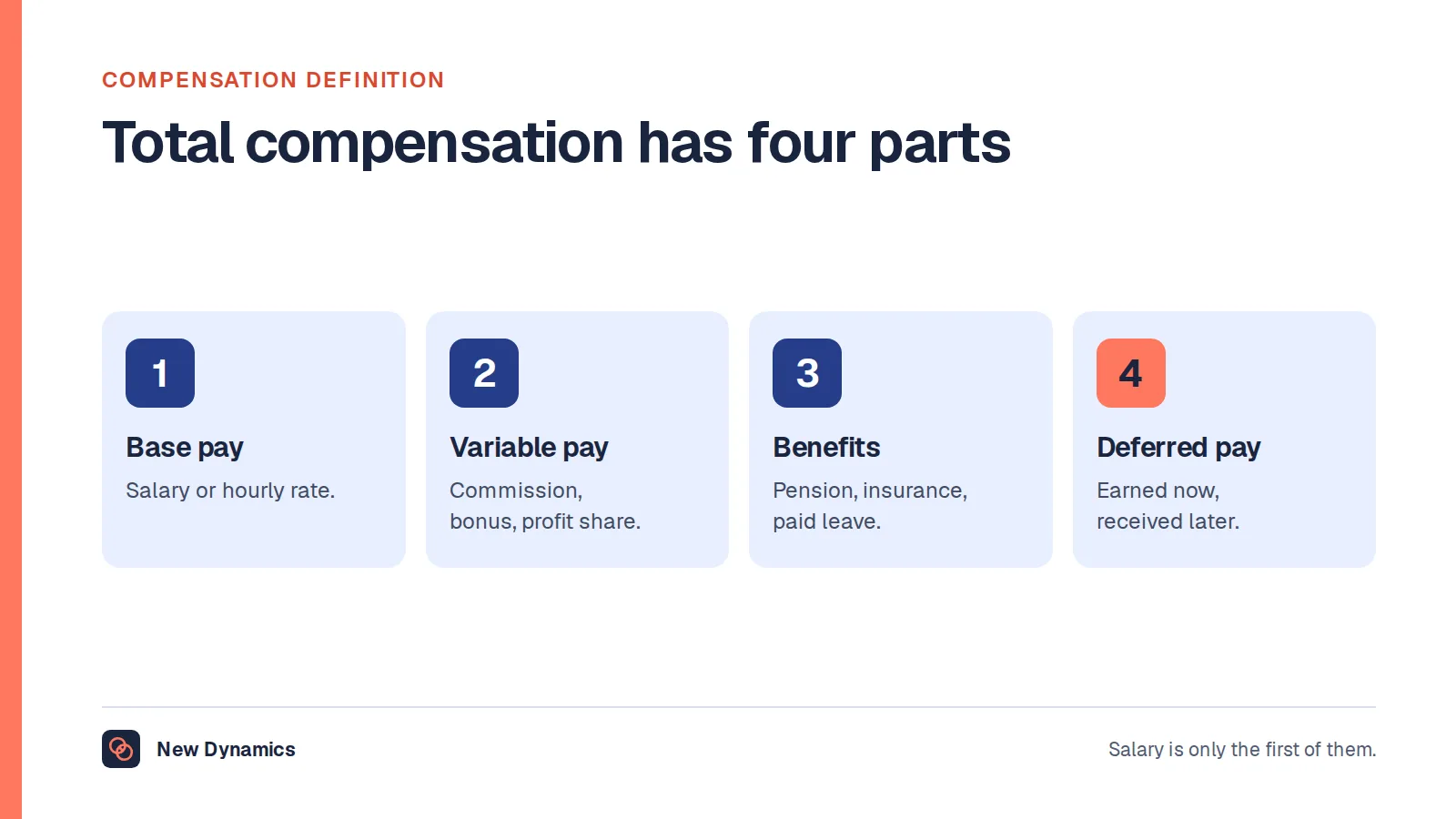
Our guide to the definition of compensation explains OTE and the parts of a pay package.
What “salary DOE” tells you, and what it does not
It tells you three things.
- The pay is negotiable. The employer expects a conversation, and has room to move.
- A budget exists. Most vacancies have an approved range, even when the advert hides it.
- You will have to ask. The advert will not help you decide whether the job is worth applying for.
It does not tell you the bottom or the top of the range, how the employer measures experience, or whether the rest of the package is fixed.

Why employers write DOE
- They are open on level. The team might hire a capable junior or a seasoned senior, and the pay would differ a good deal.
- They want room to negotiate. A published range anchors every candidate at the top of it.
- They do not want current staff to see the figure. This is usually a sign that internal pay is inconsistent.
- They do not want competitors to see it.
- Habit. The last advert said DOE, so this one does too.
Some of these reasons are understandable. None of them helps the candidate, and several suggest problems that publishing a range would force the employer to fix.
How to respond to a DOE advert: six steps
- Research the market. Look at adverts for similar roles that do give figures, salary surveys for your profession, and what people in your network tell you.
- Decide your own range. Know the figure you would be pleased with and the figure below which you would walk away, before anyone asks.
- Ask for the range early. It is a normal question. Try: “Could you share the salary range for this role, so that we can both be sure it is worth going further?” Ask the recruiter at the first contact, not at the final interview.
- Show the experience that the pay depends on. DOE means that evidence moves the number. Bring specific results, the scale you have worked at and the problems you have solved. Our guide to soft skills for a CV shows how to word them.
- Look at the whole package. Pension, bonus, holiday, flexibility and development all have value. Ask which parts are guaranteed.
- Get it in writing. Pay, review date and any promised increase should be in the offer letter.
If they ask for your number first
You can turn the question round politely: “I would like to understand the role fully before I name a figure. What range have you budgeted?”
If you have to answer, give a range based on your research, with your preferred figure near the bottom of it, and tie it to the role: “For a role of this scope I am looking at £42,000 to £48,000, depending on the rest of the package.” That figure is an illustration.
You do not have to reveal your current salary. In the EU, the Pay Transparency Directive says that an employer “shall not ask applicants about their pay history”.

Pay transparency rules are making DOE rarer
In a growing number of places, an advert that says only “DOE” no longer meets the law. Three official sources show the direction. This is general information, not legal advice, and the rules differ by country and state.
European Union. Article 5 of the Pay Transparency Directive says: “Applicants for employment shall have the right to receive, from the prospective employer, information about: (a) the initial pay or its range”. The information must be given in a way that ensures “an informed and transparent negotiation on pay, such as in a published job vacancy notice, prior to the job interview or otherwise”. Member States had until 7 June 2026 to bring national laws into force, so check how your country has applied it.
New York State. The Department of Labor's page on pay transparency says that the law requires businesses with four or more employees “to provide job descriptions and list compensation ranges for designated job opportunities, promotions, and transfers”.
Colorado. The state's labour department explains that the Equal Pay for Equal Work Act “requires employers to disclose compensation in all job postings and notices, both internal and public”, together with information about benefits.
Other jurisdictions have their own rules, and many have none. Where a range must be published, an employer can still say that the offer within it depends on experience.
What employers should write instead of DOE
Replace the three letters with five pieces of information.
- The range. Publish the real budgeted range, not one so wide that it says nothing.
- The criteria. Say what puts a candidate at the bottom, the middle and the top: years in a comparable role, qualifications, or particular skills.
- The benefits. Pension, holiday, bonus scheme and anything else with a value.
- The variable pay. If there is commission or a bonus, give the base and the on-target figure separately.
- The review point. Say when pay is next reviewed, and what it depends on.
For example: “£38,000 to £46,000, depending on experience. Offers above £42,000 need three or more years in a similar role. 5% employer pension, 28 days' holiday, salary review each April.” The figures are an illustration.
Publishing a range has a cost. It shows your existing staff where they sit. That is also the benefit. A range you would be embarrassed to show your own team is a pay structure that needs work, and our job evaluation guide can help you to build one. After hiring, link progression through the range to a fair review. See our guide to the performance rating scale.

Frequently asked questions
What does DOE stand for in a job advert?
DOE usually stands for “depending on experience”. It is also written as “dependent on experience” or “depends on experience”. It means that the employer will decide the pay according to the experience of the person hired.
What does DOE mean for salary?
“Salary: DOE” means that the salary is not fixed. The employer has a budget, and will offer more to a candidate with more relevant experience. The advert does not show the range, so you need to ask for it.
Is it acceptable to ask for the salary range when the advert says DOE?
Yes. It is a normal, professional question, and it saves time on both sides. Ask the recruiter or hiring manager at the first contact. In some places, including the EU under the Pay Transparency Directive, applicants have a right to the information.
How do I answer “what salary are you looking for” when pay is DOE?
First ask what range has been budgeted. If you must answer, give a range based on market research, with the figure you want near the bottom of it, and link it to the scope of the role and the rest of the package.
What is the difference between DOE and OTE?
DOE, depending on experience, means that base pay is set according to the candidate. OTE, on-target earnings, is the total of base pay plus commission or bonus that you would earn by meeting the employer's targets.
Do employers have to publish a salary range?
It depends on where they are. New York State and Colorado require compensation ranges in job postings, and the EU Pay Transparency Directive gives applicants a right to information about initial pay or its range. Many other places have no such rule.
Your next step: ask, or publish
- If you are applying to a DOE advert, research three comparable roles with published pay, and ask for the range in your first message.
- If you are hiring, find your last advert and check whether it gave a range.
- Write the range, the criteria and the benefits for your next vacancy before you advertise it.
- Check which pay transparency rules apply where you recruit.
For a structure behind the numbers, read and download our compensation policy guide. The guide is free to read, and the PDF uses our short download form.
Want pay progression to rest on fair, consistent performance evidence? Book a New Dynamics demo and bring your current review cycle. You can also email contact@new-dynamics.com.