TL;DR
- Soft skills are the ways you work with people, problems and yourself, such as listening, teamwork, planning and adapting. Employers look for them in every role.
- A list of adjectives proves nothing. Show each soft skill through an achievement: what you did, how you did it and what changed as a result.
- Pick the five or six soft skills that the job advert asks for, use the employer's words, and place the evidence in your profile, your work history and a short skills section.
Nearly every CV claims that its owner is a “hard-working team player with excellent communication skills”. Recruiters see lines like that constantly, and they learn nothing from them. The people who stand out are the ones who prove it.
This article lists 30 soft skills for a CV or resume, each with a line that shows the skill in action. It also explains which skills to choose, where to put them and the mistakes that make a skills section worthless.
If you lead a team, soft skills are also what you develop in others. See how New Dynamics continuous feedback helps people to build skills through regular, specific feedback.
A note on words: “CV” is the usual term in the UK, and “resume” in the US. The advice here applies to both.
What are soft skills?
Soft skills are the ways you work with people, with problems and with yourself. Communication, teamwork, problem solving and time management are typical examples. They apply in almost every job, which is why they are also called transferable or essential skills.
Hard skills, by contrast, are technical abilities tied to particular work, such as bookkeeping, welding, Python or fluent German.
One widely used map is the Skills Builder Universal Framework, which names eight essential skills in four groups.
| Group | Essential skills |
|---|---|
| Communication | Listening, speaking |
| Creative problem solving | Problem solving, creativity |
| Self-management | Adapting, planning |
| Collaboration | Leadership, teamwork |
The framework breaks each skill into steps. Listening, for example, is defined as “receiving, retaining and processing information”, and its first steps include focusing, recalling and checking by asking questions. That is a helpful reminder that soft skills are concrete behaviours, which you can describe and show evidence for.
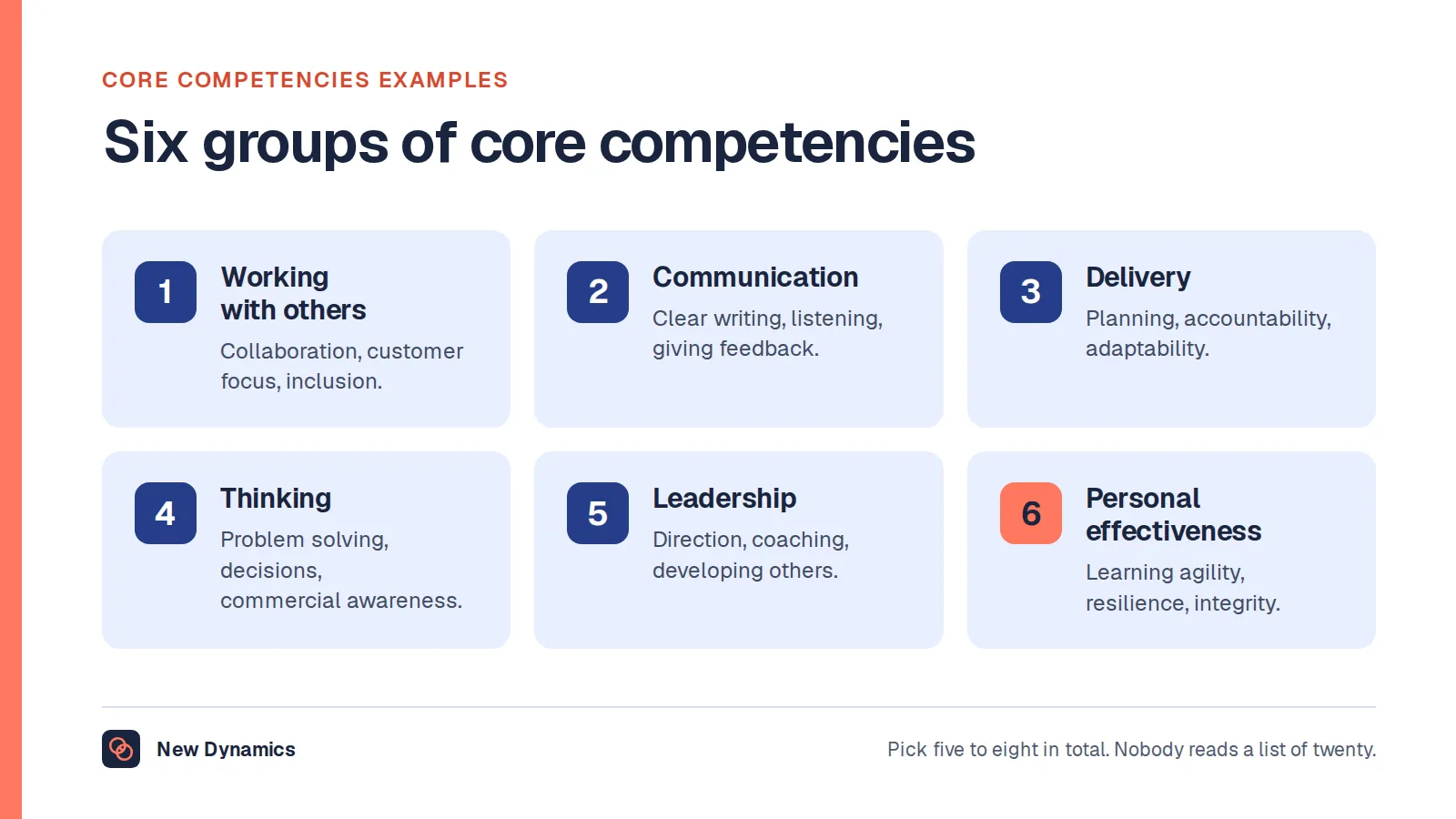
Employers often call them competencies or behaviours. Our guide to core competencies shows how organisations define them.

Which soft skills should you put on your CV?
Start with the job advert. The UK's National Careers Service, in its guide to how to write a CV, advises: “You should tailor your CV to the job or opportunity you're applying for.” It suggests looking at the job description and essential criteria, and adds: “you could highlight skills you have that they have asked for. This can improve your chances of getting an interview.”
So work through these steps.
- Highlight every soft skill in the advert. Look for words such as communicate, collaborate, organise, prioritise, lead, adapt and resolve.
- Choose the five or six that matter most, judging by how often and how early they appear.
- Match each to a real example from work, study, volunteering or another part of your life.
- Use the employer's words. If the advert says “stakeholder management”, do not write “people skills”.
- Drop what you cannot prove. A shorter list with evidence beats a longer one without.
30 soft skills for a CV, with proof lines
Each skill comes with an example line. The details are illustrative. Replace them with your own facts, and never claim a result that you cannot discuss at interview.
Communication
- Written communication: Rewrote 40 help articles in plain English, and repeat contacts on those topics fell by a fifth.
- Presenting: Presented monthly results to a leadership team of twelve, and was asked to repeat the session for the board.
- Listening: Interviewed 15 customers about onboarding, and turned their comments into three changes that the product team adopted.
- Explaining complex ideas: Trained 30 non-technical colleagues to use the new reporting tool, with no support tickets in the first month.
- Negotiation: Renegotiated two supplier contracts, saving £18,000 a year while keeping service levels.
- Giving feedback: Introduced fortnightly peer reviews in a team of six, which halved the errors reaching customers.
- Languages and cross-cultural communication: Handled accounts in English and Spanish across four countries.
Teamwork and collaboration
- Teamwork: Worked with finance and sales to fix invoicing errors, and cut disputed invoices by half.
- Building relationships: Built a network of 20 referral partners from scratch, which now supplies a quarter of new business.
- Supporting colleagues: Covered a colleague's accounts for six weeks alongside my own, with no complaints or missed deadlines.
- Inclusion: Set up a buddy scheme for new starters that every new joiner has used since.
- Managing conflict: Mediated a dispute between two shift teams, and agreed a handover routine that both still use.
- Customer focus: Kept a satisfaction score of 4.7 out of 5 across more than 300 surveyed contacts.
Problem solving and creativity
- Problem solving: Traced recurring stock errors to a unit-of-measure mismatch and fixed it at source.
- Analytical thinking: Analysed two years of returns data, and identified a packaging fault behind a third of claims.
- Creativity: Proposed and tested a simpler sign-up flow, which raised completion from 58% to 74%.
- Decision-making: Chose and introduced a new scheduling tool within budget, and had the whole team using it in three weeks.
- Initiative: Noticed that new customers were dropping out at setup, and wrote the checklist that is now standard.
- Attention to detail: Checked and corrected 1,200 product records before a system migration, with no errors reported afterwards.
Self-management
- Time management: Met every reporting deadline for two years while studying part time for a professional qualification.
- Planning and organising: Planned an office move for 60 people, finished on time and 5% under budget.
- Adaptability: Moved from retail to a support role during a restructure, and was fully productive within a month.
- Resilience: Kept the service running through a three-month staff shortage, while holding response times within target.
- Learning quickly: Taught myself SQL in three months, and now produce the team's weekly reports.
- Reliability: Trusted to open and close the branch alone within six months of joining.
- Working independently: Managed a remote territory of 80 accounts with a monthly check-in.
Leadership
- Leading a team: Led a team of eight through a system change, with no loss of service and two internal promotions.
- Coaching and mentoring: Mentored three apprentices, all of whom completed their qualifications and stayed with the company.
- Delegation: Handed the weekly report to a junior colleague, and coached them until it needed no review.
- Leading without authority: Coordinated a cross-department project of twelve people, none of whom reported to me.
You do not need a management title to show leadership. See our guide to boss vs leader.

Where to put soft skills on your CV
The National Careers Service says that a CV should include contact details, an introduction, education history, work history and references. Soft skills belong in three of those places.
Your introduction, or profile. Use two or three lines that combine who you are, your strongest relevant skills and your evidence. For example: “Customer support team leader with five years' experience. Known for calm problem solving and clear writing. Cut first-response time by half while raising satisfaction to 4.6 out of 5.”
Your work history. This is where the proof lives. The National Careers Service suggests describing what you did in “2 to 3 lines using the STAR method”: situation, task, action and result. Begin each line with a verb, and end with the result.
A short skills section. List five or six skills using the employer's words, each with a phrase of evidence. For example: “Stakeholder management: monthly reporting to five directors.” Avoid a bare list of adjectives.
You can also show soft skills in education, volunteering and interests, especially early in your career. The National Careers Service notes that if you are applying for your first job, you can focus on skills you have learned through projects, work experience or volunteering.
How to prove a soft skill: the formula
Use this pattern for every line.
Action verb + what you did + how + result
| Weak | Strong |
|---|---|
| Excellent communicator | Wrote the weekly customer update, read by 2,000 subscribers, with a 45% open rate |
| Team player | Worked with finance and sales to cut disputed invoices by half |
| Good at solving problems | Traced stock errors to a data fault and fixed it at source |
| Strong leadership skills | Led a team of eight through a system change, with no loss of service |
| Highly organised | Planned an office move for 60 people, on time and under budget |
If you do not have a number, use scope (how many people, how often), a comparison (before and after) or recognition (an award, a promotion or a quoted comment).
Soft skills for a CV with no experience
Everyone has evidence. Look in these places.
- Study: group projects, presentations, deadlines met alongside a job.
- Part-time and casual work: dealing with customers, handling cash, turning up reliably.
- Volunteering and clubs: organising events, coaching, committees, fundraising.
- Caring and family responsibilities: planning, negotiating, staying calm under pressure.
- Personal projects: a blog, a small online shop, a repair, a language learned.
Example: “Captained a university hockey team of 16: organised training and travel, and managed a £2,000 budget.” That one line shows leadership, planning and reliability.
Common mistakes
A list of adjectives. “Motivated, flexible, dynamic” could describe anyone. Give evidence or leave it out.
Too many skills. Fifteen soft skills look like padding. Choose the five or six that the job needs.
The same CV for every job. Tailor each application to the advert, as the National Careers Service advises.
Clichés. “Thinks outside the box”, “works well alone and in a team” and “perfectionist” use space without adding anything.
Claims that you cannot support. Anything on your CV may come up at interview. Our manager interview questions show the kind of probing to expect.
Forgetting hard skills. Soft skills support your technical abilities. They do not replace them.

Frequently asked questions
What are the best soft skills to put on a CV?
The best are the ones in the job advert that you can prove. Common requests include communication, teamwork, problem solving, planning and organising, adaptability and leadership. Choose five or six, and show each through an achievement.
How do I list soft skills on a resume?
Put the evidence in your work history, using lines that start with a verb and end with a result. Add two or three lines in your profile, and a short skills section of five or six skills in the employer's words, each with a phrase of proof.
What is the difference between soft skills and hard skills?
Hard skills are technical abilities tied to particular work, such as accounting, coding or driving a forklift. Soft skills are the ways you work with people, problems and yourself, such as listening, teamwork and planning. Employers usually want both.
How many soft skills should I put on my CV?
Five or six is plenty. A short list that matches the advert and is backed by evidence is more convincing than a long list of adjectives. Your work history can show others without naming them.
What soft skills can I put on a CV with no work experience?
Use evidence from study, part-time work, volunteering, sport, caring responsibilities and personal projects. Teamwork, reliability, planning, communication and learning quickly can all be shown through those experiences.
Should I have a separate skills section for soft skills?
A short one is useful, because readers often scan for key words. Keep it to five or six skills, use the wording from the advert and add a few words of evidence to each. The main proof should still sit in your work history.
Your next step: rewrite three lines
- Find a job advert that you like, and highlight the soft skills it asks for.
- Choose three, and write one proof line for each using the formula.
- Replace three adjectives on your current CV with those lines.
- Ask someone else to read it, and to tell you which skills they see.
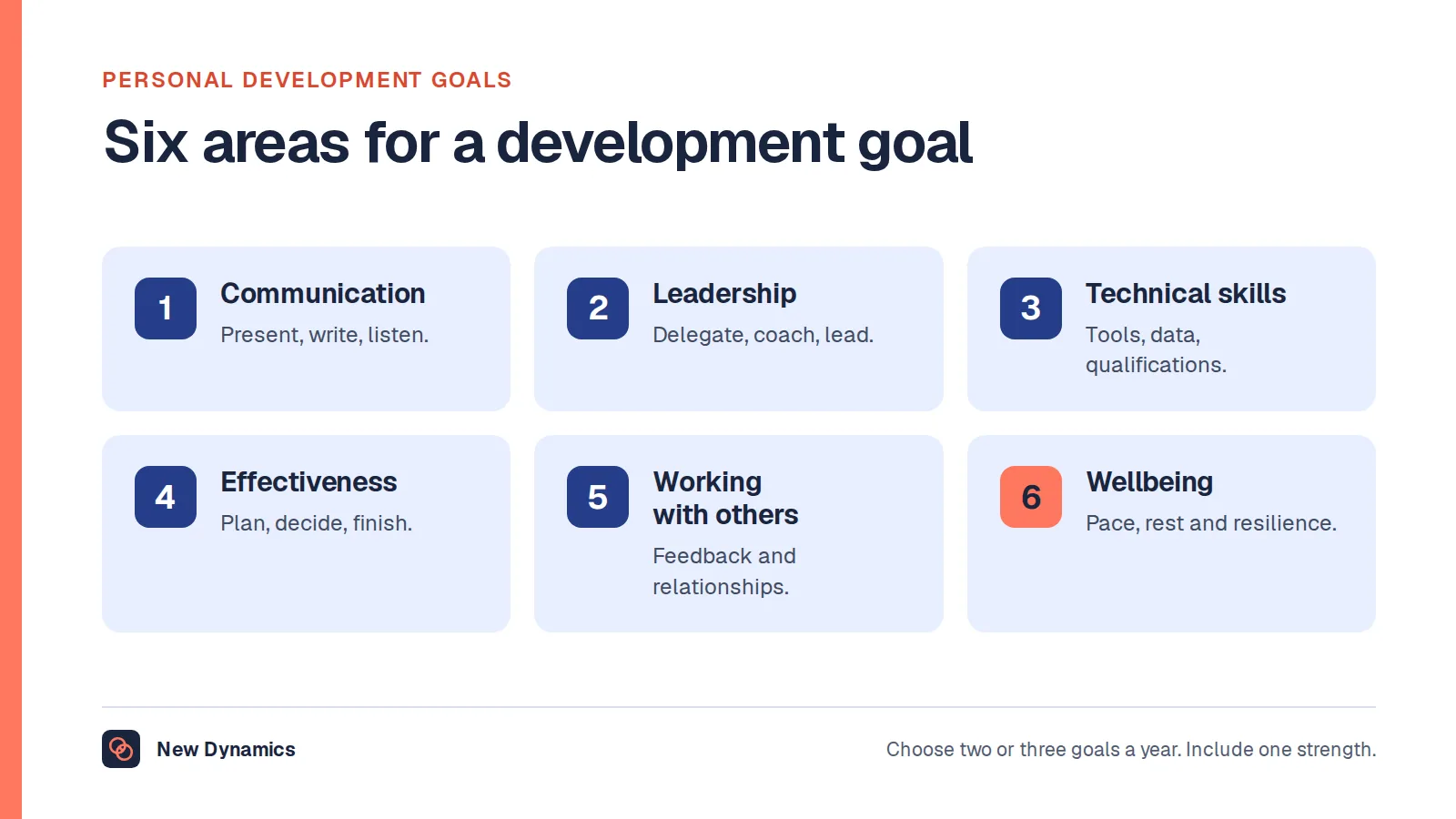
Want to plan how to build the skills you cannot yet prove? Read and download our career development guide. The guide is free to read, and the PDF uses our short download form. Our personal development goals examples can help too.
Do you lead a team and want skills to grow through regular feedback and clear goals? Book a New Dynamics demo and bring your current approach. You can also email contact@new-dynamics.com.