TL;DR
- A KPI is a measure you watch all the time to see whether something important is healthy. An OKR is a time-limited goal: an objective plus key results that show progress towards a change.
- KPIs tell you where you are. OKRs say where you want to get to this quarter. A KPI that is off track is often the reason to write an OKR.
- Use both. Keep a small set of KPIs for the ongoing health of each team, and three to five OKRs for the changes that matter most right now.
Teams often argue about whether they should use OKRs or KPIs, as if they had to choose. They do different jobs. One is a gauge on the dashboard. The other is the journey you have decided to make.
This article explains OKR vs KPI in plain English: what each one is, the differences that matter, examples from several teams and a simple way to use both together.
If you want objectives, key results and progress check-ins in one shared place, explore New Dynamics Goals & OKRs.
What is a KPI?
A KPI, or key performance indicator, is a measure you track continuously because it tells you whether something important is healthy. Revenue, customer retention, on-time delivery and staff turnover are common examples.
A KPI has no end date. You watch it month after month, usually against a threshold or target range. When it moves the wrong way, you investigate.
Good KPIs are few. The GOV.UK Service Manual advises teams to choose three or four metrics that answer the question “is this service working?”. Our success indicator examples list 40 measures by team and explain how to pick them.
What is an OKR?
An OKR is an objective plus a small number of key results.
- The objective says what you want to achieve, in words. It should be clear and motivating.
- The key results say how you will know. They are measurable outcomes with a deadline, usually a quarter.
Google's guide to setting goals with OKRs puts it this way: “Objectives are ambitious and may feel somewhat uncomfortable”, while “Key results are measurable and should be easy to grade with a number”.
An OKR is temporary by design. It describes a change you want to make in a set period. When the period ends, you grade it, learn from it and write new ones.

OKR vs KPI: the key differences
| Question | KPI | OKR |
|---|---|---|
| What is it? | An ongoing measure of health | A time-limited goal with measurable results |
| What is it for? | Monitoring. Are we on track? | Change. What are we trying to improve? |
| How long does it last? | Indefinitely | Usually a quarter, sometimes a year |
| How ambitious is it? | Realistic. You expect to stay in range | Stretching. Falling a little short can still be a success |
| How many? | A handful per team | Three to five objectives, each with about three key results |
| Who sets it? | Usually leaders and analysts | A mix of top-down priorities and team proposals |
| What does “red” mean? | Something is wrong. Investigate | The goal was hard, or the plan needs to change |
| Typical form | A number with a threshold | A sentence, plus two to four numbers with a deadline |
The guidance on numbers comes from Google's guide, which recommends “three to five objectives with about three key results for each objective” and warns that more can lead to over-extended teams.
Ambition is the big difference
With a KPI, you want green. If on-time delivery is at 96% against a 95% threshold, all is well.
With an OKR, constant green is a warning sign. Google's guide says the sweet spot for an OKR grade is 60% to 70%, and adds: “if someone consistently fully attains their objectives, their OKRs aren't ambitious enough”. That only works if people are not punished for aiming high and landing slightly short.
How OKRs and KPIs work together
The two connect in a simple loop.
- KPIs show where you are. Customer retention has slipped from 90% to 86%.
- A KPI problem prompts an OKR. The team writes an objective to fix it this quarter.
- Key results may include the KPI itself, alongside measures of the changes you are making.
- When the OKR ends, the KPI carries on. You keep watching retention after the push is over.
So a KPI can appear inside an OKR as a key result. The difference is what you are doing with the number. As a KPI, you are monitoring it. As a key result, you have committed to moving it by a certain amount by a certain date.

OKR and KPI examples
The figures are illustrative. Measure your own baseline first.
Customer service
- KPIs: median time to first response, customer satisfaction after contact, reopened ticket rate.
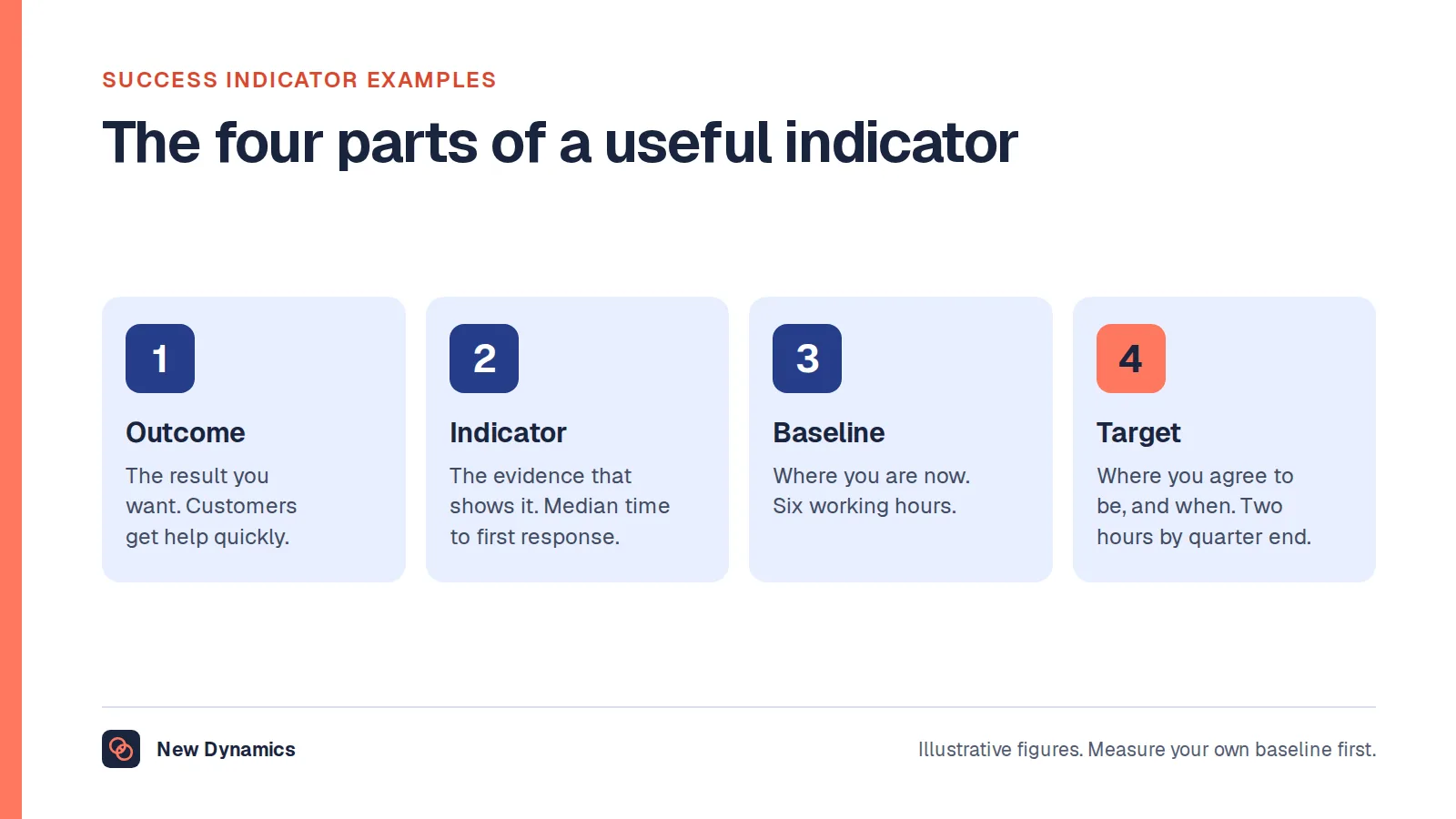
- OKR: Objective: make it effortless for customers to get help. Key results: cut median first response from six working hours to two. Raise satisfaction from 4.2 to 4.5 out of 5. Keep reopened tickets at or below 5%.
Sales
- KPIs: monthly revenue, win rate on qualified opportunities, pipeline coverage.
- OKR: Objective: break into the healthcare sector. Key results: hold first meetings with 30 healthcare organisations. Win five new healthcare customers. Publish two healthcare case studies with customer approval.
Product and engineering
- KPIs: service availability, escaped defects, time to restore service.
- OKR: Objective: make onboarding so simple that new customers need no help. Key results: raise the share of customers who complete setup unaided from 40% to 70%. Cut setup support tickets by half. Reduce average setup time from three days to one.
HR and People
- KPIs: time to fill priority roles, retention of new starters at six months, completion of regular one-to-ones.
- OKR: Objective: give every new starter a great first 90 days. Key results: every new starter has a 30-60-90 day plan by day five. Six-month retention rises from 82% to 90%. Nine in ten new starters say they knew what was expected of them.
Finance
- KPIs: days to close the month, days sales outstanding, forecast accuracy.
- OKR: Objective: give budget holders numbers they can act on sooner. Key results: close the month in five working days, down from nine. Deliver dashboards to all budget holders by day six. Budget holders rate usefulness at four out of five or higher.
Notice the pattern. The KPIs would look much the same next year. The OKRs would not.
For more, see our OKR examples library.
When to use a KPI, and when to use an OKR
Use a KPI when:
- the thing matters permanently, such as safety, revenue or service levels;
- you mainly need to know whether it is in a healthy range;
- no special effort is planned, and you simply need to keep watch.
Use an OKR when:
- you want to change something, such as enter a market, fix a weak process or launch a product;
- the work cuts across teams and needs a shared focus;
- you are willing to stretch, and to learn from falling short.
If a team has only KPIs, it keeps the lights on and improves little. If it has only OKRs, it may chase new things while the basics quietly decay.
Should OKRs and KPIs affect pay and reviews?
Treat the two differently.
KPIs describe the ongoing health of a role or a team, and they can reasonably inform a performance review, with context. Guard against gaming by pairing each number with a quality safeguard.
OKRs are meant to be ambitious. Google's guide is explicit that “OKRs are not synonymous with employee evaluations”. If an OKR score feeds straight into a rating or a bonus, people will set safe goals and the point is lost. In a review, discuss what the person attempted, what they achieved and what they learned, and use the grades as context. See performance reviews: the good, the bad and the ugly.
Common mistakes
Renaming KPIs as OKRs. “Maintain 99.9% availability” is a KPI. Writing it under the heading “objective” changes nothing.
Key results that are tasks. “Launch the new help centre” is an activity. “Cut setup tickets by half” is a result.
Too many of either. Twenty KPIs and ten objectives mean no focus. Keep a handful of each.
No baseline. “Raise satisfaction to 4.5” means little if nobody knows where it is today.
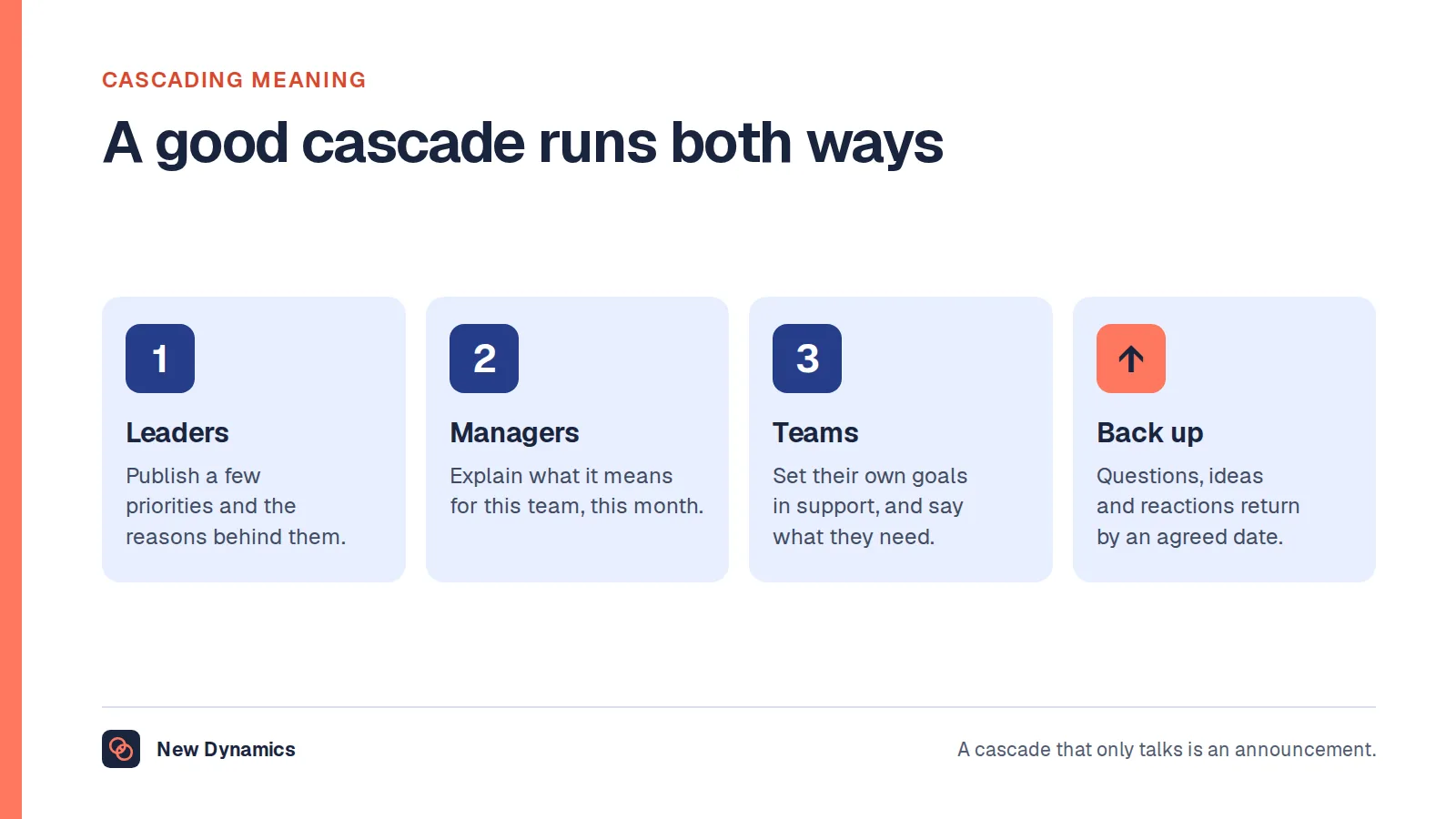
Setting OKRs only from the top. Google's guide says successful OKRs often come from a mix of top-down and bottom-up suggestions. We cover this in how to cascade goals at work.
Set and forget. Check OKRs every week or fortnight, and KPIs on their natural rhythm. A goal reviewed only at the end of the quarter was never really a goal.

Frequently asked questions
What is the difference between an OKR and a KPI?
A KPI is an ongoing measure that shows whether something important is healthy, such as customer retention. An OKR is a time-limited goal made of an objective and measurable key results, used to drive a specific change. KPIs monitor. OKRs improve.
Can a KPI be a key result?
Yes. If a KPI is off track, you can make it a key result by committing to move it from a baseline to a target by a date. For example, “raise six-month retention from 82% to 90% this quarter”. After the OKR ends, you keep tracking it as a KPI.
Are OKRs better than KPIs?
Neither is better. They do different jobs. KPIs keep watch on the ongoing health of the business. OKRs focus effort on the few changes that matter most now. Most organisations benefit from a small set of each.
How many OKRs and KPIs should a team have?
Google's guide recommends three to five objectives with about three key results each. For KPIs, three or four per team is usually enough to answer whether the work is going well. More than that spreads attention thin.
Should OKRs be linked to bonuses?
It is usually better not to link them directly. OKRs are meant to be ambitious, and a typical good score is around 60% to 70%. If scores drive pay, people set safe goals. Use OKR results as context in a wider performance conversation.
What comes first, KPIs or OKRs?
KPIs usually come first. You need to know how the business is doing before you decide what to change. Once a small set of KPIs is in place, use them to spot the biggest gaps and opportunities, then write OKRs to address them.
Your next step: sort your current measures
- List every number your team reports today.
- Mark each one as a KPI (watch it) or a key result (move it this quarter).
- Cut the KPIs to the few that answer “is this working?”.
- Write one objective for the biggest gap, with two or three key results.
For a method and a worksheet, read and download our OKR guide. The guide is free to read, and the PDF uses our short download form.
Want objectives, key results and check-ins connected to feedback and reviews? Book a New Dynamics demo and bring your current goals. You can also email contact@new-dynamics.com.