TL;DR
- A 30-60-90 day plan sets out what a person will learn, deliver and improve in their first three months. The usual pattern is learn in the first 30 days, contribute by day 60 and lead by day 90.
- Keep it to one page: two or three goals per phase, the evidence that will show progress, the support needed and a review date. The plan belongs to the employee and the manager together.
- Review it at 30, 60 and 90 days, keep a shared record and change it when reality changes. Nothing at the end of probation should come as a surprise.
The first three months in a job decide a great deal. A new colleague either finds their feet, builds relationships and starts to contribute, or they drift, guessing at what is expected. A 30-60-90 day plan is a simple way to make the first outcome more likely.
This article explains what the plan is, gives you a template to copy and offers three worked examples: a new employee, a new manager and a candidate preparing for an interview. It also covers how managers should review the plan.
A plan works best when it sits beside the tasks and conversations of onboarding. See how New Dynamics onboarding brings tasks, early goals and manager conversations into a clear path for a new employee.
What is a 30-60-90 day plan?
A 30-60-90 day plan is a short document that sets out what a person will focus on during their first 30, 60 and 90 days in a role. Each phase has a theme:
- Days 1 to 30: learn. Understand the organisation, the role, the people and the tools.
- Days 31 to 60: contribute. Take on real work with support, and deliver some early results.
- Days 61 to 90: lead. Work independently, improve something and plan what comes next.
The same structure suits a new starter, someone promoted into management or a person moving to a new team. Some people also prepare one for a job interview, to show how they would approach the role.

Why the first 90 days deserve a plan
The CIPD describes induction as an opportunity for an organisation to welcome a new recruit, help them settle in and ensure they have the knowledge and support they need to perform their role. It adds that effective induction “may also positively affect employee turnover, absenteeism and employer brand”, in its induction factsheet.
Acas gives practical advice in Planning an induction programme. It says employers should plan a worker's induction before they start, and tailor it to the person: “someone starting their first job might need a more detailed induction than someone with experience”. It also warns against overload: “Avoid giving too much information on the first day. This could be overwhelming.”
A 30-60-90 day plan puts that advice on one page. It spreads learning over weeks, names the support on offer and gives both people something concrete to review.
The three phases explained
Days 1 to 30: learn
The aim is understanding. Output comes later. A new colleague should finish the first month knowing how the organisation works, what their role is for, who they depend on and what good looks like.
Typical goals:
- complete required training and gain access to systems;
- meet the ten people most important to the role;
- shadow the core processes and write down questions;
- agree what success looks like at 60 and 90 days.
Days 31 to 60: contribute
Now the person takes on real work, with a safety net. They should deliver something useful and start to form their own view of what could be better.
Typical goals:
- own a defined piece of work from start to finish;
- handle routine tasks without step-by-step guidance;
- ask for feedback from two colleagues, and act on it;
- identify one process that could be improved.
Days 61 to 90: lead
By the third month the person should work independently at the expected standard, and begin to add something of their own.
Typical goals:
- meet the normal expectations for the role;
- deliver one improvement, however small;
- agree longer-term goals and a development plan;
- give feedback on the onboarding experience itself.
30-60-90 day plan template
Copy this structure. One page is enough.
| Phase | Focus | Goals (two or three) | Evidence of progress | Support needed | Review date |
|---|---|---|---|---|---|
| Days 1 to 30 | Learn | What I will understand and complete | Training done, people met, notes | Buddy, access, time with manager | Day 30 |
| Days 31 to 60 | Contribute | What I will deliver with support | Work completed, feedback received | Coaching, clear priorities | Day 60 |
| Days 61 to 90 | Lead | What I will own and improve | Standard met, improvement delivered | Stretch task, development conversation | Day 90 |
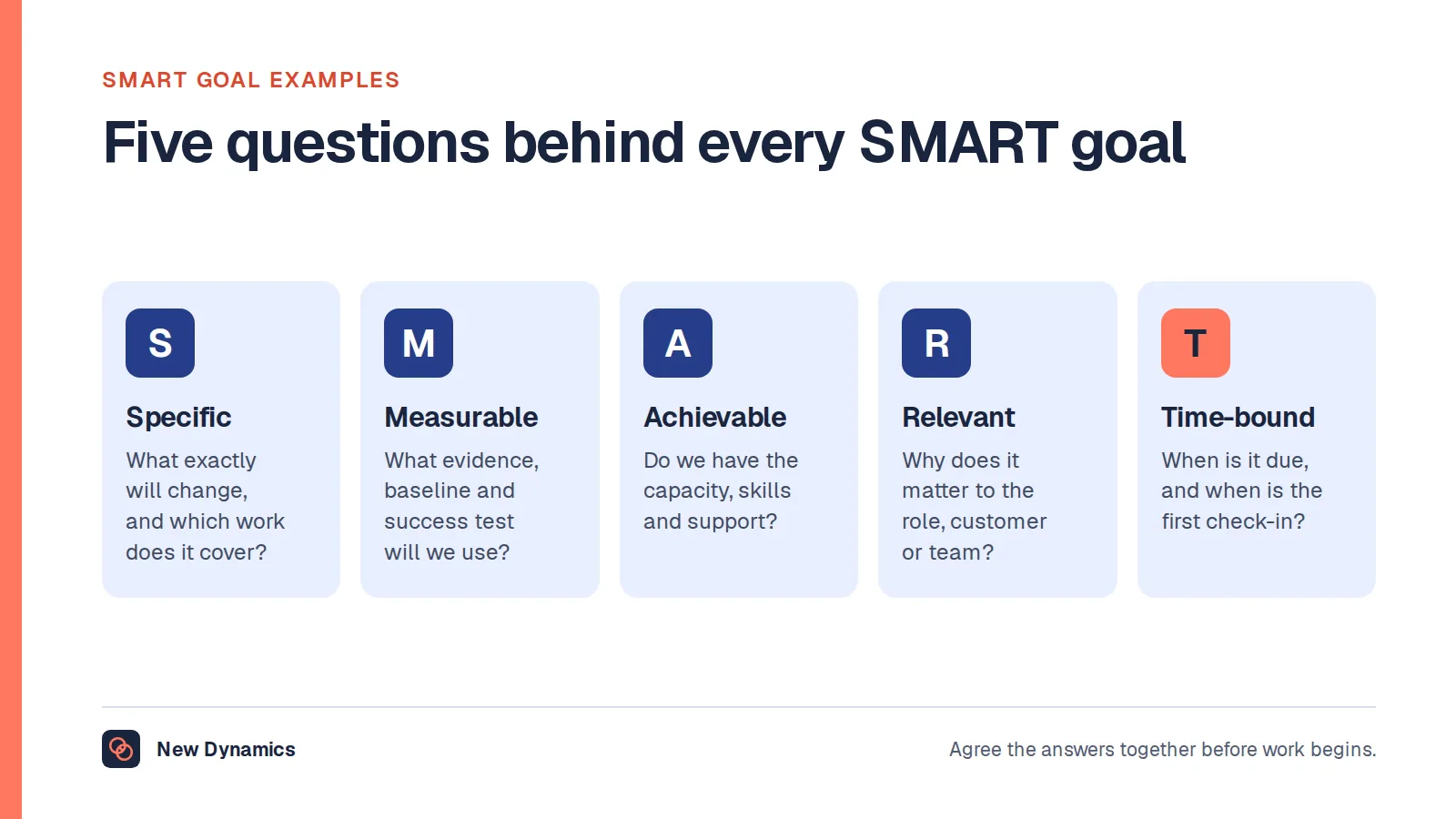
Write goals that are specific and checkable. Our 50 SMART goal examples show the wording, and success indicator examples will help you choose the evidence.
Example: a new customer support specialist
Days 1 to 30. Complete product and systems training. Shadow ten customer conversations and note common questions. Meet the support, product and billing teams. Answer simple tickets with a buddy checking each reply.
Days 31 to 60. Handle routine tickets independently, with a weekly sample reviewed by the team leader. Reach the team's normal quality standard on those samples. Write or improve two help articles based on questions that keep coming up.
Days 61 to 90. Take a full share of the queue, including some complex cases. Suggest one improvement to a reply template or process, and test it. Agree goals for the next quarter.
Evidence: training record, reviewed ticket samples, the two articles and the team leader's notes from each review.
Example: a new manager
A manager's first plan should be mostly about people. The urge to change things can wait.
Days 1 to 30. Hold a one-to-one with every team member and ask the same questions: what is working, what is not, what should I know? Meet key stakeholders. Understand current goals, budgets and commitments. Make no major changes.
Days 31 to 60. Share what you heard with the team and agree two or three priorities together. Set a regular rhythm of one-to-ones and team meetings. Fix one irritation that the team raised, to show that you listened.
Days 61 to 90. Agree goals with each person. Give everyone some specific feedback. Present a short plan for the next six months to your own manager.
Our one-to-one meeting guide has the questions, and characteristics of a great leader covers the behaviours that matter most.
Example: a 30-60-90 day plan for an interview
Some employers ask candidates to present one. Others welcome it when you offer. Keep it humble, because you do not yet know the organisation.
- Base it on what you know: the job description, the company's public information and what you heard in earlier interviews.
- Make the first 30 days about listening. Name who you would want to meet and what you would want to learn.
- Show how you would find early wins, and avoid promising specific results you cannot know are achievable.
- State your assumptions, and say you would revise the plan after your first weeks.
- Keep it to one page or three slides.
A good interview plan shows how you think. Nobody expects it to predict the future.

How managers should review the plan
The plan is only useful if it is discussed. Acas advises managers to talk with a new worker regularly, listen to them, answer their questions and give them regular feedback.
Where there is a probation period, Acas guidance on probation reviews says reviews should check progress and performance and also “discuss the employee's wellbeing and how they're feeling in their role”. It asks managers to keep records of probation reviews and to share them with the employee after each meeting. Most importantly, “the outcome of probation should not come as a surprise to the employee”.
A simple review rhythm:
- End of week one: how is it going, and what is confusing?
- Day 30: what have you learned, and what should we change in the plan?
- Day 60: what have you delivered, and what feedback have you had?
- Day 90: are you meeting the standard, and what are your goals for the next six months?
Keep a short shared note after each conversation. It protects both of you, and it gives the first formal review something to build on. See performance reviews: the good, the bad and the ugly.

Common mistakes with 30-60-90 day plans
Too much in the first 30 days. New starters who are given targets before they understand the job tend to make avoidable mistakes.
Goals that cannot be checked. “Get up to speed” means nothing. “Handle routine tickets independently” can be observed.
Written by the manager alone. The plan works better when the new colleague helps to write it, from the second week onwards.
One plan for everyone. A graduate and an experienced hire need different plans. Acas's advice to tailor induction applies here too.
Never revised. If priorities change in week five, change the plan, and write down why.
Forgotten after day 90. The final review should flow into normal goals and development conversations. Our employee onboarding guide and 90-day onboarding checklist show how.
Frequently asked questions
What is a 30-60-90 day plan?
A 30-60-90 day plan is a short document that sets out what a person will learn, deliver and improve in their first 30, 60 and 90 days in a role. It is used for new employees, new managers and internal moves, and sometimes in job interviews.
What should a 30-60-90 day plan include?
Include two or three goals for each phase, the evidence that will show progress, the support the person needs and the date of each review. The usual themes are learn in the first 30 days, contribute by day 60 and lead by day 90.
What is the 30-60-90 rule at work?
At work, the 30-60-90 rule is the idea that a new role should be approached in three monthly stages: first learn, then contribute, then lead. It guards against expecting full performance too early and against leaving new starters without direction.
How do I write a 30-60-90 day plan for an interview?
Base it on the job description and what you have learned about the employer. Make the first 30 days about listening and learning, show how you would look for early wins, state your assumptions and keep it to one page or three slides.
Is a 30 day plan enough?
A 30 day plan helps with the first month, but most roles take longer to learn. Extending it to 60 and 90 days covers the move from learning to independent work, which is where new starters most need clear expectations and feedback.
Who should write the 30-60-90 day plan?
The manager should draft the outline before the person starts, because they know the role's priorities. The new colleague should then help to complete and adjust it during the first weeks. A plan written together is more realistic and more likely to be used.
Your next step: draft the plan before day one
- Write two or three goals for each phase of the next role you are hiring for.
- Add the evidence and the support for each goal.
- Put the four review conversations in the diary now.
- In week two, revise the plan with your new colleague.
For a fuller approach to the first months, read and download our employee onboarding guide. The guide is free to read, and the PDF uses our short download form.
Want onboarding tasks, early goals and check-ins in one place? Book a New Dynamics demo and bring your current onboarding plan. You can also email contact@new-dynamics.com.