TL;DR
- To cascade something at work means to pass it down through the organisation level by level, from senior leaders to managers to teams. The word usually applies to goals or to information.
- Cascading goals gives everyone a line of sight to the organisation's priorities. Done rigidly, it is slow and leaves no room for ideas from the people closest to the work.
- A good cascade runs in both directions. Share the top priorities openly, let teams set their own goals in support of them, check understanding and carry questions back up.
“We'll cascade this to the teams next week.” If you have sat in a management meeting, you have heard the word. It sounds tidy. In practice, a cascade is where many good strategies and important messages quietly lose their meaning.
This article explains the cascading meaning in a workplace context, shows how to cascade goals and information well, and sets out where cascades go wrong and what to do instead.
If you want every team's goals visibly connected to the organisation's priorities, explore New Dynamics Goals & OKRs.
What does cascade mean?
In everyday English, a cascade is a waterfall that drops in stages, one pool spilling into the next. At work, to cascade something means to pass it down through the organisation level by level: from senior leaders to managers, and from managers to their teams.
Two things are usually cascaded:
- Goals. The organisation's objectives are translated into objectives for divisions, teams and individuals.
- Information. Decisions, news and changes are briefed from the top down through line managers.
When someone asks “what is cascaded?”, the answer is whatever leaders want everyone to understand or act on. The method is the same in both cases, and so are the risks.

Cascading goals: what it means
Cascading goals is the practice of starting with the organisation's objectives and working downwards, so that each level's goals support the level above.
A simple example:
| Level | Goal |
|---|---|
| Organisation | Keep more of our customers, raising annual retention from 85% to 90% |
| Customer service | Resolve routine issues faster without losing quality |
| Team | Cut median resolution time from two working days to one and a half |
| Individual | Build a reply template library for the ten most common questions |
The figures are illustrative. Read from the bottom up, each goal answers the question “why does this matter?” by pointing to the one above it.
The purpose is line of sight. The CIPD performance management factsheet says managers should help employees “see the connections between organisational and individual objectives”. A cascade is one way to make those connections explicit.
Where cascading goals goes wrong
A strict, top-down cascade has well-known problems.
It is slow. If each level waits for the level above to finish, front-line teams may receive their goals weeks into the period.
It dilutes meaning. Every translation loses something. By the fourth layer, a goal about customer retention can arrive as “answer more tickets”.
It ignores what teams know. The people closest to customers and processes often see problems and opportunities that leaders cannot. A pure cascade gives them nowhere to put that knowledge.
It assumes a tidy hierarchy. Many people work across teams or report to more than one manager. Their goals do not fit neatly under one box on the chart.
It encourages copying. Under time pressure, managers paste the goal above and change a word. The result is alignment on paper only.
A better approach: align instead of copy
Many organisations now talk about aligning goals. The difference is direction. Leaders set and publish a small number of priorities. Teams then propose their own goals in support of them, and managers check the fit.
Google's guide to setting goals with OKRs describes this well. It says successful OKRs “can often come from a mix of top-down and bottom-up suggestions”, and that it can help to commit first to organisational objectives “so that teams and individuals can set their own objectives in service of those larger goals”. It also recommends that OKRs “should be public within an organization so that every employee knows the organizational objectives and metrics for success”.
In practice:
- Publish the top priorities early, in plain language, with the reasons behind them.
- Ask each team what it can contribute, and what it needs from others.
- Check the connection. For each team goal, ask which organisational priority it supports. A goal with no answer deserves a second look.
- Leave room for local goals. Some valuable work, such as fixing a broken process, will not map to the strategy. That is fine.
- Make goals visible across teams, so that dependencies and duplicates show up.
- Review together. Revisit the connections each quarter as priorities move.
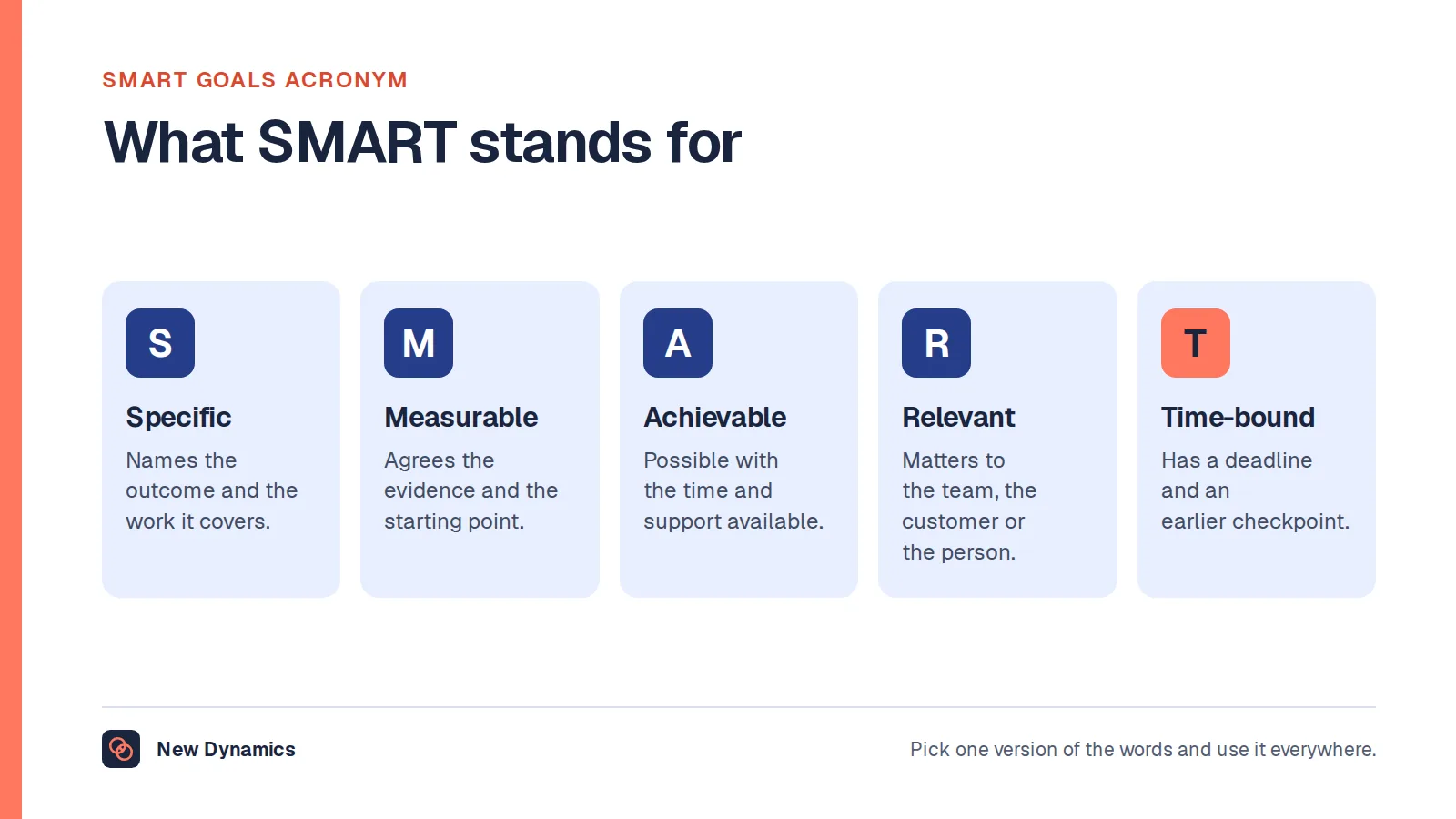
Our OKR guide explains the method, and what the SMART goals acronym stands for will help with the wording. For the measures, see our success indicator examples.

Cascading information: what it means
Cascading information means passing a message down the management line, so that every employee hears it from their own manager. It is sometimes called a team briefing.
The approach has real strengths. People often pay more attention to their own manager than to an all-staff email. The manager can explain what the news means for this particular team, and can answer questions on the spot.
It has real weaknesses too:
- Speed varies. One team hears on Monday, another on Friday, and the rumour gets there first.
- The message changes. Each person retells it in their own words, with their own emphasis.
- Some managers skip it. A cascade is only as strong as its least diligent link.
- It can be one-way. If nothing flows back up, leaders never learn how the message landed.
That last point matters most. Acas, in its guidance on consultation, defines consultation as when an employer “talks and listens about organisational issues and changes”. It notes that employees are more likely to support a change if they believe their employer has genuinely considered their views. A cascade that only talks is an announcement.
How to cascade information well
- Write a short core brief. One page covering what is happening, why, what it means for people and what happens next. Everyone should receive the same facts.
- Brief the managers first, and let them ask their own questions. They cannot explain what they do not understand.
- Set a time window. For example, every team should be briefed within 48 hours. For sensitive news, brief everyone on the same day.
- Ask managers to add the local meaning. What does this change for our team, this month?
- Collect questions and reactions, and send them back up by an agreed date.
- Publish answers to the common questions for everyone.
- Check that it arrived. Ask a few people in different teams what they heard. The gaps will tell you where the cascade leaks.
Use more than one channel for important messages. A written note, the manager's briefing and an open question session reinforce each other.

When not to cascade
Cascading is the wrong tool in some situations.
- Urgent safety or security information. Tell everyone directly and at once.
- News that affects people's jobs. Those affected should hear it first, in person, from someone who can answer their questions. Legal duties to inform and consult may apply, so take advice.
- Simple factual updates. A change to the expenses system does not need four layers of briefing.
- Questions that need debate. If you want views before deciding, consult. Do not cascade a decision that has not been made.
Frequently asked questions
What does cascade mean at work?
At work, to cascade means to pass something down through the organisation level by level, from senior leaders to managers to teams. It usually refers to goals, which are translated into team and individual objectives, or to information, which is briefed by line managers.
What are cascading goals?
Cascading goals are objectives that start at the top of an organisation and are translated downwards, so that each level's goals support the level above. The aim is to give every employee a clear line of sight between their work and the organisation's priorities.
What is the difference between cascading and aligning goals?
Cascading works from the top down: each level receives goals derived from the level above. Aligning works in both directions: leaders publish priorities, and teams propose their own goals in support of them. Aligning is usually faster and makes better use of what teams know.
What does it mean to cascade information?
To cascade information is to pass a message down the management line, so that employees hear it from their own manager, often in a team briefing. It works best with a short written core brief, a time limit and a route for questions to travel back up.
What is cascaded in an organisation?
Most often strategy, goals, decisions, policy changes and organisational news. In each case, leaders want everyone to understand or act on the same message, and rely on managers to explain what it means for their own team.
What are the problems with cascading?
Cascades can be slow, and the message can change as each person retells it. Some managers skip the briefing. A strict top-down cascade also ignores what front-line teams know. Build in a way for questions, ideas and feedback to travel back up.
Your next step: test your last cascade
- Pick the last important goal or message that was cascaded in your organisation.
- Ask five people in different teams what they understood by it.
- Compare their answers with what leaders intended.
- Fix the weakest link: the brief, the timing, a manager's skills or the route back up.
For a method that connects goals across teams, read and download our OKR guide. The guide is free to read, and the PDF uses our short download form.
Want every team to see how its goals support the organisation's priorities? Book a New Dynamics demo and bring your current goal-setting process. You can also email contact@new-dynamics.com.