TL;DR
- A workplace engagement survey asks employees how they experience their work, manager and organisation, so that leaders can find and fix what gets in the way.
- Use the 40 sample questions as a bank. Pick 20 to 30, keep the wording plain, use one agreement scale and protect small groups from being identified.
- The survey is the easy part. Share the results quickly, choose two or three priorities, give each an owner and tell people what changed before you ask again.
Many organisations run an engagement survey. Fewer can name one thing that changed because of the last one. When people answer forty questions and hear nothing back, they learn that the survey is a ritual, and next year they either skip it or tell you what you want to hear.
This article shows how to run a workplace engagement survey that people trust. You will find 40 sample questions grouped by theme, practical design choices and a simple plan for turning results into action.
Surveys work best alongside everyday conversations. If you want feedback to flow between surveys as well, see how New Dynamics continuous feedback supports it.
What is a workplace engagement survey?
A workplace engagement survey is a structured set of questions that asks employees how they experience their work, their manager and the organisation. Its purpose is to help leaders find what helps people do their best work and what gets in the way.
Engagement itself needs a definition. The CIPD factsheet on employee engagement and motivation recommends one built on three elements:
- Vigour: energy, resilience and effort.
- Dedication: enthusiasm, inspiration and pride.
- Absorption: concentration and being engrossed in the work.
Notice that none of these is the same as happiness or satisfaction. A person can be content and coasting. An engaged person brings energy to the work and cares how it turns out.
What an engagement survey can and cannot tell you
The CIPD notes that employee surveys “give a representative view of experiences across the organisation”. That is their strength. Everyone is asked the same questions at the same time, so you can compare teams and track change.
The same factsheet warns that composite measures which combine questions into one overall engagement score “can oversimplify matters dramatically”. A single number going up or down tells you very little about what to do. It recommends measures that are clear and specific enough to be actionable.
So treat the survey as a map of where to look. The answers come from the conversations that follow.

How to design a workplace engagement survey
Decide what you will act on
Only ask about things you are willing to change. A question about pay, when pay cannot move this year, raises expectations that you will then disappoint.
Keep it short
Twenty to thirty questions is enough for a full survey, and five to ten for a regular pulse. Longer surveys tend to put people off and invite tired answers towards the end.
Use one scale
A five-point agreement scale, from strongly disagree to strongly agree, is familiar and easy to analyse. Keep the same scale throughout so that people do not have to relearn it.
Write questions people can answer
- One idea per question. “My manager is supportive and gives clear direction” is two questions.
- Plain words. Avoid internal jargon and abbreviations.
- No leading wording. “How much do you enjoy our great culture?” teaches people what to say.
- Ask about experience the person has directly. They can answer for their own team. They are guessing about other departments.
Protect confidentiality
Decide the smallest group for which you will show results, publish that number before the survey opens and keep to it. Be careful with combinations of filters, which can identify an individual even when each filter alone is safe. Tell people plainly who can see what.
Choose a rhythm you can sustain
A common pattern is one fuller survey a year with shorter pulses in between. Do not survey again until you have reported back on the last round. If you are choosing a tool to run it, our employee engagement software buyer's guide lists the questions to ask.
40 workplace engagement survey questions by theme
Use these as a bank. Each is written for a five-point agreement scale. Pick the ones that match what you are prepared to act on.
Purpose and pride
- I understand how my work contributes to the organisation's goals.
- I am proud of the work my team does.
- I would recommend this organisation as a place to work.
- I believe in what this organisation is trying to achieve.
- I can see myself working here in two years' time.
My work
- My priorities for the next few months are clear to me.
- I can get the tools and information my job needs without long delays.
- I have enough say in how I do my work.
- My job makes good use of my skills.
- Most days, I feel I have accomplished something worthwhile.
My manager
- My manager gives me useful feedback on my work.
- My manager cares about my wellbeing.
- I have regular one-to-one conversations with my manager.
- My manager helps me remove obstacles to my work.
- I trust my manager to treat people fairly.
Growth and development
- I have had a meaningful conversation about my development in the last six months.
- I have opportunities to learn new skills here.
- I can see a path for my career in this organisation.
- I am given work that stretches me.
- The feedback I receive helps me improve.
Recognition and fairness
- Good work in my team gets noticed.
- People here are rewarded according to their contribution.
- My last performance review was fair.
- Decisions about promotion are made fairly.
- I understand how my performance is assessed.
Voice and inclusion
- I feel safe to speak up when I disagree.
- My team listens to my ideas, even when we do not use them.
- I feel I belong in my team.
- People here are treated with respect, whatever their background.
- When I raise a problem, something happens as a result.
Wellbeing and workload
- My workload is manageable.
- I can take time off when I need it.
- I am able to switch off from work outside my working hours.
- I would feel comfortable telling my manager if I were struggling.
- The pace of work here is sustainable.
Leadership and change
- Senior leaders communicate a clear direction.
- I trust the decisions made by senior leaders.
- Changes that affect me are explained well.
- Senior leaders act in line with the organisation's stated values.
- I believe action will be taken as a result of this survey.
Question 40 is the most useful on the list. If agreement is low, fix that before anything else, because it shapes how honestly people answer everything else.
An example of an established engagement index
If you want a small, stable set to track over time, look at how large employers do it. The UK Civil Service People Survey calculates its engagement index from five statements, published in its technical guide:
- “I am proud when I tell others I am part of [my organisation]”
- “I would recommend [my organisation] as a great place to work”
- “I feel a strong personal attachment to [my organisation]”
- “[My organisation] inspires me to do the best in my job”
- “[My organisation] motivates me to help it achieve its objectives”
Each is answered on a five-point agreement scale. The design is worth copying in spirit: a few outcome questions that stay the same every year, surrounded by questions about the conditions that drive them.
Open-text questions worth asking
Two or three open questions add the detail that scores cannot:
- What is one thing that would make your work easier?
- What should we stop doing?
- What is the best thing about working here?
- What would make you more likely to stay?
- Is there anything else you would like us to know?
Read every comment. Group them into themes and share the themes. Never quote a comment in a way that could identify its author.

How to turn survey results into action
- Share results quickly. Aim to report headline results to everyone within a few weeks. Silence is read as bad news.
- Look for patterns. Compare teams, locations and length of service. A modest overall score often hides one or two teams with a serious problem.
- Choose two or three priorities. Trying to fix everything means fixing nothing. Pick the issues that matter most to people and that you can influence.
- Discuss results in teams. Give each manager their team's results, where the group is large enough, and a simple agenda: what do we recognise, what surprises us, what one thing shall we change?
- Give every action an owner and a date. Treat actions like any other goal. Our 50 SMART goal examples show how to word them.
- Tell people what changed. Use the phrase “you said, we did” and be honest about what you could not do, and why.
- Check progress before the next survey. A short pulse on the priority topics shows whether the change landed.
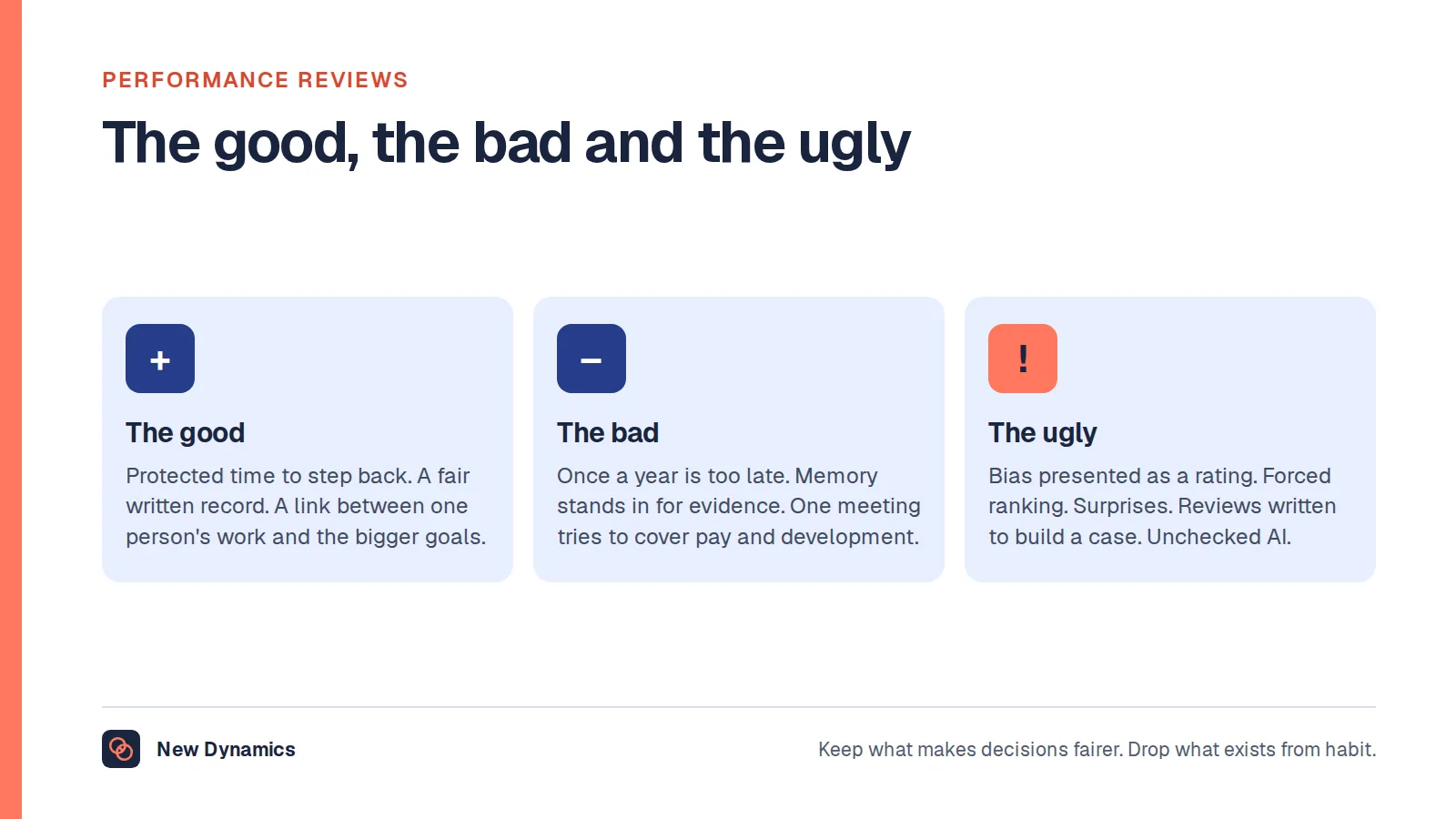
Managers make or break this stage. The CIPD names line managers who motivate, empower and support as a key driver of engagement. Regular one-to-one conversations are where most survey actions are delivered. Fair reviews matter too, as we explain in performance reviews: the good, the bad and the ugly.

Common mistakes with engagement surveys
Asking and not acting. This is worse than not asking. It teaches people that speaking up is pointless.
Chasing the score. Managers who are targeted on a number will find ways to lift the number. Target the actions instead.
Breaking confidentiality. One incident of a manager working out who said what will damage trust for years.
Surveying too often. Frequent pulses with no visible response create fatigue.
Comparing with outside benchmarks too eagerly. Differences in wording, timing and workforce make comparisons rough at best. Your own trend is more useful.
Leaving managers alone with bad results. A low score is a request for help. Offer support before judgement.
Answering results with slogans. Posters do not fix workload. If you enjoy a quote of the day, use our original workplace quotes as conversation starters, never as a response to a problem.
Frequently asked questions
What is a workplace engagement survey?
A workplace engagement survey is a structured questionnaire that asks employees how they experience their work, their manager and the organisation. It is used to find what helps people do their best work and what gets in the way, so that leaders can act.
How many questions should an engagement survey have?
Twenty to thirty questions suit a full survey, and five to ten suit a regular pulse. Shorter surveys are easier to complete thoughtfully. Only include questions you are prepared to act on.
What questions should I ask in an employee engagement survey?
Cover purpose and pride, the work itself, the manager, development, recognition and fairness, voice and inclusion, wellbeing and leadership. Use plain statements answered on one agreement scale, and add two or three open questions.
Should engagement surveys be anonymous?
Many are confidential, with results shown only for groups above a minimum size. Confidentiality encourages honest answers. Publish the minimum group size in advance, keep to it and explain who can see which results.
How often should you run an engagement survey?
Many organisations run one fuller survey a year with shorter pulses in between. The right rhythm is the one you can respond to. Report back on each round before you start the next.
What should we do with engagement survey results?
Share them quickly, look for patterns between teams, choose two or three priorities, give each action an owner and a date, and tell employees what changed. Discuss results in teams, because most improvements happen there.
Your next step: plan the response before you write the survey
- Decide which topics you are willing to act on this year.
- Choose 20 to 30 questions from the bank above, plus two open questions.
- Set the minimum group size and the date you will share results.
- Book the team discussions before the survey opens.
For a worksheet that takes you from listening to action, read and download our employee engagement guide. The guide is free to read, and the PDF uses our short download form.
Want feedback, recognition and one-to-ones to carry on between surveys? Book a New Dynamics demo and bring your last survey results. You can also email contact@new-dynamics.com.