TL;DR
- Negative feedback tells someone that something they did is not working. It becomes constructive when it is specific, describes behaviour and its effect, and points to what to do next.
- Use the Situation-Behaviour-Impact model: say when it happened, what you observed and what effect it had. Then ask for the other person's view.
- Give feedback soon, in private and one issue at a time. Avoid labels, avoid always and never, and agree a next step. Adapt the 30 examples to your own words.
Many people put off giving negative feedback. They wait for the right moment, soften the message until it disappears or save it for the annual review. The person on the receiving end, meanwhile, carries on doing the thing, unaware that anything is wrong.
These 30 negative feedback examples show how to say difficult things clearly and kindly. Each is written as constructive feedback, so that the person knows what happened, why it matters and what to do next.
Feedback works best when it is frequent and close to the event. See how New Dynamics continuous feedback makes it a normal part of work.
What is negative feedback at work?
Negative feedback tells someone that something they did is not working. It is sometimes called critical or corrective feedback. It is the opposite of positive feedback, which tells people what to keep doing.
Constructive feedback is negative feedback given in a way that helps. Three things make the difference:
- it is specific, about one event or pattern;
- it describes behaviour and its effect, and leaves personality out of it;
- it looks forward to what should happen next.
“Your reports are sloppy” is criticism. “Last month's report had four figures that did not match the source data, so finance had to recheck the whole pack” is constructive, because the person knows exactly what to fix.
The term also has a technical meaning in biology and engineering, where a negative feedback loop keeps a system stable. This article is about conversations at work.
The CIPD performance management factsheet says managers should “give feedback that motivates employees and helps them improve, and hold them to account”. Constructive feedback does all three.
The SBI model: a simple structure
The Center for Creative Leadership teaches a three-part structure called Situation-Behavior-Impact. In its words:
- Situation: “Describe the specific situation in which the behavior occurred.”
- Behaviour: “Describe the actual, observable behavior being discussed. Keep to facts only.”
- Impact: “Describe the results of the behavior in terms of the impact it had, whether the effect was positive or negative.”
The Center suggests adding a question about the person's intentions. That turns feedback into what it calls “a two-way dialogue”, where both people can discuss the gap between what was intended and what happened.
Every example below follows this pattern, and most end with a question.

Negative feedback examples about deadlines and reliability
- “The client proposal was due on Tuesday and arrived on Thursday. The sales team had to postpone the meeting. What got in the way, and how can we spot a delay earlier next time?”
- “You have been more than ten minutes late to three of the last five stand-ups. The team repeats updates for you, which costs everyone time. Is something making mornings difficult?”
- “I asked for a status update on Friday and did not get one, so I could not answer the director's question on Monday. When something will slip, I need to hear from you before the deadline.”
Constructive feedback examples about quality of work
- “In this month's report, four figures did not match the source data. Finance had to recheck the whole pack. Can we build a checking step into your process?”
- “The code you merged on Wednesday had no tests, and it broke the checkout page for an hour. Our standard is tests for every change. What would help you keep to it under time pressure?”
- “The slide deck had three different fonts and two spelling mistakes in the title. It distracted the client from a strong argument. Would a peer review before sending help?”
Negative feedback examples about communication
- “Your email to the supplier on Monday said their delay was ‘unacceptable and unprofessional’. They have since asked to deal with someone else. How could you have made the point and kept the relationship?”
- “In yesterday's handover, you did not mention that the customer had already complained twice. The evening team was caught off guard. What should a complete handover include?”
- “You answered the customer's question in one line with a link. She wrote back confused. A sentence of explanation would have saved a second exchange.”
Feedback examples about meetings
- “In this morning's meeting you interrupted Priya three times. She stopped contributing, and we lost her view on the risk. I would like you to let people finish.”
- “You had your laptop open and were typing during the client call. The client paused twice to check you were listening. Please close it during calls, or tell me if something urgent needs you.”
- “You did not speak in the last three planning meetings, and I know you have views, because you share them with me afterwards. The team needs to hear them. What would make it easier to speak up?”
Critical feedback examples about teamwork
- “When Sam asked for help with the migration on Tuesday, you said it was not your job. He spent a day on something you could have solved in an hour. How do you see your role when a teammate is stuck?”
- “You rewrote Aisha's section of the document without telling her. She felt undermined, and she had reasons for her approach. Next time, please raise it with her first.”
- “In the retrospective you said the delay was entirely the design team's fault. Two of them were in the room. It made the conversation defensive. How else could you have raised the issue?”
Examples about attitude and behaviour
Feedback about attitude is the hardest to give well, because attitude cannot be observed. Describe what the person said or did.
- “When I announced the new process, you sighed and said ‘here we go again’ in front of the team. Two newer colleagues looked to you for a reaction. If you have concerns, I want to hear them, and I would like to hear them from you directly.”
- “You have turned down the last three requests to cover a colleague's shift. Others are covering more than their share. Is there a reason I should know about?”
- “During the review you said ‘that will never work’ four times without offering an alternative. The team stopped suggesting ideas. When you see a problem, can you bring an option too?”
Negative feedback examples for customer-facing roles
- “On the call with Mr Evans, you told him the refund policy was ‘not my problem’. He has since closed his account. What could you have said when you could not give him what he wanted?”
- “You promised the customer a call back by Friday and did not make it. She rang again on Monday, upset. If you cannot keep a promise, a short message to say so protects the relationship.”
- “Your ticket replies this week were accurate, but five customers replied asking what the next step was. Ending each reply with a clear next step would save them, and you, a second message.”
Feedback for someone you manage who is struggling
- “Your sales are 40% below target for the second quarter running, and your call numbers have fallen too. I want to understand what has changed, and then agree a plan together.”
- “Since you became team leader, three people have told me they do not know their priorities. I think you are trying to do too much yourself. Let's look at what you could delegate.”
- “You have missed two of the three goals we agreed in January. I should have checked in sooner, and that is on me. Let's review what is realistic, and meet every fortnight from now on.”
Constructive feedback examples for a peer
- “When you copy the whole department on a small question, I lose time working out whether I need to act. Could you send it to the person who can answer?”
- “In the client meeting you answered questions that were in my area before I could. It made us look uncoordinated. Can we agree beforehand who covers what?”
- “I noticed that the shared tracker has not been updated for two weeks. I have been making decisions from old information. Would a Friday reminder help?”
Giving negative feedback to your manager
- “When priorities change during the week without a message, I end up finishing work that is no longer needed. Could we have a quick note when something changes?”
- “In our last three one-to-ones we ran out of time before reaching my development. It matters to me. Could we start with it next time?”
- “When you corrected me in front of the client, I felt undermined, and I think it weakened our position. I would find it easier to hear that kind of point afterwards.”
The names and figures in these examples are fictional.

How to give constructive feedback: seven steps
- Check your motive. Are you trying to help, or to vent? Wait until you can do the first.
- Do it soon, and in private. Within a day or two, away from an audience.
- Ask first. “Can I share an observation about this morning's meeting?” gives the person a moment to prepare.
- Use Situation, Behaviour, Impact. Say one thing, clearly. Do not bundle five issues together.
- Ask for their view. “How did you see it?” You may learn something that changes your mind.
- Agree a next step. What will be different, and how will you both know?
- Follow up. Notice the improvement and say so. Feedback that is never mentioned again feels like a verdict.
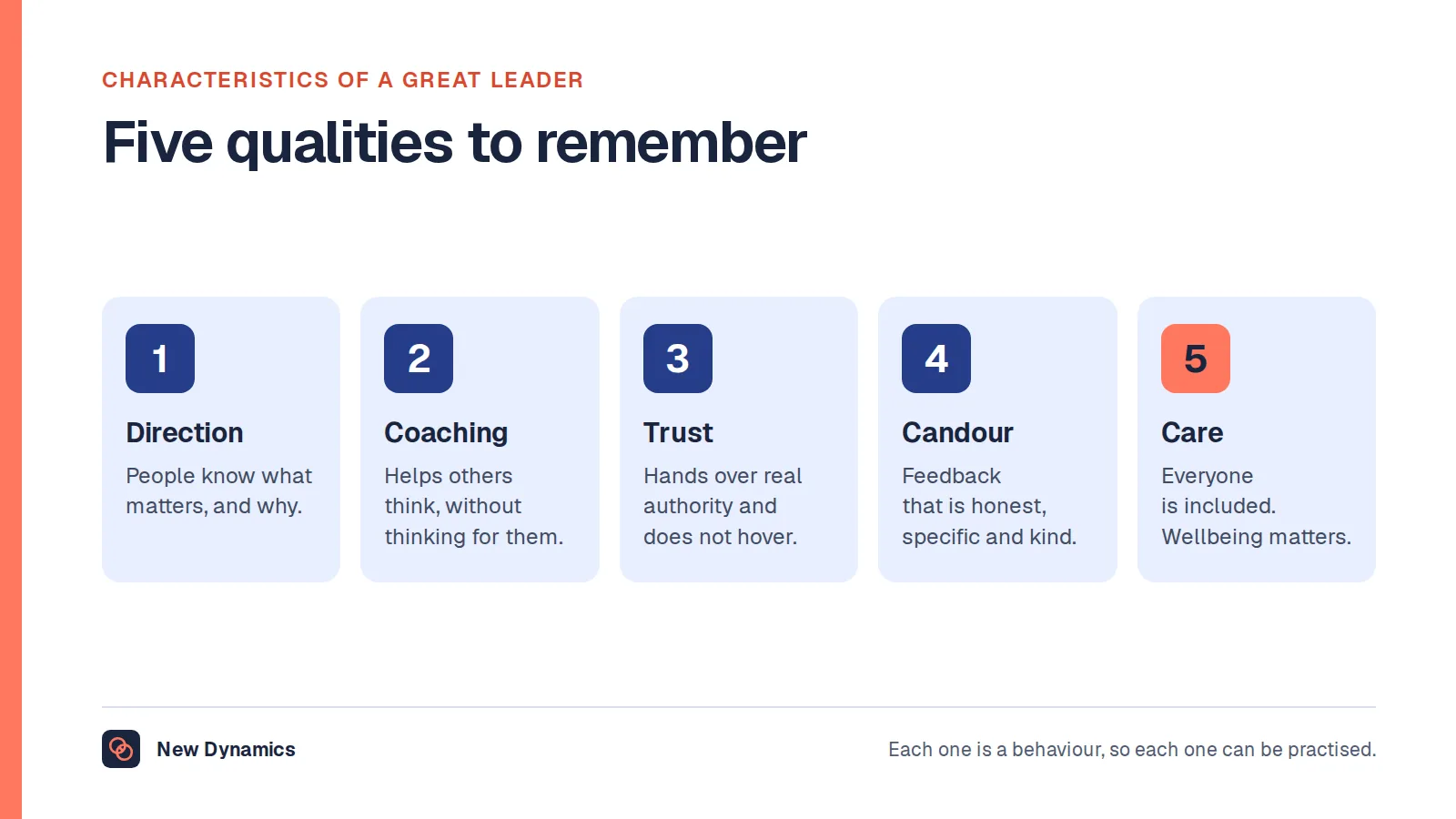
Our employee feedback guide goes deeper on timing and setting, and characteristics of a great leader explains why candour is a form of respect.
How to receive negative feedback
- Listen to the end. Resist the urge to explain straight away.
- Ask for an example if the feedback is vague.
- Say it back. “So the issue is that the report was late and you heard nothing from me?”
- Thank the person. Giving it was probably uncomfortable for them too. If you manage people, this is what makes an open door policy real.
- Take time if you need it. “I would like to think about that. Can we talk again tomorrow?”
- Decide what to do. You do not have to agree with everything, but look for the part that is true.
Common mistakes with negative feedback
The compliment sandwich. Hiding the message between two compliments confuses people. They may remember only the praise, or come to distrust it.
Labels in place of behaviour. “You are careless” invites an argument. “Four figures were wrong” does not.
Always and never. One exception lets the person dismiss the whole point.
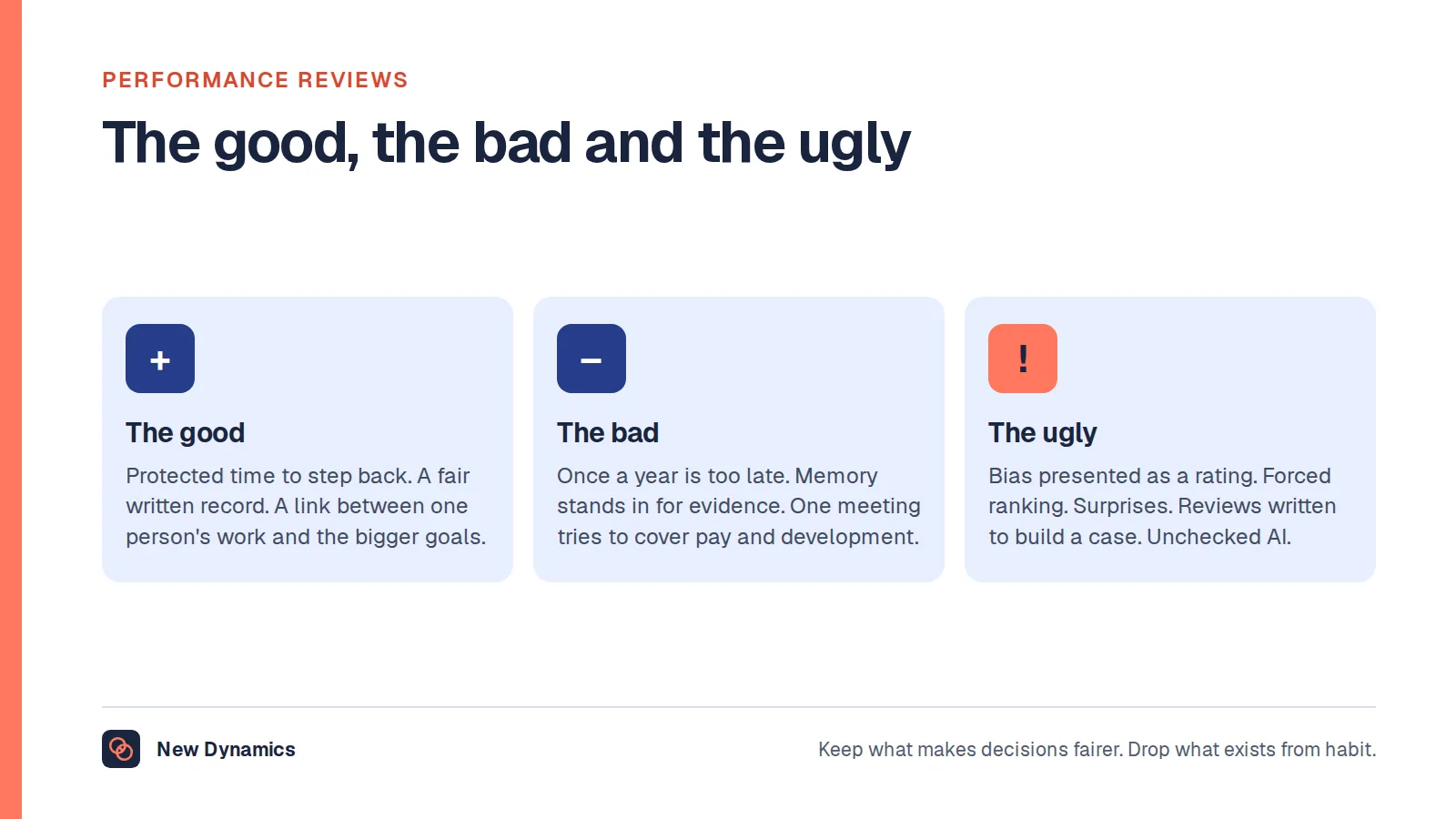
Saving it up. A list of grievances delivered at the annual review is unfair, and it comes too late to help. See performance reviews: the good, the bad and the ugly.
Feedback by message. Text strips out tone. Deliver difficult feedback in person or on a call, and follow up in writing if needed.
No positive feedback at all. People tend to accept criticism more readily from someone who also notices what they do well.

Frequently asked questions
What is an example of negative feedback?
“The client proposal was due on Tuesday and arrived on Thursday, so the sales team had to postpone the meeting. What got in the way, and how can we spot a delay earlier next time?” It names the situation, the behaviour and the impact, then asks a question.
What is the difference between negative and constructive feedback?
Negative feedback tells someone that something is not working. Constructive feedback is negative feedback delivered in a way that helps: it is specific, describes behaviour and its effect without judging character, and points to what should happen next.
How do you give constructive feedback?
Give it soon and in private. Describe the situation, the behaviour you observed and its impact. Ask for the other person's view, agree a next step and follow up. Keep to one issue at a time, and avoid labels such as lazy or careless.
What is the SBI feedback model?
SBI stands for Situation, Behaviour, Impact. It is a structure taught by the Center for Creative Leadership. You describe the specific situation, the observable behaviour and the effect it had. Adding a question about intent turns it into a two-way conversation.
How do you give negative feedback to your boss?
Ask for a moment in private, describe a specific situation and its effect on your work, and suggest what would help. For example: “When priorities change without a message, I finish work that is no longer needed. Could we have a quick note when something changes?”
Should you use the compliment sandwich?
It is better avoided. Placing criticism between two compliments tends to blur the message, and people learn to distrust your praise. Give positive feedback often and separately, so that a difficult message can be delivered plainly when it is needed.
Your next step: give one piece of feedback this week
- Think of one thing you have been putting off saying.
- Write it as situation, behaviour and impact, in three sentences.
- Add a question.
- Say it within two days, in private, and agree a next step.
For more on timing, setting and making feedback a habit, read and download our employee feedback guide. The guide is free to read, and the PDF uses our short download form.
Want feedback to flow all year, in every direction? Book a New Dynamics demo and bring your current approach. You can also email contact@new-dynamics.com.