TL;DR
- Strategic workforce planning works out what people and skills an organisation will need to deliver its strategy, compares that with what it has and acts on the gap before it becomes a crisis.
- The CIPD describes six stages: understand the organisation, analyse the workforce, determine future needs, identify gaps, develop an action plan, and monitor and evaluate. The process is a loop, not a line.
- There are five ways to close a gap: build skills, buy them in, borrow them, redeploy people or redesign the work. Most plans need a mix, and the cheapest option is often the one already on the payroll.
Most organisations plan their money in detail and their people by reflex. A vacancy appears, and a job advert follows. A new product is approved, and someone asks three months later who will build it. Strategic workforce planning reverses the order. It asks what people and skills the strategy will need, in time to do something about it.
This article explains what strategic workforce planning is, walks through the six stages with a worked example, sets out five workforce planning strategies for closing a gap, and lists the mistakes that leave plans on the shelf.
Planning starts with a clear picture of who you have and how they are organised. See how New Dynamics org charts show roles, reporting lines and the relationships between them.
What is strategic workforce planning?
Strategic workforce planning is the process of working out what people and skills an organisation will need to deliver its strategy, comparing that with the workforce it has and acting on the difference.
The CIPD, the UK's professional body for HR, defines workforce planning in its workforce planning factsheet as “the process of balancing labour supply (skills) against the demand (numbers needed)”. It sums up the aim in a sentence that is worth keeping in view:
“It's about getting the right number of people with the right skills employed in the right place at the right time, at the right cost and on the right contract to deliver an organisation's short and long-term objectives.”
Operational and strategic workforce planning
The CIPD distinguishes two aspects.
| Aspect | The question | Horizon | Typical output |
|---|---|---|---|
| “Hard” or operational | How many people, with what skills, do we need? | Weeks to a year | Rotas, headcount budgets, hiring plans |
| “Soft” or strategic | What might the future require, and what are our options? | One to five years | Scenarios, skills priorities, big bets |
In the factsheet's words, hard workforce planning “is about numbers”, while soft, or strategic, workforce planning “is about defining a strategy or developing a strategic framework within which information can be assessed”. The strategic kind, it says, lets managers “consider a range of possibilities before reaching a stage where they are forced into action by circumstances”.
Staff planning for next month's rota and strategic planning for the next three years are both needed. This article concentrates on the second.
Why it matters
The CIPD lists what a good process can do. Among other things, it can help an organisation to respond to changing customer needs, focus people development, target inefficiencies, improve retention and improve productivity.
In plainer terms:
- Skills take time. A capability that takes two years to build cannot be ordered in the month it is needed.
- Hiring in a hurry is expensive, and it is how poor appointments get made.
- For many organisations, people are the largest cost. That deserves at least the attention the capital budget gets.
- It surfaces unrealistic plans. The CIPD notes that workforce planning “can uncover obstacles or unrealistic targets that could hinder strategic change”. It is better to find out in the planning round.
The six stages of workforce planning
The CIPD describes six main stages. It also stresses that the process is iterative: what you learn in the later stages sends you back to the earlier ones.
1. Understand the organisation and its environment
Start with the strategy, not with the headcount. Where is the organisation trying to get to in three years? What will change in products, customers, technology, regulation and the labour market? Which of those changes alter the work people do?
2. Analyse the current workforce
Build an honest picture of what you have: numbers, skills, locations, contracts, age profile, turnover and the views of employees. The CIPD suggests looking at “knowledge, skills, abilities and talent profiles, as well as attrition rates”, and at employees' satisfaction and intention to leave.
Pay special attention to critical roles, where a vacancy would hurt most, and to knowledge held by one or two people.
3. Determine future workforce needs
Translate the strategy into roles, skills and numbers. Because the future is uncertain, plan for more than one version of it. The CIPD recommends scenario planning, which “can show how different futures might affect people requirements”.
Three scenarios are usually enough: the plan goes as expected, growth is faster than expected, and a squeeze.
4. Identify the gaps
Compare the future need with the current workforce, allowing for the people who will leave, retire or move in the meantime. You will find gaps, where you have too few people or skills, and surpluses, where you have more than you will need. Both need a plan.
Our skills gap analysis guide sets out a method.
5. Develop an action plan
Decide how each gap will be closed, by whom and by when. The CIPD notes that where recruitment or retention is difficult, “skills will need to be built via staff development or borrowed via outsourcing”. The next section sets out the options.
6. Monitor and evaluate
Agree a small set of measures, review them regularly and change the plan when the facts change. The CIPD advises organisations to “design and embed clear evaluation processes into all stages”.

Five workforce planning strategies for closing a gap
“Build, buy and borrow” is common HR shorthand. We add two more options that are often overlooked.
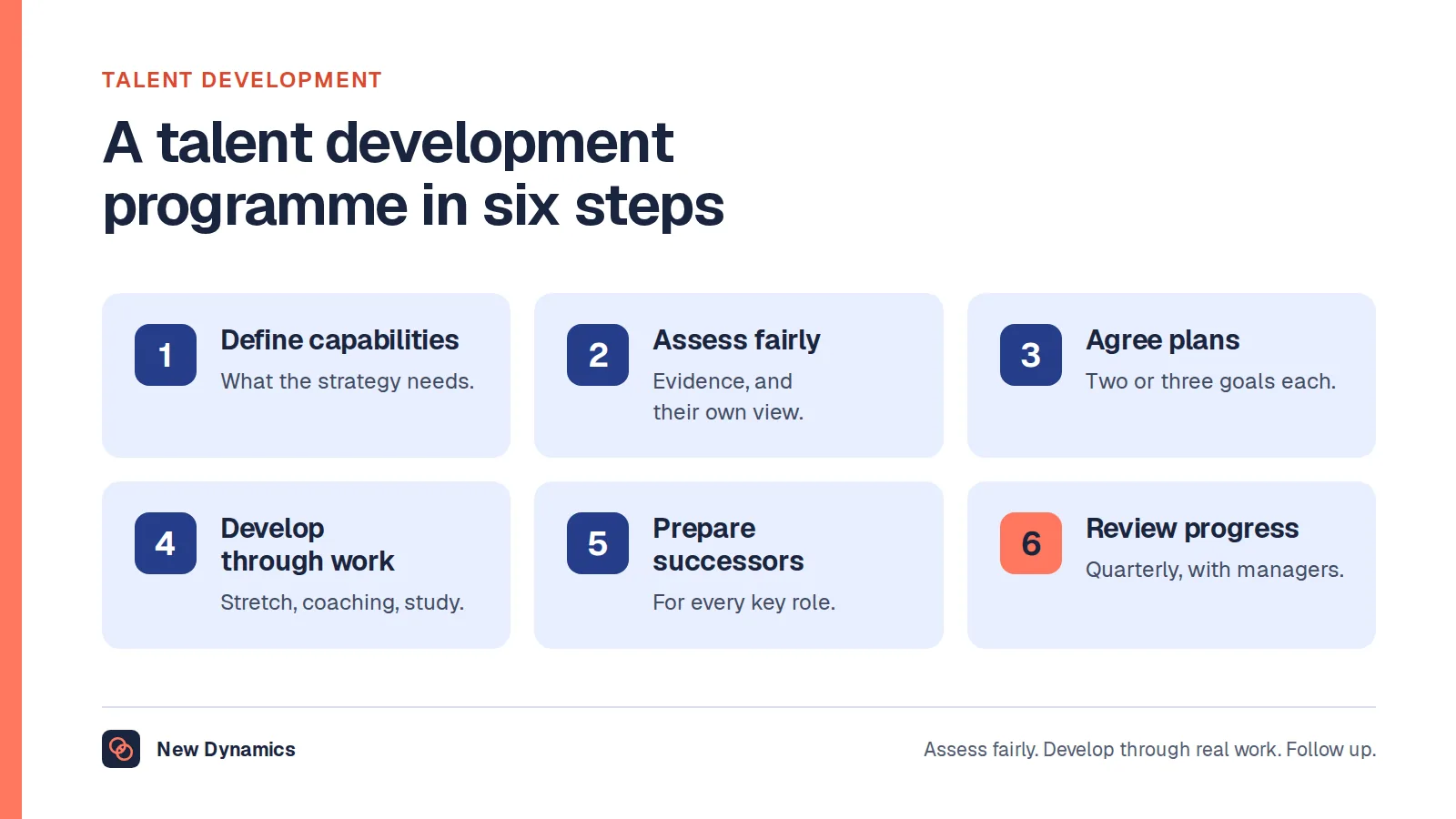
- Build. Develop the skills in the people you have, through training, stretch assignments, coaching and career paths. It is slow, and it can strengthen retention. See our guide to talent development.
- Buy. Recruit people who already have the skills. It is faster, it costs more and it depends on the labour market.
- Borrow. Use contractors, agencies, partners or outsourcing for skills you need briefly or cannot justify full time.
- Redeploy. Move people from areas of surplus to areas of need, with retraining. This is often the cheapest option, and the one that is forgotten.
- Redesign. Change the work. Automate a task, simplify a process or reshape roles so that scarce skills are used only where they are essential. See job enrichment.
Most plans use a mix. A useful discipline is to ask of every gap, “Could we build or redeploy before we buy?”
Where a gap concerns a specific senior or critical role, succession planning takes over. The OpenStax textbook Principles of Management describes succession planning as “the process for reviewing key roles and determining the readiness levels of potential internal (and external!) candidates to fill these roles”. Our succession planning guide explains how.

A worked example
The organisation and the figures are illustrative.
Stage 1. A regional insurer with 400 staff plans to move most customer service online within three years and to launch two new products.
Stage 2. It has 120 people in its call centre, with 18% annual turnover, and eight data analysts. Half of its underwriters are within five years of retirement.
Stage 3. In the expected scenario, call volumes fall by 40% over three years, while demand grows for digital service, data analysis and product specialists. It will need about 70 call handlers, 25 digital service staff and 20 analysts.
Stage 4. The gaps are a surplus of about 50 call-handling roles, a shortage of 25 digital service staff and 12 analysts, and a succession risk in underwriting.
Stage 5. The action plan:
- Redeploy and build: natural turnover will remove about 20 call-handling roles a year. Offer retraining into digital service to current call handlers, with 25 places over two years.
- Build and buy: start an analyst training route for six internal candidates, and recruit six experienced analysts.
- Build: pair each underwriter nearing retirement with a successor, and record what they know.
- Redesign: automate routine policy changes so that specialists handle only complex cases.
Stage 6. Each quarter, the leadership team reviews progress on redeployment, analyst hiring, underwriting cover and turnover, and revisits the scenarios once a year.
Notice what the plan avoided: a redundancy programme in one department while another was recruiting externally for skills that could have been taught.
Who should be involved?
Workforce planning is sometimes treated as an HR spreadsheet exercise. The CIPD is clear that it has to be organisation-wide and that it “requires effective communication between the HR team and the rest of the business”.
- Senior leaders set the strategy and own the plan.
- Finance connects it to budgets.
- Line managers supply the detail about roles and skills, and carry out most of the actions. The CIPD says they “will need support from people professionals and others to fulfil their responsibilities”.
- HR runs the process, provides the data and challenges assumptions.
- Employees and their representatives should be consulted, especially where roles will change. If redundancies are possible, take advice on your legal duties early. Our redundancy and workforce change guide gives an overview.
Common mistakes
Starting with headcount. A plan that begins with last year's numbers plus or minus 5% is a budget. Start with the strategy.
Planning for one future. The single forecast will be wrong. Scenarios make the plan robust.
Counting heads and ignoring skills. Two teams of ten can have very different capabilities.
Poor data. The CIPD stresses that good-quality information is vital, and that data should be kept over time so that trends can be seen.
A plan with no owner. If nobody is accountable for each action, nothing happens.
Doing it once. A plan written in January and never revisited is out of date by the summer.
Forgetting the people in it. Behind every surplus is a person with a career. Tell people early, and offer routes to new roles.

Frequently asked questions
What is strategic workforce planning?
Strategic workforce planning is the process of working out what people and skills an organisation will need to deliver its strategy, comparing that with the current workforce and acting on the gaps. It usually looks one to five years ahead and considers several scenarios.
What are the stages of workforce planning?
The CIPD describes six: understand the organisation and its environment, analyse the current workforce, determine future workforce needs, identify the gaps, develop an action plan, and monitor and evaluate. The process is iterative, so later stages feed back into earlier ones.
What is the difference between workforce planning and strategic workforce planning?
Operational workforce planning deals with numbers over weeks or months, such as rotas and hiring plans. Strategic workforce planning looks further ahead, links to the organisation's strategy and explores scenarios, so that leaders can weigh options before events force their hand.
What are the main workforce planning strategies?
There are five ways to close a gap: build skills in current employees, buy skills through recruitment, borrow them through contractors or partners, redeploy people from areas of surplus, and redesign the work so that fewer scarce skills are needed.
Who is responsible for workforce planning?
Senior leaders own the plan, because it follows from the strategy. HR runs the process and supplies the data, finance links it to budgets, and line managers provide detail and carry out most of the actions. Employees and their representatives should be consulted.
How often should a workforce plan be reviewed?
Review progress against the action plan every quarter, and revisit the scenarios and the assumptions at least once a year or whenever the strategy changes. Keeping consistent data over time makes each review easier.
Your next step: start with one critical area
- Pick one part of the organisation that the strategy depends on.
- List its critical roles and skills today, and what it will need in three years.
- Name the two biggest gaps.
- For each gap, choose from build, buy, borrow, redeploy and redesign, and give the action an owner.
For a method that compares the skills you have with the skills you need, read and download our skills gap analysis guide. The guide is free to read, and the PDF uses our short download form.
Want a clear view of your structure, goals and skills in one place? Book a New Dynamics demo and bring your current plan. You can also email contact@new-dynamics.com.