TL;DR
- Talent development is everything an organisation does to assess and grow the capability of its people, so that it has the skills and the leaders it will need. It is wider than training and narrower than talent management.
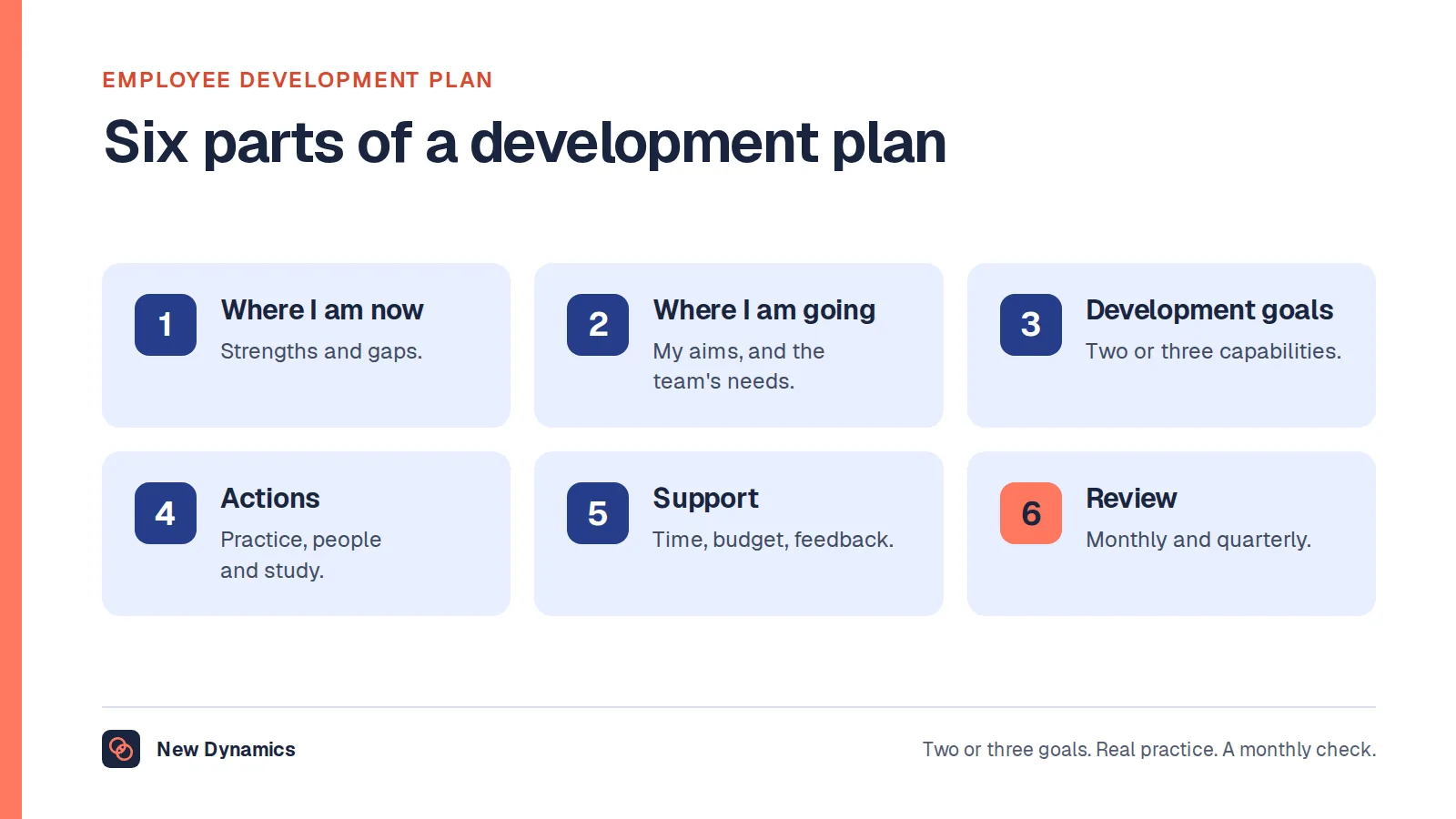
- A working programme has six parts: know the capabilities you need, assess people fairly, agree individual development plans, develop mostly through real work, prepare successors for key roles and review progress.
- The common failure is a talent review that ends in a list and no action. What matters is the follow-up: stretch work, feedback, coaching and managers who are held to account for developing people.
Every organisation says that its people are its greatest asset. Fewer can answer three simple questions. Which skills will we need in three years? Who could step into our key roles tomorrow? What is each of our best people learning this year?
Talent development is how you get answers. This article explains what it means, how it differs from training and talent management, a six-step programme that suits organisations of any size, how a talent review works and the mistakes that waste time and budget.
Development needs evidence and regular conversation. See how New Dynamics performance reviews bring goals, feedback and development into one fair discussion.
What is talent development?
The open textbook Principles of Management, published by OpenStax, gives a plain definition in its section on talent development and succession planning: “Talent development describes all process and programs that an organization utilizes to assess and develop talent.”
It places the subject in context. Succession planning is “the process for reviewing key roles and determining the readiness levels of potential internal (and external!) candidates to fill these roles”. It is a link between talent development and recruitment. And although HR facilitates it, OpenStax calls talent development “a true business process”, which relies heavily on input from leaders.
Three related terms are worth separating.
| Term | What it covers |
|---|---|
| Training | Teaching a specific skill or piece of knowledge |
| Talent development | Assessing and growing people's capability over time, for current and future needs |
| Talent management | The wider system: attracting, hiring, developing, rewarding and retaining people |
For what we mean by talent itself, and the argument about whether it means a few people or everyone, see our article on the definition of talent at work.
Why talent development matters
It builds the skills that the strategy needs. Hiring alone is slow, expensive and uncertain.
It prepares successors. Key roles should not depend on one person staying for ever.
It keeps good people. Capable people tend to stay where they are learning, and leave where they have stopped.
It makes promotion fairer. A deliberate process gives more people a chance to show what they can do than a manager's instinct does.
OpenStax puts it bluntly. An organisation can recruit the right people and design its reward programmes with care, but if it cannot assess and develop the key talent that it has, “everything else feels like a wasted effort”.

A talent development programme in six steps
1. Define the capabilities you need
Start from the strategy. Which skills, knowledge and behaviours will the organisation need in the next two to three years? Which roles are critical? Write the answer as a short list of capabilities, described as behaviours. Our guide to core competencies shows how.
2. Assess people fairly
Look at each person's performance, their aspirations and their readiness for more. Use evidence from the whole year: goals, feedback from several people and the work itself. Ask people what they want. An assessment made without the employee's own view is a guess.
3. Agree individual development plans
Every employee should have a short plan, with two or three development goals, actions and review dates. That includes your steady performers, who are the majority and keep the organisation running. Our employee development plan template gives the structure.
4. Develop mostly through real work
Courses help. Much of the strongest development comes from doing: stretch assignments, projects, secondments, covering for a manager, presenting to senior people and solving a real problem with a coach alongside. Add learning from others, through mentoring, feedback and shadowing, and some study. The CIPD notes that the key to making and embedding a change “is reflecting on your learning”.
5. Prepare successors for key roles
For each critical role, identify who could step in now, who could be ready in a year or two, and what each would need. If there is nobody, that is a finding worth acting on. Our succession planning guide sets out the method.
6. Review progress, and hold managers to account
Check development plans quarterly. Ask leaders to report on what has happened since the last talent review. Make developing people part of how managers themselves are assessed. Work that is reviewed tends to get done.
The talent review explained
OpenStax describes the talent review as one of the key tools of talent development. It usually follows the performance management cycle, and it looks forward: it “is more focused on employee development and potential for the future”.
A typical review works like this.
- Managers prepare a short summary for each person: performance over time, strengths, development needs, aspirations and readiness for other roles.
- Leaders meet to discuss and calibrate. Hearing several views reduces the effect of one manager's bias.
- Each person gets development actions. OpenStax advises that the leadership team should discuss key development actions for each employee, starting with those of highest potential if time is short.
- HR keeps the record and follows up. OpenStax says that HR should keep a master list of outcomes and development activities, and should help leaders to plan and carry them out.
The nine-box grid, and its limits
OpenStax notes that talent reviews “often employ the use of a 9-box template, which plots employee performance versus employee potential”. It is a simple way to structure a discussion.
Use it with care.
- “Potential” is a judgement, and judgements carry bias. Ask for evidence, and ask who is missing from the top boxes and why.
- A box is not a verdict. People move as roles, managers and circumstances change.
- The grid is the start of the conversation. The value lies in the actions agreed for each person.
- Be honest with people. Decide what you will tell employees about how they are seen, and tell them consistently.
Our performance calibration guide explains how to run a fair discussion.

Talent development examples
- A rotation for early-career staff. Three six-month placements in different teams, each with a project and a mentor.
- A stretch project. A capable analyst leads a cross-department review, with a senior sponsor.
- An acting-up arrangement. A deputy covers for their manager for a month, with coaching before and after.
- A mentoring scheme that pairs people across departments.
- A first-time manager programme, with practice on real situations and feedback from the team.
- Skills academies for capabilities that the strategy needs, such as data or customer service.
- A successor plan for each critical role, with named development actions.
- Internal vacancies advertised first, with support for people who apply.
The manager's role
Most development happens, or fails to happen, between a manager and a member of their team. Managers should:
- know each person's aims and strengths;
- hold a development conversation at least every quarter. Our one-to-one meeting questions include a set for development;
- find stretch work, and give feedback on it;
- let good people move on, within the organisation where possible;
- be assessed on it. We describe the skills in management skills.
How to measure talent development
- Coverage: the share of employees with a current development plan, and the share of plans reviewed each quarter.
- Internal moves: the share of vacancies filled from inside, including key roles.
- Readiness: the number of critical roles with at least one ready successor.
- Retention of people identified as key to the future.
- Fairness: who is getting stretch work and promotion, across different groups.
- Experience: survey answers to “I have opportunities to learn and grow here”.
Treat the numbers as prompts for questions. Development takes years to show in results.
Common mistakes
A review that ends in a list. Without follow-up, a talent review is an expensive meeting.
Developing only “high potentials”. Most of the work is done by steady, capable people. They need development too, and they notice when they are left out.
Confusing development with courses. A training catalogue is not a programme.
Secret labels. People usually sense how they are seen. Unexplained labels breed mistrust.
Bias in judging potential. Confidence can be mistaken for competence, and similarity for promise. Ask for evidence.
Managers who hoard talent. Reward managers who develop people and release them.
No link to strategy. Developing skills that the organisation will not need wastes everyone's time.

Frequently asked questions
What is talent development?
Talent development is everything an organisation does to assess and grow the capability of its people, for current roles and future needs. It includes development plans, stretch assignments, coaching, mentoring, training, talent reviews and succession planning.
What is the difference between talent development and talent management?
Talent management is the whole system for attracting, hiring, developing, rewarding and retaining people. Talent development is the part that assesses and grows people's capability once they are in the organisation. Training is one activity within development.
What is a talent review?
A talent review is a structured discussion, usually among leaders, of each employee's performance, potential, aspirations and readiness for other roles. It follows the performance cycle, looks to the future and should end with agreed development actions for each person.
What is a talent development programme?
It is a planned approach with six parts: defining the capabilities that the organisation needs, assessing people fairly, agreeing individual development plans, developing people mainly through real work, preparing successors for key roles and reviewing progress regularly.
What are examples of talent development activities?
Examples include stretch projects, job rotations, acting-up arrangements, secondments, mentoring, coaching, first-time manager programmes, skills academies, shadowing senior leaders and successor plans for critical roles.
Who is responsible for talent development?
HR designs and facilitates the process, but leaders and line managers own it. Managers hold the development conversations and find the stretch work. Employees are responsible for their own plans. Senior leaders set the tone by making time for it.
Your next step: answer three questions
- Which three capabilities will your team most need in two years' time?
- For your two most critical roles, who could step in, and what would they need?
- What is each person in your team learning this quarter?
If you cannot answer, start there. For a method for the second question, read and download our succession planning guide. The guide is free to read, and the PDF uses our short download form.
Want development goals, feedback and reviews in one place, so that talent decisions rest on evidence? Book a New Dynamics demo and bring your current approach. You can also email contact@new-dynamics.com.