TL;DR
- Job enrichment is the vertical expansion of a job: giving someone more autonomy, responsibility and decision-making authority over work they already do. It adds depth, where job enlargement adds breadth.
- An enriched job lets the person plan, carry out and evaluate a whole piece of work, use a range of skills and see the result. Textbooks report that enrichment tends to raise satisfaction and reduce absence and turnover.
- It fails when it is a disguise for more work at the same pay, or when people lack the skills, time or wish for more responsibility. Ask first, train, and hand over real authority.
A customer service adviser handles forty calls a day. Every refund over £20 needs a supervisor's approval, every unusual request is escalated, and the adviser never learns what happened next. The job is busy, and it is dull. Nobody chose to make it that way. It simply accumulated rules.
Job enrichment is the practice of putting judgement and ownership back into jobs like that one. This article explains what it means, how it differs from job enlargement and job rotation, 20 examples, a five-step method and the risks to watch for.
Enriched jobs need clear goals and regular feedback. See how New Dynamics continuous feedback helps people to see the results of their work and to improve it.
What is job enrichment?
The open textbook Introduction to Business, published by OpenStax, defines it in its section on applying motivation theory: “Job enrichment is the vertical expansion of an employee's job.” It continues: “enrichment attempts to increase job depth by providing the employee with more autonomy, responsibility, and decision-making authority. In an enriched job, the employee can use a variety of talents and skills and has more control over the planning, execution, and evaluation of the required tasks.”
So an enriched job has three marks.
- The person plans some of their own work, as well as carrying it out.
- The person decides things that used to need permission.
- The person sees and evaluates the result, and hears from whoever receives the work.
Job enrichment vs job enlargement vs job rotation
OpenStax describes three ways to redesign a job.
| Option | What changes | OpenStax's description |
|---|---|---|
| Job enlargement | More tasks at the same level | “The horizontal expansion of a job” |
| Job rotation | The person moves between jobs | “The shifting of workers from one job to another” |
| Job enrichment | More autonomy, responsibility and authority | “The vertical expansion of an employee's job” |
The textbook adds a warning about enlargement. Employees “may perceive that they are being asked to work harder and do more with no change in their level of responsibility or compensation”, which can cause resentment. That warning applies to badly done enrichment as well.

Where the idea comes from
Job enrichment grew out of Frederick Herzberg's motivator-hygiene theory. The OpenStax textbook Organizational Behavior explains it in its chapter on content theories of motivation. Herzberg argued that there are two sets of needs.
- Hygienes concern the context of the job: “pay, working conditions, supervision, and security”. When they are poor, people are dissatisfied. When they are good, people are not dissatisfied, but they are not necessarily motivated.
- Motivators “relate to job content”, which is “what we actually do when we perform our job duties”. Duties that lead to feelings of achievement and recognition are motivators.
The practical implication, in OpenStax's words, is “the somewhat counterintuitive idea that managers should focus more on motivators than on hygienes”. Fair pay and decent conditions are necessary. They are not what makes work absorbing. For that, you have to change the work.
The same chapter puts the design challenge neatly: “Designing jobs that are neither too challenging nor too boring is key to managing motivation.”
Why enrich jobs?
OpenStax summarises the evidence in one sentence: “In general, job enrichment has been found to increase job satisfaction and reduce absenteeism and turnover.”
There is a wellbeing argument too. In Great Britain, the Health and Safety Executive's Control standard for managing work-related stress says that employees should be “able to have a say about the way they do their work”, and that they should be “encouraged to use their skills and initiative to do their work”.
And there is a business argument. Decisions made close to the customer are usually faster. Supervisors who no longer approve every small item have time to manage.
20 examples of job enrichment
Give authority
- A support adviser may issue refunds up to £100 without approval.
- A nurse-led clinic manages follow-up appointments for stable patients.
- A machine operator may stop the line when they see a quality problem.
- A junior accountant deals directly with the client on routine queries.
- A team agrees its own rota within rules set by the manager.
Give a whole piece of work
- A developer takes a feature from the customer's request through to release, including testing.
- A caseworker keeps the same clients from the first contact to the outcome.
- A marketing executive owns one campaign from the brief to the results report.
- An engineer sees a repair through, including the follow-up call to the customer.
Give planning and improvement
- A warehouse team sets its own daily targets against the weekly plan.
- An administrator redesigns the filing process that they use every day.
- A sales team decides how to divide its territory.
- An adviser writes and maintains the help articles for the problems they handle most.
Give feedback and contact
- Production staff visit a customer's site to see the product in use.
- Kitchen staff hear the comments from diners, good and bad.
- Analysts present their own findings to the decision-makers.
- Each adviser sees their own satisfaction scores and comments every week.
Give growth
- An experienced colleague trains and mentors new starters.
- A specialist represents the team on a cross-department project.
- A team member deputises for the manager during holidays, with real authority.
Go back to the adviser at the start of this article. An enriched version of that job might allow refunds up to £100, ownership of each complaint until it is resolved, weekly sight of their own customer feedback and a say in rewriting the scripts.

How to enrich a job in five steps
- Ask the people who do the job. Which decisions could they take themselves? Which rules get in the way? What would make the work more satisfying? Not everyone wants more responsibility, and you need to know who does.
- Map the approvals and handoffs. List every point at which the person has to stop and ask. For each one, ask what would go wrong if they decided alone, and how often.
- Hand over authority, with limits. Set clear boundaries, such as a refund limit, and make the decision truly theirs within them. Our guide to leadership styles explains how to match delegation to readiness.
- Provide training, information and feedback. Authority without skill or data sets people up to fail. Give them the numbers that show how their work is going.
- Review, and adjust pay and grading if the job has grown. Check after three months. If the role now carries materially more responsibility, the job should be re-evaluated. Our job evaluation guide explains how.
The risks, and how to avoid them
Enrichment as a disguise for more work. If tasks are added and nothing is taken away, people will see through it. Remove work as well as adding it.
More responsibility, same pay, for ever. A job that has really grown should be re-evaluated.
Responsibility without authority. Being held to account for a result that you cannot influence is the opposite of enrichment. See our accountability examples.
Assuming that everyone wants it. Some people want a job that they can do well and leave behind at five o'clock. That is legitimate. Offer, and do not impose.
Overload. More decisions mean more mental load. Watch the hours, and the stress.
Supervisors who feel bypassed. Their role changes from approving to coaching. Prepare them for it, and recognise the new role.
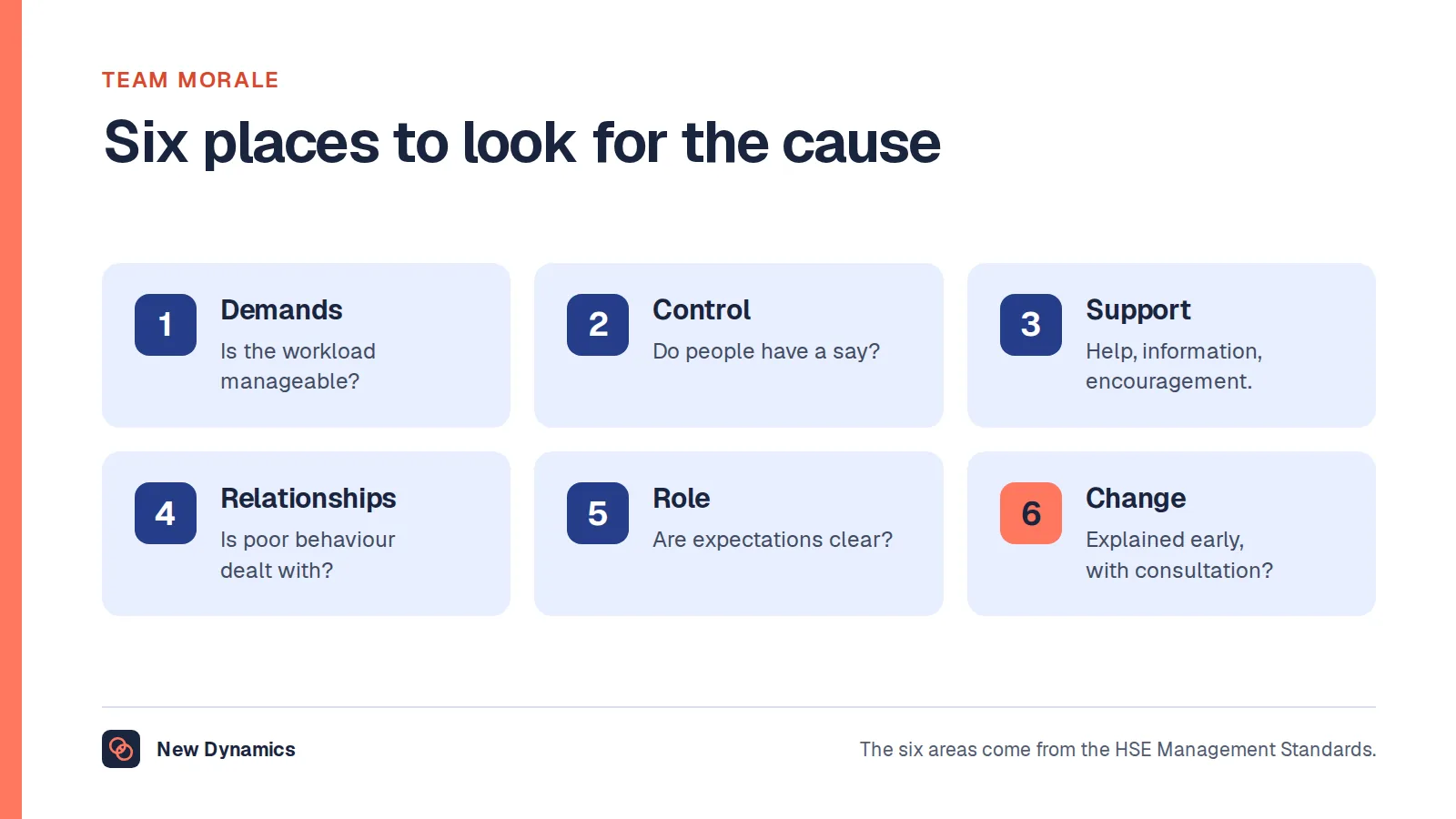
Forgetting the basics. Herzberg's point cuts both ways. If pay is unfair or conditions are poor, enrichment will not make up for it. See our guide to team morale.
How to tell whether it is working
- People take decisions without asking, and the decisions are good.
- Fewer items wait for approval, and customers get answers sooner.
- Absence and turnover in the team fall over time.
- In surveys, more people agree that they have a say in how they do their work, and that their work uses their skills.
- Supervisors spend more time coaching and less time checking.
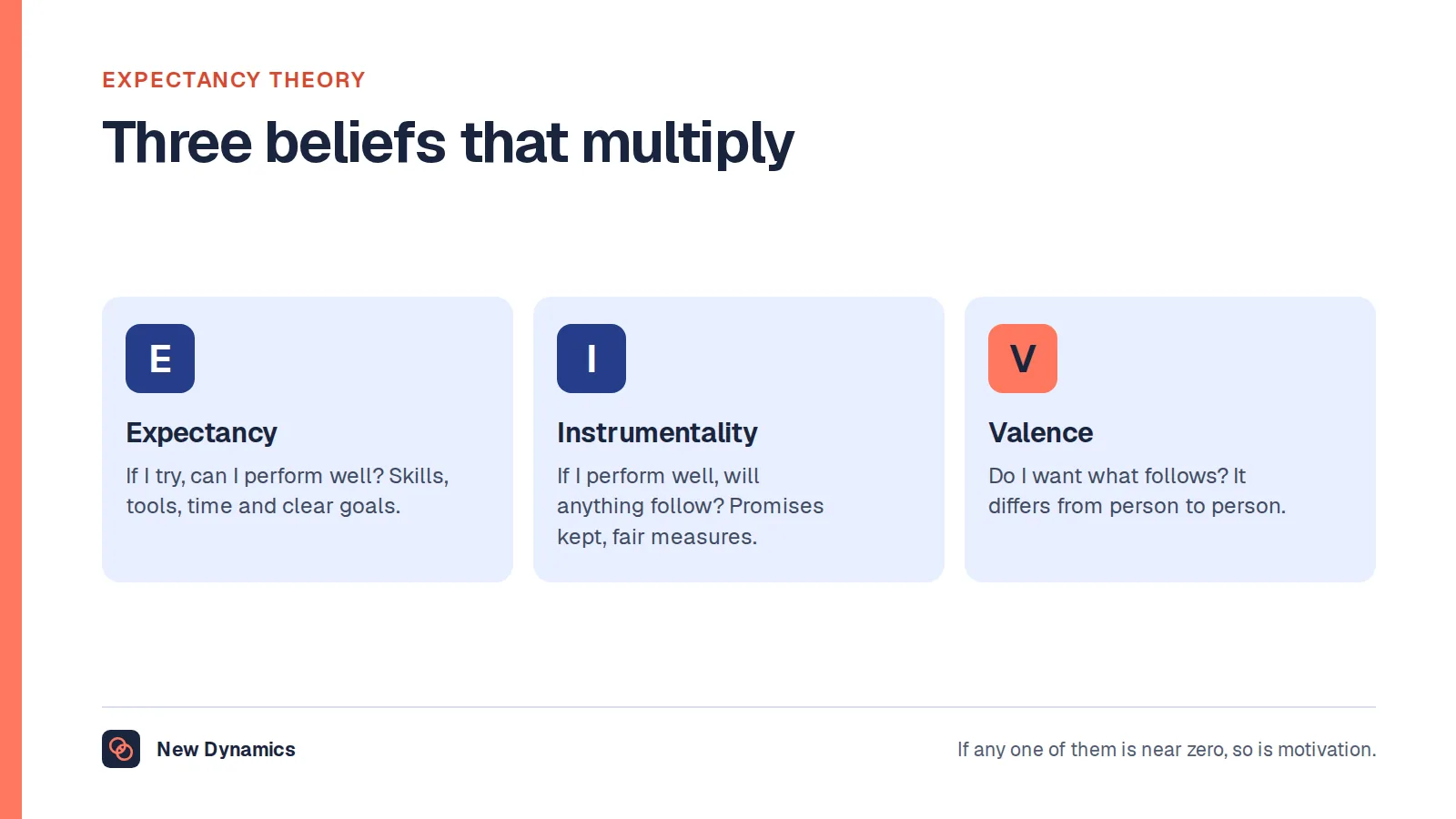
Give it at least two or three months, and ask the people involved what they would change. Our expectancy theory article explains why the link between effort, results and recognition has to stay visible.

Frequently asked questions
What is job enrichment?
Job enrichment is the vertical expansion of a job: giving an employee more autonomy, responsibility and decision-making authority over their work. An enriched job lets the person plan, carry out and evaluate a whole piece of work, and use a wider range of skills.
What is an example of an enriched job?
A customer support adviser who may issue refunds up to a set limit without approval, who keeps ownership of each complaint until it is resolved, who sees their own customer feedback each week and who helps to rewrite the team's scripts has an enriched job.
What is the difference between job enrichment and job enlargement?
Job enlargement is horizontal: it adds more tasks at the same level of responsibility. Job enrichment is vertical: it adds autonomy, responsibility and decision-making authority. Enlargement makes a job broader. Enrichment makes it deeper.
What are the benefits of job enrichment?
The OpenStax textbook Introduction to Business reports that, in general, job enrichment has been found to increase job satisfaction and to reduce absenteeism and turnover. It can also speed up decisions and free supervisors to coach.
What are the disadvantages of job enrichment?
It can be used to disguise extra work without extra pay, it can overload people, it needs training and good information, not everyone wants more responsibility, and supervisors may feel bypassed. Ask people first, remove work as well as adding it and review pay if the job grows.
Who developed the idea of job enrichment?
Job enrichment is associated with Frederick Herzberg's motivator-hygiene theory, which was influential in the 1950s and 1960s. Herzberg argued that motivation comes from the content of the job, such as achievement and recognition, more than from pay and conditions.
Your next step: find three approvals to remove
- Ask your team: “Which decisions do you have to ask about, that you could make yourselves?”
- Choose three, and set a clear limit for each.
- Hand them over for a month, with the information people need to decide well.
- Review together what happened, and what to hand over next.
For ways to listen to your team and act on what you hear, read and download our employee engagement guide. The guide is free to read, and the PDF uses our short download form.
Want clear goals and regular feedback for every role? Book a New Dynamics demo and bring a job that you would like to redesign. You can also email contact@new-dynamics.com.