TL;DR
- HR management is the work of attracting, developing, rewarding and looking after the people an organisation depends on, fairly and within the law.
- The main HR functions are workforce planning and recruitment, onboarding, reward, learning, performance, employee relations, engagement and wellbeing, inclusion, compliance, HR operations and organisation design.
- HR matters because people decisions carry legal, financial and human consequences. Good HR makes managers better at those decisions. It does not take the decisions away from them.
Ask ten people what HR does and you will hear about hiring, firing, payroll and the Christmas party. The real answer is broader, and more useful. HR management is how an organisation makes its people decisions: who to hire, how to pay them, how to help them grow, what to do when things go wrong.
This article explains what HR management is, sets out the main HR functions with examples, and explains why it matters whether you have an HR department of fifty or none.
Good HR starts on a new colleague's first day. See how New Dynamics onboarding brings tasks, early goals and manager conversations into a clear path for a new employee.
What is HR management?
HR management, or human resource management (HRM), is the work of attracting, developing, rewarding and looking after the people an organisation depends on, fairly and within the law.
The US Bureau of Labor Statistics describes the job of human resources managers in one sentence: they “plan, coordinate, and direct the administrative functions of an organization”. Among the typical duties it lists are to:
- plan and coordinate an organisation's workforce to best use employees' talents;
- link an organisation's management with its employees;
- advise other managers on human resources issues;
- oversee recruitment, interview, selection and hiring processes;
- handle staffing issues, such as mediating disputes and directing disciplinary procedures.
Notice the pattern. HR rarely manages people directly. It designs the processes, gives the advice and keeps the records that help every manager do that job well.

The main HR functions, with examples
Different textbooks count the areas of HR differently. Some list five, some seven, some twelve. These eleven cover the ground.
1. Workforce planning and recruitment
Deciding which roles are needed, then finding and selecting people for them.
Example: HR works with a sales director to define a new role, writes an advert with a clear job title, trains the interview panel and checks that the process treats candidates consistently.
2. Onboarding
Turning a new hire into a productive, settled colleague.
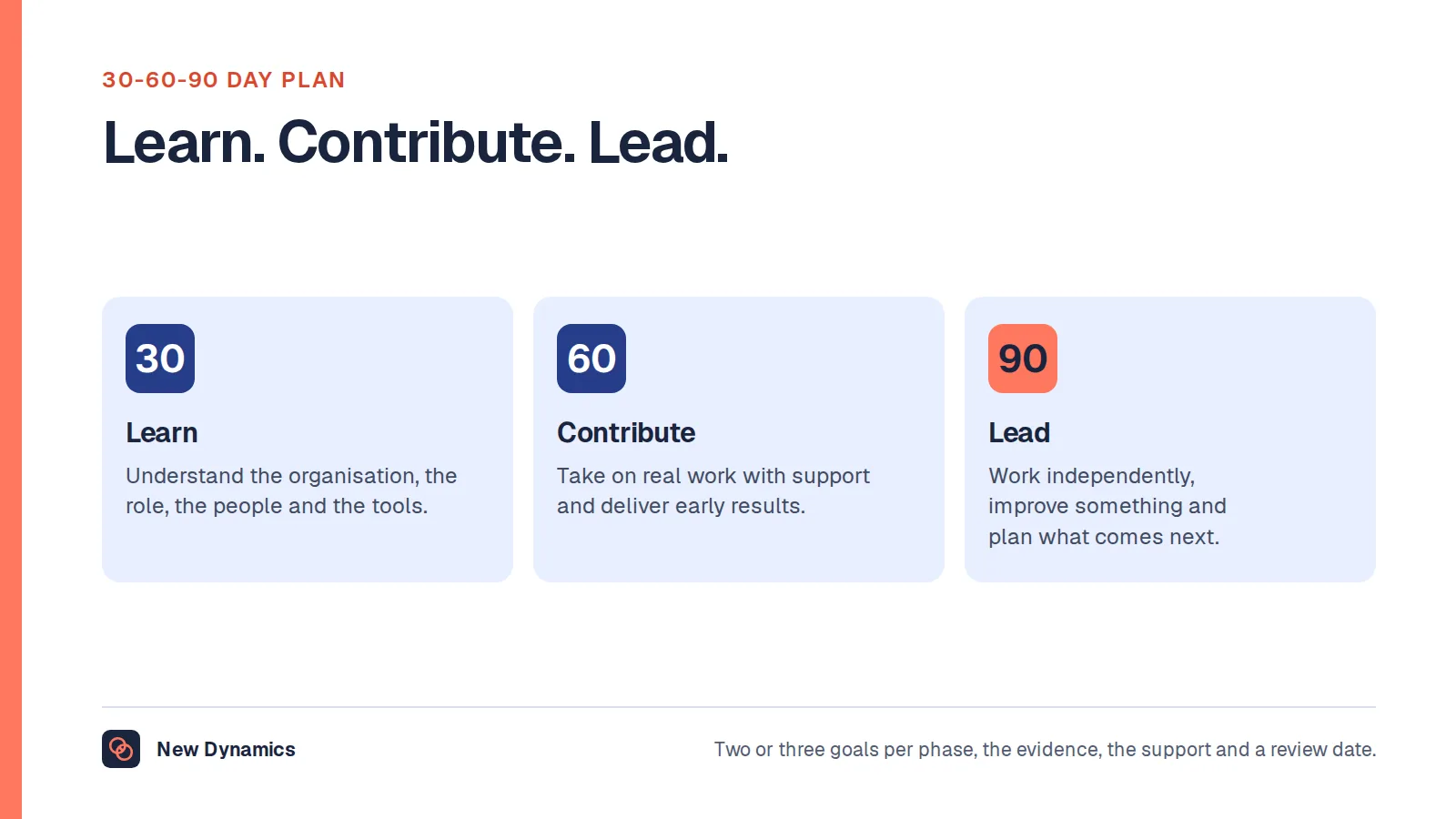
Example: a checklist covers equipment, introductions, first-week goals and a check-in at 30, 60 and 90 days. Our 90-day onboarding checklist is a ready-made starting point. For the goals that go with it, see our 30-60-90 day plan template and examples.
3. Pay, reward and benefits
Setting pay structures, running pay reviews and managing benefits, so that reward is competitive and fair.
Example: HR reviews pay by role and level, finds two people doing the same job on very different salaries and corrects the gap. Our compensation policy guide gives a framework.
4. Learning and development
Helping people build the skills the organisation needs now and next.
Example: new managers receive training in giving feedback before they hold their first reviews.
5. Performance management
Agreeing goals, giving feedback, reviewing progress and recognising good work.
Example: quarterly check-ins replace a single annual form, so that nothing in the formal review is a surprise. See performance reviews: the good, the bad and the ugly.
6. Employee relations
Handling grievances, discipline, absence and conflict fairly and consistently.
Example: HR advises a manager on how to investigate a complaint, keeps a record and makes sure the employee knows their right to appeal.
7. Engagement and wellbeing
Listening to employees and acting on what they say.
Example: a short survey shows that workload is the main concern in one team. The team agrees to drop two low-value reports. Our guide to running a workplace engagement survey explains the method.
8. Diversity and inclusion
Making sure people are treated fairly and can do their best work, whatever their background.
Example: HR checks promotion outcomes by group and finds that part-time staff are rarely promoted. It reviews the criteria. Our plain guide to the definition of discrimination at work explains the legal terms.
9. Compliance, policy and health and safety
Keeping the organisation within employment law and its own rules.
Example: HR reviews whether roles in the United States are correctly classified, using the tests we describe in exempt vs non-exempt employees.
10. HR operations, data and systems
Contracts, records, payroll inputs, reporting and the technology behind them.
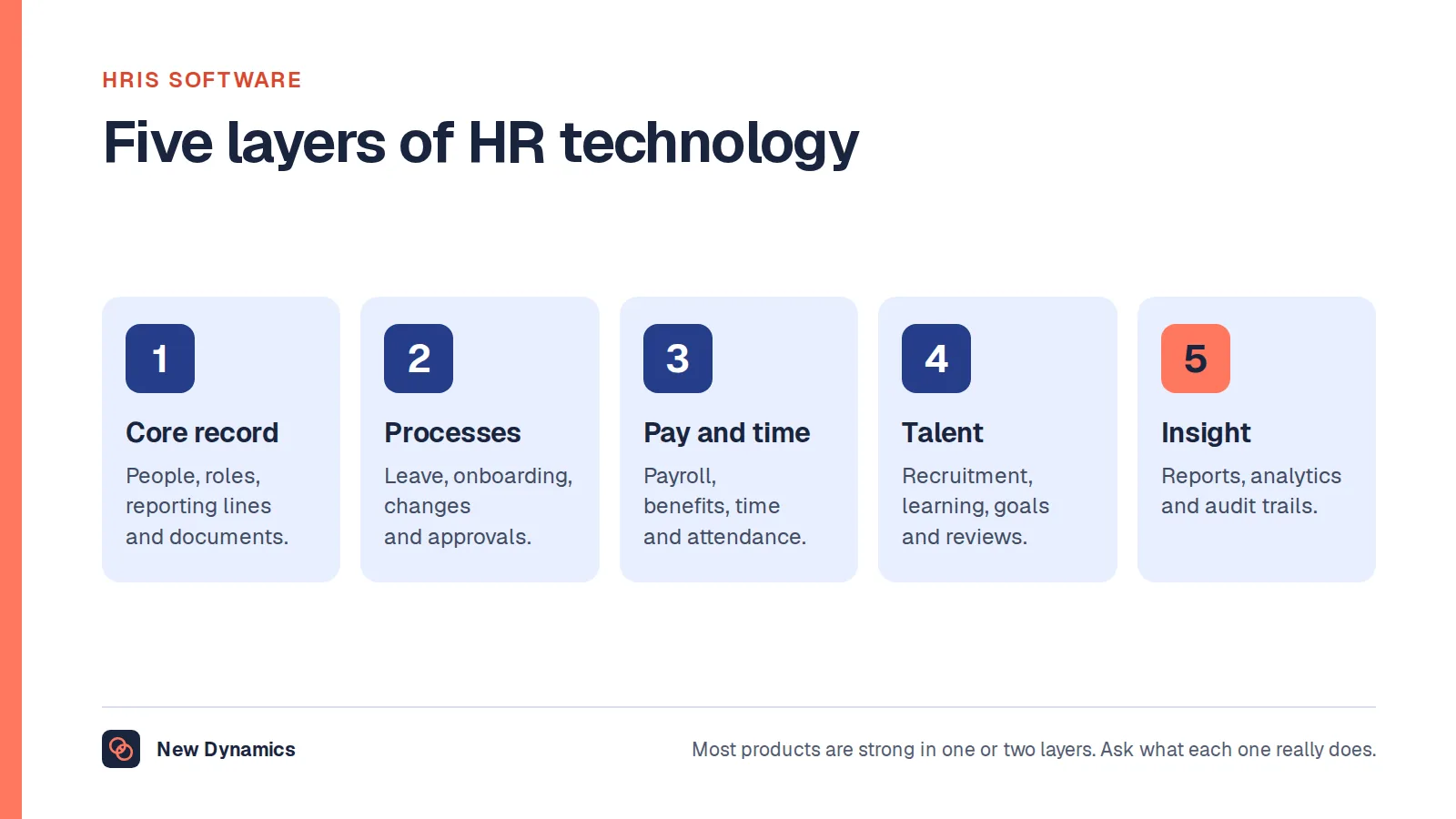
Example: moving from spreadsheets to an HR system, so that leave, reporting lines and documents live in one place. See HRIS software explained.
11. Organisation design and change
Shaping structures, roles and culture, and guiding people through change.
Example: two teams merge. HR helps to design the new structure, consults the people affected and supports their managers through the transition.
Why HR management is important
People decisions have legal consequences. Hiring, pay, discipline and dismissal are all regulated. Mistakes are costly and avoidable.
In many organisations, people are the largest cost and the main source of value. Hiring well, developing people and keeping good performers affects every other result.
Fairness builds trust. Consistent processes for pay, promotion and complaints give people confidence that effort will be recognised and problems will be heard.
Managers need support. Many managers were promoted for technical skill. HR gives them the tools, training and advice to lead people well. We describe those skills in characteristics of a great leader.
Change needs care. Restructures, new technology and growth all land on people. HR helps the organisation change without losing those it needs.
Someone has to hold the whole picture. Individual managers see their own teams. HR sees patterns across the organisation, such as where people are leaving and why.
HR management in small and large organisations
In a small business, there may be no HR department. The owner or an office manager does the work, often with outside advice. The functions above still exist. They are simply done by fewer people, with lighter processes. The priorities are usually sound contracts, clear policies, reliable payroll and a fair way of handling problems.
In a larger organisation, HR splits into generalists, often called HR business partners, who advise managers, and specialists in areas such as reward, recruitment, learning and employee relations. A shared services team handles administration.
The risk changes with size. Small organisations tend to suffer from too little process. Large ones can suffer from too much.

What good HR professionals bring
The CIPD's Profession Map describes the standards expected of people professionals. It asks them to be “an expert in people, an expert in work, and an expert in change”, and to work in ways that are “principles-led, evidence-based and outcomes-driven”.
In practice that means three habits:
- Principles-led: doing what is right and fair, including when it is inconvenient.
- Evidence-based: using data and research, as well as opinion, to decide.
- Outcomes-driven: judging HR work by what changes for people and the organisation. Activity alone proves nothing.
If you are building an HR career, our comparison of HR certifications covers the main credentials.
How to tell whether HR management is working
Look at outcomes. Counting HR activity tells you little. Useful signs include:
- good candidates accept your offers, and new starters stay beyond their first year;
- managers hold regular one-to-ones, and reviews contain no surprises;
- pay and promotion outcomes do not differ between groups in ways you cannot explain;
- employees say they know what is expected of them and that problems get dealt with;
- disputes are resolved early, and few become formal;
- people leave for reasons you understand, at a rate you can live with.
Choose a few indicators and track them over time. Our success indicator examples show how to pick measures that cannot easily be gamed.

Frequently asked questions
What is HR management?
HR management, or human resource management, is the work of attracting, developing, rewarding and looking after the people an organisation depends on, fairly and within the law. It designs the processes, advice and records that help every manager lead people well.
What are the main functions of HR?
The main functions are workforce planning and recruitment, onboarding, pay and reward, learning and development, performance management, employee relations, engagement and wellbeing, diversity and inclusion, compliance and policy, HR operations and systems, and organisation design and change.
Why is HR important?
HR is important because people decisions carry legal, financial and human consequences. Good HR helps an organisation hire well, develop and keep good people, treat them fairly, stay within the law and manage change. It supports managers, who make most people decisions.
What are the areas of HR?
There is no fixed number. Commonly listed areas include recruitment, reward, learning and development, performance management, employee relations, engagement and wellbeing, inclusion, compliance, HR operations and organisation design. Large organisations often have specialists in each.
What is the difference between HR and HRM?
In everyday use they mean the same thing. HR, or human resources, usually names the department or function. HRM, or human resource management, names the activity of managing people processes. Some writers use HRM to stress a more strategic approach.
Does a small business need HR?
Every business with employees has HR work to do, even without an HR department. A small business needs sound contracts, clear policies, reliable payroll and a fair way to handle problems. The owner or a manager can do this, with outside advice when needed.
Your next step: map who does what
- List the eleven functions above.
- Write beside each who is responsible today, and how well it is working.
- Pick the one gap that carries the most risk.
- Agree an owner and a first improvement.
For a worksheet that maps HR work across the employee journey, read and download our human resources management guide. The guide is free to read, and the PDF uses our short download form.
Want goals, feedback, reviews and onboarding in one connected system? Book a New Dynamics demo and bring your current process. You can also email contact@new-dynamics.com.