TL;DR
- Employee turnover is the rate at which people leave an organisation and are replaced. The turnover rate is the number of leavers in a period divided by the average headcount, multiplied by 100.
- One overall figure hides more than it shows. Split it four ways: voluntary, involuntary, early and regretted. The UK Civil Service, for example, reports a turnover rate and a separate resignation rate.
- Turnover costs fall into six groups: leaving, cover, hiring, training, lost output and knock-on effects. Estimate them for one role with your own figures before quoting anyone else's.
“What is our turnover?” is a question with two answers. Ask the finance director and you will hear about sales. Ask the HR director and you will hear about leavers. This article is about the second meaning, and about the number that goes with it.
It gives the meaning of employee turnover, shows how to calculate the turnover rate in five steps with a worked example, explains four ways to split the figure so that it becomes useful, sets out the six kinds of cost and lists the mistakes that make turnover numbers misleading.
One kind of turnover deserves early attention: new starters who leave within months. See how New Dynamics onboarding brings tasks, early goals and manager conversations into a clear path for a new starter.
What is turnover? Two meanings
The Cambridge Dictionary gives turnover two business senses.
- Business turnover: “the amount of business that a company does in a period of time”. In the UK this is the everyday word for sales or revenue, as when a company reports an annual turnover of £2 million.
- Employee turnover: “the rate at which employees leave a company and are replaced by new people”.
If you searched for what turnover means in a company, check which sense the speaker intends. A set of accounts means the first. An HR report means the second. The rest of this article deals with the second.
What is staff turnover?
Staff turnover, employee turnover and labour turnover all mean the same thing. The Cambridge Business English Dictionary defines labour turnover as “the rate at which employees leave a company and are replaced by new employees”. American English spells it labor turnover.
The turnover rate expresses this as a percentage: the share of the workforce that left during a period, usually a year.
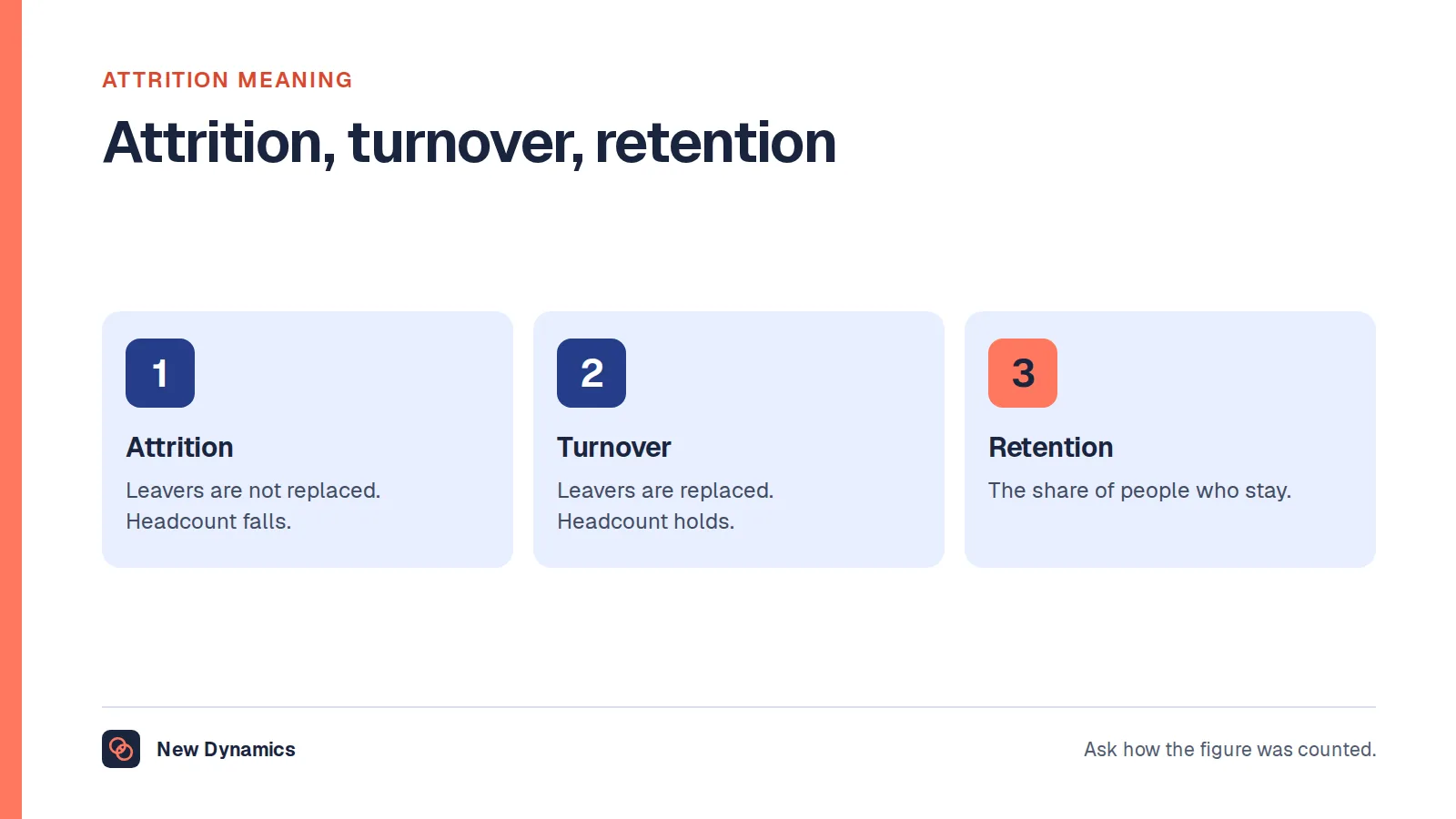
Two related words are often mixed up with it. Attrition, in its strict sense, means that leavers are not replaced, so the workforce shrinks. Retention is the opposite view: the share of people who stay. Our article on the meaning of attrition sets out the difference.
Why measure it at all? The CIPD's factsheet on employee turnover and retention says in its summary: “By understanding why staff leave an organisation, employers can devise initiatives that reduce turnover and increase employee retention.”
The turnover rate formula
Turnover rate = (number of leavers in the period ÷ average number of employees in the period) × 100
The average number of employees is usually the headcount at the start of the period plus the headcount at the end, divided by two. Where headcount swings during the year, as it does in seasonal businesses, average the twelve month-end figures.
How to calculate the turnover rate in five steps
Take a company that began the year with 190 employees and ended it with 210. During the year, 30 people left.
- Choose the period. Twelve months is standard. Shorter periods are useful for trends, but label them clearly.
- Count the leavers. Everyone whose employment ended in the period, whatever the reason: 30.
- Find the average headcount. (190 + 210) ÷ 2 = 200.
- Divide, and multiply by 100. 30 ÷ 200 × 100 = 15%.
- Split the result. Of the 30 leavers, 18 resigned, 8 were dismissed or made redundant, and 4 retired or reached the end of a fixed-term contract. That gives a voluntary rate of 9%, an involuntary rate of 4% and 2% for other reasons.
To turn a monthly rate into a rough annual one, multiply by twelve. Better still, use a rolling twelve-month total, which smooths out seasonal peaks.

Decide what counts, and write it down
Two organisations with identical leavers can publish different turnover rates, because they count differently. Decide the following, record the decisions and keep them the same from year to year.
- Which leavers? All of them, or only resignations? Do retirements, redundancies and the end of fixed-term contracts count?
- Which workers? Employees only, or agency staff and contractors too?
- Headcount or full-time equivalent? Headcount is usual for turnover.
- Internal moves. A transfer between departments is turnover for the department, but not for the organisation.
Official statistics show why this matters. The UK government's Civil Service Statistics 2025 bulletin explains its own rule: “Turnover rate includes all moves out of the Civil Service over each year to 31 March.” On that wording, a move from one department to another would not count.
Four ways to split the turnover rate
An overall rate tells you that people are leaving. It does not tell you whether to worry. Four cuts make it useful.
- Voluntary turnover. People who chose to go: resignations. This is the figure that most reflects how it feels to work for you.
- Involuntary turnover. People whom the organisation chose to let go: dismissals and redundancies. A high figure may point to hiring mistakes or to restructuring.
- Early turnover. Leavers with less than a year's service, as a share of all leavers or of all new starters. In the worked example, if 12 of the 30 leavers had less than a year's service, 40% of turnover is early. Look at recruitment, the accuracy of the job advert and the first ninety days. Our guide to employee orientation covers the first weeks.
- Regretted turnover. Leavers whom you would have wanted to keep, by an agreed definition such as strong performers or people in hard-to-fill roles. Define it before you look at the names.
The Civil Service bulletin gives a real example of the first cut. It reports that 38,610 people left the Civil Service in 2024/25, and that resignation was the most common reason, accounting for over half of leavers. It then states two rates side by side: “The turnover rate in the Civil Service fell to 7.1% from 7.5% in 2023/24. The resignation rate fell to 3.6% from 4.2% in 2023/24.”
After these four, cut the figure by department, manager, job, location, length of service and, where your numbers are large enough to protect anonymity, by groups such as sex, ethnicity and age. Patterns point to causes.

Turnover rate, retention rate and stability
| Measure | Formula | What it tells you |
|---|---|---|
| Turnover rate | Leavers in the period ÷ average headcount × 100 | How much leaving there was |
| Retention rate | People employed at the start who are still employed at the end ÷ headcount at the start × 100 | How many of your people stayed |
| Stability index | Employees with at least one year's service ÷ headcount a year ago × 100 | How much experience you are keeping |
The turnover rate and the retention rate do not add up to 100. In the worked example, suppose that 25 of the 30 leavers were among the 190 people employed at the start of the year, and the other 5 joined and left within it. Then 165 of the original 190 remain, a retention rate of 165 ÷ 190 × 100 = 86.8%, beside a turnover rate of 15%.
One post that is filled and vacated four times in a year produces four leavers and a high turnover rate, while the retention rate barely moves. Use the measures together.
What is a good turnover rate?
There is no single good figure. Rates differ widely between industries, jobs, countries and years, and a rate that would alarm a law firm may be normal for a seasonal business. Three comparisons are more useful than a universal benchmark.
- Against yourself. Is the rate rising or falling over several years?
- Against similar employers. Use sector figures from an official or professional source, and check that they count leavers as you do.
- Against your plans. Can you recruit and train fast enough to replace the people who go?
Some turnover is healthy. It brings in new skills, creates openings for promotion and allows people who are in the wrong job to move on. Zero turnover is not a target. The CIPD's factsheet has a section on when employee turnover becomes problematic, which is the right question to ask.
Turnover costs: six kinds
Published estimates of the cost of replacing an employee vary enormously, and some are repeated without a source. It is more reliable to estimate the cost for one of your own roles. Six kinds of cost are involved.
- Leaving costs. HR and payroll administration, exit interviews, pay in lieu of notice and accrued holiday pay.
- Cover costs. Overtime, agency staff or an acting-up allowance while the post is empty.
- Hiring costs. Advertising, agency fees, screening tools and the hours that managers spend shortlisting and interviewing.
- Training costs. Induction, courses and the time of the colleagues who train the new person.
- Lost output. The vacancy itself, and the months in which a new starter is not yet fully productive.
- Knock-on costs. Pressure on the remaining team, lost knowledge, disrupted customer relationships and, sometimes, further resignations.
The first four can be taken from invoices and timesheets. The last two are estimates, and can be the largest. Put your own numbers against each line for one common role, and you will have a figure that your finance director can trust.

How to reduce unwanted turnover
Find the cause before you choose the cure.
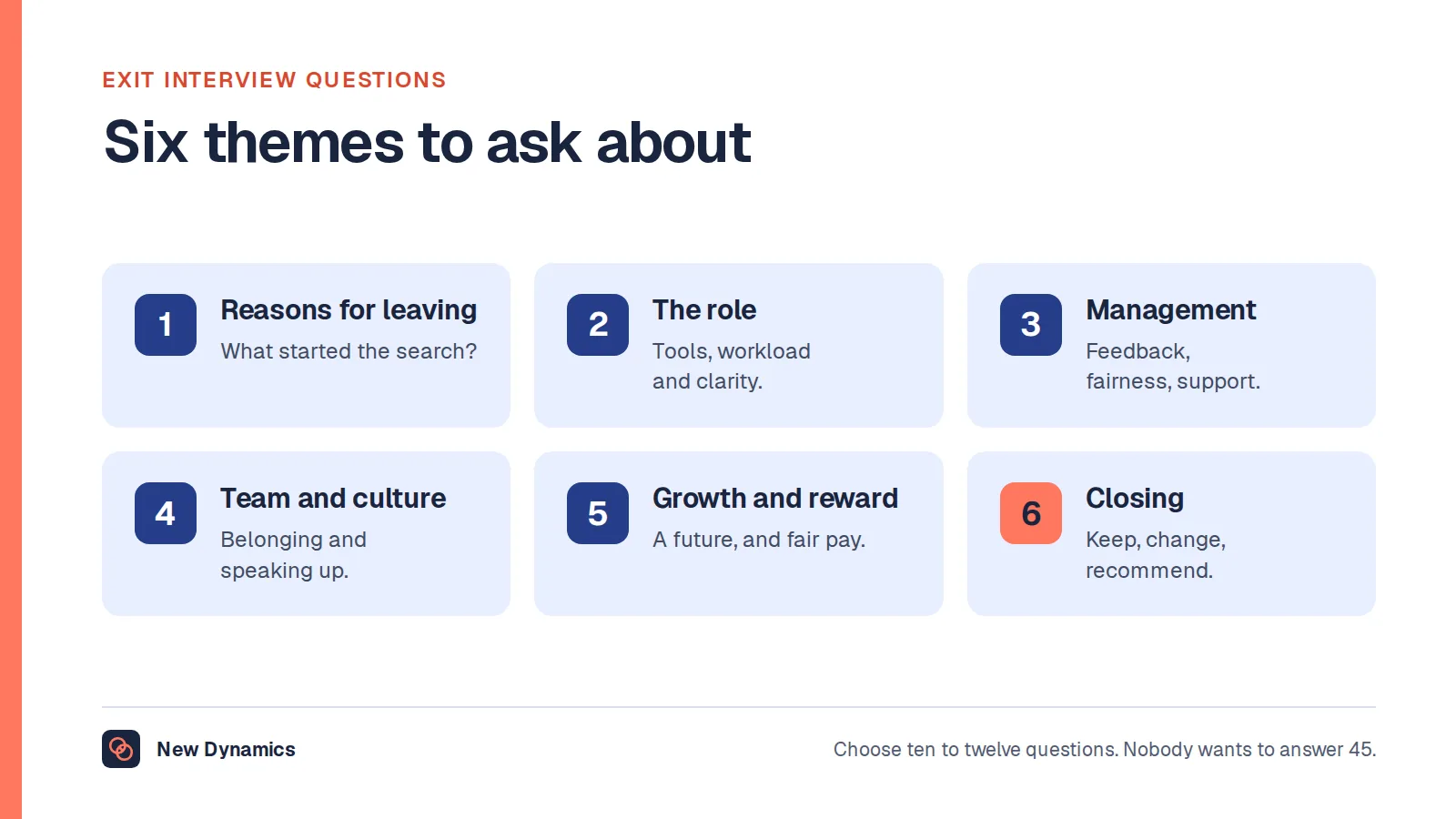
- Ask leavers, and listen. Use consistent exit interview questions, and analyse the answers by theme.
- Ask stayers. A short engagement survey and regular one-to-ones reveal problems while people can still be kept.
- Fix the first year. Give an honest picture of the job at recruitment, and a structured start.
- Check pay and fairness. Review pay against the market, and look at who gets promotion and development.
- Develop managers. The relationship with the line manager shapes much of a person's daily experience of work.
- Offer growth and flexibility. People stay where they can see a future and can fit work around life.
Common mistakes
Quoting one number. An overall rate without the four cuts cannot guide action.
Changing the definition. If this year's figure leaves out retirements and last year's included them, the trend is meaningless.
Dividing by the year-end headcount. In a growing or shrinking organisation this distorts the rate. Use the average.
Small-number panic. In a team of five, one leaver is 20%. Look at counts as well as percentages.
Treating all turnover as bad. Some departures are right for both sides.
Borrowing a cost figure. A statistic from an unknown source persuades nobody. Your own estimate does.
Frequently asked questions
What is turnover in a company?
The word has two meanings. In finance, turnover is the amount of business that a company does in a period, which is another word for sales or revenue. In HR, turnover is the rate at which employees leave a company and are replaced.
What is staff turnover?
Staff turnover, also called employee turnover or labour turnover, is the rate at which employees leave an organisation and are replaced by new people. It is usually reported as a percentage of the workforce over a year.
How do you calculate the turnover rate?
Divide the number of leavers in the period by the average number of employees in the period, and multiply by 100. For example, 30 leavers from an average headcount of 200 is a turnover rate of 15%.
What is the difference between voluntary and involuntary turnover?
Voluntary turnover is people who chose to leave, mainly through resignation. Involuntary turnover is people whom the organisation chose to let go, through dismissal or redundancy. Report them separately, because they have different causes and remedies.
What is a good employee turnover rate?
There is no universal figure. Rates differ between industries, jobs and years. Compare your rate with your own past, with similar employers that count leavers in the same way, and with your ability to recruit and train replacements.
What are turnover costs?
Turnover costs are the costs of people leaving and being replaced. They fall into six groups: leaving costs, cover for the vacancy, hiring, training, lost output while the post is empty and the new person learns, and knock-on effects on the team and customers.
Your next step: calculate four numbers
- Work out last year's overall turnover rate with the formula above.
- Split it into voluntary, involuntary and other.
- Count the leavers who had less than a year's service.
- Estimate the six costs for one common role.
Then choose one cause to work on. For a fuller method, read and download our employee retention guide. The guide is free to read, and the PDF uses our short download form.
Want structured onboarding, regular check-ins and clear goals, so that fewer good people leave? Book a New Dynamics demo and bring your current approach. You can also email contact@new-dynamics.com.