TL;DR
- At work, orientation is the training or preparation given to someone starting a new job. It usually covers the organisation, its rules and the practical things a new starter needs to know.
- There are two kinds: a formal company orientation, and the more important job orientation given by the new person's own supervisor about work rules, equipment and expectations.
- Orientation is the first part of onboarding, not the whole of it. In the UK the same thing is usually called induction, and workers have the right to be paid for the time.
You have accepted the job, and the email says: “Your orientation is on Monday at 9am.” If it is your first job, or your first in a large organisation, you may not know what that means, whether you will be paid or what to bring.
This article gives the definition of orientation in a work setting, explains what happens at one, separates it from onboarding and induction, answers the practical questions that new starters ask, and gives employers a six-part plan.
Orientation is where a new starter's first goals should be set. See how New Dynamics onboarding brings tasks, early goals and manager conversations into a clear path for a new starter.
What does orientation mean?
The word has several meanings. It can refer to the direction something faces, or to a person's beliefs or preferences. At work it has a specific sense. The Cambridge Dictionary defines this meaning of orientation as “training or preparation for a new job or activity”, with the example “The department has arranged an orientation session.”
The open textbook Introduction to Business, published by OpenStax, gives the HR version in its section on employee training and development: “New-employee training is essential and usually begins with orientation, which entails getting the new employee ready to perform on the job.”
So a job orientation is the event, or short series of events, at the very start of employment in which a new person is welcomed, given the information they need and shown how things work.
Two kinds of orientation
OpenStax describes two kinds, and is clear about which matters more.
Formal company orientation. This is “often a half-day classroom program”. It “provides information about the company history, company values and expectations, policies, and the customers the company serves, as well as an overview of products and services”.
Job orientation by your supervisor. OpenStax continues: “More important, however, is the specific job orientation by the new employee's supervisor concerning work rules, equipment, and performance expectations.” This second briefing “tends to be more informal and may last for several days or even weeks”.
Many employers do the first kind well and neglect the second. A new starter can leave a polished welcome session and still not know what they are supposed to do on Tuesday.

Orientation, induction and onboarding
| Term | Meaning | Typical length |
|---|---|---|
| Orientation | The welcome and initial briefing: organisation, rules, practicalities, first look at the job | Hours to a few days |
| Induction | The usual British word for the same process, sometimes covering the first weeks | Days to weeks |
| Onboarding | The whole journey from accepting the offer to being fully effective in the role | About three months, sometimes longer |
| Probation | A formal period in which a new worker's performance is assessed | Often three to six months |
Acas, the workplace advice service for Great Britain, defines an induction as “the process of welcoming someone to an organisation or role”, and notes that it is “sometimes called ‘onboarding’”. It adds: “An induction is not the same thing as a probation period.” The two might happen at the same time.
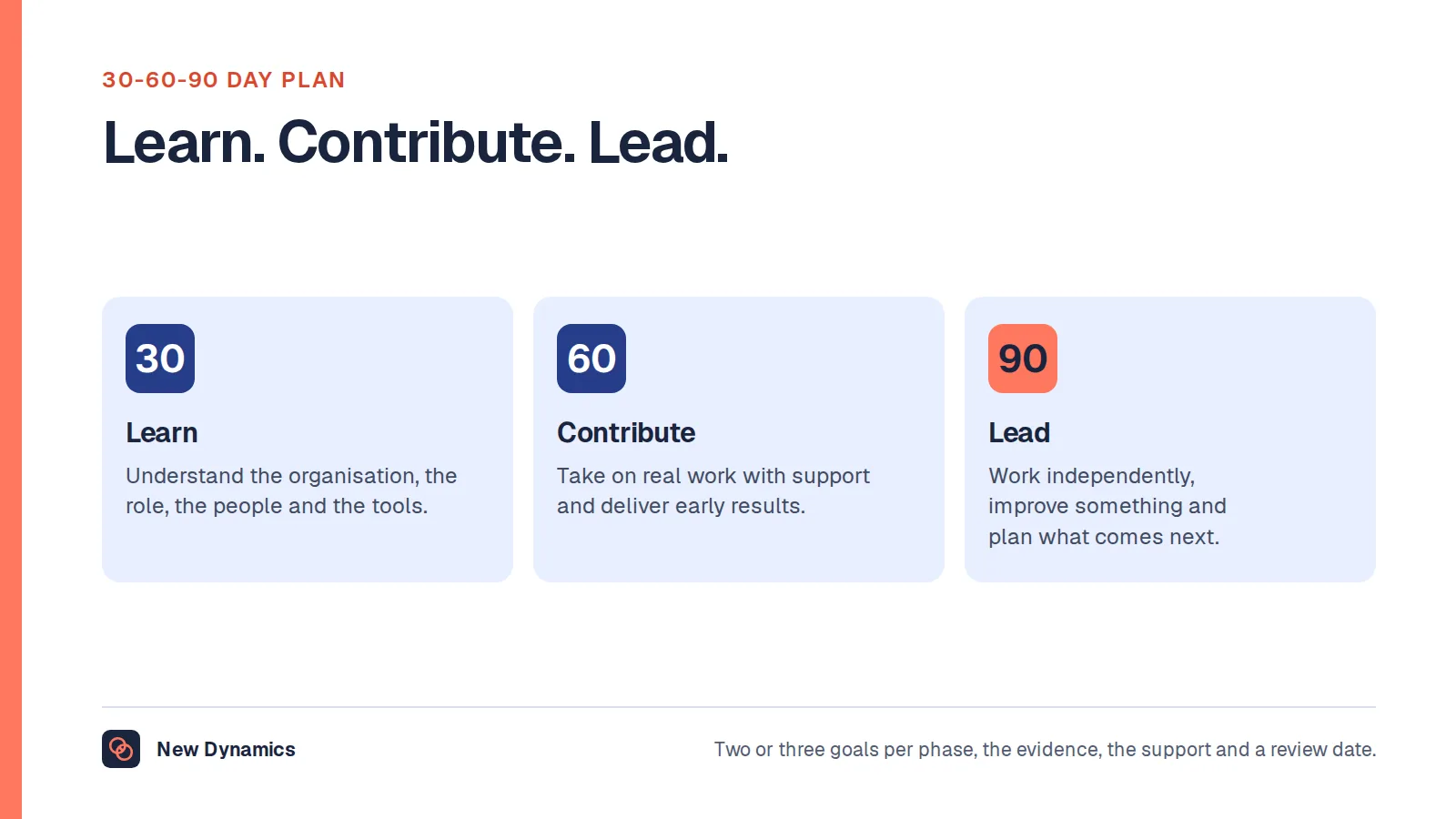
In short, orientation is the first part of onboarding. Our 30-60-90 day plan covers the rest.
What to expect at a job orientation
Every employer is different, but a typical first day includes:
- paperwork: contract, right-to-work and identity checks, bank and tax details;
- a welcome: an introduction to the organisation, its purpose and how it is structured;
- policies: conduct, health and safety, data protection, absence and holidays;
- practicalities: building access, equipment, system logins, where things are;
- people: your manager, your team and, in a good organisation, a buddy;
- the job: what you will be working on, how your performance will be judged and what the first week looks like.
Questions new starters ask
Does orientation mean that I got the job? Yes, in the normal case. Orientation comes after you have accepted an offer. If an employer invites you to an “orientation” before making an offer, ask whether it is part of the selection process.
Is orientation paid? In Great Britain, Acas says: “Workers have the right to be paid for any hours they work from the first day of employment. This includes any time they spend on induction.” Rules differ elsewhere, so check locally. This is general information, not legal advice.
What should I bring? Whatever the employer asks for, which usually means identity and right-to-work documents and bank details. Bring a notebook, and questions.
What should I wear? Ask beforehand. If nobody answers, dress slightly smarter than you expect the team to.
How long does it last? Anything from an hour to several days. OpenStax notes that the supervisor's job orientation may last “for several days or even weeks”.
A six-part orientation plan for employers
Acas advises that “you should plan a worker's induction before they start”. It adds: “You should tailor an induction plan to the new worker.” Someone starting their first job might need a more detailed induction than someone with experience.
- Before day one. Send what Acas calls an induction pack: what to expect on the first day, and practical information such as dress code and building access. Have equipment and logins ready.
- The welcome. Someone should be expecting the new person. Introduce the team, and explain what the organisation does and why.
- The essentials. Cover contracts, policies and safety. The Health and Safety Executive says that employers must give workers “clear instructions and information, as well as adequate training and supervision”, and names new recruits among those with particular training needs.
- The job. The manager explains the role, the work rules, the tools and what good performance looks like. This is the part that OpenStax calls more important.
- A buddy. Acas suggests “assigning a mentor or ‘buddy’”: someone in the team who helps the new worker to settle in.
- First goals and a check-in. Agree what the person should achieve in the first week and month, and book a conversation at the end of week one.
Acas also reminds employers to spread activities out “so the worker is not overwhelmed”, and to consider whether a worker needs any reasonable adjustments.

Common mistakes
Information overload. Eight hours of slides on day one, most of it forgotten by day two. Spread it over the first week.
All company, no job. The new starter learns the history of the firm and not what to do tomorrow.
Nobody is ready. No desk, no laptop, no login and a manager who is on holiday. First impressions last.
One size for everyone. A graduate, an experienced hire and a remote worker need different things. Acas's advice to tailor the plan applies.
Forgetting remote starters. Send equipment early, schedule video introductions and check in daily in the first week.
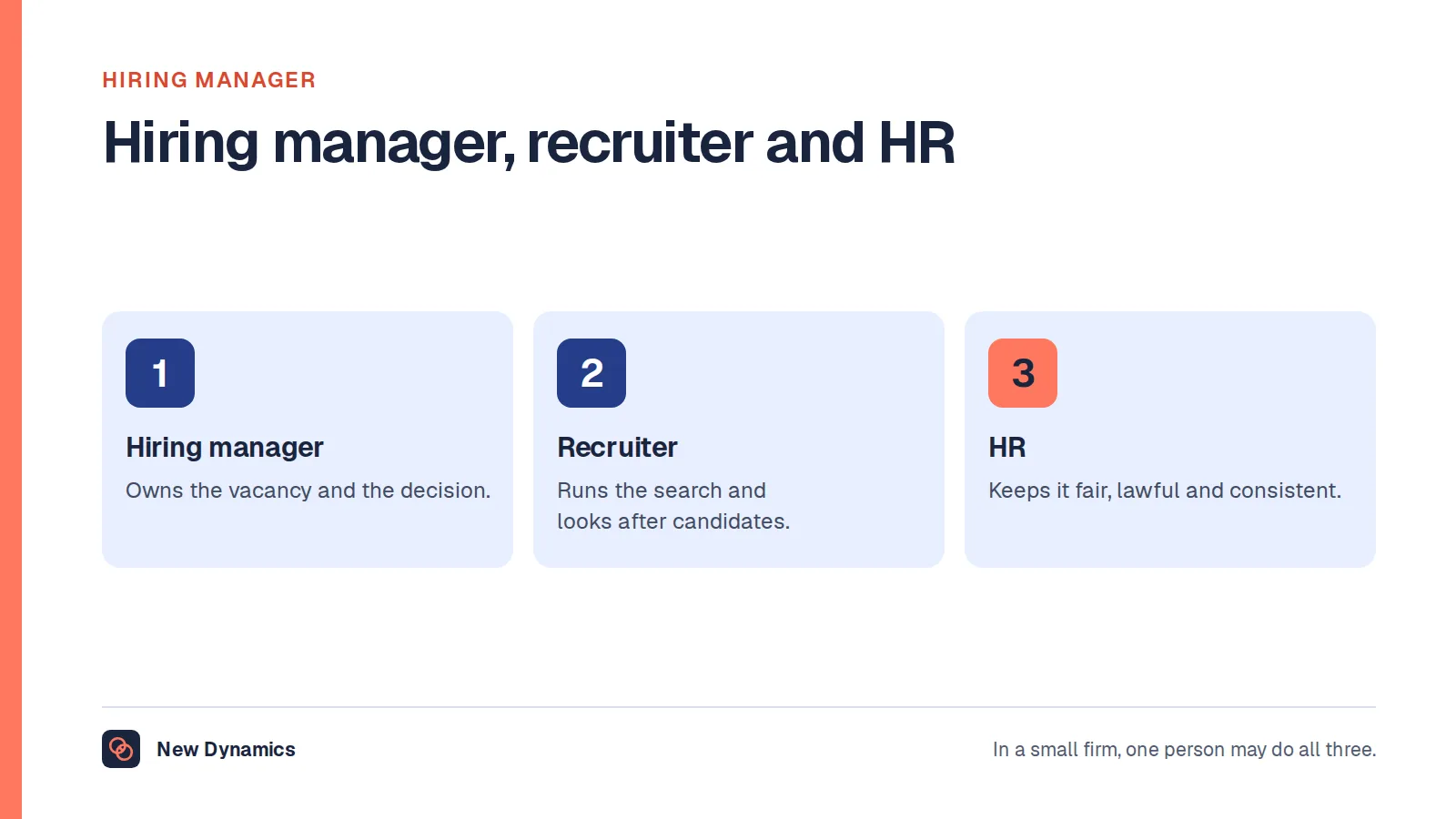
Finally, do not treat orientation as the end. If it is not followed by goals, feedback and regular one-to-ones, it fades quickly. Our guide to the hiring manager explains who owns what comes next.

Frequently asked questions
What is the definition of orientation?
At work, orientation is training or preparation for a new job. It is the welcome and initial briefing in which a new employee learns about the organisation, its rules and practical arrangements, and is prepared to start doing the job.
What does orientation mean for a job?
It means the first session, or first few days, of your employment, in which you complete paperwork, meet your manager and team, learn the policies and find out what you will be doing. It normally happens after you have accepted an offer.
Is orientation the same as onboarding?
No. Orientation is the first part of onboarding. Onboarding is the whole process of bringing someone into the organisation until they are fully effective, which usually takes about three months. In the UK, orientation is more often called induction.
Do you get paid for orientation?
In Great Britain, Acas says that workers have the right to be paid for any hours they work from the first day of employment, including time spent on induction. Rules differ in other countries, so check what applies where you work.
How long does a job orientation last?
It varies from an hour to several days. OpenStax describes a formal company orientation as often a half-day classroom programme, followed by a job orientation from the supervisor that may last for several days or even weeks.
What should an orientation include?
It should include preparation before day one, a welcome and introductions, the essential paperwork, policies and safety information, a briefing on the job from the manager, a buddy, and first goals with an early check-in.
Your next step: check your day one
- If you are starting a job, write down three questions to ask at orientation: what the first week looks like, how you will be judged and whom to ask for help.
- If you are hiring, walk through your next starter's first day hour by hour. Find the gaps.
- Make sure that the manager, and not only HR, has time booked with the new person on day one.
- Book the end-of-week-one conversation now.
For a complete plan, read and download our employee onboarding guide. The guide is free to read, and the PDF uses our short download form.
Want every new starter to have goals and check-ins from the first week? Book a New Dynamics demo and bring your current first-day plan. You can also email contact@new-dynamics.com.