TL;DR
- In HR, attrition is a reduction in the number of employees that comes from not replacing people who leave, rather than from making anyone leave. British English calls it natural wastage.
- Strictly, attrition shrinks the workforce and turnover does not, because under turnover the leavers are replaced. In everyday use, many people say attrition for any departure, so check which meaning is intended.
- The attrition rate is leavers divided by average headcount, times 100. The number only becomes useful when you ask who left, when, why, whether they chose to go and whether you wanted to keep them.
“We will reduce headcount through attrition.” The sentence turns up in restructuring announcements, and it is meant to reassure: nobody will be pushed. “Our attrition is too high.” That sentence turns up in board reports, and it means something close to the opposite: too many people are choosing to go. One word is doing two jobs.
This article gives the meaning of attrition at work, separates it from turnover and natural wastage, shows how to calculate an attrition rate, and sets out the questions that make the number useful.
People usually signal that they are unhappy long before they resign. See how New Dynamics continuous feedback gives every employee a regular voice.
What does attrition mean?
In general English, attrition means a gradual wearing down, as in “a war of attrition”. The business meaning is narrower.
The Cambridge Dictionary's business entry defines attrition as “a reduction in the number of employees in a company made by not replacing those who leave, rather than forcing people to leave their jobs”. Its examples show both of the uses in our opening paragraph: “The majority of jobs will go through natural attrition” and “Staff attrition rates are high.”
Cambridge labels this business sense American, and gives the British equivalent as natural wastage: “a reduction in the number of people who work for an organization that is achieved by not replacing those people who leave”.
The same dictionary lists a marketing sense, customer attrition, which is a reduction in the number of people who buy a product or service. This article is about employees.
Attrition, turnover and retention
- Attrition. People leave and are not replaced. Headcount falls. People retire, resign or move on, and the posts are left empty or removed.
- Turnover. People leave and are replaced. Headcount holds, but there are costs: recruitment, training and lost knowledge. The CIPD's factsheet on employee turnover and retention says in its summary: “Employee turnover can have a negative impact on an organisation's performance.”
- Retention. The other side of the coin: the share of people who stay over a period.
That is the strict distinction. In everyday use it is blurred. Many HR teams say “attrition rate” for the share of employees who leave, whether or not they are replaced, which makes it another name for the turnover rate. Neither use is wrong. When someone quotes an attrition figure, ask how it was counted.

Types of attrition
- Voluntary. The employee chooses to go: resignation, or retirement.
- Involuntary. The employer ends the employment: dismissal, redundancy, the end of a fixed-term contract. Under the strict meaning of attrition, these are not attrition at all.
- Internal. The person leaves the team and stays in the organisation. It is a loss to the manager, and often a gain to the employer.
- Regretted and non-regretted. Whether you wanted to keep the person. A low-performing employee who moves on is a different event from the loss of your best engineer.
- Early. Leavers in their first months. These are the most avoidable, and they point to hiring or onboarding.
Attrition as a way to reduce headcount
When an organisation needs fewer people, letting attrition do the work is the gentlest method. Nobody loses a job. Vacancies are simply not filled. GOV.UK's guidance for employers on avoiding redundancies lists “restricting recruitment” among the steps to take to avoid compulsory redundancies, along with seeking volunteers, reducing overtime and filling vacancies elsewhere in the business with existing employees.
It has limits.
- It is slow, and you cannot set the pace.
- It is unplanned. The people who leave are not necessarily in the posts that you need to lose. You may shrink the team that you wanted to grow.
- It loads those who stay. If work is not removed when posts are, the remaining people absorb it. That produces more attrition, of the kind that you did not want.
- It can lose the wrong people. Those with the best options elsewhere find it easiest to leave.
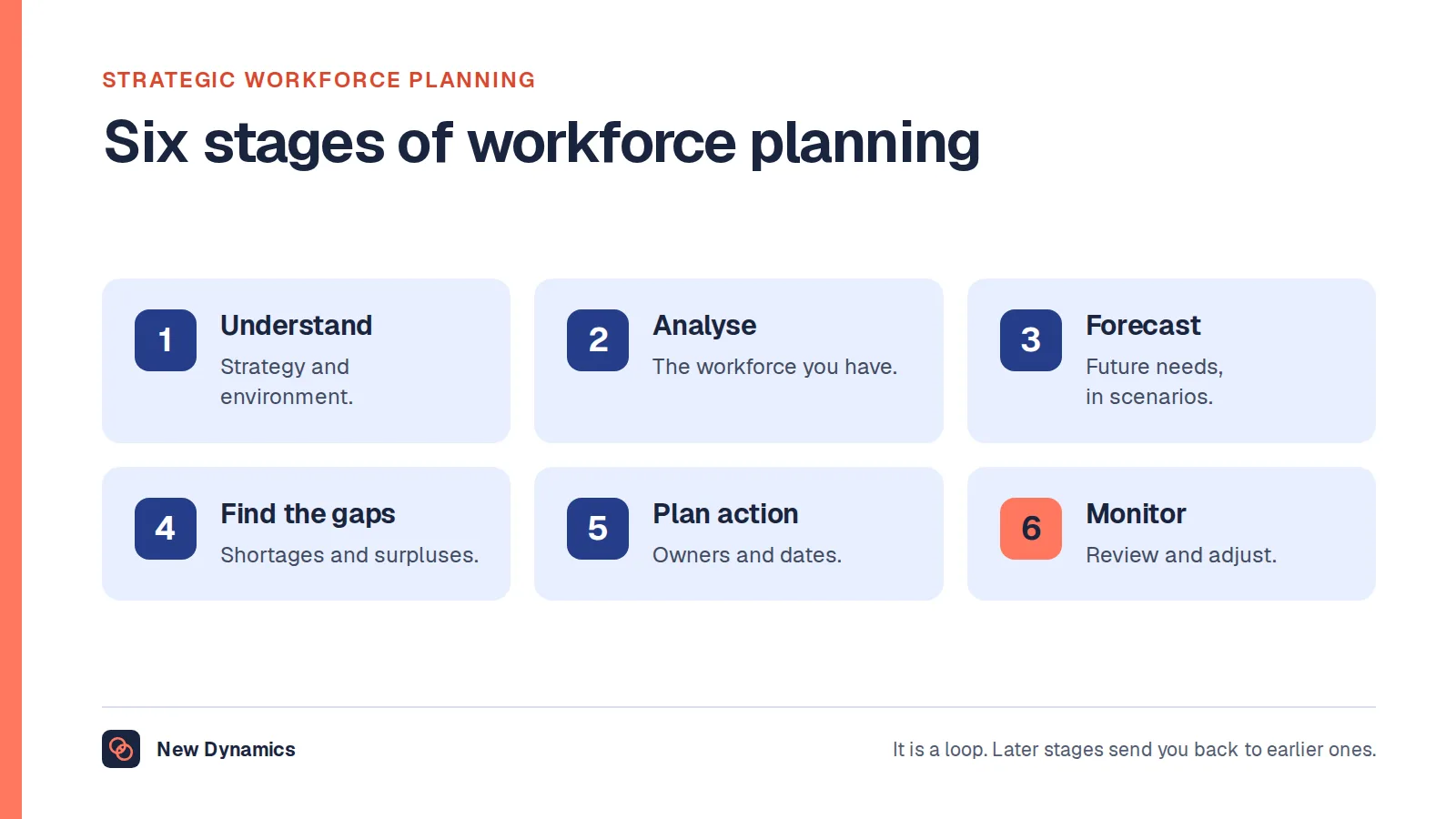
Used with a hiring freeze and no plan, attrition is a way of letting chance redesign your organisation. Used as part of a workforce plan, with redeployment and retraining, it is humane and effective. Our guide to strategic workforce planning explains the planning side, and our plain guide to the definition of redundancy covers the alternative.
How to calculate the attrition rate in five steps
The usual formula is simple.
Attrition rate = (number of leavers in the period ÷ average number of employees in the period) × 100
- Choose the period. A month, a quarter or a year. Annual figures are easiest to compare.
- Count the leavers. Decide what you are counting, and say so: all leavers, voluntary leavers only, or only leavers who were not replaced.
- Find the average headcount. Add the headcount at the start and at the end of the period, and divide by two. For a year, an average of the twelve monthly figures is better.
- Divide and multiply by 100.
- Break it down. By team, role, length of service, location and reason. The overall figure hides more than it shows.
A worked example. A company starts the year with 190 employees and ends it with 210, so the average headcount is 200. During the year 24 people leave. The rate is 24 ÷ 200 × 100, which is 12%. Of the 24, 18 resigned, so the voluntary rate is 9%. Four posts were not refilled, so attrition in the strict sense is 2%.
Two cautions. Monthly rates jump about in a small organisation, where one leaver can move the figure by several points. And a rate says nothing about how long people stayed. If most of your leavers go within a year of joining, your average looks the same as that of an employer whose people leave after ten years, and your problem is quite different.

Is attrition good or bad?
Neither, by itself. Some attrition is healthy. It brings in new ideas, opens promotions for those who stay, and lets people who are in the wrong job move on. No attrition at all can mean that people are stuck.
It becomes a problem when the people who leave are those you most want to keep, when they leave early, when the losses cluster in one team, or when the rate is high enough that teams are always training and never settled. There is no universal “good” rate. Rates differ between sectors and between jobs, so compare yourself with your own past and with similar employers.
Five questions to ask of the number
- Who? Which roles, teams, grades and groups are leaving? Check whether any group is leaving at a higher rate than others.
- When? After how long? Early leavers point to hiring and onboarding. Leavers at two or three years may point to development.
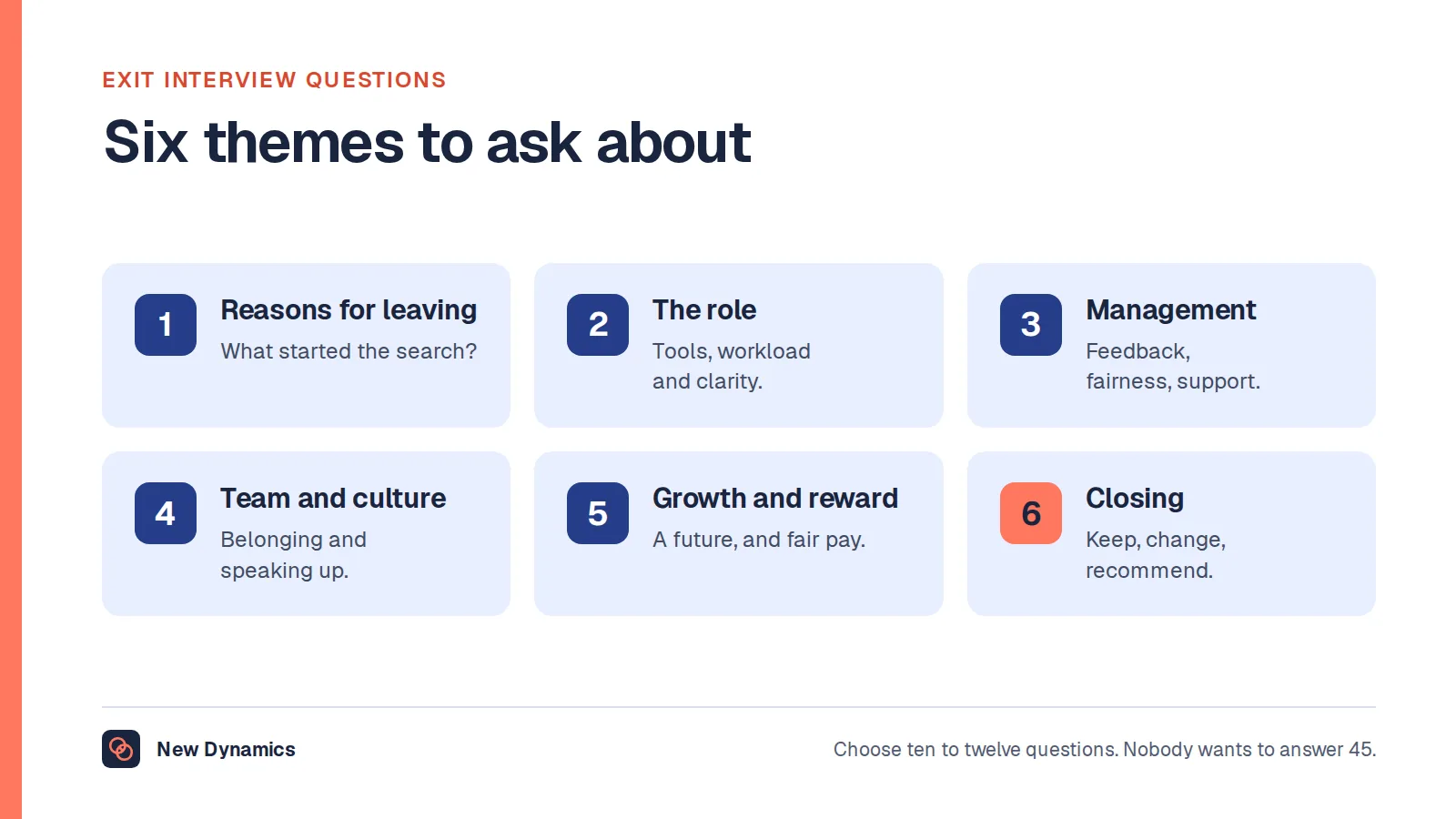
- Why? What do exit interviews and surveys say, and what do the people who stay say? Our exit interview questions help you to ask.
- Voluntary? Did they choose to go, or did you end the employment?
- Regretted? Would you have kept them if you could?
A single manager's team with three regretted, voluntary, early leavers in a year is a finding. A company-wide rate of 12% is only a number.

How to reduce unwanted attrition
The CIPD's summary names practices that improve retention, “such as flexibility, fair treatment and employee wellbeing”. In practical terms:
- Hire honestly. Describe the job as it is. Some early leavers were sold a different job.
- Onboard properly. The first ninety days decide a great deal.
- Train managers. People's daily experience of work is mostly their experience of their manager.
- Talk about development at least twice a year, and make internal moves easy.
- Pay fairly, and explain how pay is decided.
- Offer flexibility where the work allows.
- Ask before people leave. “Stay” conversations with your best people are worth more than exit interviews.
- Act on what you hear. A survey with no action teaches people not to answer.
Common mistakes
One number for everything. An overall rate hides the team where half the people left.
Mixing definitions. Comparing your all-leavers rate with someone else's voluntary rate.
Celebrating low attrition. It can mean contentment. It can also mean that people have nowhere to go, or that poor performance is tolerated.
Treating attrition as a free way to cut costs. Without removing work, it moves the cost to the people who remain.
Exit interviews as the only source. Departing employees are often polite. Ask those who stay.
Blaming pay by default. Pay matters. It is rarely the whole story.
Frequently asked questions
What does attrition mean?
In HR, attrition means a reduction in the number of employees that comes from not replacing those who leave, rather than forcing anyone to leave. In everyday use, it often means employees leaving for any reason. The general meaning of the word is a gradual wearing down.
What is the difference between attrition and turnover?
Strictly, attrition means that leavers are not replaced, so headcount falls. Turnover means that leavers are replaced, so headcount holds. Many organisations use the two words interchangeably, so check how a figure was counted.
How do you calculate the attrition rate?
Divide the number of leavers in a period by the average number of employees in that period, and multiply by 100. If 24 people leave in a year and the average headcount is 200, the rate is 12%.
What is natural wastage?
Natural wastage is the British term for attrition in the strict sense: a reduction in the number of people who work for an organisation, achieved by not replacing those who leave.
What is a good attrition rate?
There is no universal figure. Rates differ between sectors and jobs. Compare your rate with your own past and with similar employers, and look at who is leaving, when and why.
Is attrition the same as redundancy?
No. With attrition, people leave of their own accord or retire, and the post is not refilled. Redundancy is a dismissal because the job is no longer needed. Restricting recruitment is one of the steps that GOV.UK lists for avoiding compulsory redundancies.
Your next step: split your number
- Work out your leaver rate for the past twelve months with the formula above.
- Split it into voluntary and involuntary, and into leavers in their first year and the rest.
- Find the two teams with the highest rates, and ask why.
- Hold one stay conversation this month with someone you would hate to lose.
For a fuller approach to keeping the people you need, read and download our employee retention guide. The guide is free to read, and the PDF uses our short download form.
Want to hear concerns while there is still time to act? Book a New Dynamics demo and bring your current approach. You can also email contact@new-dynamics.com.