TL;DR
- An exit interview is a voluntary conversation with someone who is leaving, held to understand why they are going and what the organisation could do better.
- Ask open questions about the decision to leave, the role, the manager, the culture, growth and reward. Use a neutral interviewer, and be honest about the limits of confidentiality.
- One interview is an anecdote. The value comes from recording answers consistently, reviewing the themes every quarter and telling current employees what changed.
Someone hands in their notice. There is a card, a collection and a slightly awkward speech. And then a person who knows exactly what it is like to work in your organisation walks out of the door, taking that knowledge with them.
An exit interview is the chance to ask before they go. This article gives you 45 exit interview questions grouped by theme, a free template, an exit survey you can copy and a process for turning the answers into action.
The best time to hear a concern is before someone resigns. See how New Dynamics continuous feedback helps managers and employees to raise issues while there is still time to fix them.
What is an exit interview?
An exit interview is a conversation with an employee who is leaving, held to understand why they are going and what the organisation could do better. It is usually voluntary, takes 30 to 60 minutes and happens during the notice period.
An exit survey asks similar questions in a written form. Many organisations use both: a short survey for comparable data, and a conversation for the story behind it.
Exit interviews have three purposes.
- To learn why people leave, so that you can keep others.
- To spot patterns, such as one team, manager or stage of employment that loses more people than the rest.
- To part well. People who leave on good terms may recommend you, refer candidates and sometimes return.
Why exit interviews matter
A single interview tells you little. A pattern can change an organisation.
Everett Spain and Boris Groysberg open their Harvard Business Review article Making Exit Interviews Count with an example. An international financial services company hired a midlevel manager to oversee a department of 17 employees. A year later, only eight remained. An executive read the exit interviews of the four who had resigned and found that they had all told the same story: the manager lacked critical leadership skills. The interviews also pointed to a deeper problem. The organisation was promoting managers on the basis of technical skill, not managerial skill, and the executive committee changed its promotion process as a result.
That is the point of the exercise. The value lies in what the organisation does with what it hears.

45 exit interview questions by theme
Choose ten to twelve for a conversation. Nobody wants to answer 45.
Reasons for leaving
- What prompted you to start looking for another role?
- Was there a particular moment when you decided to leave? What happened?
- What does your new role offer that this one did not?
- Which factors mattered most in your decision: the work, your manager, pay, progression, flexibility or something else?
- Did you raise your concerns with anyone before you decided to leave? What happened?
- What could we have done to keep you?
- Would anything have changed your mind in the past six months?
The role and the work
- How closely did the job match what you were told when you joined?
- Which parts of the work did you enjoy most? Which least?
- Did you have the tools, information and training to do the job well?
- Was your workload manageable?
- Were your goals and priorities clear?
- Did you have enough freedom to decide how to do your work?
- What would you change about the role for the next person?
Your manager
- How would you describe your working relationship with your manager?
- How often did you receive useful feedback?
- Did you have regular one-to-ones? Were they worth your time?
- Did you feel recognised for your work?
- Did your manager support your development?
- Were you treated fairly?
- What could your manager do differently?
Team and culture
- How would you describe the culture here to a friend?
- How well did your team work together?
- How well did other teams work with yours?
- Did you feel that you belonged here?
- Did you feel able to raise concerns or disagree openly?
- Did you ever experience or witness behaviour that concerned you, such as bullying, harassment or discrimination?
- Do leaders here act in line with the values they talk about?
- How well did the organisation communicate about decisions that affected you?
Growth, pay and conditions
- Could you see a future for yourself here?
- Did you have the opportunities to learn and progress that you wanted?
- How did your pay and benefits compare with your new role?
- Did you feel that pay decisions were fair and explained?
- Did our flexible working arrangements meet your needs?
- How was your wellbeing affected by working here?
The employee journey
- How well did recruitment and onboarding prepare you for the job?
- How useful were your performance reviews?
- Which policies or processes got in your way?
- How well have we handled your departure so far?
Closing questions
- What should we keep doing, whatever else changes?
- What is the first thing you would change if you ran this organisation?
- Would you recommend us as a place to work? Why, or why not?
- Would you consider returning in the future?
- Is there anything that we have not asked and should have?
- May we contact you in six months to ask how you see things with some distance?
Question 45 is worth keeping. People may be more candid once they have settled elsewhere.
Free exit interview template
You can download our free exit interview template as an editable CSV that opens in Excel, Google Sheets or any spreadsheet tool. No form is required. It covers the steps before, during and after the interview, with a core set of questions.
Here is the structure on one page.
| Stage | What to do |
|---|---|
| Before | Invite the leaver and explain that it is voluntary. Choose a neutral interviewer. Share the questions in advance. |
| Open | Thank them. Explain the purpose, who will see the notes and the limits of confidentiality. |
| Ask | Ten to twelve open questions across the themes. Listen, and ask for examples. Do not defend or argue. |
| Close | Ask what you have missed. Let them read and correct your notes. Thank them again. |
| After | Record the main reasons using standard categories. Follow up on any serious allegation. Review the themes every quarter and agree actions. |
Exit survey template
A short survey makes answers comparable over time. Keep it to about a dozen items, and use the same ones for everyone.
Ask people to rate each statement from 1 (strongly disagree) to 5 (strongly agree):
- My job matched what I was told when I joined.
- I had the tools and training that I needed.
- My workload was manageable.
- My manager gave me useful feedback.
- I felt recognised for my work.
- I could see a future for myself here.
- I was paid fairly for my work.
- I felt able to raise concerns.
- I was treated with respect.
- I would recommend this organisation as a place to work.
Then ask three open questions:
- What was the main reason for your decision to leave?
- What could we have done to keep you?
- What is one thing we should change?
Add a list of standard reasons for leaving, such as career progression, pay, manager, workload, flexibility, relocation and personal reasons. Let people choose a main reason and a secondary one. Our workplace engagement survey questions use a similar format, which lets you compare leavers with those who stay.

How to run an exit interview
Make it voluntary. Some people will prefer not to take part, and a forced interview yields little.
Choose the interviewer with care. People rarely speak freely to the manager they are leaving. HR, a manager from another team or the manager's own manager will usually hear more. One council's published exit interview procedure for schools says that the line manager normally conducts the interview, but that the employee may prefer the manager's manager or the personnel team.
Time it well. The middle of the notice period works best. On the last day, people are distracted. In the first days after resigning, feelings may be raw.
Be honest about confidentiality. Explain who will see the notes and how they will be used. Do not promise total secrecy. The same council procedure tells managers to explain that allegations raised may be investigated, and says that the notes will not be placed on the employee's personnel file. If someone reports harassment or discrimination, you will need to act. Our guide to the definition of discrimination at work explains the terms.
Listen. Do not defend. The aim is to understand. Ask for examples, reflect back what you heard and thank the person for their candour. This is not the moment to correct their version of events or to make a counter-offer.
Let them check the notes. Invite the leaver to read your notes and correct anything that is wrong.
Handle the data properly. Notes about an identifiable person are likely to be personal data under data protection law. Keep them secure, share them only with people who need them and follow your retention rules. See our employee data protection guide.
What to do with the answers
- Record consistently. Use the same reason categories and the same survey items for everyone.
- Look for patterns every quarter. Review by team, manager, role, length of service and location. Look at who is leaving as well as why. Losing your best people in their second year is a different problem from general turnover.
- Protect individuals. Report themes. In small teams, combine periods so that nobody can be identified.
- Agree actions with leaders. Pick one or two changes per quarter, each with an owner.
- Give managers feedback with care. Share themes with managers to help them improve, and give support as well as the message.
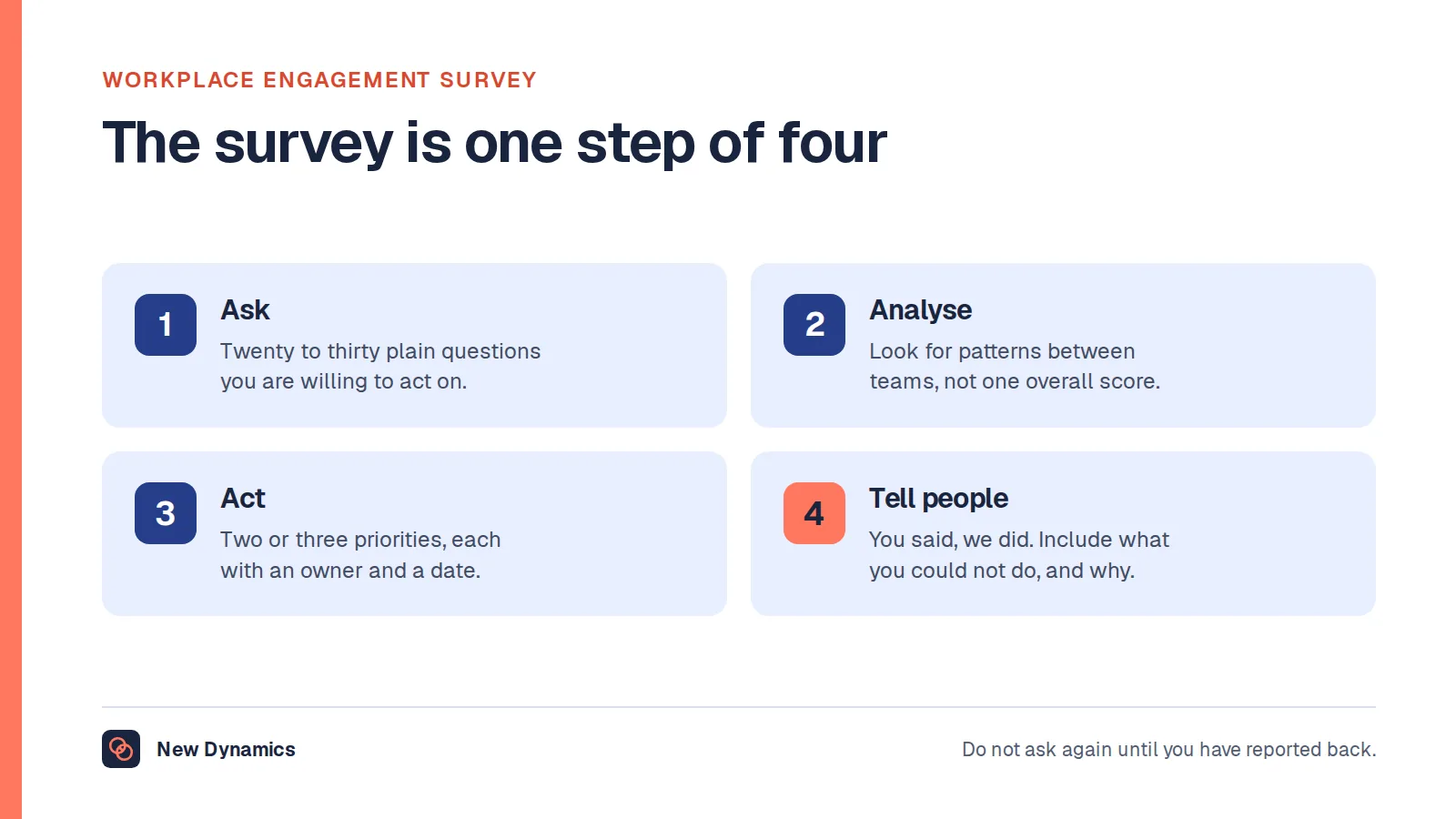
- Tell current employees what changed. “You told us that progression was unclear, so we have published career paths” builds trust in every other listening exercise.
Do not wait for the exit
An exit interview comes too late to keep the person in front of you. Use what you learn to keep the others, and listen earlier.
- Stay interviews. Ask current employees what keeps them, and what might make them leave.
- Regular one-to-ones. Many reasons for leaving are visible well ahead to a manager who asks.
- Engagement surveys, followed by visible action.
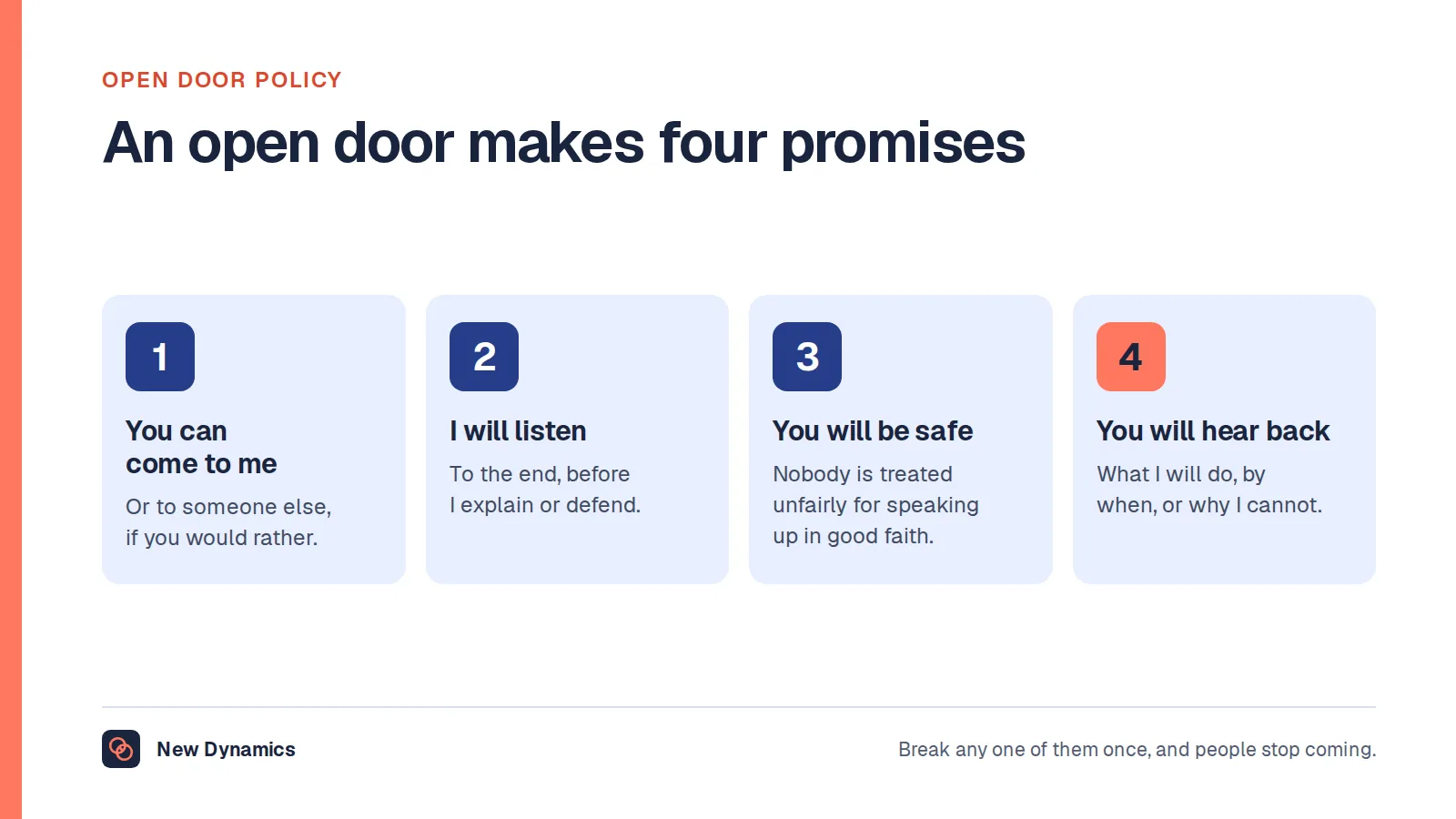
- A real route for concerns. See how to make an open door policy real.
If exit interviews keep surprising you, the listening is starting too late.
Common mistakes with exit interviews
Collecting and filing. If nobody reviews the themes, stop doing the interviews. They cost time and raise expectations.
The line manager conducts it. You will hear “a better opportunity”, and little else.
Arguing with the answers. The person's perception is the data, whether or not you agree with it.
Promising secrecy you cannot keep. Be clear about what happens if a serious allegation is raised.
Accepting the polite answer. “More money” is often the easy thing to say. Ask what started the search.
Asking only leavers. Without comparable data from people who stay, you cannot tell what is distinctive about those who go.
No feedback to the organisation. People need to see that speaking up leads somewhere.

Frequently asked questions
What is an exit interview?
An exit interview is a voluntary conversation with an employee who is leaving, held to understand why they are going and what the organisation could do better. It usually takes 30 to 60 minutes during the notice period. An exit survey asks similar questions in writing.
What are the best exit interview questions?
The most useful are open questions such as: what prompted you to start looking for another role? What could we have done to keep you? How would you describe your relationship with your manager? Could you see a future here? What is the first thing you would change?
Who should conduct an exit interview?
Someone neutral, such as an HR colleague, a manager from another team or the manager's own manager. People rarely speak freely to the line manager they are leaving, especially if that relationship is part of the reason.
Are exit interviews confidential?
They should be handled discreetly, but do not promise total confidentiality. Explain who will see the notes and how themes will be reported. If someone raises a serious allegation, such as harassment or discrimination, the organisation may need to investigate.
Do employees have to attend an exit interview?
Usually not. Most organisations offer exit interviews on a voluntary basis, and a forced conversation yields little. Offering a written survey as an alternative, or a follow-up some months later, can raise the response rate.
What should I say in my own exit interview?
Be honest, specific and professional. Give examples, describe their effect on you and suggest what would help the people who remain. Avoid personal attacks. You may want a reference or to return one day, and constructive feedback is more likely to be acted on.
Your next step: review your last ten leavers
- List the last ten people who left, with their team, manager, length of service and stated reason.
- Look for a pattern. There nearly always is one.
- Choose ten questions from this list, and agree who will conduct interviews from now on.
- Put a quarterly review of the themes in the leadership calendar.
For a fuller approach to keeping good people, read and download our employee retention guide. The guide is free to read, and the PDF uses our short download form.
Want to hear concerns while there is still time to act? Book a New Dynamics demo and bring your turnover patterns. You can also email contact@new-dynamics.com.