TL;DR
- A balanced scorecard is a one-page system for measuring and managing performance from four perspectives: financial, customer, internal process, and learning and growth. It was introduced by Robert Kaplan and David Norton in 1992.
- It is called balanced because it sets measures of customers, processes and people beside the financial results, so that leaders see the causes of future performance as well as the record of the past.
- A working scorecard has a few objectives in each perspective, and each objective has a measure, a target, an initiative and an owner. Keep it short, link the objectives and review it on a regular timetable.
Profit tells you how last year went. It says little about whether customers are drifting away, whether a key process is creaking or whether your best people are learning anything. By the time those problems reach the accounts, they are expensive.
The balanced scorecard was designed to close that gap. This article explains what it is, sets out the four perspectives, gives a worked example, shows how to build one in six steps, compares it with KPIs and OKRs and lists the common mistakes. A business scorecard, a term that some people use, usually means the same thing.
A scorecard only works if its objectives reach the people who do the work. If you want goals, key results and progress check-ins in one shared place, explore New Dynamics Goals & OKRs.
What is a balanced scorecard?
The Cambridge Business English Dictionary defines a balanced scorecard as “a system for measuring a company's performance, using such things as customer satisfaction, employee knowledge, and the company's use of new ideas”.
The idea comes from Robert S. Kaplan and David P. Norton, who set it out in the Harvard Business Review in 1992 in an article called The Balanced Scorecard: Measures that Drive Performance. It opens with a line that is still quoted: “What you measure is what you get.”
Their argument was that financial measures alone mislead. They wrote that traditional measures such as return on investment and earnings per share “can give misleading signals for continuous improvement and innovation”. Those measures, they added, “worked well for the industrial era, but they are out of step with the skills and competencies companies are trying to master today”.
The Balanced Scorecard Institute, a consultancy that trains people in the method, explains the name in its guide to balanced scorecard basics. The word balanced, it says, “refers to the inclusion of strategic measures in addition to traditional financial measures to get a more complete view of organizational performance”.
The same guide notes that the scorecard began as a performance measurement tool and has “evolved into a comprehensive framework for managing strategy”. Today it is used by businesses, government bodies and charities.
The four perspectives of the balanced scorecard
A balanced scorecard looks at the organisation from four perspectives. The names below follow the Balanced Scorecard Institute, which also gives alternatives for public bodies and charities.
- Financial (or stewardship). How well does the organisation perform financially, and how well does it use its money? Are we delivering for those who fund us?
- Customer (or stakeholder). How does the organisation look to the people whom it serves? Do customers get what they value?
- Internal process. How good and how efficient are the operations that produce the products and deliver the services? What must we excel at?
- Learning and growth (or organisational capacity). The Institute describes this as “the people, infrastructure, technology, culture, and other capabilities that enable long-term improvement and innovation”. Can we keep improving?
The perspectives are linked, from the bottom up. Skilled people and good systems improve processes. Better processes please customers. Satisfied customers produce financial results. A scorecard that shows these links tells the story of the strategy on one page.
This is where HR comes in. Most of the learning and growth perspective is people work: skills, leadership, engagement and culture. Our guide to organizational culture covers the last of these.

Five things that every scorecard line needs
Each perspective holds a small number of lines. A complete line has five parts.
- Objective. What you want to achieve, in a few words that begin with a verb: “Reduce time to resolve customer problems”.
- Measure. The indicator that shows progress. The Institute says that for each objective “at least one measure or Key Performance Indicator (KPI) will be identified and tracked over time”.
- Target. The level that you want the measure to reach, and by when.
- Initiative. The project or action that will move the measure. Without one, the target is a wish.
- Owner. One named person who is accountable for the line.

A balanced scorecard example
Here is a scorecard for an invented company: a 200-person business that installs and services heating systems. Its strategy is to grow through service contracts.
| Perspective | Objective | Measure | Target this year | Initiative |
|---|---|---|---|---|
| Financial | Grow recurring revenue | Share of revenue from service contracts | From 30% to 40% | New contract tiers |
| Customer | Be the firm that fixes it first time | First-visit fix rate | From 78% to 88% | Van stock review |
| Internal process | Schedule engineers efficiently | Jobs completed per engineer per week | From 14 to 16 | New scheduling software |
| Learning and growth | Build skills in heat pumps | Engineers certified on heat pumps | From 12 to 30 | Training programme with a supplier |
Read it from the bottom. Certified engineers and better scheduling raise the first-visit fix rate. Customers who get a first-time fix renew their contracts. Renewals grow recurring revenue. If the financial line moves and the others do not, the company should ask whether the growth will last.
A real scorecard would have two to four objectives in each perspective. More than that, and nobody can remember it.
How to build a balanced scorecard in six steps
- Clarify the strategy. Write down, in a paragraph, where the organisation is going and how it intends to win. A scorecard cannot repair a missing strategy.
- Choose objectives for each perspective. Two to four for each. Make sure that the learning and growth objectives truly support the others.
- Draw the strategy map. The Balanced Scorecard Institute describes a strategy map as “a simple graphic that shows a logical, cause-and-effect connection between strategic objectives”. If you cannot draw an arrow from an objective to another one, question why it is there.
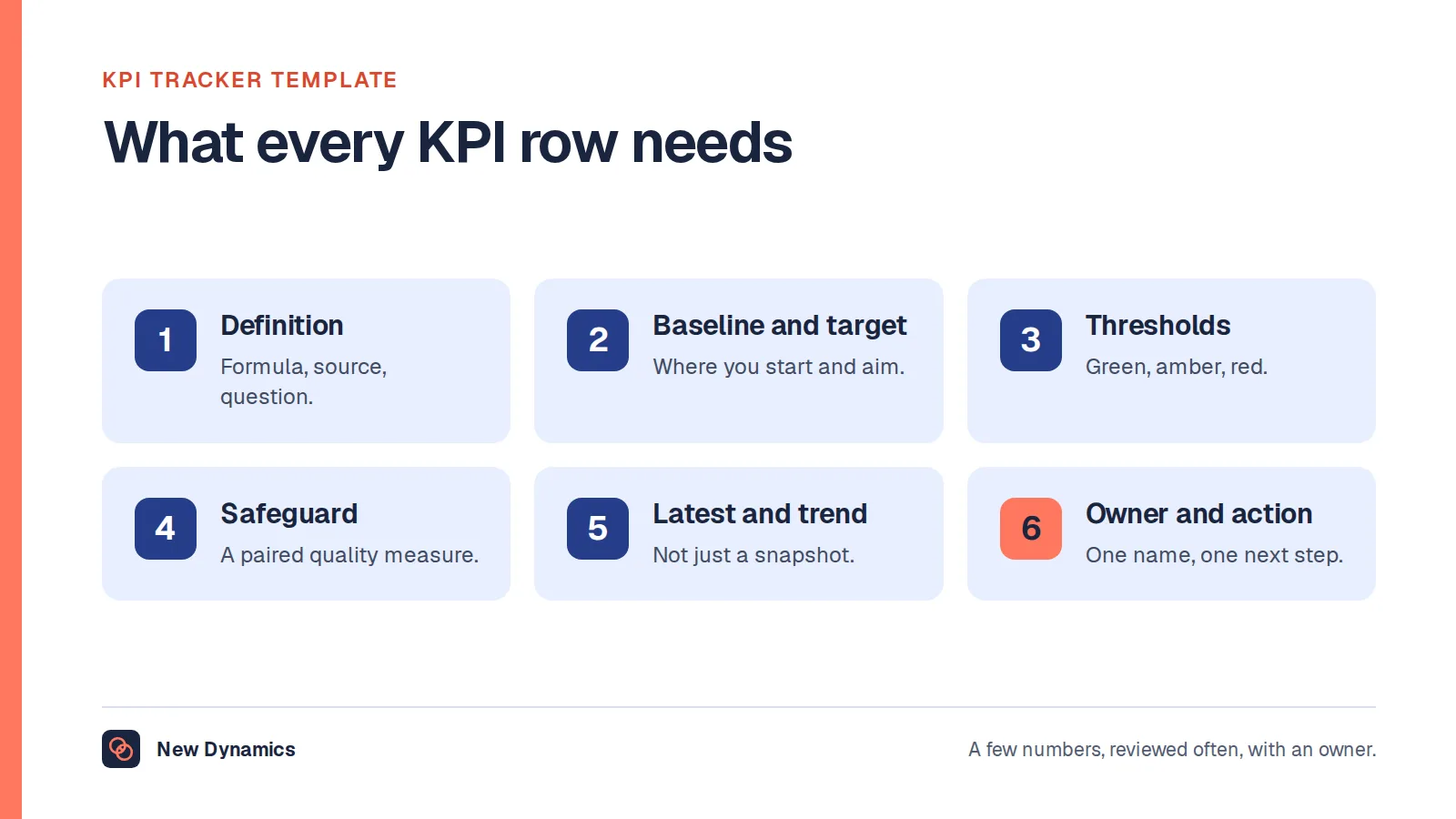
- Pick measures and targets. Prefer a mixture of leading measures, which predict, and lagging measures, which record. Our KPI tracker guide explains how to define and follow a measure.
- Choose initiatives and owners. Stop projects that support no objective. That is often the quickest benefit of the exercise.
- Cascade and review. Translate the top-level scorecard into aligned objectives for departments and teams, and review progress monthly or quarterly. Our article on the meaning of cascading shows how goals flow down without losing sense.

Balanced scorecard, KPIs and OKRs
| Tool | What it is | Best for |
|---|---|---|
| Balanced scorecard | A framework that arranges objectives and measures in four linked perspectives | Seeing the whole strategy on one page |
| KPIs | Individual indicators of performance | Monitoring the health of ongoing activity |
| OKRs | Objectives with a few measurable key results, set for a short period | Focusing effort on change this quarter |
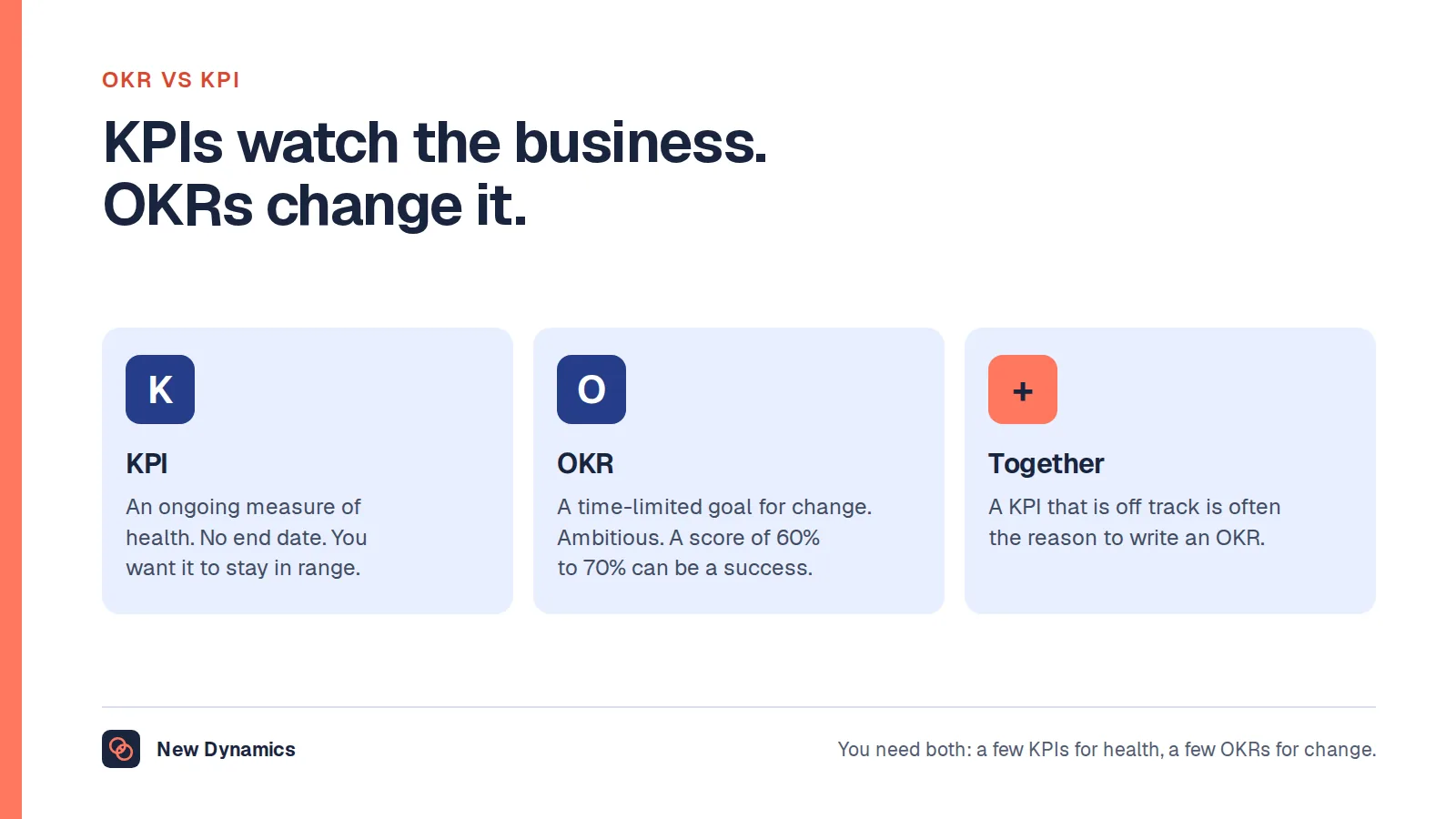
They work together. KPIs are the measures inside the scorecard. OKRs can carry the scorecard's objectives into a team's quarter. Our comparison of OKRs and KPIs explains the difference in detail.
Benefits and limits
What it does well
- It forces a conversation about what the strategy is.
- It makes leaders look at the causes of future results, including people and skills.
- It links everyday measures to a purpose.
- It gives boards and teams one shared page.
Where it struggles
- The cause-and-effect links are assumptions. Test them against the data, and change them when they fail.
- It can grow into a list of fifty measures that nobody reads.
- Four perspectives do not suit everybody. Public bodies and charities sometimes put the customer or mission at the top, and some organisations add a perspective, such as sustainability.
- Measures can be gamed when pay depends on them. Be careful about tying bonuses to scorecard lines.
Common mistakes
Starting with measures. Objectives come first. A measure without an objective is only a number.
Too many lines. Eight to sixteen objectives in total is plenty.
A people perspective filled with activity counts. “Training days delivered” says nothing about capability. Measure skills gained and used.
No owners. A line that belongs to everyone belongs to no one.
No review timetable. A scorecard that is opened once a year is a poster.
Keeping it in the boardroom. People can only act on a strategy that they have seen.
Frequently asked questions
What is a balanced scorecard in simple terms?
A balanced scorecard is a one-page system for measuring and managing an organisation's performance from four perspectives: financial, customer, internal process, and learning and growth. It sets non-financial measures beside the financial ones.
Who created the balanced scorecard?
Robert S. Kaplan and David P. Norton introduced it in a Harvard Business Review article, “The Balanced Scorecard: Measures that Drive Performance”, published in the January–February 1992 issue.
What are the four perspectives of the balanced scorecard?
They are the financial perspective, the customer or stakeholder perspective, the internal process perspective, and the learning and growth perspective, which is also called organisational capacity.
What is a business scorecard?
A business scorecard is a general term for a page of objectives and measures that shows how a business is performing. In most cases people mean a balanced scorecard, which arranges those measures in four linked perspectives.
What is a strategy map?
A strategy map is a simple diagram that shows the cause-and-effect links between the objectives on a balanced scorecard, usually running from learning and growth at the bottom, through processes and customers, to financial results at the top.
What is the difference between a balanced scorecard and KPIs?
KPIs are individual performance indicators. A balanced scorecard is a framework that chooses a small number of KPIs, attaches them to strategic objectives and arranges them in four linked perspectives, with targets, initiatives and owners.
Your next step: draft one page
- Write your strategy in one paragraph.
- Draw four boxes, and put two objectives in each.
- Draw the arrows between them. Remove any objective that connects to nothing.
- Give each objective a measure, a target, an initiative and an owner.
To carry those objectives into each team's quarter, read and download our OKR guide. The guide is free to read, and the PDF uses our short download form.
Want company objectives, team goals and progress in one shared place? Book a New Dynamics demo and bring your current scorecard. You can also email contact@new-dynamics.com.