TL;DR
- Organizational culture is the set of attitudes and agreed ways of working that the people in an organisation share. The UK Health and Safety Executive sums it up as “the way we do things around here”.
- Culture is hard to measure directly. It shows in five places: who gets promoted, what gets measured, how meetings run, what happens after a mistake and what leaders do under pressure.
- To shape culture, name specific behaviours, measure how people experience work, ask leaders to change first, align hiring, reward and promotion, and repeat the measurement. Change takes years.
Every organisation has a culture, whether or not anybody designed it. New starters work it out within weeks. They watch who speaks in meetings, what happens to the person who admits a mistake and whether the values on the wall match the behaviour in the corridor.
This article gives a plain description of organizational culture, explains how it differs from organisational climate, shows five places where culture can be seen, lists the influences that shape it and sets out five steps for changing it. British English spells it organisational culture, and many people say company culture or corporate culture. The meaning is the same.
Culture shows in what gets noticed and thanked. See how New Dynamics employee recognition makes thanks specific and visible across the whole organisation.
What is organizational culture?
The Cambridge Business English Dictionary defines organizational culture as “the types of attitudes and agreed ways of working shared by the employees of a company or organization”.
Its entry for corporate culture adds the link to results: “the beliefs and ideas that a company has and the way in which they affect how it does business and how its employees behave”.
The UK Health and Safety Executive (HSE) offers the shortest version in its overview of organisational culture: “Culture can be best understood as ‘the way we do things around here’.” It explains why that matters: “Culture forms the context within which people judge the appropriateness of their behaviour.”
The Financial Reporting Council, which publishes the UK Corporate Governance Code, defines culture in a corporate context as “a combination of the values, attitudes and behaviours manifested by a company in its operations and relations with its stakeholders”.
Put together, these give a working definition. Organizational culture is the shared set of values, attitudes and habits that tells people how to behave when nobody has told them what to do.
How to define company culture in practice
A definition is only useful if it helps you to describe your own culture. Three layers are worth separating.
- What is said. Published values, the careers page, the chief executive's speeches.
- What is done. Everyday behaviour: how decisions are made, how people treat each other, what happens to bad news.
- What is assumed. Beliefs that nobody states because everybody holds them, such as “customers come first”, “never surprise the boss” or “long hours show commitment”.
When the three agree, the culture is strong and people know where they stand. When they disagree, people believe what is done and ignore what is said.
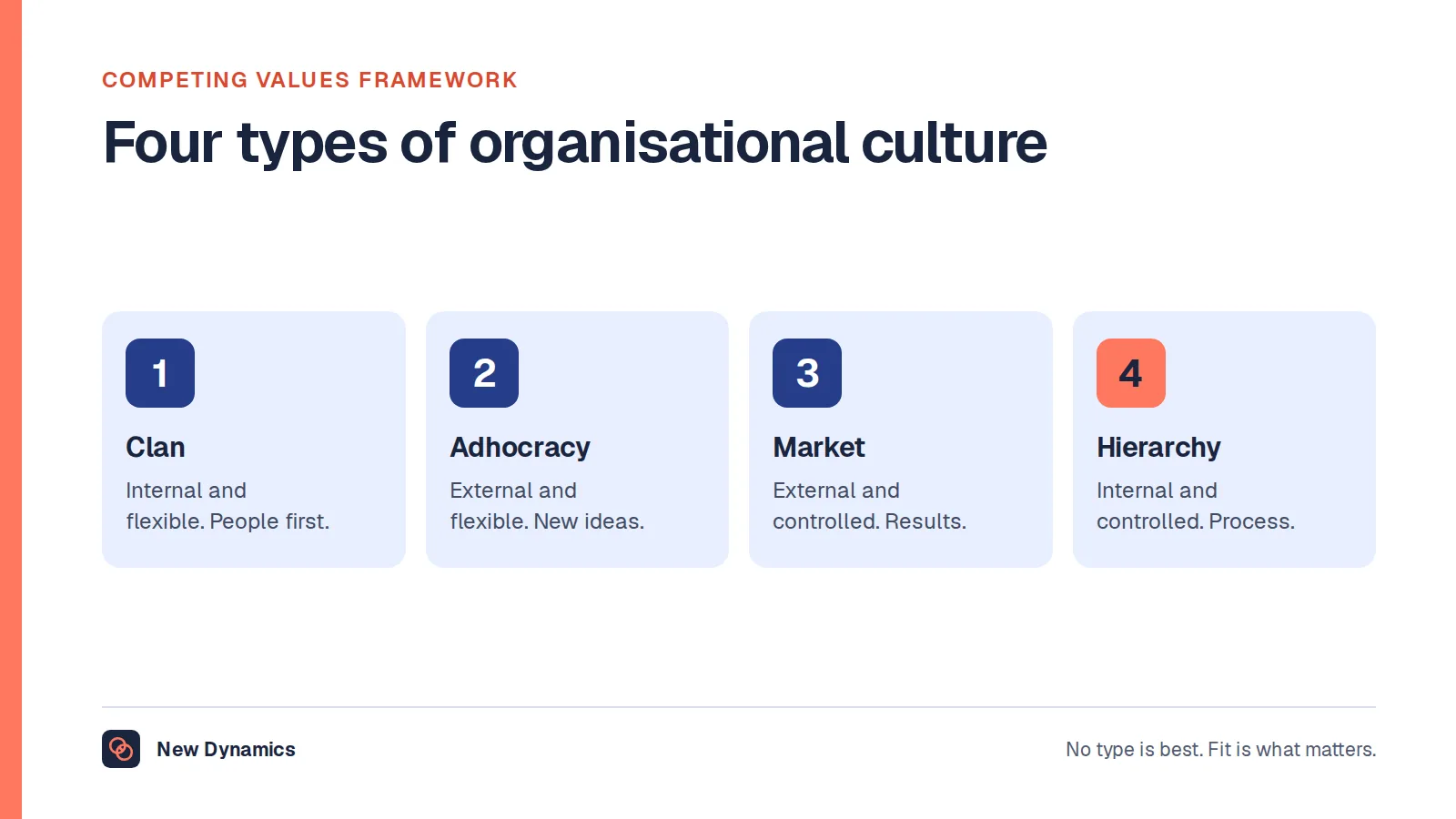
Large organisations rarely have one culture. Departments, sites and professions develop subcultures of their own. One well-known model, the Competing Values Framework, sorts cultures into four types: clan, adhocracy, market and hierarchy. Our article on hierarchy culture explains the framework.
Culture and climate
The CIPD's factsheet on organisational culture strikes a sceptical note. Its summary says that “the language of culture is often unclear, difficult to define, and therefore hard to measure”, and that real culture change is near-impossible if an organisation cannot pin down what it wants to change.
The CIPD recommends a more specific idea: organisational climate, which it describes as “the meaning and behaviour attached to policies, practices and procedures employees experience”.
| Term | What it describes | How you find out |
|---|---|---|
| Culture | Deep, shared values and assumptions: “the way we do things around here” | Observation, stories, patterns over years |
| Climate | How people experience policies, practices and procedures at present | Surveys, interviews, one-to-ones |
The distinction is practical. You cannot instruct people to hold different assumptions. You can change a practice, such as how promotion decisions are made, and you can ask people whether they have noticed. HSE makes the same link for safety: a safety climate survey, it says, “provides a snapshot of the organisation's culture in relation to safety”.
Five places where culture shows
If you want to describe a culture honestly, look at what happens, not at what is written.
- Who gets promoted. Promotions tell everybody which behaviour the organisation really values.
- What gets measured. People attend to what is counted and reported.
- How meetings run. Who speaks, who is interrupted and whether disagreement is welcome.
- What happens after a mistake. Whether people report problems early or hide them.
- What leaders do under pressure. Values are tested when they cost something.
Ask a few recent joiners what surprised them. They still see what long-serving staff have stopped noticing.

Why organizational culture matters
It shapes behaviour where rules run out. No handbook covers every situation. Culture fills the gaps.
It affects safety. HSE states: “An organisation's culture can have as big an influence on safety outcomes as the safety management system.” It adds that poor safety culture has contributed to many major incidents.
It affects who joins and who stays. People choose employers, and leave them, partly because of how it feels to work there. See our guides to the employee value proposition and the turnover rate.
It can protect or harm people. A culture that tolerates exclusion or bullying does real damage. Our article on bro culture describes one example.
It decides whether strategy happens. A plan that depends on collaboration will stall in a culture that rewards individual heroics.
Six influences on culture
HSE lists what it calls the largest influences on safety culture. They apply, with little change, to culture in general.
- Management commitment and style. What managers do, and what they let pass.
- Employee involvement. Whether people have a say in how work is done.
- Training and competence. Whether people are equipped to do what is asked.
- Communication. Whether information flows up as well as down. Our guide to the keys to effective communication covers the basics.
- Compliance with procedures. Whether the written way and the real way are the same.
- Organisational learning. Whether the organisation learns from what goes wrong. See our guide to the learning organization.
HSE adds a warning that applies well beyond safety. It finds that “the culture and style of management is even more significant” than employees' attitudes to rules, and gives as an example “a natural, unconscious bias for production over safety”.

How to shape organizational culture in five steps
HSE's first principle is sobering: “A culture change process can take several years”. These five steps draw on its key principles.
- Name specific behaviours. “Be more collaborative” means nothing. “Share the draft before it is finished” can be seen and practised. Choose three or four behaviours, not twenty.
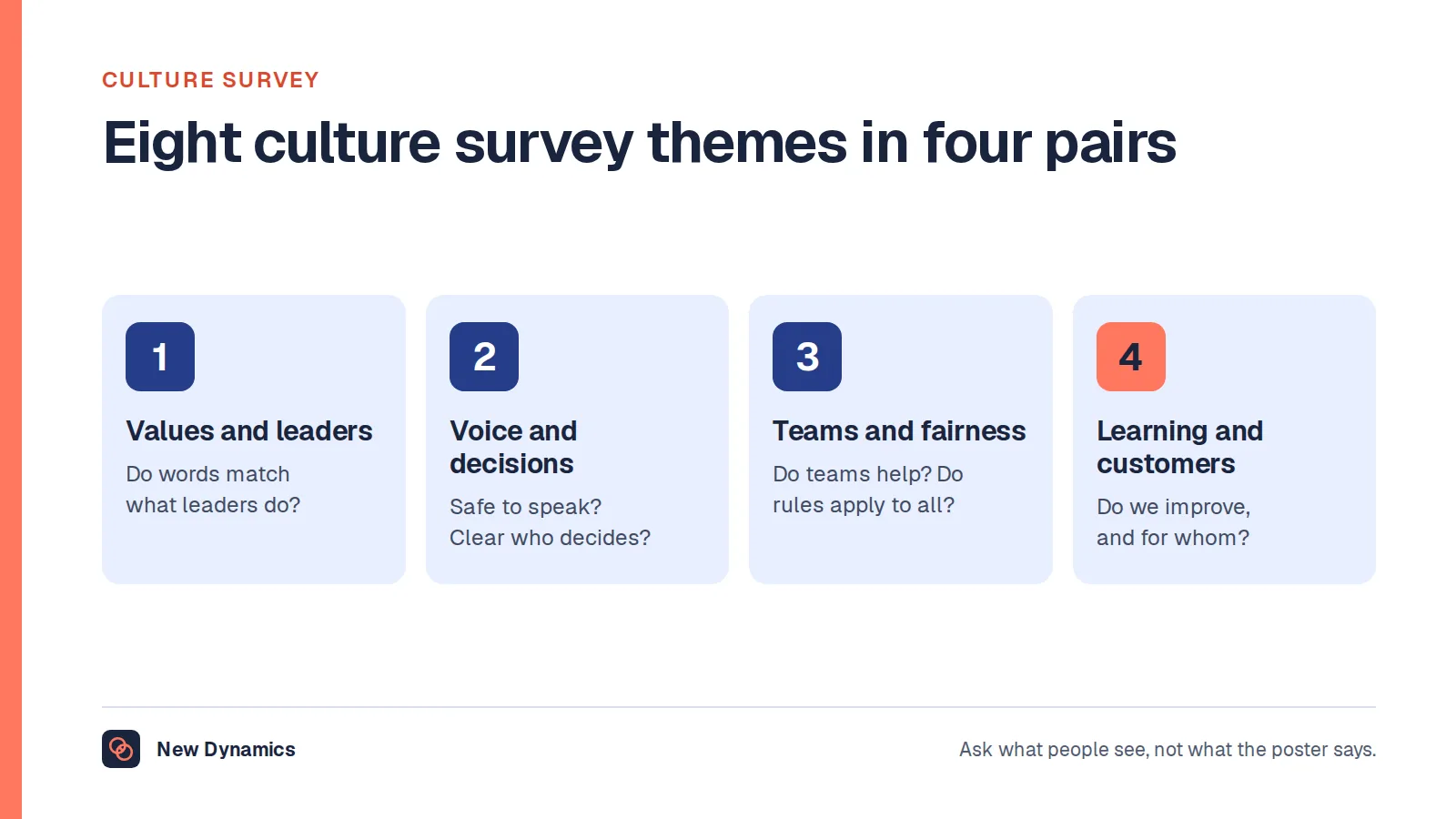
- Measure how people experience work. Use a short survey, interviews and conversations, in proportion to the size of the organisation. Our culture survey questions give a starting set.
- Leaders go first. HSE describes one common mistake: focusing on the staff levels below the manager who starts the work. It says that senior managers “should be prepared to have their own perceptions and behaviours examined and challenged”.
- Align the systems. Hiring criteria, induction, goals, recognition, pay and promotion must reward the behaviours you named. People follow what is rewarded.
- Report back and repeat. HSE stresses that it is important to act on the findings and to feed them back to employees, and that organisations have found it useful to repeat measurements to track progress.
HSE also notes that many organisations use outside help to measure and change culture, and advises them to “retain ownership of the process”.

Common mistakes
Starting with a values workshop. New words on the wall change nothing unless behaviour and systems change with them.
Treating culture as an HR project. Culture belongs to the leadership team. HR can help to measure and support it.
Aiming at everybody except the top. People copy what senior leaders do.
Surveying and then going quiet. Asking for views and doing nothing teaches people not to answer.
Hiring for “culture fit” without defining it. Undefined fit easily becomes a preference for people like us. Define the behaviours, and look for people who add to the culture.
Expecting speed. Practices can change in months. Shared assumptions change over years.
Frequently asked questions
What is organizational culture in simple terms?
Organizational culture is the shared set of attitudes, values and agreed ways of working in an organisation. The UK Health and Safety Executive sums it up as “the way we do things around here”.
How do you define company culture?
Company culture, corporate culture and organizational culture mean the same thing. The Cambridge Business English Dictionary defines corporate culture as the beliefs and ideas that a company has and the way in which they affect how it does business and how its employees behave.
What is the difference between organizational culture and climate?
Culture is the deep, shared values and assumptions of an organisation, and it changes slowly. Climate is how people currently experience its policies, practices and procedures. Climate is easier to measure and to change, which is why the CIPD recommends focusing on it.
What are examples of organizational culture?
Examples include a culture where people report mistakes early because nobody is blamed for honesty, a culture where long hours are taken as commitment, and a culture where decisions wait for the most senior person. Each shows in daily behaviour, not in a values statement.
What influences organizational culture?
The Health and Safety Executive lists six large influences on safety culture, which apply more widely: management commitment and style, employee involvement, training and competence, communication, compliance with procedures and organisational learning.
How long does it take to change organizational culture?
The Health and Safety Executive says that a culture change process can take several years. Specific practices, such as how meetings run or how promotions are decided, can change within months if leaders change first.
Your next step: describe your culture in one page
- Write down what your organisation says that it values.
- Against each value, note one recent piece of evidence for it and one against it, using the five signals.
- Ask three recent joiners what surprised them.
- Choose one behaviour to change, and decide what leaders will do differently first.
For help with introducing a change and bringing people with you, read and download our HR change management guide. The guide is free to read, and the PDF uses our short download form.
Want recognition, feedback and goals to reinforce the behaviours you have named? Book a New Dynamics demo and bring your current approach. You can also email contact@new-dynamics.com.