TL;DR
- RFP stands for request for proposal. It is a formal document in which an organisation describes what it needs and invites suppliers to propose how they would deliver it, and at what price.
- A good RFP has five parts: the requirement, the expected contract terms, what the proposal must contain, how proposals will be judged, and the timetable.
- An RFP suits purchases where suppliers' approaches will differ, such as HR software. Keep it short, ask for evidence and demonstrations, and tell suppliers how you will score them.
Sooner or later, most HR and operations leaders are told to “run an RFP”. The phrase arrives from procurement or finance, usually with a deadline and without an explanation.
This article explains the meaning of RFP, how a request for proposal differs from an RFI and an RFQ, what goes into one and how to run the process in six steps. The examples come from buying HR software, because that is where many people teams meet an RFP for the first time.
If performance reviews are on your shopping list, see how New Dynamics performance reviews handle goals, feedback and review cycles, so that you know what to ask any supplier to show you.
What does RFP mean?
RFP stands for request for proposal. The Cambridge Dictionary defines an RFP as “a formal document that an organization produces when it needs to obtain a product, service, or solution for a new project, stating what is needed when and giving details about the contract”.
The important word is proposal. The buyer describes a need, and each supplier proposes how they would meet it. Proposals will differ in approach as well as in price, and the buyer compares them against criteria set in advance.
Governments use the term formally. In the United States, the Federal Acquisition Regulation says in its section on requests for proposals that RFPs are used “to communicate Government requirements to prospective contractors and to solicit proposals”. Private companies borrow the same idea with far less formality.
RFP, RFI and RFQ: the difference
Three similar abbreviations are used at different stages of buying.
| Document | Question it asks | When to use it |
|---|---|---|
| RFI: request for information | “What is out there?” | Early, when you are learning about the market and are not ready to buy |
| RFP: request for proposal | “How would you meet our need, and at what cost?” | When you know the need, and suppliers' approaches will differ |
| RFQ: request for quotation | “What is your price for exactly this?” | When the specification is fixed and price is the main difference |
The US regulation describes the first of these well. It says that RFIs may be used when the buyer “does not presently intend to award a contract, but wants to obtain price, delivery, other market information, or capabilities for planning purposes”.
For HR software, an RFQ rarely fits, because products differ in how they work. A short RFI, or a few informal conversations, followed by an RFP to a shortlist is the usual path.

What goes into an RFP: five parts
The US regulation lists what a competitive RFP must describe “at a minimum”: the requirement, the anticipated terms and conditions, the information required in the proposal, and the factors that will be used to evaluate it, with “their relative importance”. Add a timetable, and you have a structure that works for any buyer.
- The requirement. Who you are, the problem you want to solve, the people and processes involved, and what must be true a year after the purchase.
- The terms you expect. Contract length, data protection, service levels, and what happens to your data when the contract ends.
- What the proposal must contain. The questions to answer, the evidence to supply, the pricing format and any demonstration you want to see.
- How you will decide. The criteria and their weights. For example: fit with our process 35%, ease of use 20%, security and data protection 20%, implementation and support 15%, cost 10%. These figures are an illustration.
- The timetable. Dates for questions, proposals, demonstrations, the decision and the start of work, with one named contact.
Our performance management software RFP template gives ready-made questions under headings like these.
The RFP process in six steps
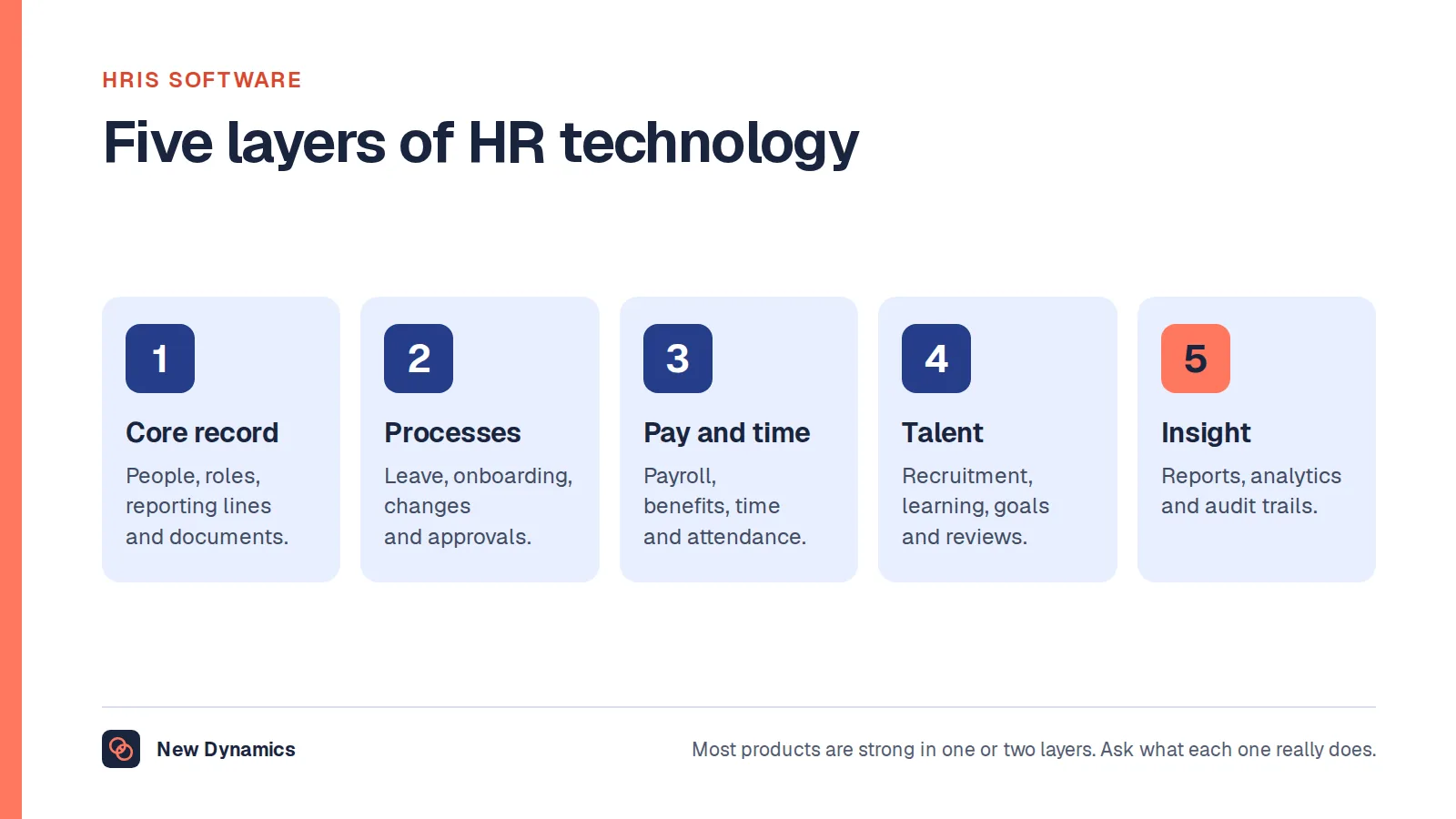
- Define the need. Talk to the people who will use the product. Write down the five or six things it must do, and separate them from things that would be pleasant. Our article on HRIS software shows how to frame requirements.
- Research the market. Read, ask peers and hold short exploratory calls. The US regulation encourages exchanges of information from “the earliest identification of a requirement”, because they help suppliers to judge whether they can meet the need.
- Write a short RFP. Aim for a document that a supplier can answer well in a few days. Every question should help you to choose.
- Send it to a shortlist. Three to five suppliers is usually enough. Give everyone the same information and the same deadline, and share the answers to any questions with all of them.
- Score proposals and see demonstrations. Score against the published criteria. Then ask the leading suppliers to demonstrate your own scenarios, with your own people in the room.
- Check, decide and tell everyone. Take up references, review the contract, decide, and tell unsuccessful suppliers promptly and politely.

Questions that an HR software RFP should cover
HR systems hold personal data about every employee, so two subjects deserve more care than they usually get.
Data protection. In the UK, the Information Commissioner's Office says in its guidance on contracts between controllers and processors that, whenever a controller uses a processor, “there must be a written contract (or other legal act) in place”. Its checklist includes that the processor must act only on the controller's documented instructions, must take appropriate security measures and may engage a sub-processor only with the controller's prior authorisation. Ask suppliers for their standard data processing agreement and their list of sub-processors. This is general information, not legal advice. Our employee data protection guide covers the wider duties.
Security. The UK National Cyber Security Centre publishes 14 cloud security principles, which it says are “designed to help you choose a cloud provider that meets your security needs” and which apply to software as a service. Ask suppliers how they meet them, or an equivalent standard, and involve your IT or security lead in reading the answers.
Beyond those, ask about:
- fit with your process: review cycles, goal setting, feedback, reporting lines and any matrix structure;
- ease of use for employees and managers, tested by them;
- integrations with your HR system, single sign-on and calendar;
- implementation: who does what, how long it takes and what it costs;
- support and training after launch;
- pricing: what is included, how it rises and the notice period;
- exit: how you get your data out, and in what format.
If the product uses AI, our AI procurement guide lists the evidence to request.
Common RFP mistakes
Hundreds of questions. Long questionnaires reward the supplier with the largest bid team. Ask fewer, sharper questions.
A feature checklist. “Does it have 360 feedback: yes or no” tells you little. Ask the supplier to show how a manager would run a review from start to finish.
Hidden criteria. If suppliers cannot see how you will decide, they guess. Publish the weights.
Price first. The cheapest system that nobody uses is the most expensive one.
Leaving users out. Include two or three managers and employees in the demonstrations. They will have to live with the choice.
No time for the supplier. A week is too short for a considered proposal. Two to three weeks is fairer, and gets you better answers.
Skipping the contract. Read the terms before you choose, while you still have a second option.

Do you always need an RFP?
No. An RFP takes weeks of work on both sides. For a small purchase, a simple tool or a renewal, it is often enough to define the need, try two or three products and check the contract.
An RFP earns its cost when the purchase is large, when several departments have a stake, when your organisation's rules require a competitive process, or when you need a clear record of why you chose as you did. Public bodies usually have procurement rules that they must follow, so check yours first.
Our HRIS selection guide walks through a lighter process with a scorecard.
Frequently asked questions
What does RFP stand for?
RFP stands for request for proposal. It is a formal document in which an organisation sets out what it needs and invites suppliers to propose how they would deliver it, on what terms and at what price.
What is the difference between an RFP, an RFI and an RFQ?
An RFI, or request for information, explores the market before you are ready to buy. An RFP asks suppliers how they would meet a defined need. An RFQ, or request for quotation, asks for a price for a fixed specification.
What should an RFP include?
Include five parts: a description of the requirement, the contract terms you expect, what each proposal must contain, the criteria and weights you will use to decide, and the timetable with a named contact.
How long does an RFP process take?
It depends on the purchase. For HR software, allow two to three weeks for suppliers to respond, and further time for scoring, demonstrations, references and contract review. It is sensible to plan for two to three months from defining the need to signing.
Who writes the RFP?
The team that owns the need usually writes the requirement and the questions, with procurement, IT, security and legal colleagues adding their sections. One named person should own the document and be the contact for suppliers.
When should you use an RFP?
Use an RFP when the purchase is large, when several departments have a stake, when your rules require a competitive process or when you need a record of why you chose as you did. For a small purchase or a renewal, a trial and a contract check are often enough.
Your next step: write the requirement on one page
- Write down the problem you want to solve, and for whom.
- List the five or six things that the product must do.
- Decide your criteria and their weights before you speak to a supplier.
- Choose three scenarios that you will ask every supplier to demonstrate.
For a fuller method with a scorecard, read and download our HRIS selection guide. The guide is free to read, and the PDF uses our short download form.
Writing an RFP for performance management software? Book a New Dynamics demo and bring your scenarios. You can also email contact@new-dynamics.com.