TL;DR
- The C-suite is the group of people with the most senior positions in a company, whose job titles usually begin with C for chief, such as chief executive officer and chief financial officer.
- It is the top level of management. C-suite executives are responsible for the whole organisation and its strategic direction, while the board oversees them.
- A title does not create the role. A small company needs the responsibilities covered, not a chief for each of them.
“We need to get this in front of the C-suite.” “She is ready for a C-level role.” The phrase is standard business English, and it still leaves many people unsure exactly who is included, and where the board fits.
This article explains the meaning of C-suite, the roles in it, what C-suite executives actually do, how the C-suite differs from the board and from company directors, and what a smaller organisation needs.
Knowing who is at the top only helps if everyone can see how roles connect. See how New Dynamics org charts show roles, reporting lines and the relationships between them.
What does C-suite mean?
The Cambridge Dictionary defines the C-suite as “the group of people with the most important positions in a company, whose job titles usually begin with C meaning ‘chief’”.
“Suite” is usually explained as the set of offices that senior executives traditionally occupied. C-level means the same thing, as in “C-level executive”. Some organisations say “executive team”, “senior leadership team” or “executive committee” for the same group, which may include people whose titles do not begin with chief.
In management terms, the C-suite is the top of three levels. The open textbook Principles of Management, published by OpenStax, describes them in its section on the manager's job: executives, middle management and first-line management. “Executive managers are at the top of the hierarchy and are responsible for the entire organization, especially its strategic direction.”
Who is in the C-suite? The core roles
Five roles appear in most large organisations.
| Title | Abbreviation | Responsible for |
|---|---|---|
| Chief executive officer | CEO | The direction and results of the whole organisation. Leads the C-suite, and answers to the board |
| Chief financial officer | CFO | Finance, reporting, funding and financial risk |
| Chief operating officer | COO | The day-to-day operations that produce and deliver what the organisation sells |
| Chief technology officer or chief information officer | CTO or CIO | Technology strategy, products and internal systems |
| Chief people officer or chief human resources officer | CPO or CHRO | People strategy, culture, reward and HR |

Other C-suite titles
The list has grown as organisations give senior ownership to new priorities.
- Chief marketing officer (CMO): brand, marketing and demand.
- Chief revenue officer (CRO) or chief commercial officer (CCO): sales, revenue and partnerships.
- Chief product officer: product strategy and roadmap.
- Chief information security officer (CISO): security of systems and data.
- Chief data officer: data strategy, governance and analytics.
- Chief legal officer or general counsel: legal affairs and compliance.
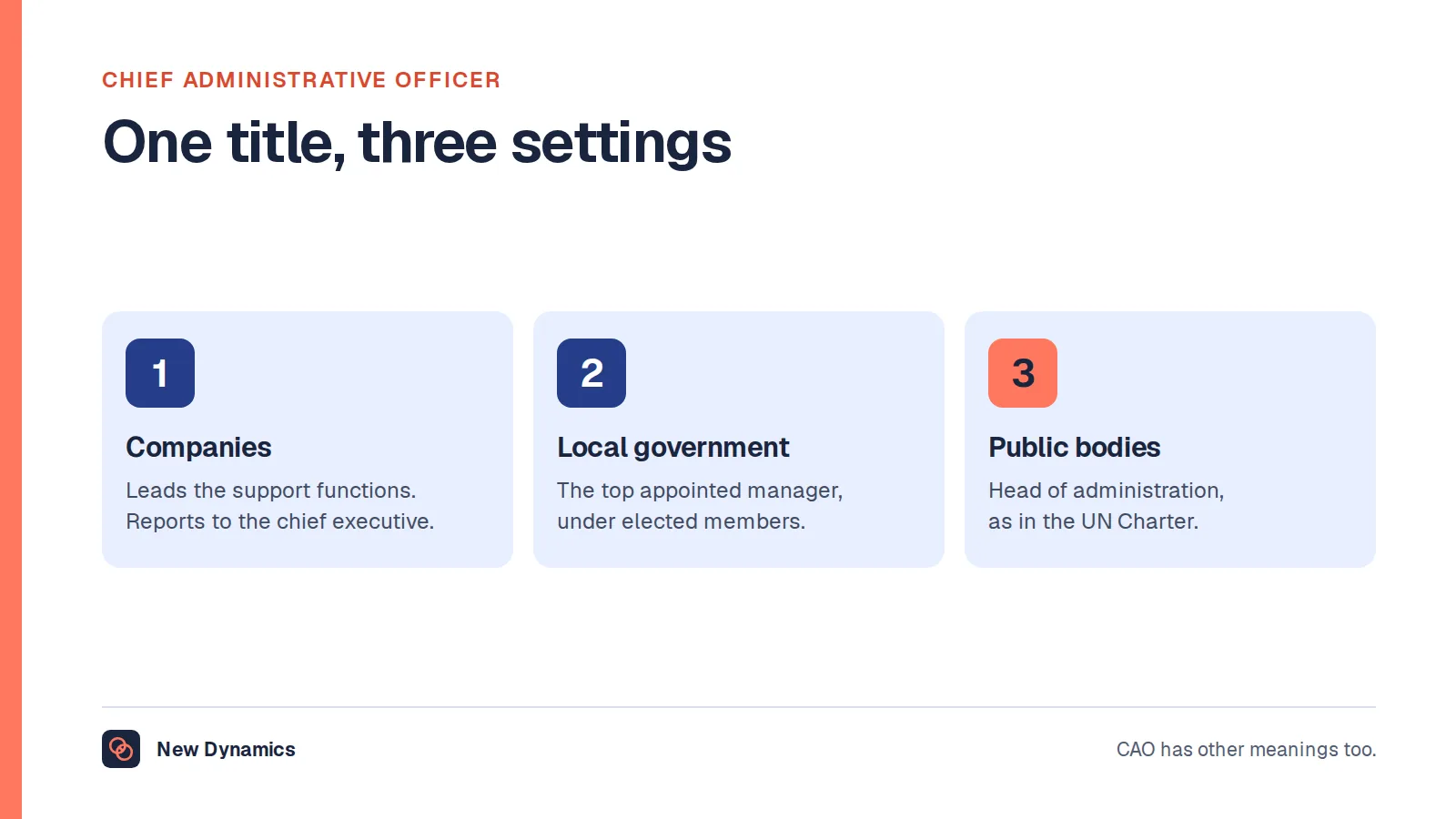
- Chief administrative officer (CAO): the support functions. See our guide to the chief administrative officer.
- Chief sustainability officer: environmental and social strategy.
- Chief of staff: not a functional head. This role supports the chief executive and coordinates the team.
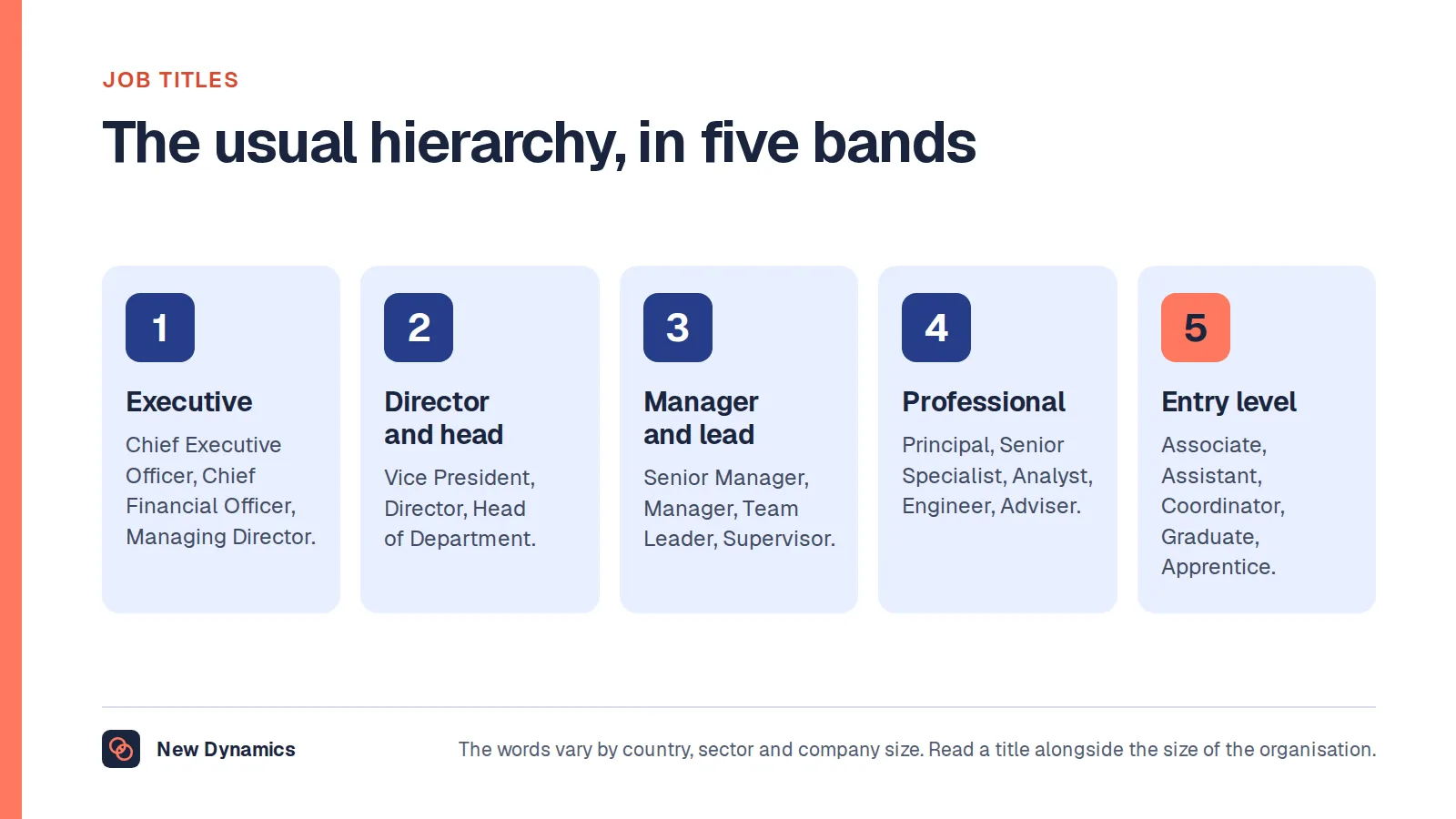
The same abbreviation can mean different things. CPO may be chief people officer or chief product officer, and CCO may be chief commercial officer or chief customer officer. Our full list of job titles sets out the levels below.
What C-suite executives actually do
OpenStax's Introduction to Business describes top management in its section on organizing. Top-level managers “develop strategic plans and address long-range issues such as which industries to compete in, how to capture market share, and what to do with profits”. They “design and approve the firm's basic policies and represent the firm to other organizations”, and they “define the company's values and ethics and thus set the tone” for employees.
In practice, that comes down to five kinds of work.
- Set direction. Decide where the organisation is going, and what it will not do.
- Allocate resources. Decide where money and people go. This is the most concrete expression of strategy.
- Build the team. Hire, develop and, when needed, replace the leaders who report to them.
- Set the tone. What executives do, tolerate and reward defines the culture more than any statement of values.
- Represent the organisation to the board, investors, regulators, customers and employees.
OpenStax adds a point about how the work differs from management lower down. Senior executives “devote more of their time to conceptual issues, while front-line managers will concentrate their efforts on technical issues”.

C-suite, board and directors: the difference
These three terms are often mixed up.
| C-suite | Board of directors | |
|---|---|---|
| What it is | The senior management team | The body that governs the company on behalf of its owners |
| Main job | Run the organisation | Oversee it: appoint and challenge the chief executive, approve strategy and major decisions |
| Members | Full-time executives | Executive directors, who also work in the company, and non-executive directors, who do not |
| Overlap | The CEO, and sometimes the CFO, often sit on the board | Most board members are not part of day-to-day management |
“Director” causes particular confusion, because it has two meanings.
- As a job title, such as marketing director, it is a level of seniority, usually below the C-suite.
- As a legal role, a company director is a person formally appointed to the board and registered as such. In the UK, Companies House guidance on being a company director says: “As a director, you're legally responsible for running the company”. It adds that you can hire professionals to help, “but you're still legally responsible for your company's records, accounts and performance”.
So a chief marketing officer may carry no legal duties as a director, while a non-executive director with no C-title carries them all. This is general information about the UK, not legal advice. Company law differs between countries.
Does a small company need a C-suite?
A ten-person company with a CEO, COO, CTO, CFO and CMO has more chiefs than it needs, and the titles can cause trouble later, when the company outgrows some of the people holding them.
What a small company needs is for the responsibilities to be covered.
- Someone decides direction and has the final say.
- Someone owns the money: cash, reporting and funding.
- Someone owns delivery to customers.
- Someone owns the product or the technology.
- Someone owns people: hiring, pay, performance and culture. This is the one most often left to chance.
One person can hold several of these. Write down who owns what, whatever the titles say. Give out C-titles when the scope of the job justifies them, and be consistent about what each level means.

The C-suite and people management
Whether or not there is a chief people officer, the C-suite sets the conditions for how people are managed.
- Goals cascade from the top. If the executive team's goals are unclear or conflict, every team below inherits the confusion.
- Executives need feedback too. The higher someone rises, the less honest feedback tends to reach them. Our guide to 360-degree feedback examples shows one remedy.
- Succession is a C-suite duty. Each executive should be developing at least one person who could replace them. Our succession planning guide sets out a method.
- What leaders tolerate becomes the standard. Our article on the characteristics of a great leader covers the behaviours.
Frequently asked questions
What does C-suite mean?
The C-suite is the group of people with the most senior positions in a company, whose job titles usually begin with C for chief, such as chief executive officer, chief financial officer and chief operating officer. It is the top level of management.
What does the C in C-suite stand for?
The C stands for chief, as in chief executive officer. “Suite” is usually explained as the set of offices that senior executives traditionally occupied. C-level means the same as C-suite.
Who is in the C-suite?
The core roles are the chief executive officer, chief financial officer, chief operating officer, chief technology or information officer, and chief people or human resources officer. Many organisations add chiefs for marketing, revenue, product, security, data and legal affairs.
What is the difference between the C-suite and the board of directors?
The C-suite runs the organisation day to day. The board governs it on behalf of the owners: it appoints and challenges the chief executive and approves strategy. The chief executive often sits on both.
Is a director part of the C-suite?
Not usually. As a job title, director is a level below the C-suite. As a legal role, a company director is a member of the board with legal responsibilities. A C-suite executive may or may not also be a legal director.
What is the highest position in the C-suite?
The chief executive officer. The other C-suite executives report to the chief executive, who in turn answers to the board of directors.
Your next step: write down who owns what
- List the five responsibilities: direction, money, delivery, product or technology, and people.
- Write one name beside each, whatever that person's title is.
- Mark any responsibility with no clear owner, or with two.
- For each owner, name the person who could step in.
For a method for the last step, read and download our succession planning guide. The guide is free to read, and the PDF uses our short download form.
Want goals that cascade clearly from the executive team to every employee? Book a New Dynamics demo and bring your org chart. You can also email contact@new-dynamics.com.