TL;DR
- 360-degree feedback gathers views on one person from several directions: their manager, peers, direct reports and sometimes customers, alongside a self-assessment. It is most useful for development.
- This article gives 20 survey questions, 15 start, stop and continue comments, and 30 sample comments on strengths and development areas across five skills, plus a worked example of a 360 summary.
- Good 360 comments describe behaviour and its effect, and suggest something the person could do. Poor ones label, guess at motives or reveal who wrote them.
You have been asked to give 360 feedback on a colleague, and the form wants “specific examples”. Or you are designing the survey, and need questions that produce something more useful than a row of fours. Either way, a blank box is a poor place to start.
This article gives 360 feedback examples that you can adapt: 20 survey questions, 15 comments in the start, stop, continue format, and 30 sample comments on strengths and development areas across five skills. It ends with a worked example of a 360 summary and guidance on writing and receiving feedback well.
If you work for more than one manager, their views belong in your review too. See how New Dynamics multi-manager reviews bring together the people who saw the work.
About these examples: all of them were written by the New Dynamics editorial team. The details are illustrative. Replace them with what you observed.
What is 360-degree feedback?
360-degree feedback collects views on one person from the people around them: their manager, peers, direct reports and sometimes customers or partners. The person usually rates themselves as well, so that they can compare their own view with everyone else's.
It is used mainly for development. The Center for Creative Leadership, in its article on how to implement a 360 feedback initiative, describes 360 feedback as “a powerful tool for learning and development”, and makes a useful distinction: receiving and discussing a report “is assessment. But development is what happens afterward”.
Our 360-degree feedback guide explains how to set up the process. This article concentrates on the wording.
What a good 360 comment looks like
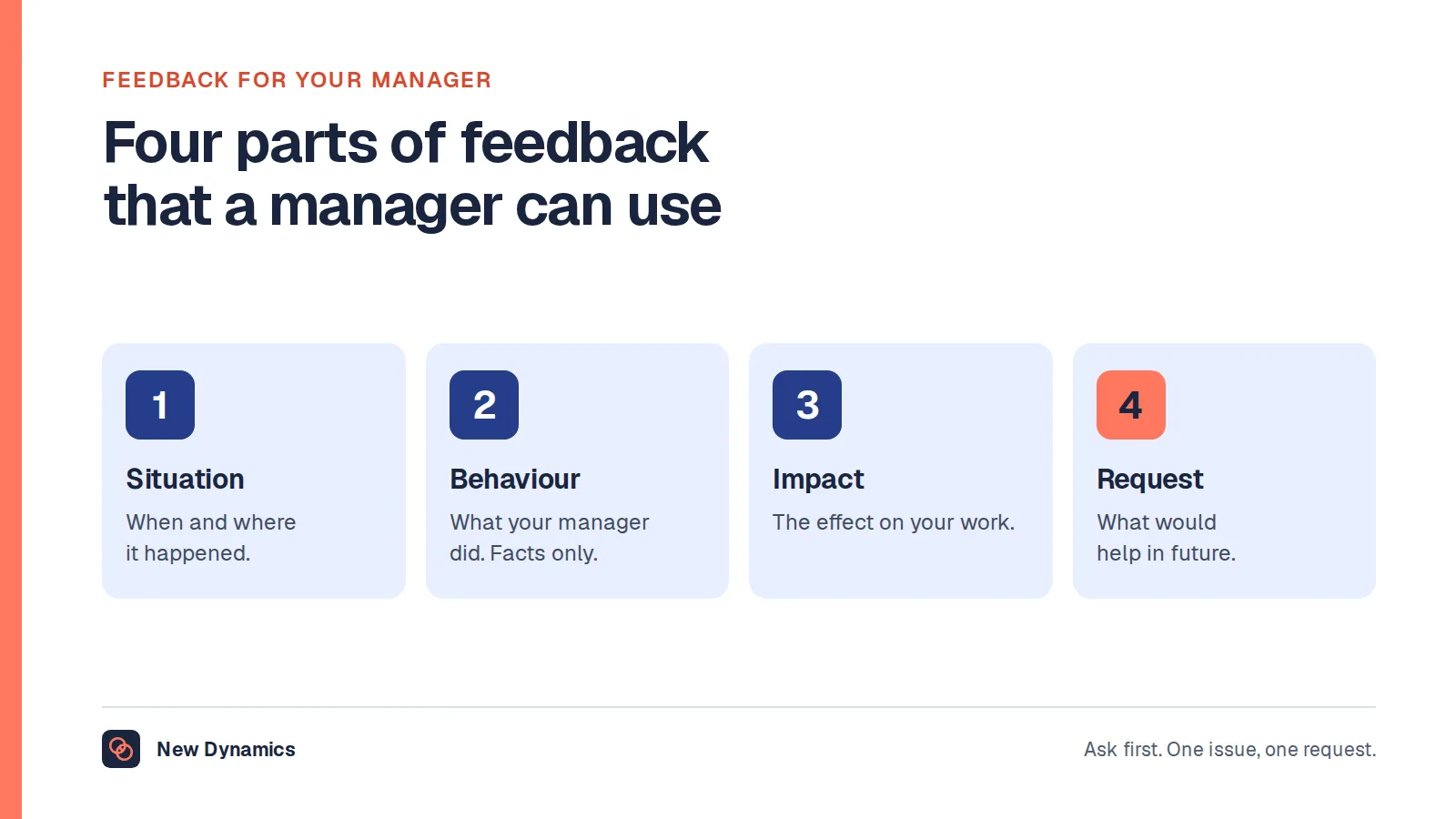
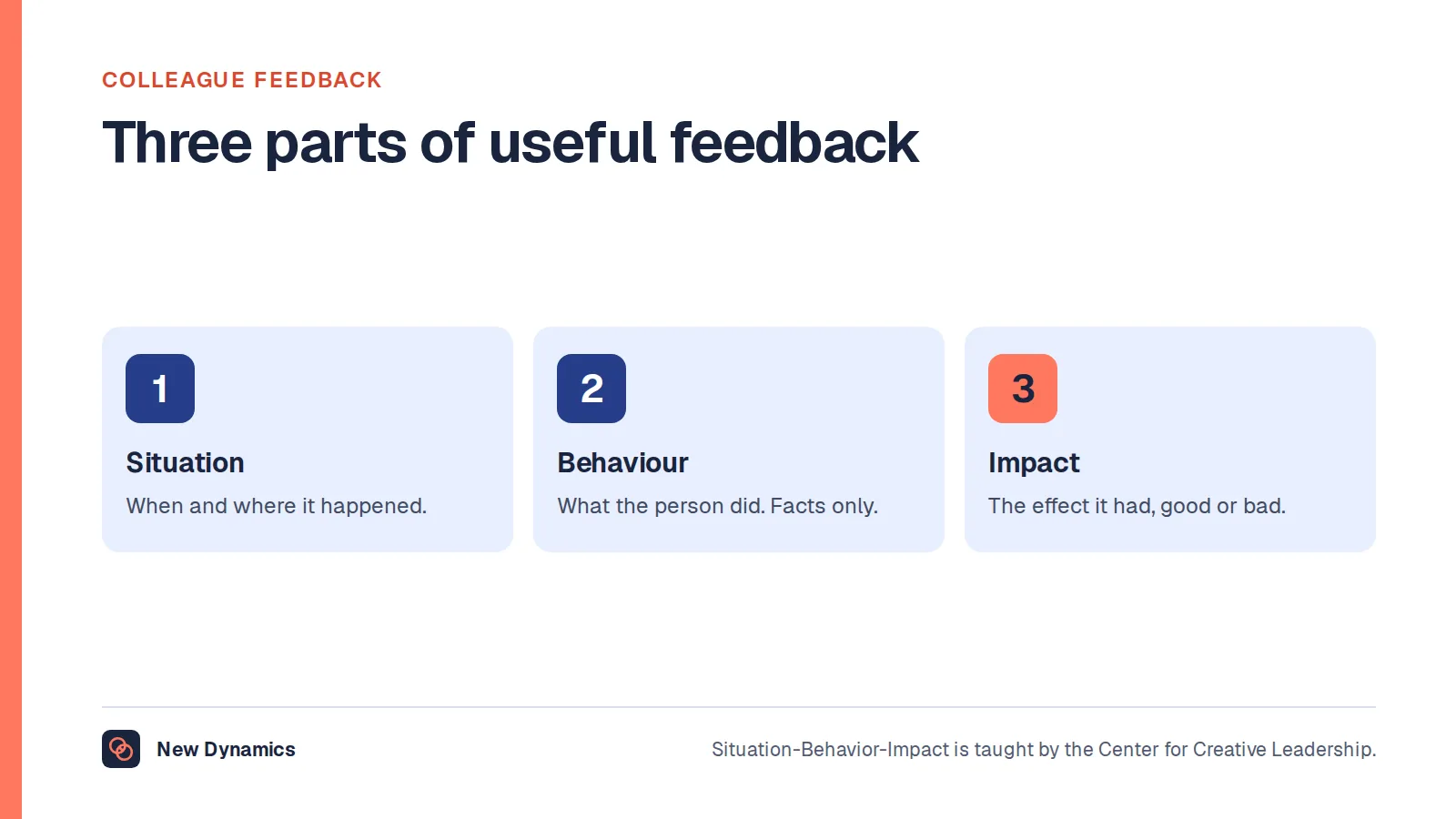
Use three parts, based on the Situation-Behavior-Impact model that the Center teaches.
- Situation: when and where.
- Behaviour: what the person did, as someone could observe it.
- Impact: the effect on you, the team or the customer.
For a development comment, add a suggestion: one thing the person could try.
- Poor: “Needs to communicate better.”
- Better: “In the March planning meetings, decisions were often announced without the reasons. The team spent time guessing at them. A two-line explanation with each decision would help.”

20 360 survey examples: questions to ask
Rating questions
Ask raters how often they observe the behaviour, from “almost never” to “almost always”, with a “not able to say” option.
- Explains decisions so that I understand the reasons.
- Listens without interrupting.
- Shares information that I need to do my work.
- Delivers what they promise, when they promise it.
- Raises problems early.
- Gives me feedback that I can use.
- Asks for feedback, and acts on it.
- Treats people with respect, whatever their role.
- Makes sure that quieter colleagues are heard.
- Stays calm and constructive under pressure.
- Makes timely decisions with the information available.
- Gives credit to others for their work.
For people managers, add:
- Makes priorities clear.
- Gives me the freedom to decide how I do my work.
- Supports my development.
- Deals with poor behaviour or poor performance in the team.
Open questions
- What should this person start doing?
- What should they stop doing?
- What should they continue doing?
- What is the one thing that would make them more effective?
Keep the whole survey to fifteen or twenty items. Long surveys get rushed answers.
15 start, stop, continue examples
Start
- “Start sharing the agenda the day before. I would come better prepared, and the meetings would be shorter.”
- “Start telling us the reasons behind priorities. When we understand why, we make better choices without asking.”
- “Start delegating whole pieces of work, including the decisions. You currently hand over tasks and keep the thinking.”
- “Start saying no to some requests from other teams. The team is stretched, and we need you to protect our time.”
- “Start giving feedback during the year. I hear how I am doing only at review time.”
Stop
- “Stop replying to emails during one-to-ones. It makes me feel that the conversation is not important.”
- “Stop rewriting the team's work without discussing it. People have stopped putting effort into first drafts.”
- “Stop committing us to deadlines before checking with the team. We then have to choose between quality and the date.”
- “Stop apologising before you give your opinion in leadership meetings. Your analysis is usually the best in the room.”
- “Stop copying the whole department into routine emails. Important messages get lost.”
Continue
- “Continue admitting it when you have got something wrong. It makes it safe for the rest of us to do the same.”
- “Continue your Friday summary. It is the one update that everybody reads.”
- “Continue asking the newest person for their view first. It has changed the discussion in our meetings.”
- “Continue standing up for the team with senior management. We notice, and it matters.”
- “Continue making time for career conversations. Mine last month was the most useful hour of my quarter.”

30 sample 360 comments by skill
Communication
Strengths
- “Her written updates are short and clear. I always know what is decided and what I need to do.”
- “He explains technical issues in plain language. Non-specialists leave his briefings able to make a decision.”
- “She tells people difficult news directly and kindly. Nobody hears about a problem from a third party.”
Development areas
- “In meetings he often speaks first and at length, and others then stay quiet. Asking for views before giving his own would bring out more ideas.”
- “Her emails can be long, with the request near the end. Putting the ask in the first two lines would get faster replies.”
- “He tends to go quiet when he disagrees, and raises the concern later. Saying it in the room would save time.”
Collaboration
Strengths
- “She shares information before being asked. On the pricing project, her early warning saved us two weeks.”
- “He gives credit by name. After the launch, he thanked the support team in front of the directors.”
- “She is the person other teams approach when they need something from ours, because she follows through.”
Development areas
- “He works very well alone, and sometimes finishes work that others needed to influence. Checking in at the halfway point would prevent rework.”
- “When priorities clash with another team, she tends to escalate quickly. Trying a direct conversation first would build the relationship.”
- “He says yes to every request, and then some slip. Agreeing priorities openly would make him more reliable.”
Leadership and managing people
Strengths
- “My priorities are always clear. When two things conflict, she tells me which comes first.”
- “He trusts me to decide how to do my work, and is available when I am stuck.”
- “She dealt with a behaviour problem in the team within the week. It showed everyone what she will and will not accept.”
Development areas
- “One-to-ones are often cancelled when he is busy. Keeping them, even for twenty minutes, would help me to stay on track.”
- “She solves problems for us very quickly. I would learn more if she asked what I would do first.”
- “Feedback from him is mostly positive and general. I would value specific suggestions on what to improve.”
Our manager feedback examples give more wording for upward feedback.
Delivery and reliability
Strengths
- “If he says Thursday, it arrives on Thursday. I plan around his dates without worrying.”
- “She flags risks early, with options. I have never been surprised by a slipped deadline.”
- “His work needs very little checking. The figures reconcile and the sources are cited.”
Development areas
- “She takes on a great deal and the last 10% sometimes drags. Finishing one thing before starting the next would help.”
- “His standards are very high, which sometimes delays delivery. Agreeing what ‘good enough’ means at the start would help him to let go.”
- “When a deadline is at risk, I tend to find out on the day. A warning a few days earlier would let me adjust.”
Judgement and decision-making
Strengths
- “He decides in good time with the information available, and explains his reasoning.”
- “She tests her assumptions with data before committing. The trial she ran in May prevented an expensive mistake.”
- “He changes his mind when the evidence changes, and says so openly.”
Development areas
- “She sometimes waits for complete information. On the supplier decision, the delay cost us the better price. Setting a decision date in advance might help.”
- “He makes quick decisions, and occasionally the people affected hear about them late. Telling them the same day would help.”
- “Decisions are sound, but the reasoning is not always written down, so questions come back months later. A short record would save time.”
Our colleague feedback examples and positive feedback examples offer more.
A worked 360 evaluation example
Here is how a summary might read for a team leader. It is illustrative.
Raters: manager, four peers, five direct reports and a self-assessment.
Strengths that most raters agree on
- Clear priorities: rated highest by direct reports.
- Reliability: peers and the manager both mention deadlines met.
- Integrity: several comments mention admitting mistakes.
Development themes
- Delegation: direct reports say that tasks are handed over and decisions are kept. The self-rating here is much higher than the ratings of others.
- Speaking up with senior leaders: peers and the manager note that she holds back in leadership meetings.
Gaps between self and others
- She rates her listening lower than everyone else does, which is a hidden strength.
- She rates her delegation higher than her team does, which is a blind spot.
Actions agreed
- For the next two projects, hand over the decision as well as the task, with a check-in at the halfway point.
- Prepare one contribution for each leadership meeting and make it in the first half.
- Review progress with her manager in three months, and ask the team the same two questions again.
The value lies in the patterns and the gaps, not in any single comment. It also lies in the two or three actions that follow.
How to write 360 feedback well
- Describe what you saw, not what you heard from others.
- Give an example with a time and a place.
- Say the effect on you or the work.
- Suggest one thing to try.
- Balance it. Name real strengths as well as development areas.
- Protect anonymity. Leave out details that identify you, if the process is anonymous.
- Keep it about work. Leave out personality, appearance, private life and anything connected to a protected characteristic. Our unconscious bias examples explain why.
- Write what you would be willing to say in person, in a constructive form.
Making a 360 process work
The Center for Creative Leadership sets out five steps for rolling out 360 feedback: articulate your purpose and strategy, get organised, build trust, gain support and connect to development. It notes that when 360s fail, “it's usually because of botched implementation, not the tool itself”.
On trust, it advises organisations to make sure “that you've addressed confidentiality of data and anonymity of rater responses”. Its own assessments combine responses within each rater category, and it explains that it requires a minimum number of raters for each category “in order to protect rater anonymity”.
Two further points from experience. Use 360 feedback for development before you think of linking it to pay, because people rate differently when money is involved. And never run one without support for the person receiving the report.

How to receive your 360 feedback
- Read it once, and put it away for a day.
- Look for patterns across raters. Let single outlying comments go.
- Do not try to work out who said what.
- Notice the gaps between your view and the views of others.
- Thank your raters, and tell them the one or two things you will work on.
- Put those actions into your development plan, and ask again in six months.
Frequently asked questions
What is an example of 360 feedback?
“In the March planning meetings, decisions were often announced without the reasons, and the team spent time guessing at them. A two-line explanation with each decision would help.” It describes a situation, a behaviour and its effect, and suggests a change.
What are good start, stop, continue examples?
Start: “Start sharing the agenda the day before.” Stop: “Stop replying to emails during one-to-ones.” Continue: “Continue admitting it when you have got something wrong.” Each one names a specific behaviour and, ideally, its effect.
What questions should a 360 survey include?
Include fifteen to twenty items about observable behaviour, such as explaining decisions, listening, sharing information, delivering on promises and giving credit. For managers, add clarity of priorities, delegation and development. End with open start, stop and continue questions.
Should 360 feedback be anonymous?
Usually, for peers and direct reports, so that people feel able to be candid. Responses should be combined within each rater group, with a minimum number of raters, so that nobody can be identified. The manager's feedback is normally not anonymous.
Should 360 feedback be used in performance reviews?
It works best for development. If ratings affect pay, people may rate differently or trade favours. Many organisations use 360 feedback to inform development plans, and keep it separate from pay and rating decisions.
How do you write 360 feedback for your manager?
Describe specific situations and their effect on you, and suggest one change. For example: “One-to-ones are often cancelled when you are busy. Keeping them, even for twenty minutes, would help me to stay on track.” Include genuine strengths as well.
Your next step: draft three comments
- Think of one colleague you have been asked to review.
- Write one thing to start, one to stop and one to continue.
- Add a situation and an effect to each.
- Check that you would be willing to say each one in person.
For a step-by-step way to set up the process, read and download our 360-degree feedback guide. The guide is free to read, and the PDF uses our short download form.
Want reviews that include everyone who saw the work? Book a New Dynamics demo and bring your current process. You can also email contact@new-dynamics.com.