TL;DR
- The best evidence describes great leaders by what they do: set clear direction, coach, trust people with real authority, speak candidly, listen, include everyone and decide well.
- Google's research on its own managers and the UK Civil Service Leadership Statement reach similar conclusions. Both list behaviours, which means they can be practised.
- You find out whether you lead well by asking the people you lead. Pick one quality, ask for feedback on it and practise it for a month.
Ask people to describe the best leader they have worked for and they rarely mention charisma. They say things like “she told me the truth”, “he trusted me with it” and “I always knew what mattered”. The characteristics of a great leader turn out to be ordinary behaviours, done consistently.
This article sets out ten of them, drawing on two published sources: Google's research into its own managers and the UK Civil Service Leadership Statement. For each quality you will find what it looks like in practice and how to tell whether you have it.
Leaders improve the way everyone does, through honest feedback. See how New Dynamics continuous feedback makes it easy for people to tell you what they see.
What makes a good leader? The short answer
A good leader helps a group of people achieve something worthwhile and leaves them more capable than before. The evidence points to behaviour, more than personality, as the thing that separates good leaders from poor ones.
If you only remember five qualities, remember these:
- Clear direction. People know what matters and why.
- Coaching. The leader helps others think, rather than thinking for them.
- Trust. People are given real authority, and the leader does not hover.
- Candour. Feedback is honest, specific and kind.
- Care. Everyone is included, and their wellbeing matters.

What the evidence says
Google's Project Oxygen
Google once set out to test the hypothesis that managers do not matter. Its re:Work guide, Following the data: the research behind great managers, describes how researchers examined more than 10,000 data points from performance reviews and feedback surveys, along with notes from interviews.
The hypothesis failed. Managers mattered a great deal, and the best ones shared ten behaviours. In Google's words, they:
- Be a good coach
- Empower the team without micromanaging
- Create a team environment that values everyone
- Focus on productivity and results
- Communicate effectively
- Support career development and discuss performance
- Implement a clear vision and strategy
- Have key technical skills
- Collaborate across Google
- Make strong decisions
Notice that technical skill is only one of the ten. The research comes from one technology company, so treat it as strong evidence from one setting. It does not settle the question for every workplace.
The UK Civil Service Leadership Statement
A very different organisation reached similar conclusions. The Civil Service Leadership Statement asks leaders to be inspiring, confident and empowering. Among its commitments:
- “We will give clear, honest feedback, supporting our teams to succeed.”
- “We will give our teams the space and authority to deliver their clearly set objectives.”
- “We will be visible, approachable, and welcome challenge, however uncomfortable.”
A technology company and a government department, working separately, both describe leadership as clarity, candour, trust and development. That agreement is worth more than any single list.
10 characteristics of a great leader
1. They give clear direction
People cannot do their best work if they have to guess what matters. Great leaders explain the goal, the reason for it and how success will be judged. They repeat it more often than feels necessary.
How to tell: ask three team members what the top priority is this quarter. Do you get one answer?
2. They coach
A coach asks questions that help someone reach their own answer. It is slower than giving instructions, and people tend to learn more from it. “What have you tried?” and “What would you do if I were not here?” are typical.
How to tell: in your last five one-to-ones, who did most of the talking?
3. They trust people with real authority
Empowerment means handing over the decision as well as the task. Great leaders agree the outcome and the boundaries, then step back. They stay available without hovering.
How to tell: how many decisions reach you that someone closer to the work could have made?
4. They are candid
Honest feedback is a form of respect. Great leaders say what they see, quickly and specifically, and they say it to the person concerned. They are equally direct with praise. Our negative feedback examples show how to word the difficult kind.
How to tell: does anyone on your team hear news about their performance for the first time in a formal review? We explain why that matters in performance reviews: the good, the bad and the ugly.
5. They listen and welcome challenge
The Civil Service statement puts it well: welcome challenge, “however uncomfortable”. Leaders who punish bad news stop hearing it. Those who thank people for it hear about problems while they are still small.
How to tell: when did someone last disagree with you in a meeting? If you cannot remember, that is your answer.
6. They include everyone and care about wellbeing
Google describes this as creating a team environment that values everyone. It shows in who gets heard, who gets the stretching work and whether workload is noticed before it becomes burnout.
How to tell: look at who spoke in your last team meeting, and who was offered the last interesting project.
7. They focus on results
Care without standards helps nobody. Great leaders keep attention on outcomes, remove obstacles and help the team say no to distractions. Our success indicator examples show how to choose measures that help.
How to tell: can the team name the two or three results that would make this a good year?
8. They decide, and explain why
A slow or unclear decision often costs a team more than a wrong one that is quickly corrected. Great leaders gather views, decide in good time, explain their reasoning and revisit the decision if the facts change.
How to tell: how many decisions are waiting on you right now, and for how long?
9. They know enough to help
Leaders do not need to be the best technician in the room. They do need enough understanding to ask good questions, judge quality and advise. Credibility built only on rank wears thin quickly.
How to tell: when the team is stuck, do people come to you for help, or avoid you until it is solved?
10. They develop other people
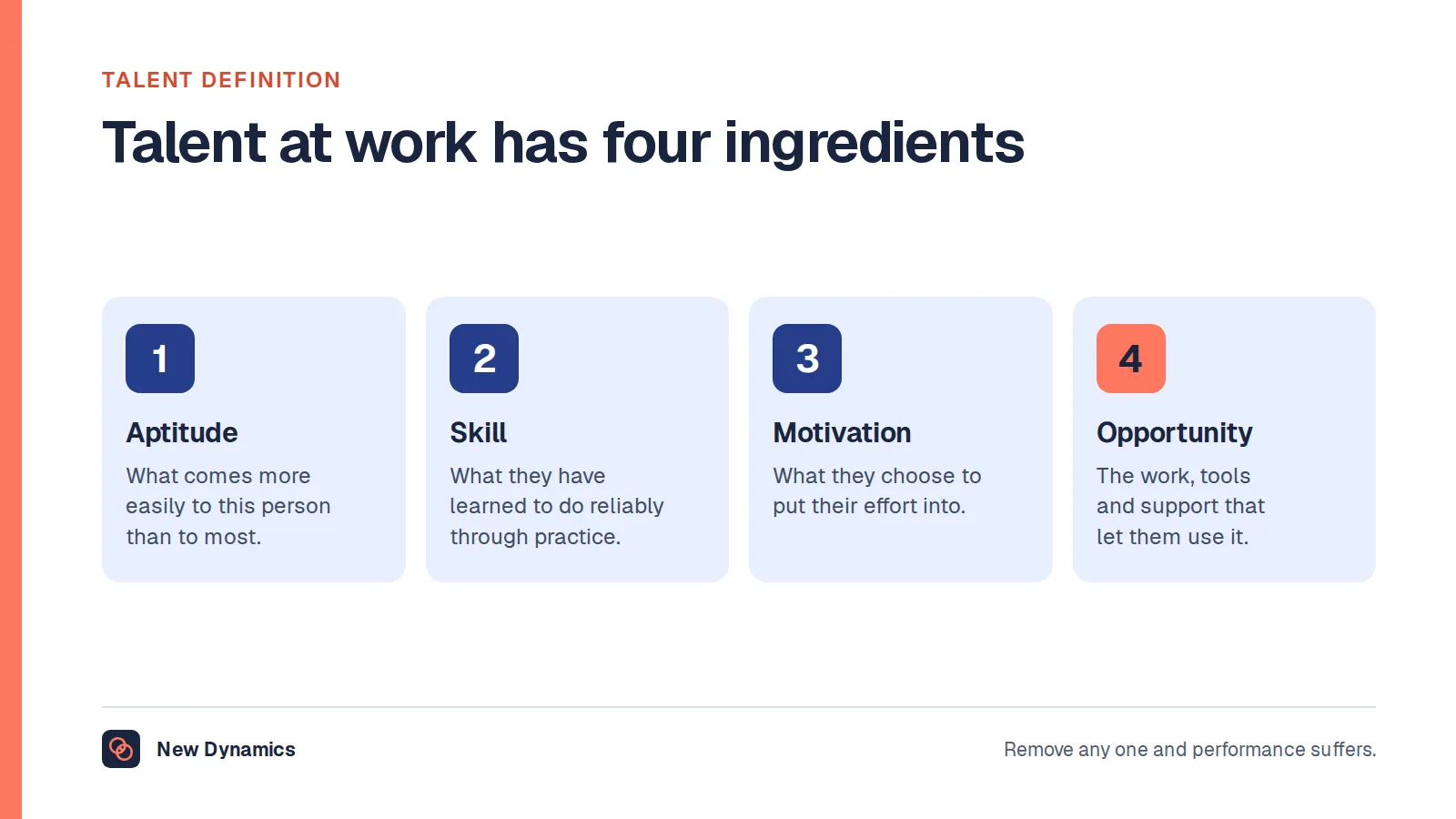
The clearest sign of a great leader is what happens to the people around them. They discuss careers, give away interesting work and are proud when someone outgrows the team. See what talent means at work for how to spot potential fairly.
How to tell: who on your team has grown the most in the last year, and what did you do to help?
Are great leaders born or made?
Personality plays a part. Some people find it easier to speak up, stay calm or read a room. But look again at the two lists above. Nearly every item is something a person does: coaching, giving feedback, delegating, deciding, including. Behaviours can be observed, practised and improved.
This matters for how organisations choose leaders. If you promote people for confidence and presence, you will get confident people with presence. If you promote people who already coach, listen and develop others, you will get leaders.

What makes someone a leader without the title?
Leadership is not a job grade. People lead whenever they help a group move forward. You are leading when you:
- make the goal clearer for everyone in the room;
- ask the question nobody else wanted to ask;
- help a colleague solve a problem without taking it over;
- give credit accurately;
- raise a risk early, with a suggestion.
People who do these things are usually leading long before anyone gives them a team. They are the ones to watch when a management role opens.
How to find out whether you lead well
Your own view is the least reliable one. Ask the people you lead. These questions work in a one-to-one, a short survey or a 360 feedback exercise:
- Are your priorities for this quarter clear?
- Do I give you feedback that helps you improve?
- Do you have enough freedom to decide how to do your work?
- Do I listen when you disagree with me?
- Do you feel included in the team?
- Do I make decisions quickly enough?
- Have we talked usefully about your development in the last six months?
- What is one thing I should start doing, and one thing I should stop?
Thank people for what they tell you, and act on at least one thing visibly. If you react defensively once, you may not be told the truth again.
Common myths about great leaders
Great leaders are charismatic. Some are. Many of the most effective are quiet, consistent and unshowy.
Great leaders have the answers. The best ones have better questions, and the confidence to say “I don't know”.
Great leaders are tough. Standards matter. Fear does not help. People who are frightened hide mistakes.
The best performer makes the best leader. Excellence in a role is evidence for that role. Leading needs different skills.
Leadership cannot be taught. Each of the ten characteristics above is a behaviour. Behaviours can be practised.
How to build one leadership quality in a month

- Pick one quality. Choose the one your team would most like you to improve. If you are not sure, ask.
- Define the behaviour. “Be a better coach” is vague. “Ask two questions before offering advice in every one-to-one” is a behaviour. Our 50 SMART goal examples show how to word it.
- Tell your team. Say what you are working on and ask them to tell you when they see it, and when they do not.
- Review after a month. Ask the same people what has changed. Keep going, or pick the next quality.
Frequently asked questions
What are the characteristics of a great leader?
Great leaders give clear direction, coach, trust people with real authority, give candid feedback, listen and welcome challenge, include everyone, focus on results, make and explain decisions, know enough to help and develop other people. These are behaviours, so they can be learned.
What are the 5 qualities of a good leader?
Five qualities cover most of what matters: clear direction, coaching, trust, candour and care. People know what matters, get help to think for themselves, are trusted with decisions, hear honest feedback and feel included and looked after.
What makes someone a leader?
Someone is a leader when they help a group of people move towards a shared goal. A title is not required. Making a goal clearer, asking the hard question, helping a colleague solve a problem and raising risks early are all acts of leadership.
Are leaders born or made?
Both play a part, but most of what great leaders do can be learned. Personality may make some behaviours easier. Coaching, giving feedback, delegating and deciding are skills that improve with practice and honest feedback.
What did Google's Project Oxygen find?
Google tested whether managers matter, using more than 10,000 data points from reviews, surveys and interviews. It found that they do, and that its best managers shared ten behaviours, including being a good coach, empowering the team without micromanaging and communicating effectively.
How can I tell whether I am a good leader?
Ask the people you lead. Use specific questions about clarity, feedback, freedom, listening and development, and ask what you should start and stop doing. Thank people for their answers and act visibly on at least one.
Your next step: ask one question this week
- Choose one of the eight questions above.
- Ask it in your next three one-to-ones, and listen without defending yourself.
- Pick one thing to change and tell your team what it is.
- Ask again in a month.
For a structured way to gather views from your whole team, read and download our 360 feedback guide. The guide is free to read, and the PDF uses our short download form.
Want feedback, goals and development conversations in one place? Book a New Dynamics demo and bring your leadership development plans. You can also email contact@new-dynamics.com.