TL;DR
- A chief executive officer, or CEO, holds the most senior executive position in a company. The CEO leads the organisation, proposes and delivers its strategy, builds the executive team and answers to the board for the results. In the UK the same job is often titled managing director.
- The job has six responsibilities: lead the strategy, deliver the results, build and lead the executive team, own the culture and the values in practice, represent the company outside, and work with the board and the chair. The UK Corporate Governance Code says the roles of chair and chief executive should not be held by the same person.
- A CEO who is a company director also carries the legal duties of a director. A good job specification says what the board keeps, how the CEO will be judged and what the succession plan is.
The chief executive is the one job in a company that every employee has a view on and almost nobody has seen described. Boards write the job specification rarely, often in a hurry, and usually when the last chief executive has just left. This article is for the board members, chairs, founders and candidates who need one.
This CEO job description explains what a chief executive officer is, sets out six responsibilities, describes the relationship with the board and the chair, summarises the legal duties a chief executive carries as a company director in the UK, lists the qualities boards look for, and gives a job specification template.
A chief executive can only lead what they can see. See how New Dynamics org charts show roles, reporting lines and the relationships between them.
What is a chief executive officer?
The Cambridge Dictionary defines a chief executive officer as “the person with the most important position in a company”, abbreviated CEO. In the UK the same job is often called managing director, which Cambridge defines as “the person in charge of a company”. The two titles can coexist in one company, usually with the chief executive above the managing director of a division, but in a single company they describe the same role.
What the definitions leave out is the relationship that defines the job. The chief executive runs the company, but does not own it and does not oversee it. The board does that. The CEO is appointed by the board, proposes strategy to it, reports to it and can be removed by it. Everything else in the job description follows from that.
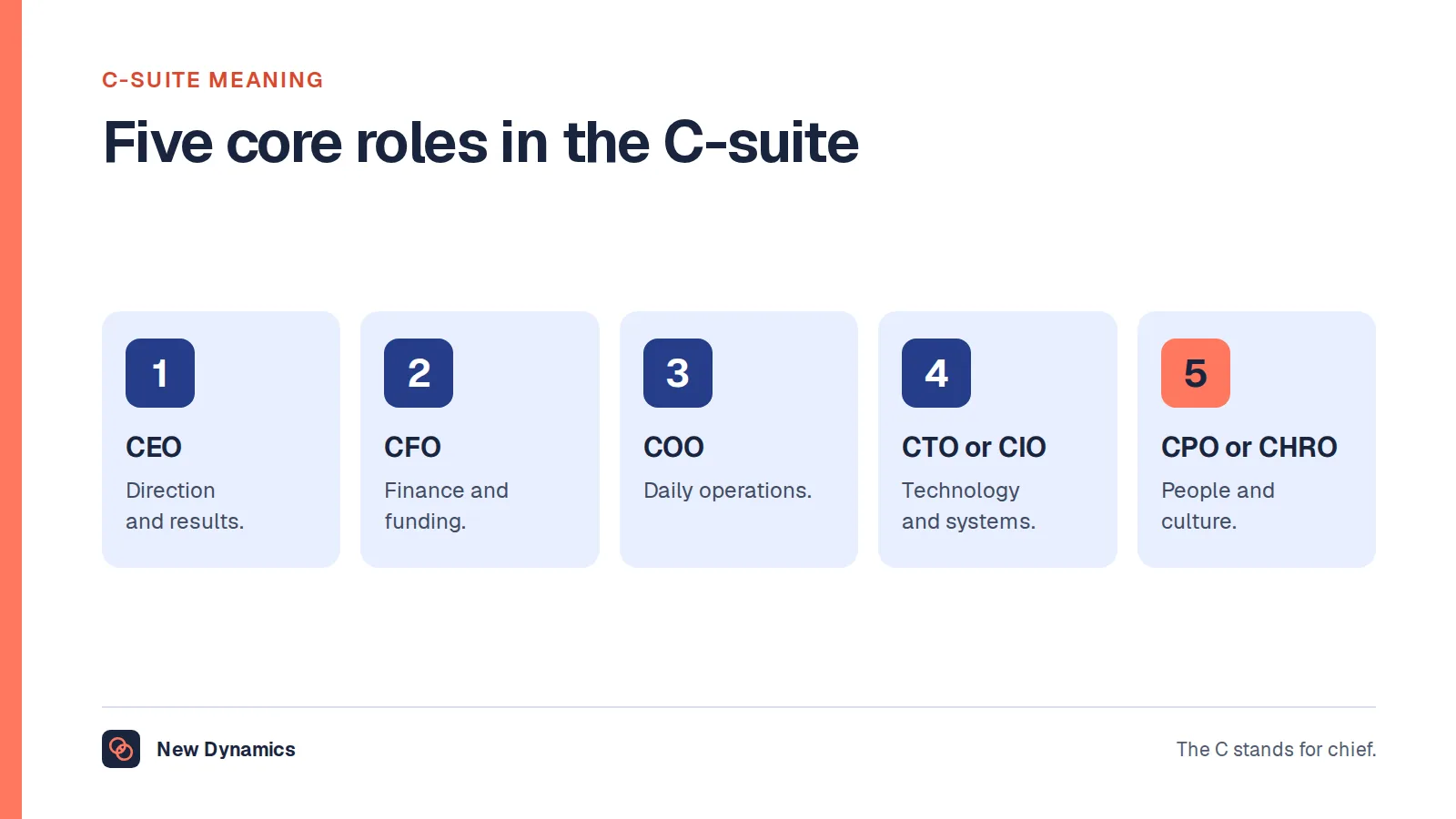
Our guide to the meaning of the C-suite explains the other chief officers who report to the CEO.
CEO responsibilities: six duties
- Lead the strategy. Propose to the board where the company is going and how it will get there, then translate the agreed strategy into plans, priorities and budgets. The board approves the strategy; the chief executive owns it.
- Deliver the results. Answer for the company's performance against the plan: financial, operational and, increasingly, the wider outcomes the board has committed to. Delegate the running of it, and stay accountable for all of it.
- Build and lead the executive team. Appoint, develop and, when necessary, replace the chief officers and senior leaders. The quality of this team is the chief executive's most important output.
- Own the culture. The UK Corporate Governance Code expects a board to establish the company's purpose, values and strategy and to satisfy itself that its culture is aligned with them. The chief executive is the person whose behaviour makes that real, or not.
- Represent the company. Be its face and voice to customers, investors, regulators, partners, the press and the public, and bring what they say back into the company.
- Work with the board and the chair. Keep the board informed, bring it the decisions that are its to take, and build a working relationship with the chair that survives disagreement.

The chief executive, the chair and the board
The relationship is easiest to see in a listed UK company, where the UK Corporate Governance Code, published by the Financial Reporting Council, sets the expectations. The 2024 Code says: “The roles of chair and chief executive should not be exercised by the same individual.” It adds that a chief executive should not become chair of the same company. Provision 14 then sets the rule that makes a written job description a governance matter: “The responsibilities of the chair, chief executive, senior independent director, board and committees should be clear, set out in writing, agreed by the board and made publicly available.”
The Code applies to companies with a premium listing on a comply-or-explain basis, but the division it describes is a sensible model for any organisation with a board.
| Who | What they do |
|---|---|
| The board | Sets purpose, values and strategy, appoints and holds to account the chief executive, approves major decisions, oversees risk and control |
| The chair | Leads the board, sets its agenda, ensures it gets the information it needs, and holds the chief executive to account |
| Chief executive | Leads the company, proposes and delivers the strategy, runs the executive team and reports to the board |
The Code also expects non-executive directors to scrutinise and hold to account the performance of management against agreed performance objectives. For a chief executive that means the job specification should say, in advance, what those objectives are and how they will be measured.

A chief executive's legal duties as a director
In most companies the chief executive is also a director of the company, and directors carry legal duties that do not depend on the job title. The UK government's guide to directors' responsibilities says that as a director of a limited company you must follow the company's rules in its articles of association, keep company records and report certain information, prepare annual accounts, complete and file the Company Tax Return, tell other shareholders if you might personally benefit from a transaction the company makes, and pay Corporation Tax. It adds: “You can hire other people to manage some of these things day-to-day (for example, an accountant) but you're still legally responsible for your company's records, accounts and performance.”
Directors who do not meet their responsibilities can be fined, prosecuted or disqualified. That applies to England, Wales, Scotland and Northern Ireland under the Companies Act 2006; the law differs in other countries. This is general information, not legal advice, and a chief executive taking up a directorship should take their own.
What boards look for in a chief executive
The US Office of Personnel Management's executive core qualifications, which federal agencies use to select their most senior executives, describe an executive who can achieve results, drive efficiency and lead people, and OPM says the five qualifications “are interdependent; successful executives bring all five to bear”. Boards hiring a chief executive tend to test for the same interdependence, in language of their own.
- Strategic judgement. A record of reading a market and choosing a direction that proved right, and of changing course when it did not.
- Delivery. Results, in a business of comparable scale or complexity, that the candidate can explain rather than merely claim.
- Leadership of leaders. Executives who have been hired, grown and, when necessary, moved on. Ask the people who worked for them.
- Integrity and judgement under pressure. The chief executive sets the standard for the whole company, especially when nobody is watching.
- Communication. Clear with the board, honest with employees, credible with investors and customers.
- Fit with the board and the chair. The relationship is the job. Test it before appointment, not after.
Qualifications vary by sector. Most chief executives have a degree and many have professional or business qualifications, but boards appoint on record, references and the interview. For the second-in-command whose job is often the proving ground, see our chief operating officer job description.
CEO job specification template
Adapt the reporting line, the measures and the board's reserved matters to your own governance.
Job title: Chief executive officer
Reports to: The board, through the chair
Direct reports: [Chief operating officer, chief financial officer, and the other members of the executive team]
Purpose of the role: To lead the company, propose and deliver the strategy agreed by the board, build the executive team and culture that can deliver it, and answer to the board for the company's performance and conduct.
Main responsibilities:
- Develop the strategy with the board and turn it into plans, priorities and budgets
- Deliver the agreed financial, operational and wider objectives
- Appoint, lead, develop and hold to account the executive team
- Set and model the company's values and culture
- Represent the company to customers, investors, regulators, partners and the public
- Keep the board fully and promptly informed and bring it the matters reserved for its decision
- Fulfil the duties of a director of the company
Matters reserved for the board: [Strategy approval, major investments and disposals, the annual budget, executive appointments and pay, risk appetite]
Experience and qualities:
- A record of leading a business or division of comparable scale and delivering results
- Strategic judgement and the ability to communicate a direction clearly
- Experience of building and leading an executive team through change
- Personal integrity and sound judgement under pressure
- [Sector, regulatory or international experience, if essential]
Measures of success: Performance against the agreed objectives, the strength and succession of the executive team, the health of the culture as measured by the board, and the quality of the relationship with the board.
For the layout of the whole document, use our job description template.
Common mistakes in CEO job specifications
No reserved matters. If the specification does not say what the board keeps, the chief executive will decide, and the board will find out afterwards.
Measures that arrive later. Objectives agreed after appointment are objectives the chief executive wrote. Set them in the specification.
A founder's job with a hired executive's title. If the founder is staying, say what the founder will do and who decides when they disagree.
Ignoring succession. The specification should say whether an internal successor is expected to be developed, and by when. Our succession planning guide explains how.

Frequently asked questions
What does a CEO do?
A chief executive officer leads the company. The CEO proposes the strategy to the board and delivers it, answers for the company's results, builds and leads the executive team, sets the culture, represents the company outside and works with the board and the chair. In most companies the CEO is also a director with the legal duties that go with it.
What is the difference between a CEO and a managing director?
Usually nothing. Managing director is the traditional British title for the person in charge of a company, and chief executive officer the American one now common everywhere. In groups, the chief executive may lead the whole company and managing directors lead its divisions.
What is the difference between the CEO and the chair?
The chair leads the board; the chief executive leads the company. The UK Corporate Governance Code says the two roles should not be held by the same person, and that a chief executive should not go on to chair the same company. The chair holds the chief executive to account on the board's behalf.
Does a CEO have legal duties?
If the chief executive is a company director, yes. UK government guidance lists a director's responsibilities, including keeping records, preparing accounts, filing the tax return and declaring personal interests, and says the director remains legally responsible even when others do the work. The rules differ in other countries. This is general information, not legal advice.
What should a CEO job specification include?
The purpose of the role, the reporting line to the board through the chair, the direct reports, six main responsibilities, the matters reserved for the board, the experience and qualities required, the measures of success and the expectation on succession.
What qualifications does a CEO need?
None are required by law. Boards appoint on a record of leading a business of comparable scale, strategic judgement, leadership of senior teams, integrity and fit with the board. Many chief executives have degrees and professional qualifications, and in regulated sectors approval by the regulator may be needed.
Your next step: write the board's side first
- List the matters reserved for the board, and check that the board agrees with the list.
- Write the chief executive's objectives for the first year and how each will be measured.
- Decide what the chair will do, in writing, before the chief executive arrives.
- State the expectation on succession, including for the new chief executive.
To plan the pipeline behind the top job, read and download our succession planning guide. The guide is free to read, and the PDF uses our short download form.
Want the executive team's structure, goals and progress visible to the board and the chief executive alike? Book a New Dynamics demo and bring your current org chart. You can also email contact@new-dynamics.com.