TL;DR
- A chief operating officer, or COO, is the senior executive responsible for how the whole organisation runs day to day. The COO turns the strategy the chief executive and board have set into plans, processes, budgets and results, and usually has most of the organisation reporting to them.
- The job has six responsibilities: run the operating plan, own the processes and systems, manage performance and budgets, lead the leadership team, drive change and improvement, and act as the CEO's deputy. What each means depends on the company, so the job description must say which model of COO you want.
- Employers look for an operational mindset, financial discipline, judgement, and the ability to lead through other leaders. A COO job description should be built around outcomes, and the interview should test how the candidate has delivered them.
Ask three companies what their chief operating officer does and you will get three answers. In one, the COO runs every function except finance. In another, the COO is the founder's second in command, taking whatever the founder cannot do. In the third, the COO is the successor being tested. The title is the same. The job is not.
This chief operating officer job description explains what a COO is, sets out the six responsibilities that appear in most versions of the job, separates the COO from the chief executive and the operations manager, describes the qualities to look for, gives a template that you can adapt to your own model, and ends with eight interview questions.
A COO lives on the operating plan, and the plan lives on goals that everyone can see. See how New Dynamics Goals & OKRs keeps commitments, owners and progress in one shared place.
What is a chief operating officer?
The Cambridge Dictionary defines a chief operating officer as “the manager in an organization who is responsible for how the whole organization is run”. It gives COO as the abbreviation and chief operations officer as an alternative title. Both spellings are in use, and both describe the same job.
The definition separates the COO from the chief executive. The Cambridge entry for the chief executive officer is “the person with the most important position in a company”. The CEO is accountable to the board for the whole enterprise, including its strategy and its results. The COO is accountable to the CEO for running it. In practice the CEO looks outward and forward, to the board, investors, customers and the market, and the COO looks inward, at whether the organisation is doing what it said it would do this quarter.
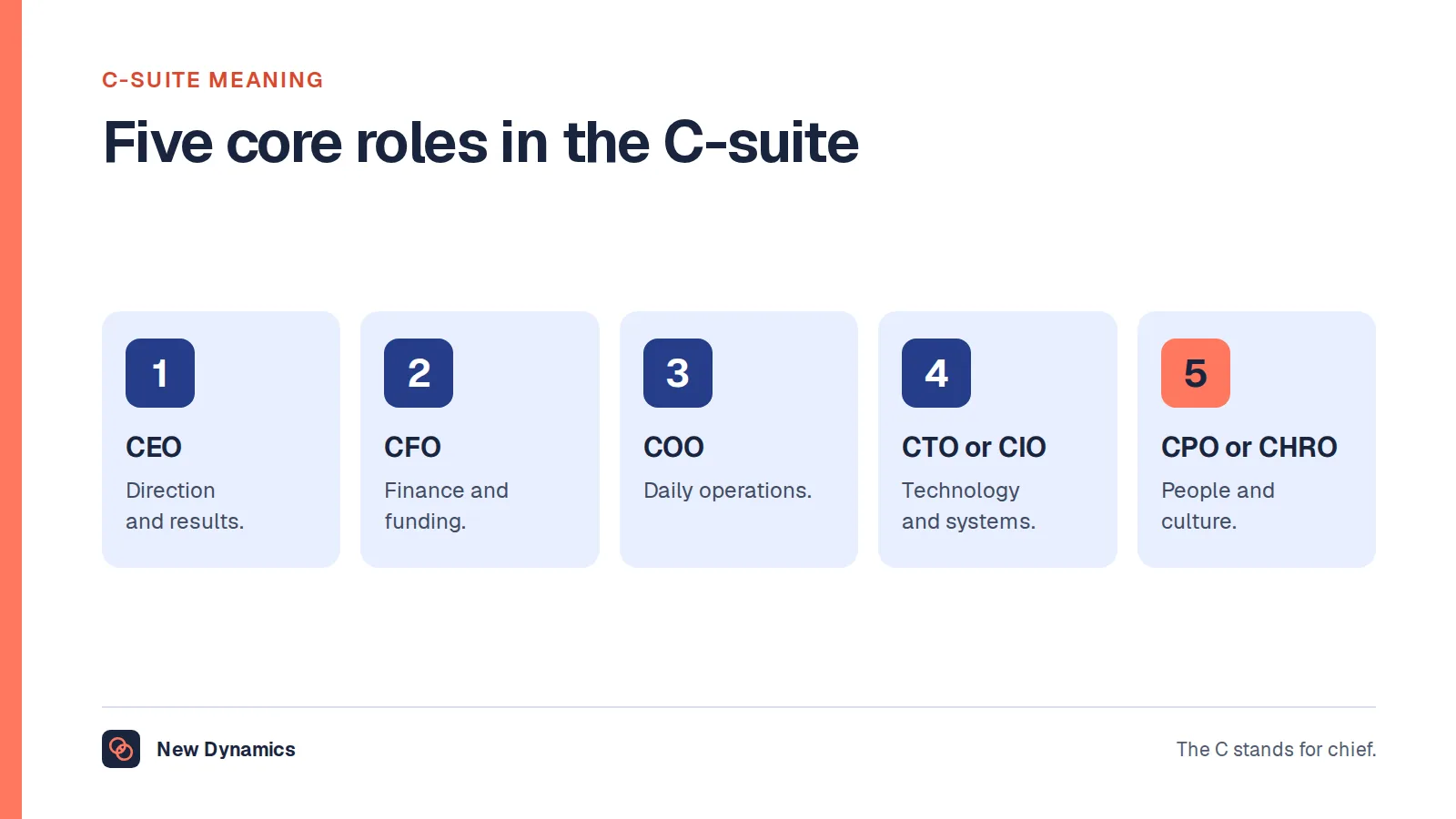
Our guide to the meaning of the C-suite places the role among the other chiefs.
Chief operating officer duties: six responsibilities
- Run the operating plan. Turn the strategy into an annual and quarterly plan with goals, owners and budgets, then run the rhythm of reviews that keeps it on track.
- Own the processes and systems. Make sure the way the organisation produces and delivers what it sells is defined, measured and improved, and that the systems behind it work.
- Manage performance and budgets. Hold the functions to their targets and their spending. Spot problems early and fix them, or escalate them, before they reach the board.
- Lead the leadership team. Most operating functions report to the COO: often production or service delivery, supply chain, customer operations, sometimes sales, technology, people and finance. Hire, develop and, when needed, replace their leaders.
- Drive change and improvement. Own the big cross-functional programmes: a new system, a new site, an acquisition to integrate, a cost base to reduce, a market to enter.
- Deputise for the CEO. Stand in when the CEO is absent, take decisions on the CEO's behalf within agreed limits, and in some companies be the CEO's designated successor.

Which COO do you want?
The reason COO job descriptions vary so much is that companies use the role for different purposes. Before you write one, decide which of these you mean.
| Model | What the COO is for |
|---|---|
| The executor | Runs the whole operation so that the CEO can focus on strategy, investors and the market |
| The complement | Brings what the CEO lacks: an operator alongside a visionary, or a builder alongside a salesperson |
| The change agent | Hired to lead one big shift: a turnaround, an integration, a scale-up or a transformation |
| The successor | Being prepared, and tested, for the top job |
Say which one it is in the purpose statement of the job description. A change agent hired as an executor, or a successor who discovers there is no succession, is an expensive misunderstanding. If the fourth model applies, our succession planning guide explains how to make the plan explicit.

COO, CEO and operations manager
| Role | Scope |
|---|---|
| Chief executive | The whole enterprise: strategy, results, the board, investors and the outside world |
| Chief operating officer | How the whole organisation runs: the operating plan, the functions, their leaders, budgets and performance |
| Operations manager | One operation or site: its people, output, quality, cost and safety, day to day |
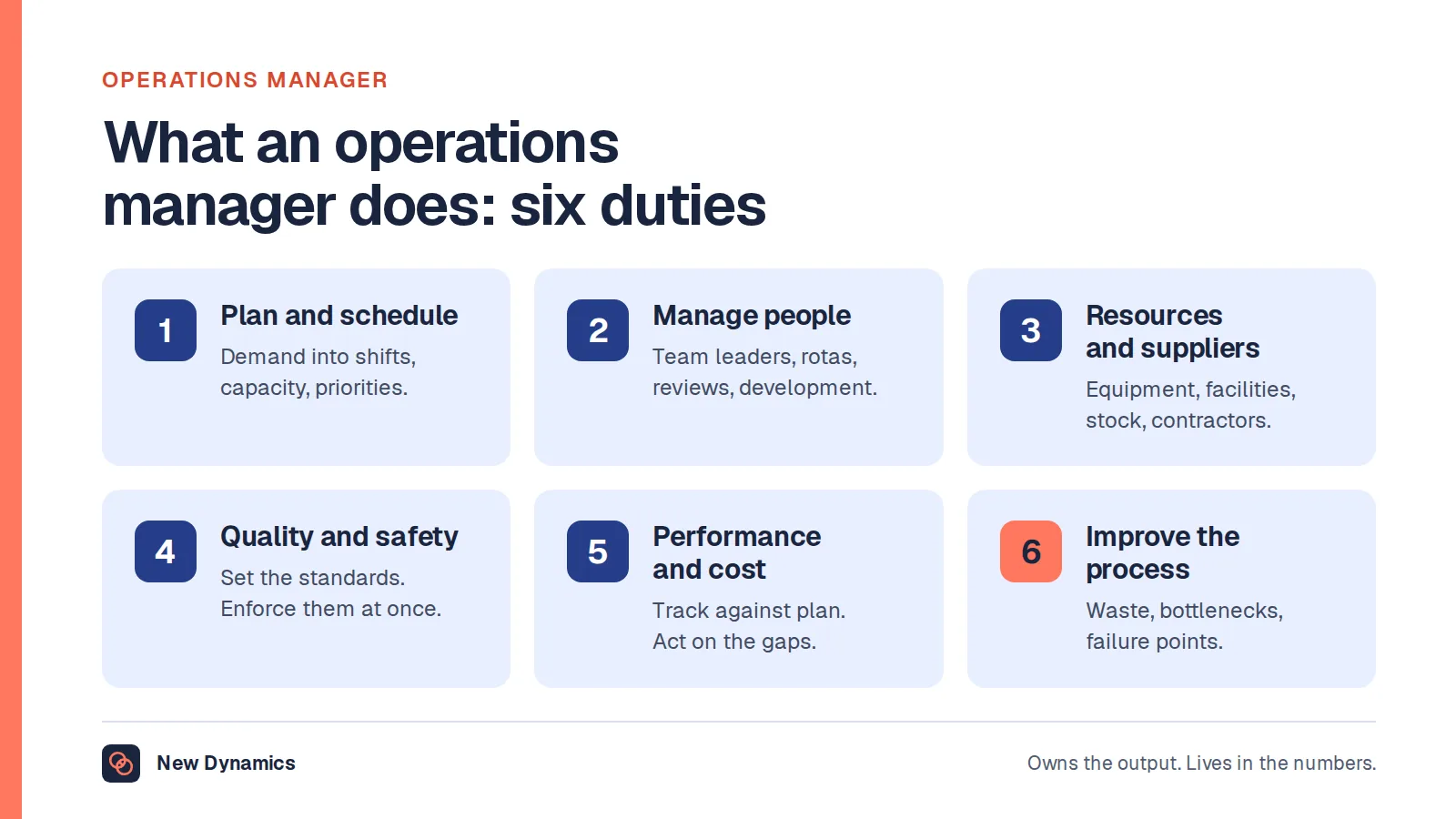
The operations manager is a middle-management role, often in production, logistics or service delivery, and our operations manager job description covers it in detail. A COO in a small company may do both jobs at once. In a large one there may be several layers between them. In the public sector and in some large organisations a chief administrative officer holds a similar remit under another name.
What to look for in a chief operating officer
The US Office of Personnel Management's executive core qualifications, which federal agencies use to select and develop senior executives, are a useful checklist for any executive hire, and three of them read like a COO's job. Under achieving results, OPM describes an operational mindset in two sentences: “Effectively translates strategies into actionable steps and processes. Partners effectively with stakeholders to drive adoption and addresses blockers to ensure successful implementation.” Under driving efficiency, fiscal responsibility begins: “Strategically manages, allocates and monitors financial resources.” Under leading people, accountability includes this: “Holds self and others accountable for measurable high-quality, timely, and cost-effective results.”
Translated into a person specification:
- An operational mindset. A record of turning plans into processes, and processes into results, at a scale close to yours.
- Financial discipline. Comfortable with a budget, a forecast and a cost base, and able to argue with the finance director as an equal.
- Leadership through leaders. The COO's team is a team of directors. The skill is hiring, developing and holding them to account, not doing their jobs.
- Judgement under pressure. Timely decisions with incomplete information, and the sense to know which ones to take to the CEO.
- Change leadership. At least one large cross-functional change delivered, with the scars to show for it.
- Fit with the CEO. The complement model in particular depends on two people who trust each other and disagree well.
Qualifications vary. Many COOs have a degree and a professional or business qualification, but companies hire on record, and the record that matters is running something large and making it better.
Chief operating officer job description template
Adapt the purpose statement to the model you have chosen, and the reporting lines to your structure.
Job title: Chief operating officer
Reports to: Chief executive officer
Direct reports: [Directors of operations, customer service, supply chain, technology and people, as applicable]
Purpose of the role: To run the organisation day to day, turning the strategy agreed by the board and the chief executive into an operating plan, and delivering its goals on quality, cost and time. [Add the model: for example, “and to lead the integration of the acquired business over the next two years”.]
Main responsibilities:
- Build and run the annual and quarterly operating plan, with clear goals, owners and budgets
- Own the organisation's core processes and systems and their continuous improvement
- Manage the performance and spending of the operating functions against plan
- Lead, develop and hold to account the directors who report to you
- Lead major cross-functional change programmes
- Deputise for the chief executive and contribute to strategy as a member of the executive team
Experience and qualities:
- A record of running a large operation and improving its results
- Strong financial and commercial judgement
- Experience of leading senior leaders through significant change
- Clear, direct communication with boards, teams and customers
- [Sector or regulatory experience, if essential]
Measures of success: Delivery of the operating plan, agreed financial and service targets, the strength of the leadership team, and the outcome of the change programme named above.
For the layout of the whole document, use our job description template.
Chief operating officer interview questions
Executive interviews should test the record, not the rhetoric. These eight questions are ours, and each asks for evidence.
- Describe the largest operation you have run. What did you inherit, what did you change, and what were the results?
- Tell us about a time you turned a strategy into an operating plan. How did you set goals and owners, and how did you keep it on track?
- Give an example of a cost base you reduced. How did you decide where to cut, and what did you protect?
- Describe a director who was not performing. What did you do, over what period, and how did it end?
- Tell us about a cross-functional change you led. What went wrong, and what did you do about it?
- How have you worked with a chief executive whose style differed from yours? Where did you disagree, and how did you resolve it?
- What would you want to know in your first 90 days here, and how would you find it out?
- What is the difference between a decision you would take yourself and one you would bring to the chief executive?
For more questions that test how someone leads, see our manager interview questions.

Common mistakes in COO job descriptions
Not saying which model. Executor, complement, change agent or successor. Leave it out and the candidate will assume, and the assumption will be wrong.
A list of every function. If everything reports to the COO, say what the CEO keeps. Otherwise you have described a second chief executive.
Vague measures of success. “Operational excellence” is not a measure. Name the plan, the targets and the programme.
Hiring a manager, not a leader of leaders. The best operations manager in the company is not necessarily ready to lead directors. Test for it.
Frequently asked questions
What does a chief operating officer do?
A chief operating officer runs the organisation day to day. The COO turns strategy into an operating plan, owns the processes and systems, manages performance and budgets, leads the directors of the operating functions, drives major change programmes and deputises for the chief executive.
What is the difference between a COO and a CEO?
The CEO holds the most senior position and is accountable to the board for the whole enterprise, including strategy and results. The COO is accountable to the CEO for how the organisation runs. The CEO tends to look outward and forward; the COO looks inward at delivery.
Is COO the same as chief operations officer?
Yes. The Cambridge Dictionary gives chief operations officer as an alternative title for chief operating officer, and both are abbreviated to COO. Use one spelling consistently in the job description and the contract.
Who reports to a COO?
It depends on the company. Typically the leaders of production or service delivery, supply chain and customer operations, and often technology, people and sometimes sales. Finance usually reports to the CEO through the chief financial officer. The job description should list the direct reports.
What qualifications does a chief operating officer need?
There is no required qualification. Most COOs have a degree and many have a professional or business qualification, but employers hire on a record of running a large operation and improving its results, leading senior leaders and delivering change.
What should a COO job description include?
The purpose of the role and which model of COO it is, the reporting line and direct reports, six main responsibilities, the experience and qualities required, and named measures of success such as the operating plan, financial and service targets and any change programme the COO will lead.
Your next step: decide the model before you write the advert
- Agree with the chief executive and the board which of the four models the COO is for.
- Write the purpose statement in one sentence that says so.
- List what reports to the COO and what the CEO keeps.
- Name three measures of success for the first year.
If the answer to step one is the successor, read and download our succession planning guide. The guide is free to read, and the PDF uses our short download form.
Want the operating plan, its goals and its owners visible to the whole leadership team? Book a New Dynamics demo and bring your current plan. You can also email contact@new-dynamics.com.