TL;DR
- Gross misconduct is behaviour by an employee that is so serious, or has such serious effects, that it can justify dismissal without notice even for a first offence. Acas's examples are fraud, physical violence, gross negligence and serious insubordination.
- Ordinary misconduct is behaviour that breaks the rules but does not destroy the working relationship on its own; it is usually dealt with by warnings. The difference is seriousness and effect, and the organisation's own policy should give examples.
- Gross misconduct allows dismissal without notice, but not without process. GOV.UK says the employer should always investigate the circumstances before dismissing, and Acas says the employer must still carry out an investigation and a fair disciplinary procedure, with a right of appeal.
Two words in a disciplinary policy do more work than any others. Whether an act is misconduct or gross misconduct decides whether an employee gets a warning or loses their job, with notice or without it, and whether a tribunal later agrees. Managers use the phrase often and define it rarely.
This article gives the meaning of gross misconduct, explains how it differs from ordinary misconduct, sets out the examples that Acas gives, shows what a fair dismissal for gross misconduct still requires, explains the employee's rights and lists the mistakes that turn a justified dismissal into an unfair one.
Most gross misconduct cases begin with a manager who has no record of the conversations that came before. See how New Dynamics continuous feedback supports check-ins between managers and their teams, so that expectations and concerns are written down long before a hearing.
What is gross misconduct?
The Cambridge Dictionary defines gross misconduct, in its HR and law sense, as “unacceptable behaviour by an employee as a result of which they will probably lose their job”. Misconduct on its own is “unacceptable or bad behaviour by someone in a position of authority or responsibility”.
Acas, the public body that advises on workplace relations, gives the working definition in its step-by-step guide to disciplinary procedures: “Some acts count as 'gross misconduct' because they are very serious or have very serious effects.” It adds that “What is seen as gross misconduct can depend on the organisation.”
Two ideas sit inside that.
- Seriousness. The act itself is grave: dishonesty, violence, a serious breach of trust or safety.
- Effect. The act, whatever its intent, does serious damage to the organisation, to colleagues, to customers or to the relationship of trust that employment depends on.
Either can be enough. A single act of fraud is gross misconduct because of what it is. A careless act that endangers lives can be gross misconduct because of what it does.
Misconduct and gross misconduct: the difference
| Question | Misconduct | Gross misconduct |
|---|---|---|
| How serious | Breaks the rules or falls below the standard expected | Very serious in itself, or has very serious effects |
| Usual outcome | A warning, then a final warning if repeated | Dismissal is possible for a first offence |
| Notice | Dismissal, if it comes, is with notice after repeated warnings | Dismissal can be without notice or pay in lieu |
| Trust | Strained but repairable | Destroyed, in the employer's reasonable view |
| Examples | Lateness, unauthorised absence, minor rudeness, misuse of equipment | Fraud, violence, gross negligence, serious insubordination |
The line between them is drawn by the seriousness of the act and its effect, and it is drawn in each organisation's own policy. Our guide to disciplinary action covers the full procedure for ordinary misconduct.

Examples of gross misconduct
Acas gives four examples of what gross misconduct at work could include.
- Fraud. Dishonesty for gain: false expenses, falsified records, theft.
- Physical violence. Towards a colleague, a customer or property.
- Gross negligence. In Acas's words, “a serious lack of care to their duties or other people”.
- Serious insubordination. Acas's example is “refusing to follow policies or take reasonable orders from a supervisor”.
Organisations add their own. Common additions in policies include serious breaches of health and safety rules, serious harassment or discrimination, being under the influence of alcohol or drugs at work, serious breaches of confidentiality or data protection, bringing the organisation into serious disrepute and serious misuse of systems. Acas notes that misconduct outside work can count too, giving the example of behaviour in front of external clients at a work Christmas party that reflects badly on the company.
Two cautions. A list in a policy is not a verdict: the facts of each case still have to be investigated and judged. And a policy that labels trivial things gross misconduct will not persuade a tribunal that dismissal was reasonable.

Dismissal for gross misconduct: without notice, not without process
Gross misconduct is the one situation in which an employer can end a contract at once. GOV.UK's guide to the reasons you can be dismissed says: “You can be dismissed for 'gross misconduct' without your employer going through the normal disciplinary procedures.” It gives violence towards a colleague, customer or property as an example. And it adds, in the next sentence: “Your employer should always investigate the circumstances before making a dismissal, even in possible gross misconduct cases.”
Acas is firmer still: “If an employer finds there has been gross misconduct, they must still carry out an investigation and a fair disciplinary procedure.” In practice a fair procedure for gross misconduct has six steps.
- Suspend, if necessary, and say why. Suspension on full pay while investigating is a neutral act, not a punishment, and should be as short as possible.
- Investigate. Gather the facts, the documents and the accounts of witnesses, with an open mind, before deciding whether there is a case to answer.
- Invite to a hearing, in writing. Set out the allegation, the evidence and the possible outcome, including dismissal, and the right to be accompanied.
- Hold the hearing. Let the employee respond to the evidence, call witnesses and explain, and adjourn to consider.
- Decide, and decide who decides. Acas says that dismissal should only be decided by a manager who has the authority to do so, and that the employer should tell the employee the reasons, the date the contract ends, the notice period and the right of appeal.
- Offer an appeal. Acas says the employer should offer the right of appeal, so the employee can challenge an outcome that is too severe or a procedure that was wrong or unfair.
An employment tribunal, Acas notes, takes the fairness of the procedure into account if an employee claims unfair dismissal. This section describes the position in Great Britain in general terms and is not legal advice. The law differs in Northern Ireland and elsewhere, and employers should take advice on any dismissal.

The employee's rights
- To know the allegation and see the evidence before the hearing.
- To be accompanied at the hearing by a colleague or a trade union representative.
- To respond, and to have that response genuinely considered before a decision.
- To an appeal, heard where possible by someone not involved in the original decision.
- To a written statement of the reasons, and to claim unfair dismissal at a tribunal where the qualifying conditions are met and the dismissal or the procedure was unfair.
Suspension is not a finding, and an investigation is not a decision. Employees who are suspended should be told that in writing.
Common mistakes by employers
Dismissing on the spot. The act may be gross misconduct; the instant dismissal without investigation or hearing is unfair anyway.
A policy that lists everything. Calling minor lateness gross misconduct empties the term of meaning and will not survive scrutiny.
The same person investigating, deciding and hearing the appeal. Separate the roles wherever the organisation's size allows.
Ignoring the employee's account. A hearing where the outcome was decided beforehand is not a hearing.
Inconsistency. Dismissing one person for what another was warned for is the surest route to an unfair dismissal finding.
No record. Every step, every letter and every decision should be documented. Our code of conduct examples show how to set the standard that gross misconduct breaches.
Frequently asked questions
What is gross misconduct?
Gross misconduct is behaviour by an employee that is so serious, or has such serious effects, that it can justify dismissal without notice even for a first offence. Acas's examples are fraud, physical violence, gross negligence and serious insubordination, and each organisation's policy should give its own.
What is the difference between misconduct and gross misconduct?
Misconduct breaks the rules or falls below the expected standard and is usually dealt with by warnings, with dismissal only after repeated warnings and with notice. Gross misconduct is very serious in itself or in its effects, and can justify dismissal without notice for a first offence. The difference is seriousness and effect.
Can you be dismissed without notice for gross misconduct?
Yes. GOV.UK says you can be dismissed for gross misconduct without the employer going through the normal disciplinary procedures, but that the employer should always investigate the circumstances first. Acas says the employer must still carry out an investigation and a fair disciplinary procedure.
What are examples of gross misconduct?
Acas lists fraud, physical violence, gross negligence and serious insubordination. Organisations commonly add serious breaches of safety, harassment or discrimination, being under the influence at work, serious breaches of confidentiality, bringing the organisation into disrepute and serious misuse of systems. Behaviour outside work can count if it affects the business.
Does gross misconduct always mean dismissal?
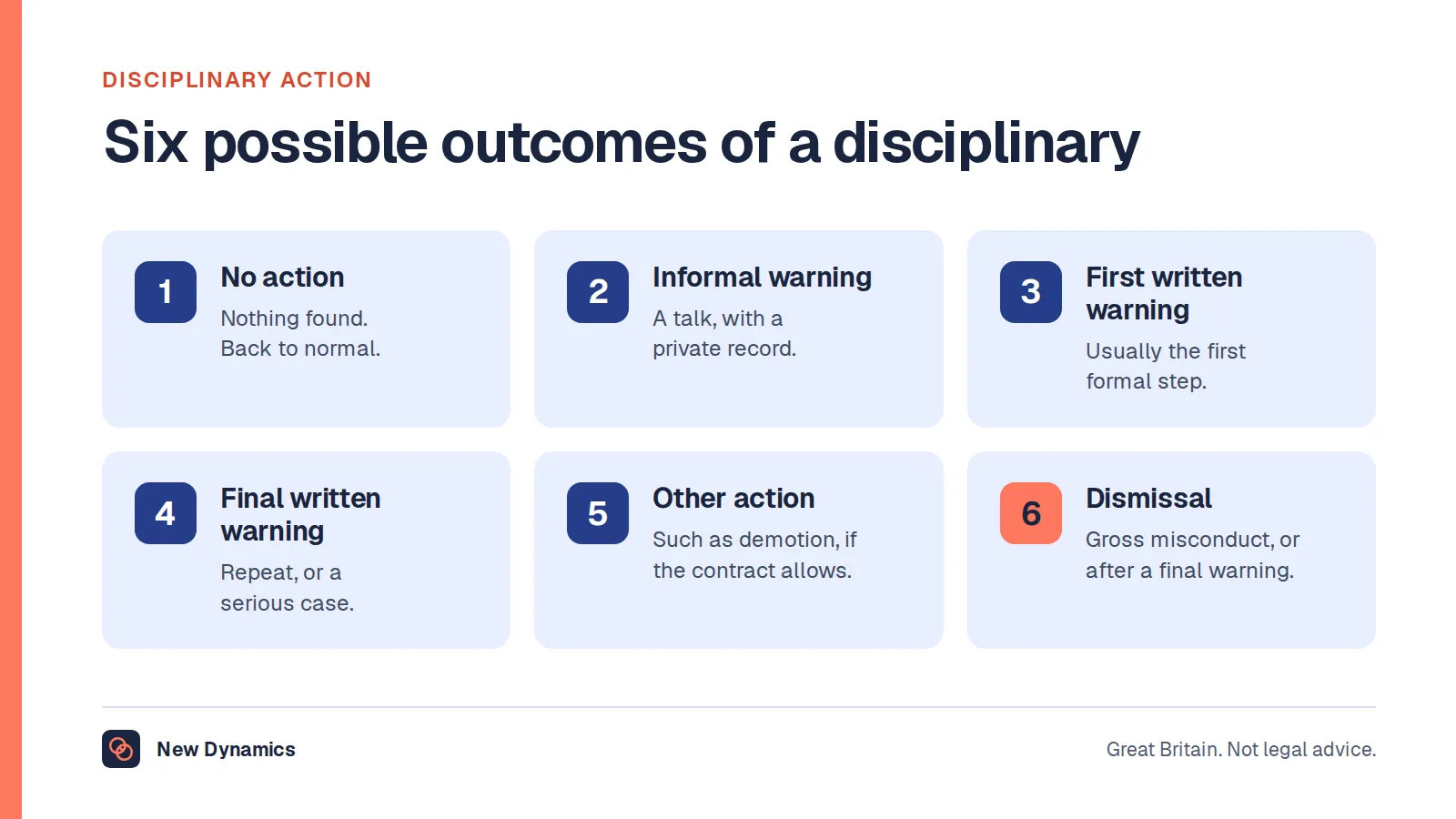
No. Dismissal is a possible outcome, not an automatic one. After a fair investigation and hearing, an employer may decide on a final written warning, demotion or another outcome, depending on the facts, any mitigation and how similar cases have been treated.
Can I appeal a dismissal for gross misconduct?
Yes. Acas says the employer should offer the right of appeal, so that the employee can challenge an outcome that is too severe or a procedure that was wrong or unfair. Appeals should be heard, where possible, by someone not involved in the original decision.
Your next step
If you manage people, read your organisation's disciplinary policy this week and check that its gross misconduct examples are serious ones, and that the procedure separates investigating, deciding and appealing. If you are facing an allegation, ask for the evidence in writing and arrange to be accompanied.
For a standard of conduct that makes the line clear before anyone crosses it, read and download our code of conduct guide. The guide is free to read, and the PDF uses our short download form.
Want expectations and concerns recorded through the year, so that a hearing is never the first conversation? Book a New Dynamics demo and bring your current approach. You can also email contact@new-dynamics.com.