TL;DR
- A code of conduct sets out how people in an organisation are expected to behave: towards each other, towards customers and with the organisation's money, information and name.
- A useful code is short and written in plain language. It gives real examples, explains how to raise a concern and says what happens next. Most cover about a dozen topics.
- A code works only if people see it applied. Leaders have to follow it, managers have to discuss it, and concerns have to be handled fairly whoever is involved.
Every workplace has rules of conduct, whether or not anyone has written them down. People learn them by watching what gets praised, what gets ignored and what gets someone into trouble. A written code of conduct makes those expectations visible, so that they are the same for everyone.
This article explains what a code of conduct is, what to include, and how to word it, with examples in plain language and a short sample. It ends with the part most organisations neglect: making the code real.
A code asks people to speak up when something is wrong. See how New Dynamics continuous feedback helps organisations to build the habit of honest conversation.
This is general information, not legal advice. Employment law varies between countries, so take advice on your own situation.
What is a code of conduct?
A code of conduct is a document that sets out how people in an organisation are expected to behave. It covers how they treat each other, how they deal with customers and suppliers, and how they handle the organisation's money, information and reputation.
You will also meet these terms.
- Rules of conduct or standards of conduct. Usually the same thing, with a more formal name.
- Code of ethics. A statement of values and principles. It says what the organisation stands for. A code of conduct says what to do about it. Many organisations combine the two.
- Employee handbook. A wider document that covers pay, leave, procedures and benefits as well as conduct.
- Disciplinary rules. The part that says what counts as misconduct and what may follow.
A well-known public example is the UK's Civil Service Code. It is built on four core values, each defined in a single line. For example, “‘honesty’ is being truthful and open”, and “‘objectivity’ is basing your advice and decisions on rigorous analysis of the evidence”. It then lists what civil servants must and must not do under each value. That pattern, a value followed by concrete behaviours, is a good model.
Why have a written code?
Fairness. Written standards apply to everyone. Unwritten ones tend to be enforced unevenly.
Clarity. New starters, in particular, cannot guess local norms about gifts, social media or side jobs.
Protection. A code tells people how to raise a concern, and promises that they will not be punished for doing so in good faith.
A sound basis for action. In Great Britain, the Acas Code of Practice on disciplinary and grievance procedures says that fairness and transparency are promoted by developing and using rules and procedures, and that these “should be set down in writing, be specific and clear”. It adds that employees and, where appropriate, their representatives should be involved in developing them.

What to include in a code of conduct
Most codes cover about a dozen topics. Adapt the list to your own risks.
- Purpose and values. Why the code exists, and what the organisation stands for.
- Who it applies to. Employees, managers, directors, contractors and agency staff.
- Respect at work. Dignity, inclusion, and no bullying, harassment or discrimination.
- Health, safety and wellbeing. Looking after yourself and others. Alcohol and drugs.
- Honesty and integrity. Accurate records, expenses and reporting.
- Conflicts of interest. Outside work, personal relationships and financial interests.
- Gifts and hospitality. What may be accepted, what must be declared and what must be refused.
- Confidentiality and data. Customer, employee and company information.
- Use of company property and systems. Equipment, email, internet and AI tools.
- Social media and public comment. Speaking about, or appearing to speak for, the organisation.
- Dealing with customers, suppliers and competitors. Fair dealing, and no bribery.
- Raising concerns. Whom to tell, how it will be handled and protection from retaliation.
- What happens when the code is breached. A link to the disciplinary procedure.
Code of conduct examples, section by section
These examples are illustrative wording. Adapt them to your organisation, and have the final text reviewed.
Respect at work
We treat everyone with dignity. We do not tolerate bullying, harassment or discrimination, whoever is responsible. Banter is not an excuse. If a colleague tells you that your behaviour is unwelcome, stop.
For example: jokes about a colleague's accent, age or religion are not acceptable, even if “everyone was laughing”.
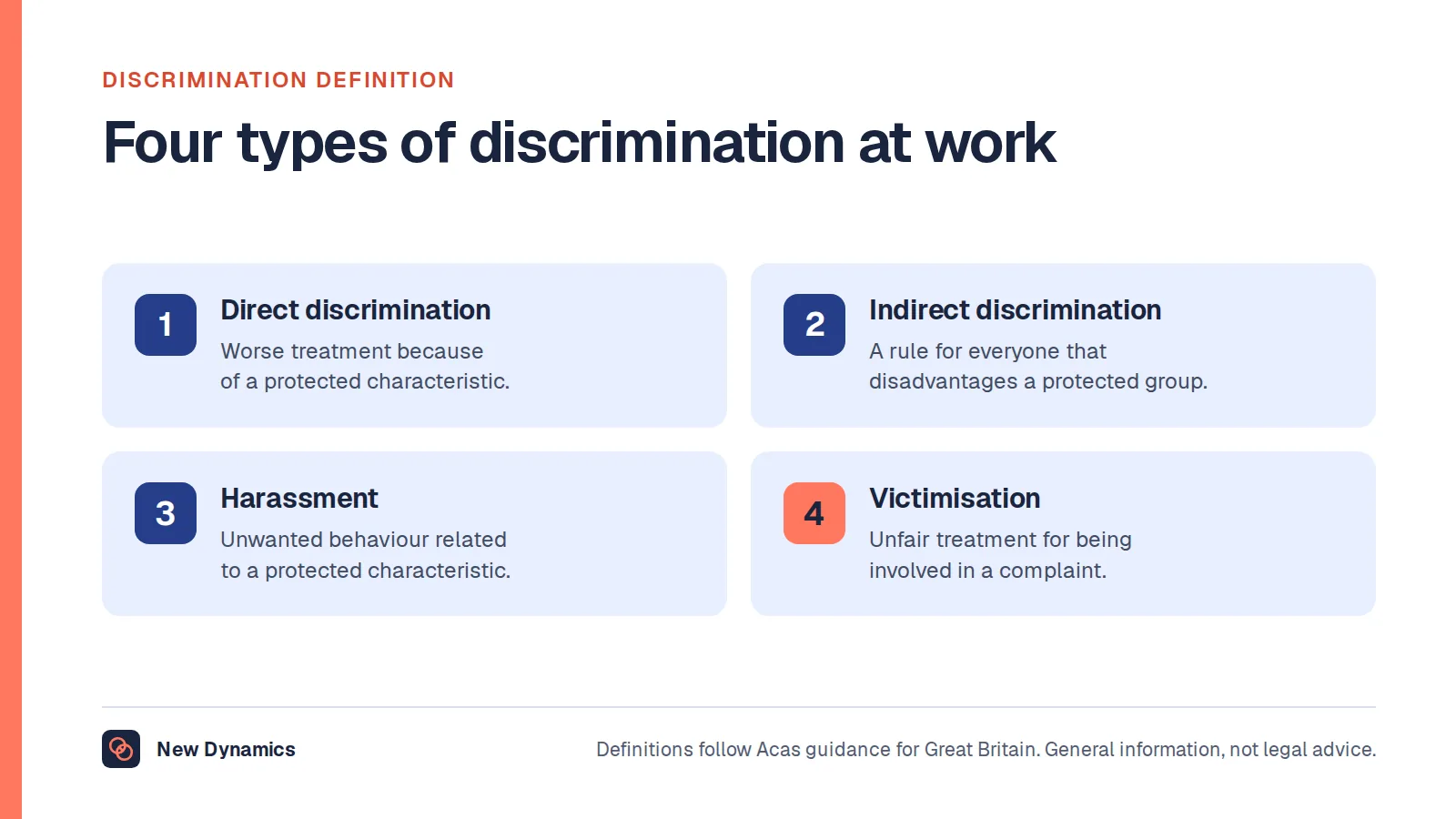
Our plain guide to the definition of discrimination at work explains the terms, and our list of workplace jokes includes five tests for humour that is safe.
Honesty and accurate records
We record time, expenses, sales and results honestly. We never alter a record to make a number look better. If you make a mistake, say so quickly. Mistakes that are admitted can be fixed.
For example: booking a sale in this quarter when the customer has not yet signed is a breach of this code.
Conflicts of interest
A conflict of interest arises when your personal interests could affect, or appear to affect, your judgement at work. Tell your manager about any conflict as soon as you are aware of it. Declaring a conflict is normal. Hiding one is a breach.
For example: if your partner works for a supplier that is bidding for our contract, declare it and step back from the decision.
Gifts and hospitality
You may accept small tokens, such as a branded pen or a modest working lunch. You must declare anything worth more than [amount], and refuse anything that could influence a decision, or appear to. Never accept cash.
For example: a supplier offers you tickets to a final during a tender. Thank them, decline and tell your manager.
Confidentiality and data
We protect information about customers, colleagues and the company. Use it only for the purpose for which it was given. Do not share it with anyone who does not need it, and do not put confidential information into tools that the company has not approved.
For example: pasting a customer list into a public AI chatbot to “tidy it up” is a breach.
See our employee data protection guide.
Company property and systems
Equipment and systems are provided for work. Reasonable personal use is fine if it does not interfere with your work, cost the company money or break any other part of this code.
Social media and public comment
You are free to have your own opinions and accounts. Make it clear that your views are your own. Do not share confidential information, and do not post anything about colleagues, customers or competitors that would breach this code if you said it at work.
Health, safety and wellbeing
Follow safety rules, report hazards and near misses, and never come to work impaired by alcohol or drugs. Look out for colleagues. If the workload is affecting your health, tell your manager.
Raising a concern
If you see something that seems wrong, say so. Talk to your manager, to another manager, to HR or use [confidential route]. We will listen, look into it fairly and tell you what we can about the outcome. Nobody will be treated badly for raising a concern in good faith, even if it turns out to be mistaken. Retaliation is itself a serious breach of this code.
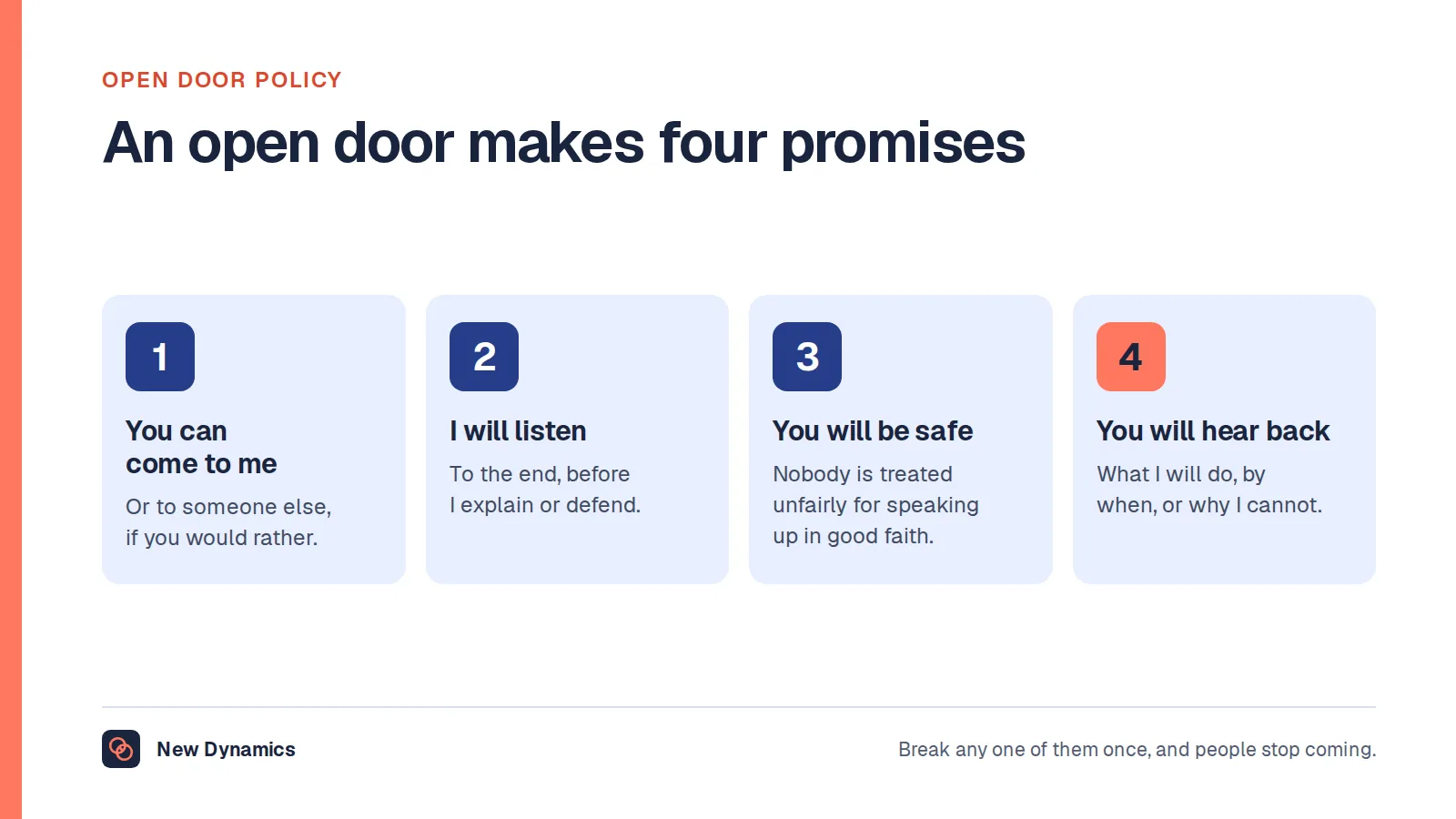
See how to make an open door policy real.
Breaches of the code
Breaches will be handled under our disciplinary procedure, fairly and consistently, whatever the seniority of the person involved. Serious breaches may amount to gross misconduct.
The Acas Code says that disciplinary rules “should give examples of acts which the employer regards as acts of gross misconduct”. It notes that these vary with the organisation, but “might include things such as theft or fraud, physical violence, gross negligence or serious insubordination”. It also says that a fair disciplinary process should always be followed before dismissing for gross misconduct.

A short sample code of conduct
Small organisations do not need twenty pages. Here is a one-page sample to adapt.
Our code of conduct
This code applies to everyone who works for or with us.
- Treat people with respect. No bullying, harassment or discrimination.
- Be honest. Keep accurate records. Own your mistakes.
- Work safely. Follow the rules, report hazards and never work impaired.
- Put the organisation's interests before personal gain. Declare conflicts of interest. Decline gifts that could influence you.
- Protect information. Keep customer, colleague and company data confidential.
- Use company property sensibly.
- Represent us well, in person and online.
- Follow the law and our policies.
- Speak up. If something seems wrong, tell your manager, another manager or [named person]. You will not be penalised for raising a concern in good faith.
- Expect fairness. Breaches are handled under our disciplinary procedure, in the same way for everyone.
If you are unsure what to do, ask yourself: is it legal, is it fair, and would I be comfortable if my colleagues and customers knew? If you are still unsure, ask.
How to write a code that people use
- Start from your real risks. List the situations where your people face difficult choices. A software firm and a construction firm need different codes.
- Involve employees. Ask what is unclear today. People follow rules that they helped to shape.
- Write plainly. Use short sentences, “we” and “you”, and no legal jargon. If a new starter cannot understand a line, rewrite it.
- Give examples. One realistic example does more than a paragraph of principle.
- Add a simple decision test, like the three questions in the sample.
- Name the routes for raising concerns, with more than one option.
- Have it reviewed for legal accuracy in each country where you operate.
- Keep it short. Put the detail in linked policies.
Our code of conduct guide includes a drafting framework and a completion checklist.
Making the code real
A code that lives in a drawer protects nobody. What matters is what people see.
- Leaders go first. Nothing undermines a code faster than a senior person who is seen to ignore it.
- Introduce it through real decisions. At induction, and in team meetings, discuss a scenario: what would you do?
- Apply it consistently. Tolerating a breach from a high performer tells everyone what the organisation really values.
- Handle concerns well. Thank the person, look into it fairly and close the loop.
- Review it every year or two, and whenever the work changes, for example when new AI tools arrive.
- Link it to everyday management. Behaviours in the code can appear in your values, your core competencies and your reviews.

Common mistakes
Copying another organisation's code. It will describe their risks, in their words.
Writing for lawyers. Dense text protects nobody if staff do not read it.
A list of prohibitions only. Say what you want people to do, as well as what is banned.
No route for concerns. A code that demands integrity and offers no safe way to speak up sets people up to fail.
One rule for some. Exceptions for senior or high-performing people destroy trust.
Launch and forget. A single email with a PDF attached is not an introduction.
Frequently asked questions
What is a code of conduct?
A code of conduct is a document that sets out how people in an organisation are expected to behave towards each other, towards customers and suppliers, and with the organisation's money, information and reputation. It usually explains how to raise concerns and what happens after a breach.
What are examples of a code of conduct?
Typical examples include: treat everyone with dignity; record time, expenses and results honestly; declare conflicts of interest; refuse gifts that could influence a decision; protect confidential information; and report concerns without fear of retaliation.
What is the difference between a code of conduct and a code of ethics?
A code of ethics states values and principles, such as integrity and respect. A code of conduct turns them into specific expected behaviours and rules. Many organisations combine the two in one document, with each value followed by concrete examples.
What should an employee code of conduct include?
Include the purpose and values, who it covers, respect at work, health and safety, honesty, conflicts of interest, gifts, confidentiality, use of company systems, social media, dealings with third parties, how to raise concerns and the consequences of a breach.
Is a code of conduct legally binding?
It depends on the country and on how the code is written and incorporated into contracts and policies. In practice, a clear code that has been communicated to staff supports fair disciplinary action. Take legal advice on your own documents.
How long should a code of conduct be?
As short as it can be while covering your real risks. A small organisation may need one page. Larger ones often have a short core code that links to detailed policies on topics such as gifts, data protection and social media.
Your next step: test your code on a new starter
- Give your current code, or the sample above, to someone who joined recently.
- Ask what is unclear, and which everyday situations it does not cover.
- Rewrite those sections in plain language, with one example each.
- Check that the routes for raising a concern are named and up to date.
For a drafting framework and a completion checklist, read and download our code of conduct guide. The guide is free to read, and the PDF uses our short download form.
Want expectations about behaviour to show up in feedback and reviews, as well as in a policy? Book a New Dynamics demo and bring your current code. You can also email contact@new-dynamics.com.