TL;DR
- A SMART goal names a specific outcome, evidence of success, realistic support, a business reason and a deadline.
- Use the 50 examples as starting points. Agree your own baseline, workload and quality checks before adopting a target.
- Connect each goal to regular feedback and a review date. Change the agreement openly when priorities or dependencies change.
A vague goal can turn a performance conversation into a guessing game. These 50 SMART goal examples for 2026 help employees and managers agree what good work looks like, how to recognise progress and when to review it. They cover everyday delivery, leadership, HR, sales, marketing, customer service, technology, operations, development and AI.
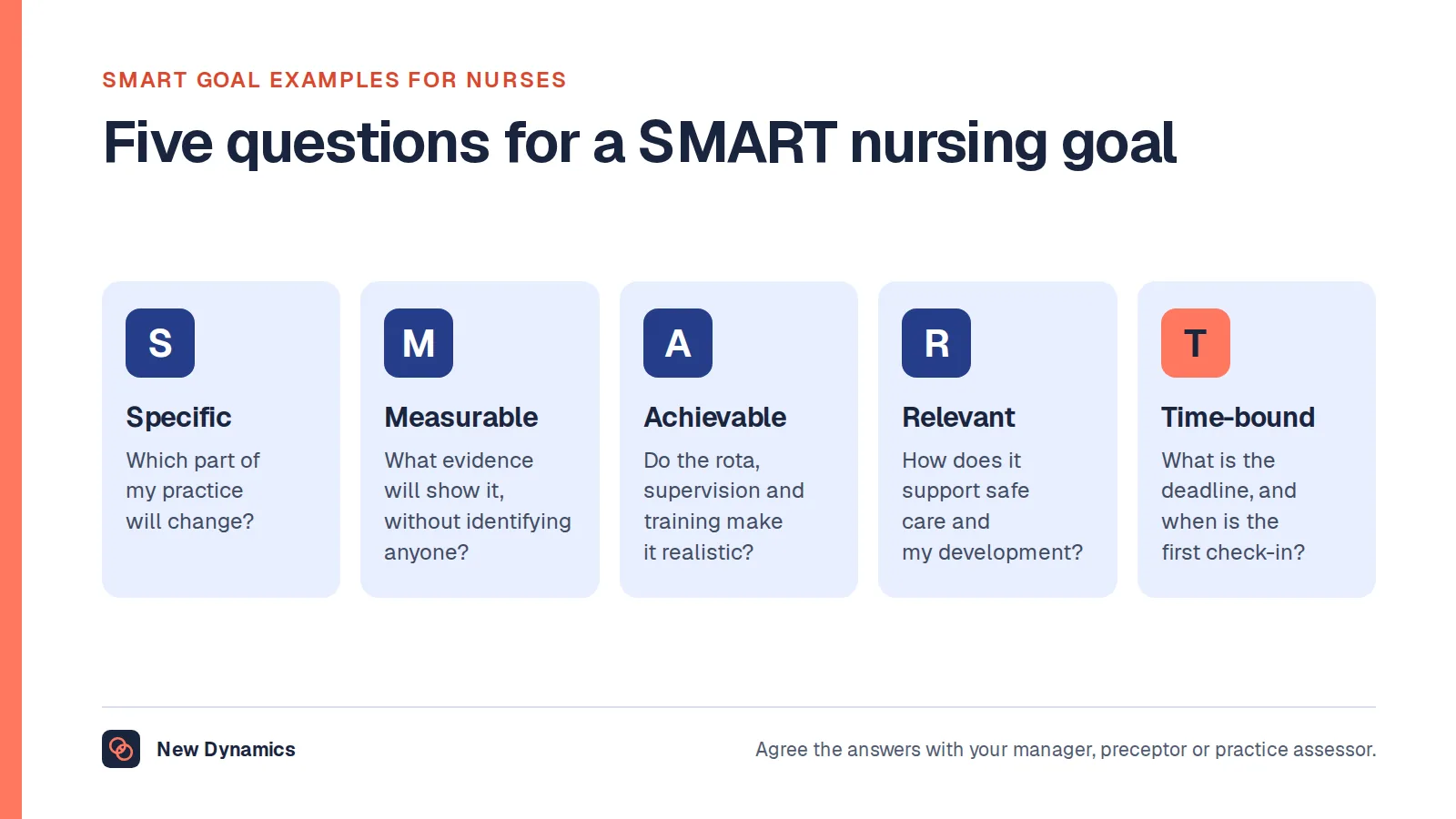
Choose an example close to your role, then adapt the numbers and support to your situation. If you need a shared place to connect objectives and progress conversations, explore New Dynamics Goals & OKRs. Working in healthcare? See our SMART goal examples for nurses.
Before you copy a goal: every target below is illustrative, not a benchmark or a customer result. The examples use deadlines in the final months of 2026. Set a fresh start date and a realistic deadline if you are reading later. Check the baseline first and agree which other work will make room for the goal.
What makes a goal SMART?
SMART means specific, measurable, achievable, relevant and time-bound. The point is a clear agreement about the work. A goal can use a numerical measure or an observable quality standard, provided the people reviewing it know what evidence to look for.
- Specific: name the outcome and the work it covers.
- Measurable: define the evidence, starting point and success test.
- Achievable: check capacity, skills, resources and dependencies.
- Relevant: explain why it matters to the role, customer or team.
- Time-bound: set a completion date and an earlier progress check.
The CIPD performance management factsheet describes SMART objectives within a wider process that includes feedback and development. A well-written sentence is a useful start; the conversations around it keep the goal useful.

How to adapt these SMART goal examples
Start with the result you need, rather than an activity that is easy to count. “Attend a course” records participation. “Use the new skill to complete an agreed task to a checked standard” describes a change in capability.
Use this working sentence:
By [date], I will [specific outcome], moving from [verified baseline] to [agreed success measure], by [practical actions], while maintaining [quality safeguard]. We will review progress [cadence] using [evidence].
Not every goal needs a percentage. A completed handover, an approved decision or a tested new skill can be suitable evidence. For numerical goals, define the denominator: “90% on time” is unclear unless everyone knows which tasks count and when their due dates were agreed.
For each example below, the review line identifies evidence to discuss. Agree the owner and access to that evidence before the work begins. Treat dependencies on another team as shared planning decisions, rather than an employee's personal failure.
SMART goal examples for employee performance
1. Deliver agreed tasks on time
By 18 December 2026, increase the share of my agreed weekly tasks completed by their due date from 75% to 90%. I will plan priorities each Monday and flag likely delays at least two working days in advance, without accepting extra work beyond agreed capacity.
Review: check the task list fortnightly; count only tasks with a recorded owner and agreed date. Discuss blocked work separately.
2. Reduce reporting errors
By 30 November 2026, reduce corrections in my monthly reporting pack from six per pack to two or fewer by using a source-data checklist and a peer check before submission. Keep the existing submission deadline.
Review: maintain a correction log and review it after each reporting cycle. Include significant errors even if found after sign-off.
3. Write clearer handovers
By 27 November 2026, create and test a handover for each of my four recurring processes. A colleague will complete one normal case for each process using the instructions, with no unresolved critical step.
Review: record test results and unanswered questions. Success means another person can use the handover, rather than simply that a document exists.
4. Make project updates useful
From 5 October to 18 December 2026, send a weekly update for each project I own by Thursday afternoon, covering progress, the next decision and any blocker. Ask the project lead to check clarity at the first three updates.
Review: inspect the updates monthly and record whether requested decisions received an owner and date. Keep each update to one readable page.
5. Improve first-time quality
By 18 December 2026, increase first-pass acceptance of my routine work submissions from 80% to 90%, using the team's existing acceptance criteria and a pre-submission check. Continue to report rework honestly.
Review: compare accepted submissions with all submissions each fortnight. Do not remove difficult work from the sample to improve the rate.
SMART goal examples for managers and leaders
6. Hold more useful one-to-ones
Between 1 October and 18 December 2026, hold a fortnightly one-to-one with every direct report, rescheduling cancellations within five working days. End each meeting with one agreed action or a clear record that no action is needed.
Review: check meeting coverage and overdue actions monthly. Keep private notes proportionate and accessible only to the right people.
7. Delegate a recurring decision
By 30 November 2026, delegate ownership of the weekly delivery plan to a team member, with agreed decision boundaries and two supported practice cycles. They will run the next three cycles without needing routine approval.
Review: discuss exceptions weekly and confirm that the colleague has capacity and authority. Delegation should develop ownership, not simply transfer workload.
8. Give timely feedback
During October and November 2026, provide each direct report with at least two specific feedback conversations tied to observed work, within five working days of the relevant event. Invite their view and agree support where needed.
Review: reflect on whether the feedback led to clearer expectations. Avoid treating the count as a reason to invent criticism or praise.
9. Resolve team blockers faster
By 18 December 2026, reduce the median time that team-owned blockers remain unresolved from six working days to three. Review the blocker list twice weekly and assign an owner to each new blocker within one working day.
Review: retain unresolved items in the reporting and separate external dependencies. Escalate problems rather than closing them administratively.
10. Build a practical development plan
By 13 November 2026, agree one development goal with each direct report, linked to an upcoming work opportunity, with protected practice time and a review date before year-end.
Review: ask each person to demonstrate or describe what they tried at the December check-in. A completed form alone is not the result.
SMART goal examples for HR and People teams
11. Make onboarding ownership clear
By 30 November 2026, ensure every new starter in the next intake has an agreed first-week plan, a named buddy and required access confirmed before their start date. Escalate missing approvals three working days ahead.
Review: use the onboarding checklist and a first-week conversation. Record late changes and do not mark access complete before testing it.
12. Improve goal-setting quality
By 18 December 2026, raise the proportion of goals in a monthly sample of 30 that include an outcome, evidence and review date from 50% to 85%. Run two manager workshops and offer a short review clinic.
Review: use the same assessment rubric for each sample. Share anonymised learning points rather than ranking individual managers publicly.
13. Shorten routine HR response times
By 30 November 2026, reduce median first response time for routine HR enquiries from three working days to one, using clearer routing and a daily triage slot. Keep sensitive cases in the appropriate confidential process.
Review: report first response and resolution separately each week. An acknowledgement is not a completed answer.
14. Turn survey feedback into action
By 11 December 2026, work with three team leaders to agree and start one action each in response to their team's survey feedback. Tell employees what will change, who owns it and when progress will be reviewed.
Review: check delivery with the team leaders fortnightly and gather voluntary feedback. Do not promise anonymity where small samples could identify people.
15. Make role expectations clearer
By 27 November 2026, refresh expectations for five priority roles with their managers and role holders, including key outcomes, decision boundaries and examples of good work. Resolve disagreements before publishing the agreed versions.
Review: test the documents in five real goal-setting conversations and capture points that still need explanation.

SMART goal examples for sales
16. Improve opportunity records
By 30 October 2026, bring all active opportunities I own up to date with a confirmed next step, owner and decision date. Maintain at least 95% completeness in weekly checks through 18 December.
Review: inspect the CRM each Friday. Record uncertain dates as uncertain rather than inventing customer commitments.
17. Strengthen qualified discovery
By 18 December 2026, complete 20 discovery conversations with prospects matching our agreed customer profile, documenting the problem, its impact and a mutually agreed next step. Use the approved outreach process and respect opt-outs.
Review: review five anonymised notes with my manager each fortnight. Conversation quality matters more than booking unqualified meetings.
18. Make proposals easier to assess
By 27 November 2026, use a customer-specific outcome summary, scope and acceptance criteria in my next eight proposals. Ask the account lead to review clarity before each proposal is sent.
Review: record questions customers ask after receipt and revise recurring unclear sections. Do not include unsupported savings or implementation promises.
19. Improve renewal preparation
By 30 October 2026, create an agreed contact and review plan for every account I own with a renewal due in December. Complete the first review conversation at least 30 days before renewal where the customer agrees.
Review: check the account list weekly, noting customer availability and unresolved issues. Measure preparation separately from the renewal decision.
20. Test a better follow-up process
By 11 December 2026, test a revised follow-up process on 30 qualified opportunities, aiming to increase the proportion with an agreed next meeting from 40% to 50%. Keep the offer and qualification criteria consistent.
Review: record outcomes and sample size weekly. Treat the small pilot as directional learning rather than proof of a universal uplift.
SMART goal examples for marketing
21. Publish content that answers buyer questions
By 18 December 2026, publish six original articles answering questions recorded in sales conversations, each with a clear audience, useful examples, an expert review and a relevant next action.
Review: check publication quality against the content brief and review engaged visits and enquiries monthly. Do not promise immediate rankings.
22. Improve landing-page clarity
By 27 November 2026, test revised copy on one priority landing page with five people matching our buyer profile. At least four should correctly explain the offer and next step without help before the copy is approved.
Review: record misunderstandings and changes, with participant consent. Use the findings as qualitative feedback rather than a statistical conversion claim.
23. Clean up campaign measurement
By 30 October 2026, apply the agreed campaign naming and tracking rules to every new email and paid campaign. Audit ten links weekly for six weeks and correct errors within two working days.
Review: verify destination pages and consent settings as well as parameters. Keep personal information out of campaign URLs.
24. Improve email relevance
By 11 December 2026, test two useful content themes with the same opted-in audience, aiming to raise unique click rate from 2% to 2.5% across four sends. Maintain unsubscribe rate at or below the current 0.3% baseline.
Review: define rates using delivered emails and compare like-for-like sends. Investigate complaints even if the numerical target is met.
25. Make a webinar reusable
Within four weeks of our October 2026 webinar, publish an edited recording, a checked transcript and three short extracts answering distinct audience questions. Obtain speaker approval before release.
Review: check captions, sound and links before publication. Attribute quotations accurately and remove attendee details unless permission covers their use.
SMART goal examples for customer service
26. Improve resolution time without rushing
By 18 December 2026, reduce median resolution time for routine support tickets from two working days to one and a half, using better triage and ten updated help articles. Keep the reopened-ticket rate at or below 5%.
Review: review both measures weekly using the same ticket category and business-hours definition. Separate incidents requiring engineering support.
27. Improve help-centre answers
By 30 November 2026, rewrite the ten help articles linked to the most repeat contacts. Test each with a support colleague unfamiliar with the draft, who must complete the described task without an unresolved critical gap.
Review: record test findings and repeat-contact themes after publication. An article view alone does not show that the answer helped.
28. Make escalations complete
By 13 November 2026, include the required context, reproduction steps and customer impact in at least 90% of my escalations, up from 65%, using an agreed handover template.
Review: review all escalations weekly with the receiving team. Do not delay urgent escalation while waiting for non-essential details.
29. Close the loop on complaints
By 18 December 2026, give every complaint I own an agreed next-update date and meet at least 95% of those commitments. If a resolution is delayed, explain the reason and revised plan before the update is due.
Review: check the complaint log twice weekly. Keep unresolved cases visible and follow any applicable service commitments.
30. Learn from difficult conversations
By 27 November 2026, review six challenging customer conversations with my coach and practise an improved response for each. Apply the approach in three later conversations and reflect on what changed.
Review: use approved, appropriately redacted records. Assess clarity and judgement, rather than promising a positive customer reaction every time.
SMART goal examples for technology and product teams
31. Reduce recurring defects
By 18 December 2026, reduce reopened defects in one agreed product area from eight per month to four or fewer. Analyse the recurring causes and add regression checks for the three most common failures.
Review: check the defect log fortnightly using unchanged severity definitions. Continue to report new issues rather than hiding them to meet the target.
32. Make releases easier to recover
By 20 November 2026, document and rehearse the rollback procedure for our priority service in a safe test environment. Two engineers should each complete the agreed scenario within 20 minutes without an unresolved critical step.
Review: keep exercise evidence and fix gaps before sign-off. A rehearsal result is not a guarantee for every production incident.
33. Improve code-review turnaround
By 11 December 2026, reduce median first-review time for standard pull requests from two working days to one, using a rotating reviewer and smaller changes. Maintain the existing required checks and approvals.
Review: examine the queue weekly, including requests still waiting. Agree exceptions for complex changes instead of encouraging rushed approval.
34. Validate a product assumption
By 27 November 2026, test a prototype of the proposed workflow with six suitable users and record where they can or cannot complete three agreed tasks. Use the findings to recommend a change, further research or no build.
Review: link the recommendation to observed behaviour and note the small sample. The goal is learning, not proving the original idea right.
35. Improve technical documentation
By 30 November 2026, update the setup instructions for our main development environment and have two colleagues follow them from a clean start. Resolve every blocking issue they encounter before marking the work complete.
Review: record setup steps, prerequisites and test dates. Remove secrets from examples and use the approved credential process.
SMART goal examples for operations and projects
36. Reduce avoidable rework
By 18 December 2026, reduce orders requiring internal correction from 7% to 4% by checking the three most common error points before release. Keep the same order categories and reporting rules.
Review: inspect the weekly correction log, including downstream errors. Pair the result with on-time delivery to avoid simply slowing the process.
37. Make project risks actionable
By 16 October 2026, give every high-priority risk on my current project a named owner, trigger and agreed response. Review the register fortnightly through project close and escalate triggered risks within one working day.
Review: use actual decisions and follow-up actions as evidence. A risk register that no one uses does not meet the purpose.
38. Reduce meeting time responsibly
By 30 November 2026, reduce scheduled recurring meeting time for our project team from six to four hours per person per week. Replace status-only meetings with written updates and retain necessary decision sessions.
Review: check calendar totals and unresolved decisions fortnightly. Restore a conversation if the change creates confusion or exclusion.
39. Improve invoice readiness
By 27 November 2026, increase supplier invoices submitted with complete supporting information from 80% to 95%, using a revised checklist and clear request ownership. Keep the existing approval and payment controls.
Review: compare complete submissions with all submissions weekly. Record disputed items separately rather than changing their status to improve the rate.
40. Build continuity into a key process
By 11 December 2026, train a backup owner for each of our three critical weekly processes. Each backup will complete a supervised cycle using current instructions and resolve any critical gap before sign-off.
Review: retain the completed checklists and confirm access through the normal approval process. Recheck cover when roles or systems change.

SMART goal examples for career development
41. Apply a new analytical skill
By 30 November 2026, complete the agreed spreadsheet training and use it to rebuild one recurring report. A colleague will verify its calculations against the current method before it is used for decisions.
Review: demonstrate the report and explain the main checks. Course completion supports the goal; reliable application is the evidence of progress.
42. Build presentation confidence
By 18 December 2026, deliver three ten-minute team presentations with a clear recommendation and supporting evidence. Ask two colleagues for feedback using the same clarity checklist and apply one improvement each time.
Review: compare the feedback and my reflections after each presentation. Avoid judging confidence from personality or speaking style alone.
43. Prepare for broader responsibility
By 11 December 2026, lead one small project with an agreed scope, stakeholder plan and closing review, supported by a mentor. Deliver the agreed outputs or document and agree scope changes before the deadline.
Review: gather feedback on planning, decisions and communication. Completing the goal is development evidence, not a promise of promotion.
44. Improve cross-team understanding
By 20 November 2026, shadow three colleagues in the teams most affected by my work and identify two handover improvements. Agree one change with the relevant owner and test it before 18 December.
Review: explain the observed problem and whether the change helped. Schedule shadowing with consent and respect confidential work.
45. Protect focused work
From 5 October to 27 November 2026, agree and protect two 90-minute focus sessions each week for my priority assignment. Review interruptions with my manager and complete the agreed milestone by 30 November.
Review: track whether the sessions support the milestone, rather than monitoring every minute. Keep availability arrangements clear for urgent work.
SMART goal examples for responsible AI use
46. Test AI on a suitable task
By 30 November 2026, test an approved AI tool on 20 low-risk draft summaries using permitted data. Compare time and accuracy with ten manually prepared examples, then recommend whether to continue, change or stop the trial.
Review: have a human check every output against its source. Record errors as well as time saved; the trial has no assumed productivity uplift.
47. Improve AI literacy through practice
By 13 November 2026, complete approved AI training and demonstrate three work-relevant tasks to a reviewer, explaining the data rules, likely errors and human checks for each.
Review: assess the demonstrations with an agreed checklist. Passing a quiz alone is not evidence that someone can use the tool appropriately.
48. Check generated content before release
By 30 October 2026, introduce a documented human review for every AI-assisted public article produced by our team, covering factual claims, sources, tone and permissions. Audit the first ten articles before year-end.
Review: record corrections and named approval. Do not publish unverified citations or customer details supplied by a model.
49. Evaluate an internal AI assistant
By 11 December 2026, assess an approved knowledge assistant against 30 representative questions with known answers. Record accuracy, unsupported answers and cases needing escalation, then present a go/no-go recommendation to the owner.
Review: use authorised test material and an agreed scoring rubric. A failed pilot can still meet this learning goal if the evidence is complete.
50. Keep AI-assisted goals grounded in real work
By 27 November 2026, trial AI-assisted drafting in five voluntary goal-setting conversations. The employee and manager will check and agree the outcome, evidence, capacity and deadline before saving any goal.
Review: compare the draft and final agreement, noting useful suggestions and errors. Keep decisions with people; do not enter restricted employee information into unapproved tools.
Connect goals to feedback and performance reviews
A goal written in October should still make sense when it is discussed in December. Set a short review rhythm so the employee and manager can see what changed while there is time to act.
At each check-in, ask four questions:
- What moved? Bring the agreed evidence, including unfinished work.
- What got in the way? Separate a capability gap from a blocked dependency.
- What support is needed? Give the next action an owner and date.
- Is the goal still right? Agree and record changes when priorities shift.
This is where a connected performance approach is useful. Link the goal to ongoing feedback, use one-to-one conversations to resolve blockers, and bring the same evidence into performance reviews. It gives the review a history beyond the most recent event.
New Dynamics is designed around this connection between goals, feedback, recognition and reviews. Explore how the process could fit your team, including different contributors and review rhythms, rather than assuming every role needs the same target or meeting schedule.
Avoid these common SMART goal mistakes
Setting a target without a baseline. Measure the starting point first. A 20% improvement is not meaningful if nobody can explain the current result or calculate the measure consistently.
Calling every goal achievable. Check time, access, skills and competing demands with the person doing the work. The Williams College SMART goals guidance includes questions about relevance and other time-sensitive work. Use that discussion to adjust the target or provide support.
Measuring activity when the outcome matters. Five training sessions might be an action in the plan; applying the skill to a checked piece of work is often the stronger result. The University of California's SMART goal examples offer further ways to connect goals with observable work.
Making one person responsible for another team's decision. Record the dependency and the escalation route. Assess controllable work fairly rather than treating every missed outcome as an individual performance issue.
Changing the target silently. Keep the original agreement and record why a revised target was accepted. Clear version history helps everyone understand the eventual review.
Frequently asked questions
What is a good SMART goal example for work?
A useful example is: “By 18 December 2026, reduce median resolution time for routine support tickets from two working days to one and a half, while keeping the reopened-ticket rate at or below 5%.” Agree the available support, ticket definition and weekly review before adopting it. The figures are illustrative and need a real baseline.
Can a SMART goal be qualitative?
Yes. Define observable evidence and who will assess it. For example, a colleague could complete a documented handover without an unresolved critical question. The assessment needs agreed criteria, even when the result is not a percentage or a financial measure.
How many SMART goals should an employee have?
There is no universal number. Start with the few outcomes that matter most for the next review period and check whether the workload is realistic. Routine duties can remain part of the role expectations without each becoming a separate development goal.
How are SMART goals different from OKRs?
SMART is a way to make an individual goal clear and assessable. OKRs organise an objective around key results showing progress towards it. The approaches can work together, but they serve different purposes. Choose the structure that helps people understand priorities and evidence rather than adding extra paperwork.
How often should SMART goals be reviewed?
Agree a rhythm that matches the work. A short project may need weekly checks; a longer development goal may suit monthly conversations. Review sooner when a dependency, workload or business priority changes, and keep the completion date separate from the check-in dates.
Can AI write SMART goals for employees?
AI can help draft wording or suggest questions, but it cannot confirm someone's capacity, consent or real work context. The employee and manager should verify and agree every goal. Use approved tools and data, check assumptions and keep decisions with people.
Your next step: agree one goal and a review date
Choose one example that addresses a real need. Replace the illustrative baseline with your evidence, agree a realistic target and name the support required. Add a quality safeguard, then book the first check-in before saving the goal.
For a worksheet to use in that conversation, read and download our SMART goals guide. The article is freely readable; the PDF uses our short download form. If your organisation uses OKRs, the OKR examples library offers another starting point.
Want goals, feedback and reviews to work together around your process? Book a New Dynamics demo and bring a real goal-setting challenge. You can also contact contact@new-dynamics.com.