TL;DR
- Payroll means three things: the list of people whom a company pays, the total amount that it pays them, and the process of calculating pay, making deductions, paying employees and reporting to the tax authority.
- Every pay run turns gross pay into net pay by taking off deductions such as tax and pension contributions. In the UK, GOV.UK sets out five tasks to complete on or before each payday.
- An employer can run payroll itself or pay a provider, but it stays legally responsible either way. Accuracy depends on clean data, a cut-off date, a second check, reconciliation, records and restricted access.
Nothing an employer does is judged as strictly as payroll. An employee may forgive a late appraisal or a dull away-day. Nobody forgives a wrong payslip. Payroll has to be right every time, for every person, by a fixed date.
This article answers the question what is payroll, explains gross and net pay, walks through a pay run using the UK government's own list of tasks, summarises what employers in the United States must withhold, compares in-house and outsourced payroll and gives six checks that keep pay accurate.
Pay decisions feed payroll, and they should rest on evidence. See how New Dynamics performance reviews bring goals, feedback and development into one fair discussion. New Dynamics does not run payroll, so this article is general background.
What is payroll? Three definitions
The Cambridge Dictionary gives payroll two meanings: “a list of the people employed by a company showing how much each one earns”, and “the total amount of money paid to the people employed by a particular company”.
In everyday business use there is a third meaning, and it is the one that most people intend. Payroll is the process of paying employees: working out what each person has earned, taking off the right deductions, paying the money on time, giving each person a payslip and reporting the figures to the tax authority.
So “she is on the payroll” means that she is an employee. “Our payroll is £2 million a year” means the total wage bill. “Payroll runs on the 25th” means the process.
Gross pay, deductions and net pay
Every pay run does the same sum for every employee.
- Gross pay. Everything that the person has earned in the period. GOV.UK's guide to PAYE and payroll for employers says that payments to employees “include their salary or wages, as well as things like any tips or bonuses, or statutory sick or maternity pay”.
- Deductions. Amounts that the employer must or may take off. GOV.UK explains that “you'll need to deduct tax and National Insurance for most employees”, and that other deductions may include student loan repayments or pension contributions.
- Net pay. What is left, which reaches the employee's bank account. It is often called take-home pay.
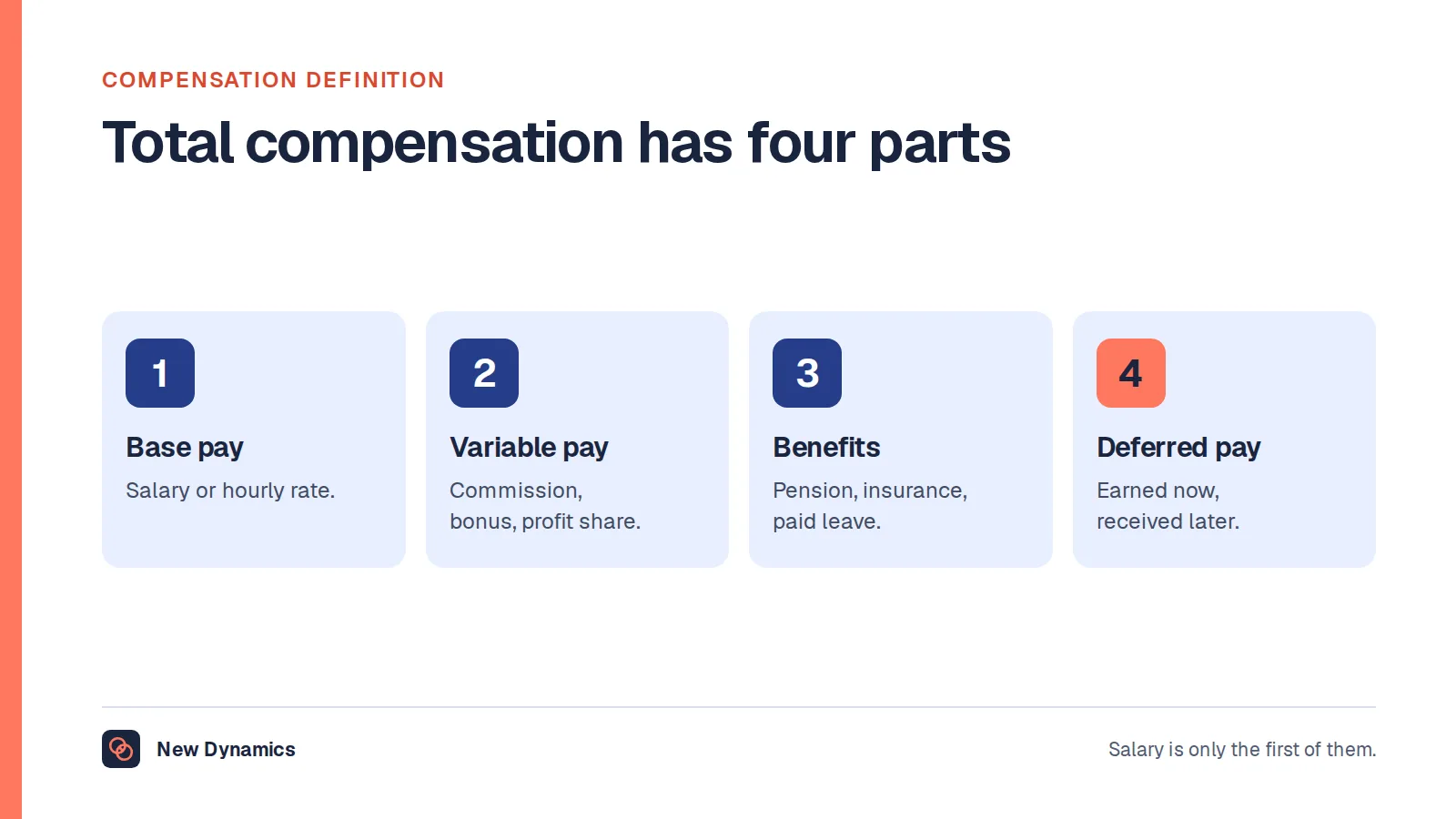
The employer also has costs that never appear in the employee's net pay, such as the employer's own National Insurance or social security contributions and its pension contributions. For the wider picture of what makes up a reward package, see our plain guide to the definition of compensation.

How a pay run works: five tasks in the UK
In the UK, most employers operate PAYE. GOV.UK defines it as “HM Revenue and Customs' (HMRC) system to collect Income Tax and National Insurance from employment”.
GOV.UK's guide to running payroll lists what an employer must do with its payroll software every time it pays employees. There are five tasks.
- Record their pay, including salary or wages and any other pay.
- Calculate deductions from their pay, like tax and National Insurance.
- Calculate the employer's National Insurance contribution that is due on their earnings above a weekly threshold.
- Produce payslips for each employee.
- Report their pay and deductions to HMRC in a Full Payment Submission (FPS).
The cycle then continues in the next tax month. The employer views what it owes, sends an Employer Payment Summary (EPS) if it needs to claim a reduction, for example for statutory pay, and pays HMRC. GOV.UK warns that an employer may have to pay a penalty if it pays late.
Thresholds, rates and dates change, so check GOV.UK for the current figures. This section summarises UK government guidance. It is general information, not tax or legal advice.

Payslips
GOV.UK's page on payslips tells employees: “Your employer must provide you with a payslip.” Payslips can be printed or electronic, and they must be provided on or before payday. A payslip must show:
- earnings before and after any deductions;
- the amount of any deductions that may change each time the employee is paid, for example tax and National Insurance;
- the number of hours worked, if pay varies depending on time worked.
Records
GOV.UK says that employers must collect and keep records of what they pay employees and the deductions they make, of reports and payments to HMRC, of employee leave and sickness absences, of tax code notices and of taxable expenses or benefits. The records “must show you've reported accurately”, and employers must keep them for 3 years from the end of the tax year to which they relate.
Payroll in the United States
The terms differ, but the shape is the same. The Internal Revenue Service's page on understanding employment taxes says: “Employers must deposit and report federal employment taxes.” It lists four examples.
- Federal income tax. Employers generally must withhold it from employees' wages, using the employee's Form W-4.
- Social Security and Medicare taxes. Employers generally must withhold these from wages and pay the employer's share as well.
- Additional Medicare tax, which employers withhold above a wage threshold. There is no employer match.
- Federal unemployment (FUTA) tax. The IRS says: “You pay FUTA tax only from your own funds.” Employees do not pay it.
States and cities add their own taxes and rules. Pay also depends on whether a person is entitled to overtime, which our guide to exempt and non-exempt employees explains. This is a summary of federal guidance, not tax or legal advice.
In-house or outsourced payroll
GOV.UK sets out the choice in one line. You can operate PAYE by “paying a payroll provider to do it for you” or by “doing it yourself using payroll software”.
| Approach | How it works | Suits |
|---|---|---|
| In-house | Your own staff run payroll with payroll software | Employers with payroll skills and steady headcount |
| Payroll provider | A bureau or accountant runs the calculations and reports for you | Small employers, and those without in-house skills |
| Wider outsourcing | A provider takes on payroll with other HR administration | Employers that want one supplier for several tasks |
One sentence in the GOV.UK guidance deserves attention: “As an employer, you're legally responsible for completing all PAYE tasks - even if you pay someone else to do them.” Outsourcing moves the work. It does not move the responsibility.
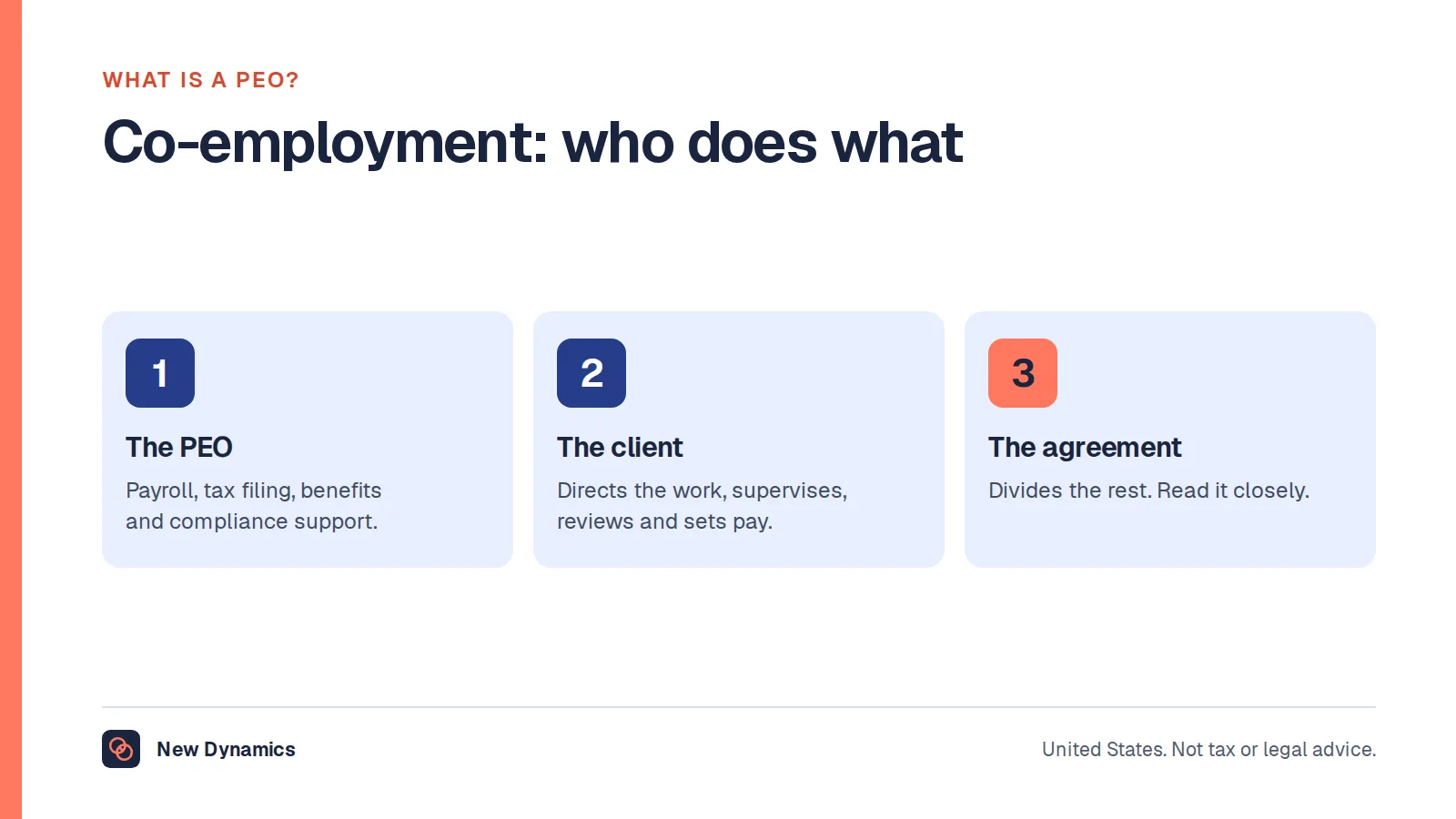
For the wider options, see our guides to the meaning of BPO and the meaning of PEO, a model used in the United States. Payroll usually connects to the HR record, which our guide to HRIS software describes.
Who does what: HR, payroll and managers
Payroll sits in finance in some organisations and in HR in others. Wherever it sits, three groups feed it.
- HR supplies starters, leavers, contract changes, pay rises, leave and absence.
- Managers approve overtime, timesheets, bonuses and expenses, on time.
- Employees keep their own bank and address details up to date, and check their payslips.
Many payroll errors begin outside the payroll team, with information that arrived late or wrong.
Six checks that keep payroll accurate
- Clean starter data. Collect bank details, tax information and the start date before the first pay run, as part of onboarding.
- A cut-off date. Publish the date by which changes must arrive each month, and hold to it.
- A second pair of eyes. One person prepares the run, and another checks and approves it.
- Reconciliation. Compare the totals with last month, and explain every difference: starters, leavers, pay rises and one-off payments.
- Records. Keep what the law requires, for as long as it requires. In the UK that includes pay, deductions, reports, leave and sickness absence.
- Restricted access. Payroll data is personal and sensitive. Limit who can see and change it. Our employee data protection guide covers the principles.
When a mistake does happen, tell the employee quickly, correct it at once where you can and explain what you have changed so that it will not happen again.

Common mistakes
Treating payroll as a purely technical task. It is the most regular contact that an employer has with every employee.
Late changes. A pay rise agreed after the cut-off belongs in next month's run, with back pay.
One person who knows everything. Holidays and illness happen. Document the process and train a deputy.
Assuming that the provider is responsible. The legal duty stays with the employer.
Misclassifying people. Treating an employee as a contractor, or a non-exempt worker as exempt, produces wrong pay and legal risk.
Ignoring payslip questions. A confusing payslip generates queries every month. Explain the lines once, clearly.
Frequently asked questions
What is payroll in simple terms?
Payroll is the process of paying employees. It covers working out what each person has earned, taking off deductions such as tax, paying the net amount on time, providing a payslip and reporting the figures to the tax authority. The word also means the list of people paid and the total paid.
What does it mean to be on the payroll?
To be on the payroll is to be an employee of the organisation. The Cambridge Dictionary defines a payroll as a list of the people employed by a company showing how much each one earns.
What is the difference between gross pay and net pay?
Gross pay is everything an employee has earned in the period before deductions. Net pay, or take-home pay, is what is left after deductions such as income tax, National Insurance or social security, pension contributions and student loan repayments.
What are the steps in running payroll?
GOV.UK lists five tasks for UK employers on or before each payday: record pay, calculate deductions, calculate the employer's National Insurance contribution, produce payslips and report pay and deductions to HMRC in a Full Payment Submission. The employer then pays HMRC.
Is the employer still responsible if payroll is outsourced?
Yes. GOV.UK states that an employer is legally responsible for completing all PAYE tasks, even if it pays someone else to do them. A provider does the work, but the duty stays with the employer.
Is payroll part of HR or finance?
It can sit in either. Finance often owns payroll because it involves payments and accounting. HR often owns it because it depends on employee data. What matters is a clear process for HR, managers and employees to supply accurate information before the cut-off date.
Your next step: check three things
- Find out who can run payroll if the usual person is away.
- Check that a cut-off date is published, and that managers know it.
- Read your own payslip, and ask whether a new starter would understand every line.
For a clear approach to pay decisions, which payroll then carries out, read and download our compensation policy guide. The guide is free to read, and the PDF uses our short download form.
Want pay reviews to rest on goals, feedback and fair discussion? Book a New Dynamics demo and bring your current approach. You can also email contact@new-dynamics.com.