TL;DR
- A business development manager finds and creates the opportunities an organisation grows through: new markets, customers, partnerships, products and services. Prospects describes the role as identifying “new business opportunities in order to generate revenue, improve profitability and help businesses grow”, taking “a strategic, long-term approach to identifying opportunities and creating value for the organisation”.
- The job is not a renamed sales job, though many adverts make it one. The National Careers Service's version of the day includes analysing companies and market trends “to spot new investment opportunities”, attending events and conferences to network, negotiating with new and existing clients, writing reports and presenting to customers and senior management, forecasting sales targets, and running training workshops for business development teams.
- The measurement problem is the interesting part. If the payoff is a year away, a monthly revenue target will quietly turn the role back into sales. Decide at the start which leading measures count (conversations held, partnerships signed, markets tested) and which lagging ones the person is genuinely accountable for.
Most business development manager adverts are sales adverts with a longer title. Sometimes that is what the employer means, which is fine, but it should be said, because the people who are good at one are not reliably good at the other.
This article sets out a business development manager job description: what the job is, the test that separates business development from sales, eight duties, what to measure when the payoff is a year away, the consultant variant, routes in and a template. It is general information about the role.
Long-horizon work is where targets go wrong: a quarterly revenue number quietly turns business development back into selling. See how New Dynamics Goals & OKRs keep targets and progress in one place.
What a business development manager does
Prospects' business development manager profile describes the job as identifying "new business opportunities in order to generate revenue, improve profitability and help businesses grow". The role takes "a strategic, long-term approach to identifying opportunities and creating value for the organisation", and the work "can involve careful planning and positioning in the appropriate markets, building relationships and identifying potential partnerships, or enhancing the business's performance, position or reputation". It may also mean researching and developing "new markets, products or services to meet emerging or untapped customer needs".
Scale varies. The same profile notes you may be the sole business development manager in a smaller organisation, work as part of a team, or lead a team in a large one, which is the first thing an advert should settle.
Business development or sales? The test

One question usually settles it: is the offer already defined?
- If the offer is defined and the job is to sell it to more people, that is sales. Pipeline, conversion, quota, close.
- If the job is to work out what the offer should be, who should buy it and through whom, that is business development. Markets, partnerships, propositions, routes to market.
- If it is both, say so in the advert and split the objectives, because the weekly behaviour the two demand is different.
Prospects is explicit that the sales-oriented version exists: where the role "is more sales orientated", it adds planning and delivering sales campaigns and building a pipeline, negotiating pricing and closing deals, forecasting sales and analysing performance, and contributing to sales and marketing strategy.
The honest version of the advert names which one it is. The dishonest version says "hunter mentality" and hopes.
The consultant variant
"Business development consultant" usually means one of three things:
- A self-employed or agency specialist brought in to open a market, build a partner channel or test a proposition, on a contract with a defined scope.
- An internal title used in professional services, where partners sell and a consultant supports the pursuit.
- A junior title in sales-led organisations, where the work is lead generation.
Ask which before accepting a role or writing an advert. The word consultant does most of the ambiguity.
Eight duties
- Research opportunities. "Research and identify new business opportunities, including new markets, customers, partnerships, products and services, and new ways of reaching existing markets", and "analyse companies and market trends to spot new investment opportunities".
- Build relationships. "Build and maintain relationships with customers, clients, partners and other stakeholders to generate repeat business and new opportunities", and "develop strong relationships with customers".
- Generate and pursue leads. "Generate leads, cold call prospective customers and meet with clients (face-to-face or remotely)", and "understand customer needs and develop effective plans to meet these".
- Plan strategy. "Think strategically and develop plans to grow the business, improve performance and reach new audiences", and "implement business development strategies, including planning and delivering operational changes where needed".
- Negotiate and contract. "Negotiate and manage business deals and contracts, working with relevant colleagues where appropriate", and negotiate services and prices with new and existing clients.
- Work through internal teams. "Collaborate with internal teams (e.g. marketing, finance, logistics) to support business growth and delivery, and report on progress to senior management."
- Monitor the market and show up. "Monitor market trends, attend events and build networks to raise the organisation's profile", including conferences and trade events.
- Improve and report. "Identify opportunities to improve products, services or business processes, as well as to secure grants and funding", write reports, present to customers and senior management, and "forecast sales targets and help plan how to meet them".

In larger organisations the role also runs training workshops for business development teams, which is the point at which it starts to look like the sales management occupation O*NET describes as Sales Managers, planning, directing or coordinating "the actual distribution or movement of a product or service to the customer", establishing "sales territories, quotas, and goals", determining "price schedules and discount rates" and coaching staff on sales tactics.
What to measure when the payoff is a year away

This is where the role most often fails, and it is a measurement failure rather than a hiring one.
- Name the lagging measures the person genuinely owns. Revenue from new markets, signed partnerships, contracts won, over a period long enough to be fair.
- Name the leading measures that predict them. Qualified conversations, proposals issued, pilots agreed, partners onboarded. These are the ones to review monthly.
- Separate new from existing. Growing an existing account is account management. Counting it as business development flatters the number and starves the new work.
- Agree the horizon in writing. If the sales cycle is nine months, a first-quarter revenue target is a decision to change the job.
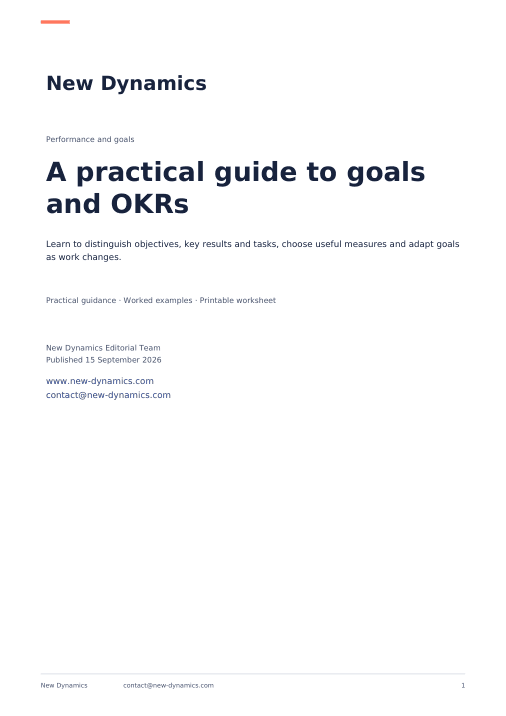
Our OKR guide covers writing objectives where the outcome is slow and the work has to be visible in the meantime.
The week
- Desk work. Market research, list building, proposal and bid writing, internal papers.
- Conversations. Prospects, partners, existing customers, and the internal teams who have to deliver whatever is promised.
- Events. Conferences, trade shows and industry meetings, the National Careers Service notes you could work evenings "attending events or appointments".
- Travel. The same profile notes you will usually need a driving licence.
- Reporting. Pipeline, forecasts and progress to senior management.
How it differs from three nearby roles
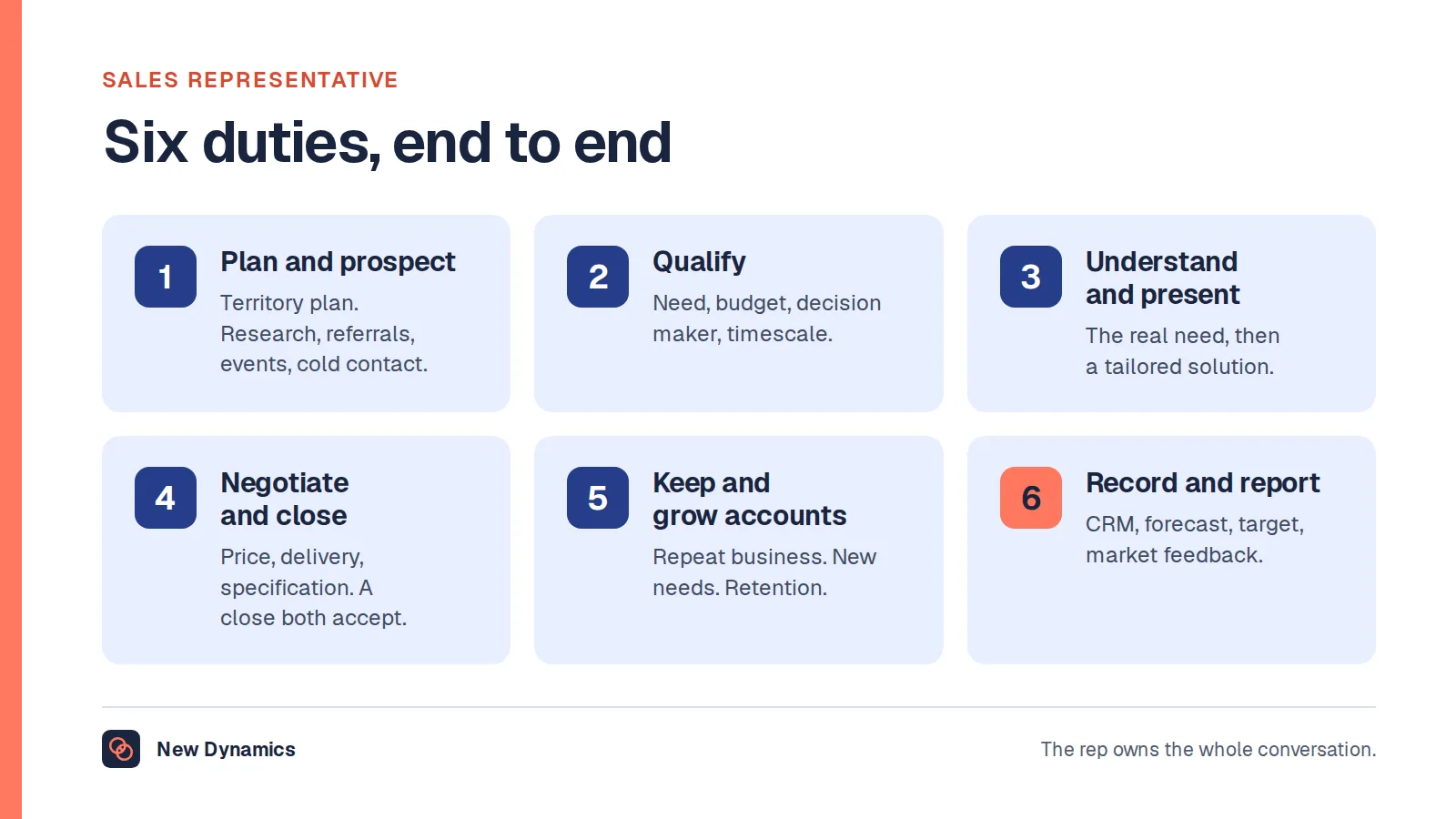
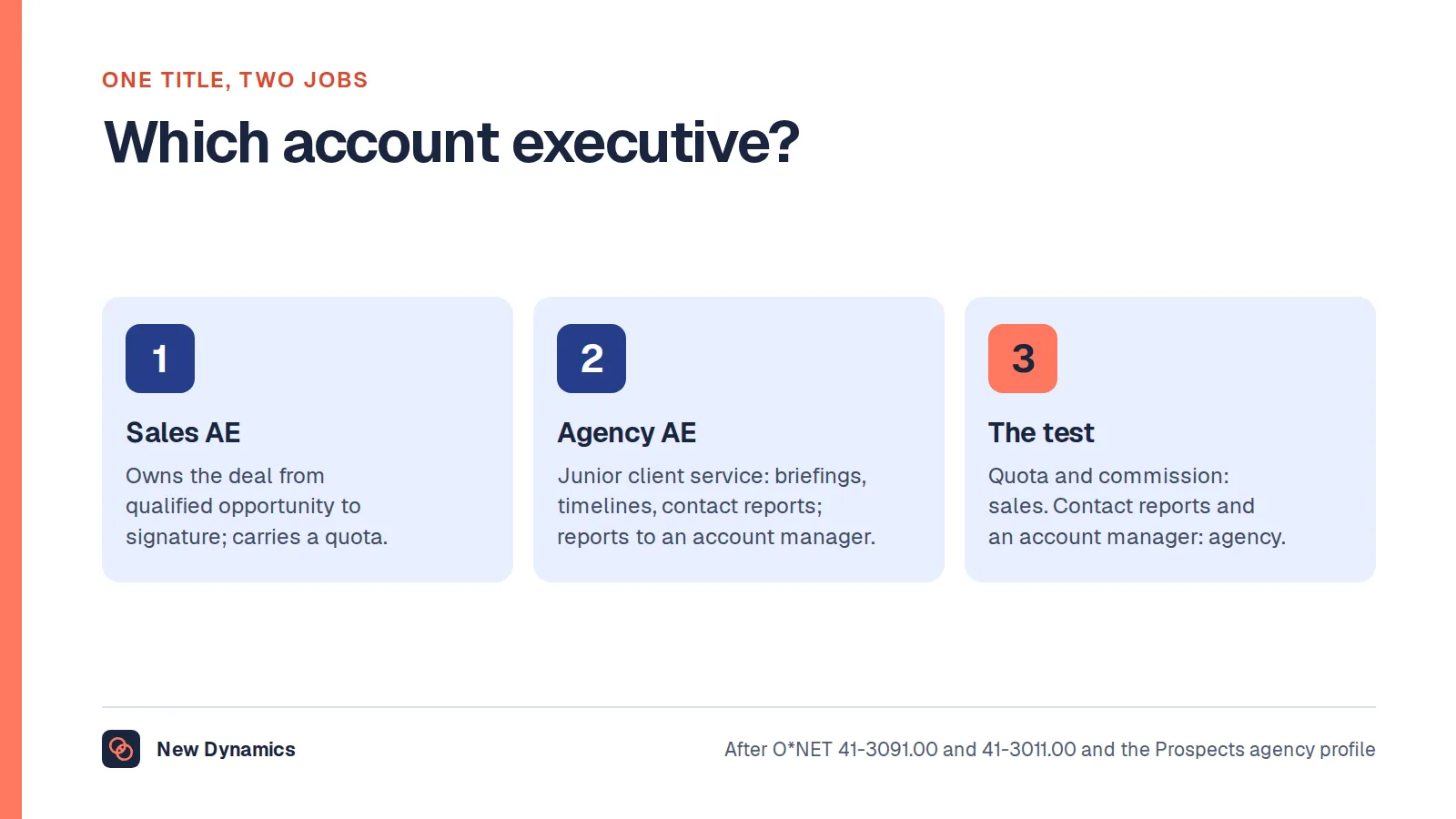
- Account executive. Owns named accounts and a quota against a defined offer. See our account executive job description.
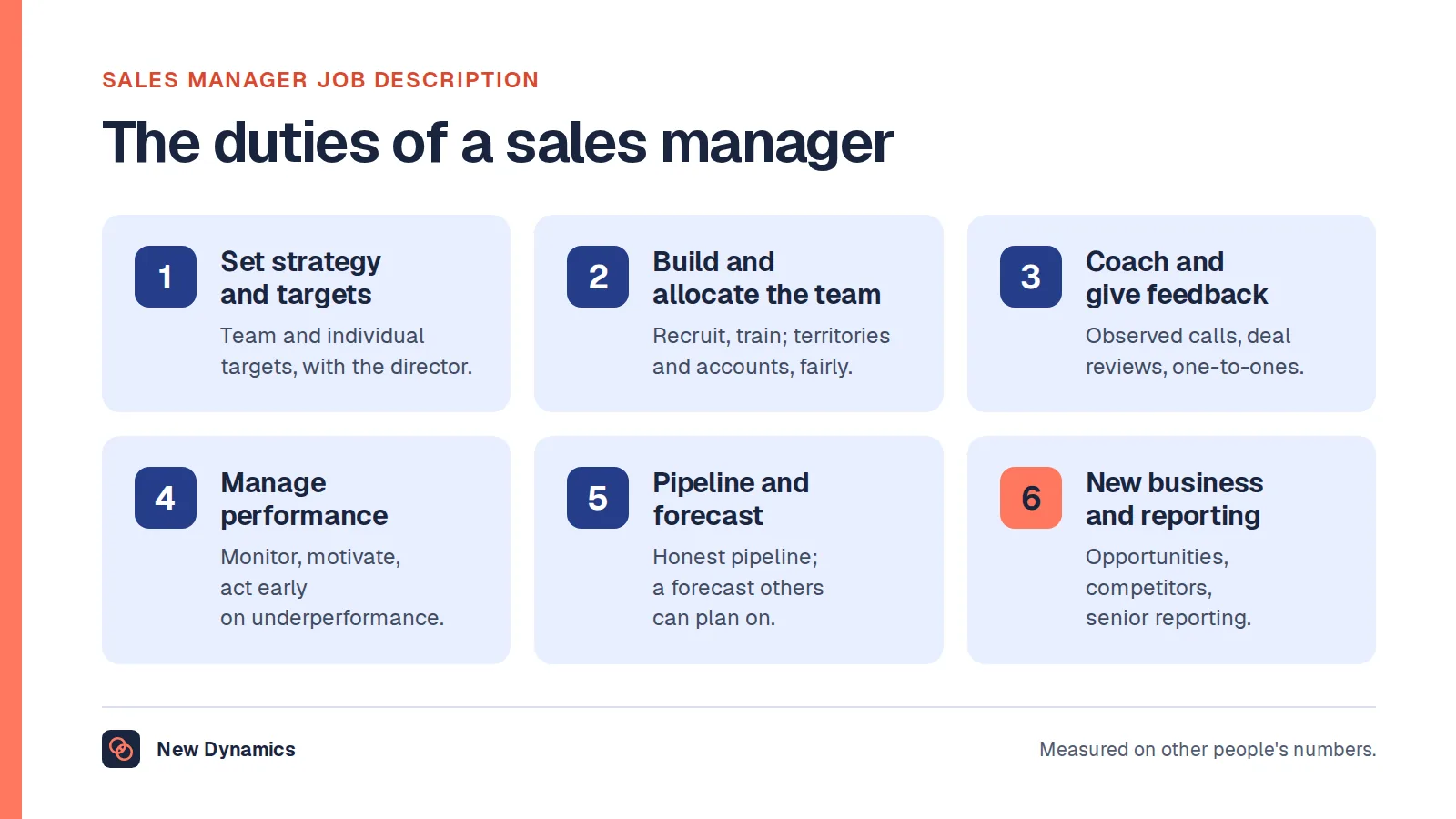
- Sales manager. Runs a team, a territory and a number. See our sales manager job description. Business development may report into it or sit alongside it.
- Marketing. Creates demand at scale; business development converts specific opportunities and shapes what is offered. The two fail together when neither owns the proposition.
Skills
The National Careers Service lists the ability to sell products and services, business management skills, excellent verbal communication, leadership skills, initiative, customer service skills, persuading skills, ambition and a desire to succeed, and confident use of a computer and the main software packages. It also notes the practical requirement: "you'll usually need a driving licence."
Two worth adding for the non-sales version of the job: written argument, because most internal decisions are won on a paper rather than in a meeting, and patience, because the feedback loop is long enough to be discouraging.
Routes in and progression
There is no single entry route: common ones are a graduate scheme, a move from sales or account management, or a move from the sector itself where product knowledge matters more than sales technique.
Progression, per the National Careers Service: senior development manager, business development executive or marketing director, or specialising in a sector such as travel, engineering, e-commerce or healthcare. Prospects lists sectors including construction, education, finance, healthcare, IT, logistics, manufacturing, pharmaceuticals, professional services and telecommunications, and notes the split between business-to-business and business-to-consumer work.
A business development manager job description template
Job title: Business development manager
Reports to: [Sales director / managing director]
Scope: [new markets, existing markets, partnerships, products], [sectors], [B2B or B2C], [team: sole, member or leader]
Purpose: Find, shape and win the opportunities the business grows through, and make sure the organisation can deliver them.
Responsibilities
- Research and identify new markets, customers, partners, products and routes to market.
- Build and maintain relationships with customers, partners and stakeholders.
- Generate and qualify leads, and meet prospective customers.
- Develop and implement business development plans, including any operational changes they require.
- Negotiate and manage deals and contracts with the relevant colleagues.
- Work with marketing, finance, operations and delivery teams, and report progress to senior management.
- Monitor market trends, attend events and represent the organisation.
- Identify improvements to products, services and processes, and funding opportunities where relevant.
You will need: [sector knowledge]; the ability to write a persuasive proposal; comfort with a long feedback loop; a full driving licence.
How the role is measured: [leading measures, reviewed monthly] and [lagging measures, over the agreed horizon].
Pay: [basic salary] plus [bonus or commission arrangement].
What the advert should say
- Business development or sales. Whether the offer is defined, and whether the person closes.
- New or existing. Which revenue counts, and whether account growth is included.
- The horizon and the measures. Leading and lagging, and over what period.
- The practicalities. Territory, travel, events, evenings, and whether a driving licence is needed.
Frequently asked questions
What does a business development manager do?
Finds and creates the opportunities an organisation grows through: researching new markets, customers, partnerships and products, building relationships, generating and pursuing leads, developing and implementing growth plans, negotiating deals and contracts, working with internal teams, monitoring the market and attending events, and reporting progress to senior management.
What is the difference between business development and sales?
Whether the offer is already defined. Sales takes a defined offer to more buyers and closes it. Business development works out what the offer should be, who should buy it and through which routes and partnerships. Many roles are both, and the advert should say so and split the objectives, because the two demand different weekly behaviour.
What is a business development consultant?
Usually one of three things: a self-employed or agency specialist engaged to open a market or build a channel on a defined scope; an internal professional services title supporting partner-led pursuits; or a junior lead-generation title in a sales-led organisation. Ask which before accepting the role or writing the advert.
What skills does a business development manager need?
The National Careers Service lists the ability to sell products and services, business management skills, excellent verbal communication, leadership, initiative, customer service and persuading skills, ambition, and confident use of the main software packages, and notes that a driving licence is usually needed. For the non-sales version, add written argument and patience with a long feedback loop.
How should a business development manager be measured?
On leading measures reviewed frequently (qualified conversations, proposals issued, pilots agreed, partners onboarded) and on lagging measures over a horizon that matches the sales cycle. Counting growth in existing accounts as business development flatters the figure and starves the new work.
What qualifications do you need?
None specifically. People arrive through graduate schemes, from sales or account management, or from the sector itself where product and market knowledge matter more than sales technique. Progression runs to senior business development roles, marketing director, or specialising in a sector.
Your next step: settle the sales question in the advert
- State whether the offer is defined and whether the person is expected to close.
- Say which revenue counts as business development, and whether account growth is included.
- Agree the leading and lagging measures, and the horizon, before the start date.
- Put the territory, travel and event expectations in the advert.
For writing objectives where the outcome is slow and the work still has to be visible, read and download our OKR guide. The guide is free to read, and the PDF uses our short download form.
Want objectives, check-ins and reviews in one place, so a long-cycle role is not judged on last month? Book a New Dynamics demo and bring your current scorecard. You can also email contact@new-dynamics.com.