PERFORMANCE MANAGEMENT FOR MEDIA AND AGENCIES

Reviews that keep pace with a studio.

Agencies, studios, publishers and production companies are small, fast and usually spread over more than one office. Teams form around a pitch or a production and disband when it ships. Freelancers sit beside permanent staff. Decisions are taken quickly by a founder or managing director, and nobody has time for a process that takes a quarter to set up. This page explains how the sector runs performance management, with examples you can adapt.

A feedback composer with colleague selection and a recent conversation, shown in the New Dynamics desktop interface.
A recognition feed with appreciation, company values and applause, shown in the New Dynamics mobile layout.
Explore feedback
HOW THE SECTOR WORKS

How performance management works in media, agencies and creative studios

The work is a series of projects

A campaign, a title, a series or a build has a start and an end. The people on it may never work together again. Waiting for an annual review means the detail of six projects is lost. Studios that manage performance well hold a short retrospective at the end of each project and write a few lines about each person’s contribution while the client or the audience response is still known.

Creative progression needs its own framework

A junior designer, a mid-weight copywriter and a creative director are judged on craft, but also on how they take a brief, present to a client and develop others. Without a published progression framework, promotions follow whoever is closest to the founders. A simple ladder with three or four levels per discipline gives the review a shared language and makes salary bands defensible.

Freelance and permanent, one picture

Freelancers can be a large share of a studio on a busy month. They are managed through their contract, not through appraisal, but the studio still needs to know who was excellent and who should not be booked again. A simple end-of-project note, kept in the same place as permanent staff feedback, gives producers and resourcing leads one view of the talent they rely on.

Several offices, one managing director

A studio with offices in two or three cities often runs performance by the personality of whoever leads each office. The managing director wants to know that reviews happened everywhere, that pay conversations are consistent and that the strong people in the smaller office are visible. A shared cycle with light forms does that without adding a layer of process the culture would reject.

THE RHYTHM

The performance year in media, agencies and creative studios

A typical pattern. Your own calendar, agreements and policies come first.

  1. Every project

    Retro and a few lines per person

    The producer or creative lead notes each person’s contribution, permanent or freelance, while the work is fresh.

  2. Fortnightly

    One-to-ones

    Short conversations on workload, craft and what the person wants to do next. Notes shared, not filed.

  3. Twice a year

    Review against the ladder

    Self-reflection, project notes and the lead’s view, against the progression framework for the discipline.

  4. Once a year

    Pay and promotion

    Decisions made across offices at the same time, using the review record rather than who shouted loudest.

  5. As needed

    Quick setup for a new team

    A new office or acquired studio joins the same cycle in days, with its own forms if it needs them.

IN PRACTICE

Performance management examples in media, agencies and creative studios

Three illustrative scenarios showing a goal, the evidence that informs it and the conversation that follows. Adapt them to your own roles.

Illustrative example

Mid-weight designer, branding agency

The goal
Lead the design on two client projects end to end and present work to clients without the creative director in the room.
The evidence
End-of-project notes from two producers, client feedback and the creative director’s view of the presentations.
The conversation
The creative director and the head of production both contribute. The gap to senior is client presence, so the next pitch is chosen for it.
Illustrative example

Producer, video production company

The goal
Bring three productions in on budget and develop a coordinator into a production manager.
The evidence
Budget outturns, feedback from directors and clients, and the coordinator’s progress.
The conversation
A fortnightly one-to-one with the head of production. The half-year review takes twenty minutes because the notes exist.
Illustrative example

Editor, digital publisher

The goal
Grow the audience for one section and coach two junior writers on structure and headlines.
The evidence
Audience figures for the section as context, the writers’ development and feedback from the editor-in-chief.
The conversation
The review separates the editor’s own work from the team’s output, and recognises the coaching the numbers would not show.
THE VIEW FROM HR

What HR leaders in media, agencies and creative studios wrestle with

Illustrative voices. New Dynamics wrote these composite perspectives to reflect themes that are common in the sector. They are not customer testimonials, and the names do not refer to real people.

Three offices, three ways of doing reviews, and the managing director asking me which of them had actually happened. One light cycle for everyone was the answer. Nobody misses the old forms.

AmeliaHR Director, integrated agency groupIllustrative voice

Many of the people on a big job are freelance. If the producer does not write two lines about them at wrap, we book the wrong ones next time and lose the right ones to a rival.

BenHead of People, production studioIllustrative voice
WHERE NEW DYNAMICS FITS

New Dynamics for media, agencies and creative studios

New Dynamics connects goals, feedback, recognition and reviews in one place. Bring a real process to the demo, and confirm each requirement with the team.

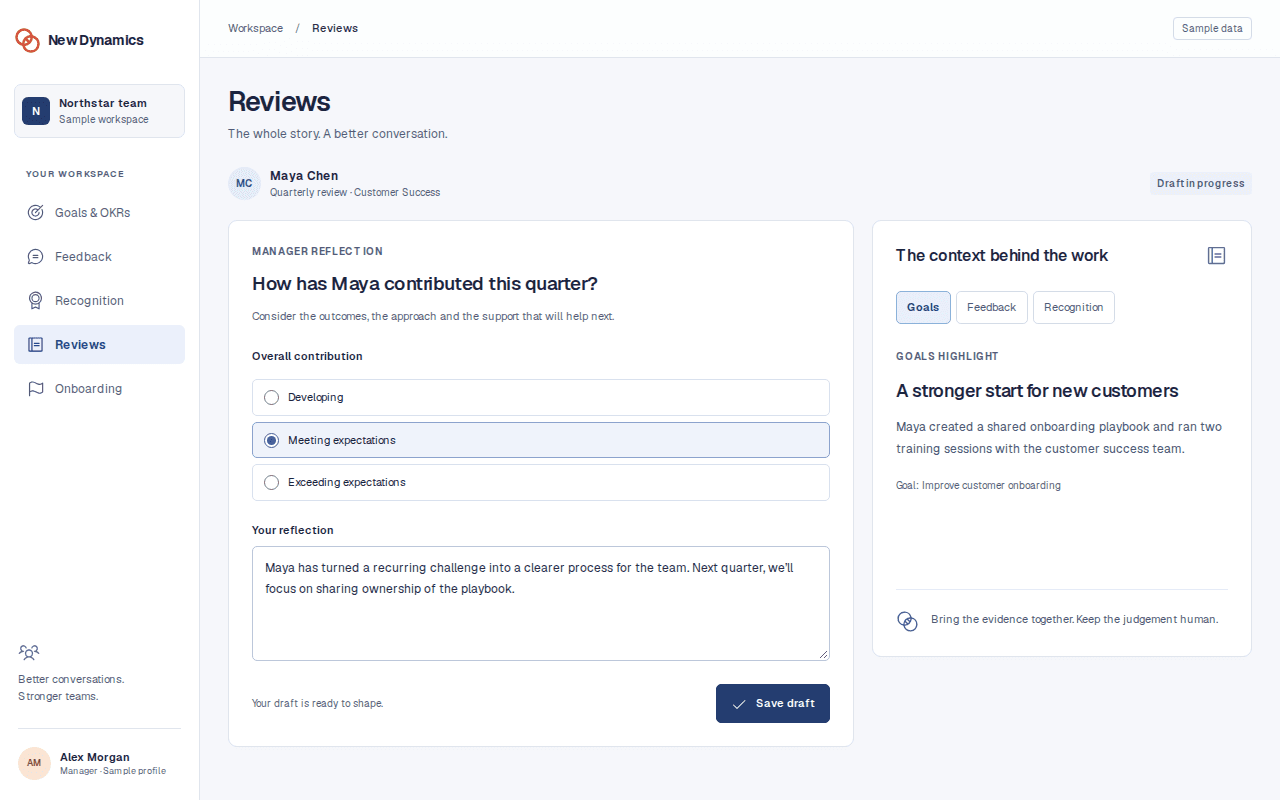
A half-year review built from the projects.

Bring project notes, goals and recognition into view for a short review against the progression ladder, with room for the lead’s judgement.

Try the interactive preview
A review draft alongside goals, feedback and recognition evidence, shown in the New Dynamics desktop interface.
A review draft alongside goals, feedback and recognition evidence, shown in the New Dynamics mobile layout.
Explore reviews

Goals for the next level.

See how a designer’s or producer’s goals for craft, client work and coaching could stay visible between reviews.

Try the interactive preview
A goal workspace with aligned priorities, key results and progress, shown in the New Dynamics desktop interface.
A goal workspace with aligned priorities, key results and progress, shown in the New Dynamics mobile layout.
Explore goals & okrs

Your questions, answered.

How often should an agency run performance reviews?

Twice a year suits most agencies and studios, supported by fortnightly one-to-ones and a short note at the end of each project. Annual reviews lose the detail of a year’s projects; quarterly reviews take more time than a fast-moving studio will give.

Should freelancers be included in performance management?

Freelancers are managed through their contract, not appraisal, but keeping an end-of-project note about them alongside permanent staff feedback helps producers book the right people again. Keep the record factual and about the work.

How do you keep reviews consistent across several offices?

Use one cycle, one set of light forms and a published progression ladder per discipline, then hold pay and promotion decisions across offices at the same time. Completion tracking shows the managing director that reviews happened everywhere.

How quickly can New Dynamics be set up for a small studio?

Setup depends on your forms, cycle and people data, and is scoped with the team. Send us the review form you use today and we will show your cycle running in the platform before you commit; ask at the demo what setup would involve for your studio.

OTHER SECTORS

Performance management in other industries

Bring out the best
in your people.

See what performance management could look like for your organisation.

Book a demo