TL;DR
- A financial adviser provides clients with expert guidance on managing their money, researching the market to recommend suitable products and helping clients act on the plan. In the UK, advice is regulated by the Financial Conduct Authority, and advisers must hold a recognised qualification.
- Advice is either independent, drawn from the whole market, or restricted to certain products or providers, and clients must be told which before advice is given. The job has seven responsibilities: find the facts, assess risk and suitability, research and recommend, present and implement, review, keep compliant records and grow the client base.
- The minimum UK qualification is a level 4 diploma from an FCA-accredited body, reached by degree, trainee scheme or the paraplanner and financial planner apprenticeship. Adverts should say whether the role is independent or restricted, employed or self-employed, and how it is paid.
A financial adviser is trusted with the decisions people make once or twice in a life: the pension, the mortgage, what happens to the savings. That trust is why the job is regulated, and why a financial advisor job description has to be written around suitability, disclosure and records as much as around sales.
This article explains what a financial adviser does, the difference between independent and restricted advice, seven responsibilities, the skills employers look for, the qualifications and rules that apply in the UK, a template and wording for a CV. It uses UK sources; regulation differs in other countries.
Advisers are measured on client outcomes, compliance and growth, and all three need to be visible. See how New Dynamics Goals & OKRs keep targets and progress in one place.
What does a financial adviser do?
Prospects, the UK graduate careers service, says in its financial adviser profile: “As a financial adviser, you'll provide clients with expert guidance on how to manage their money.” Advisers research the marketplace to recommend the most suitable products and services for the client's needs and objectives, then help the client put the plan into action. Specialisms include employee pension schemes for employers, and mortgage, pension or investment advice for individuals, or a broader service covering savings, protection insurance and tax-efficient investment.
Prospects adds the regulatory point: “To provide financial advice in the UK, you must hold a recognised qualification and comply with strict rules and regulations set by the Financial Conduct Authority (FCA).” Advisers are also known as financial planners, retail investment advisers or wealth managers. The UK National Careers Service's financial adviser profile says advisers “help people and organisations choose investments, savings, pensions, mortgages and insurance products”, with typical hours of 35 to 40 a week and enhanced background checks required.
Independent or restricted advice
Prospects explains that there are two types of adviser and advice. Independent financial advisers “research, consider and recommend products from the whole of the market” and must provide “unbiased and unrestricted advice based on a comprehensive and fair analysis of all relevant retail investment products and providers”. Restricted advisers “can only recommend certain products or providers”, limited to a product type or to one or a few providers. “All financial advisers must clearly inform their clients, before providing advice, whether they provide independent or restricted advice.”
| Type | Range | What the client must be told |
|---|---|---|
| Independent | Whole of market | That the advice is independent |
| Restricted | Certain products or providers only | That the advice is restricted, and how |
A job description should state which the firm offers, because it decides the research the adviser must do and the disclosure they must make.

Financial adviser responsibilities: seven areas
Prospects lists the typical tasks. Grouped into seven:
- Find the facts. Contact clients and arrange meetings, and conduct thorough reviews of their current financial situation, existing provision, goals and risk tolerance.
- Assess risk and suitability. Carry out risk analyses and suitability assessments so that advice meets the client's needs.
- Research and recommend. Analyse client information, develop personalised plans and research the market for suitable products from a range of providers, or a limited range if restricted.
- Present and implement. Design and present clear strategies for short- and long-term goals, explain complex information simply, and support clients in making informed decisions and putting them into action. The NCS adds negotiating with providers.
- Review. Monitor clients' plans, review them regularly and adapt to changes in circumstances or markets; the NCS lists updating clients about pensions and investments.
- Keep compliant records. Maintain accurate, compliant client records and ensure all advice complies with FCA regulations “including disclosure, product suitability and cost transparency”, using planning software and CRM systems.
- Grow the client base. Manage and grow a portfolio of clients through relationships and referrals, work with paraplanners, solicitors and accountants, meet business targets where the role is sales-focused, and keep up to date through CPD.

Skills employers look for
Prospects lists communication, interpersonal and listening skills, “the ability to explain complex financial information clearly and simply”, relationship building and networking, research, analytical and critical thinking, influencing and negotiation with resilience and persistence, time management, client care, self-discipline, attention to detail, numeracy and confidence with planning software, “discretion and commitment to client confidentiality”, professionalism and ethics, judgement, adaptability, a proactive mindset and commitment to CPD. The NCS adds knowledge of economics and accounting, maths for financial plans, the ability to sell and business management for negotiating rates.
For an advert, six things: technical knowledge, plain explanation, listening, integrity, resilience in a targeted role and disciplined record keeping.
Qualifications and rules in the UK
Minimum qualification. Prospects says that to practise as a financial adviser in the UK “you must have a recognised qualification from a body that is accredited by the FCA”, and that “The minimum level of qualification is a Level 4 diploma”, with many advisers holding further qualifications or chartered or certified status. It names the level 4 diplomas offered by the London Institute of Banking & Finance, the Chartered Insurance Institute and the Chartered Institute for Securities & Investment.
Routes in. Graduates of any discipline can apply for trainee adviser roles, with accountancy, business management and finance an advantage; some employers require the level 4 qualification already, others support it during training. Prospects names the paraplanner and financial planner level 4 higher apprenticeship as the recognised apprenticeship route, and notes that people also start in financial services, pensions or customer service administration and work up.
Checks and conduct. The NCS lists enhanced background checks. Advisers work within FCA rules on disclosure, suitability and cost transparency, and firms will have their own approval and supervision processes.
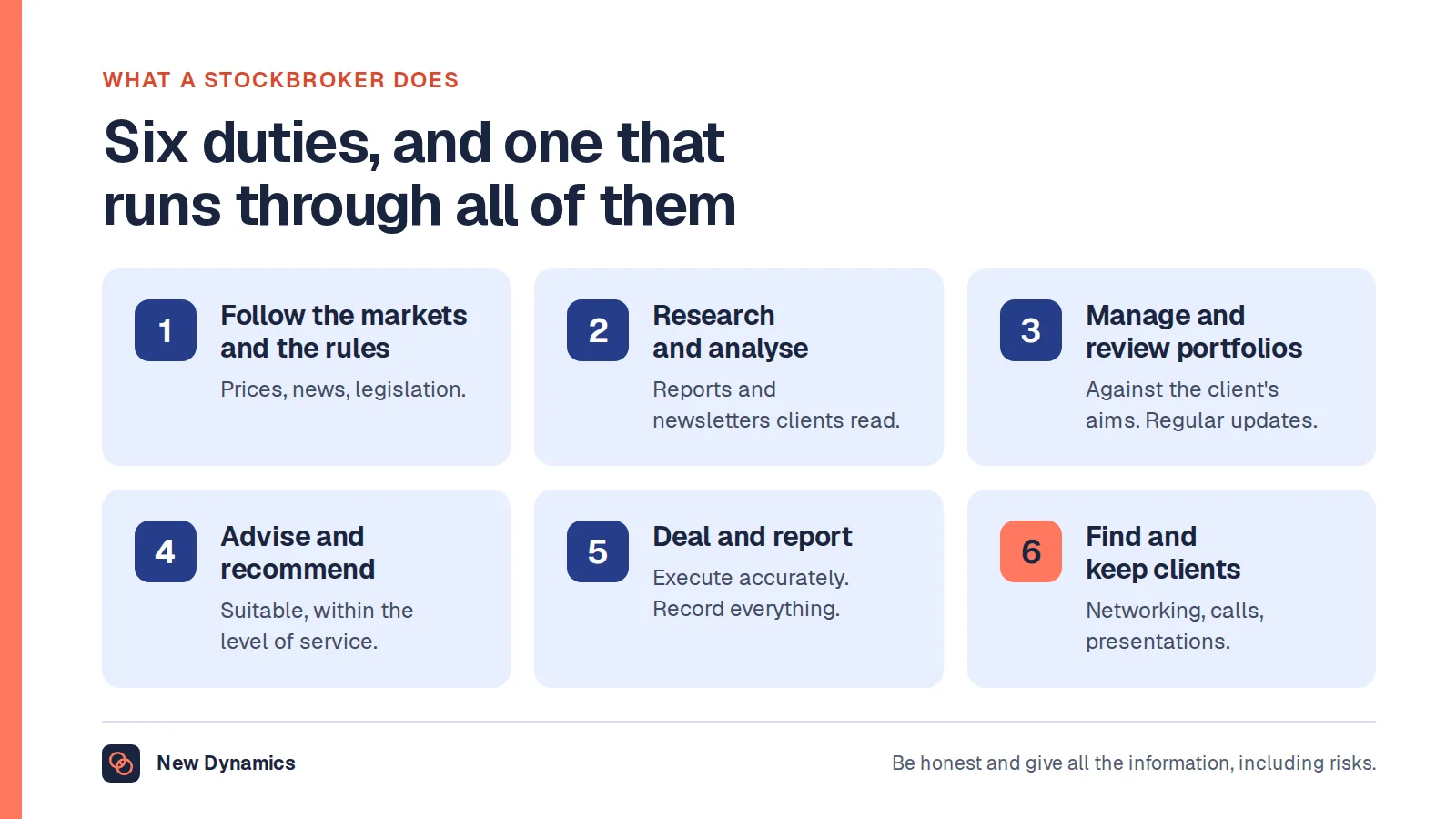
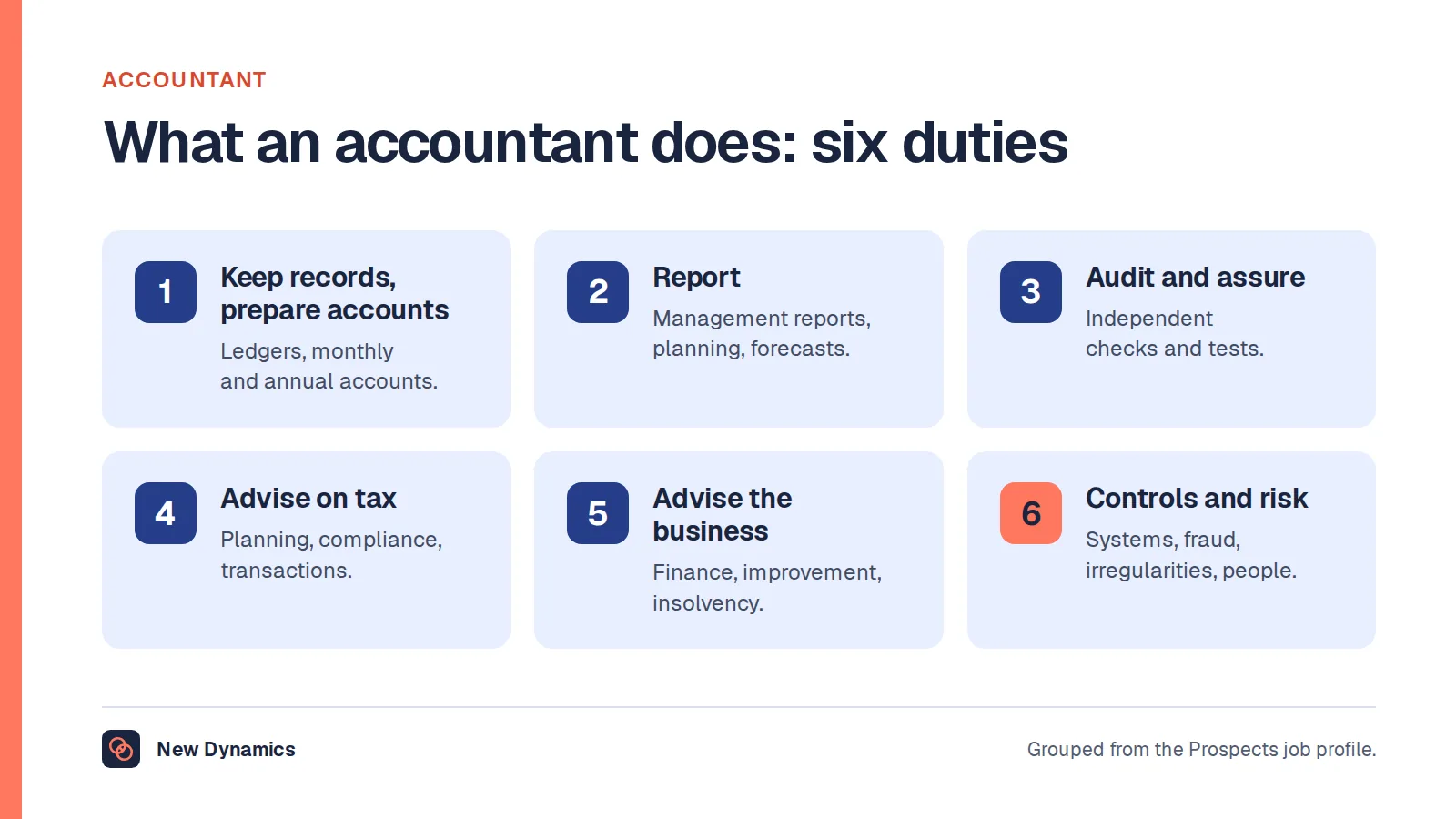
Progression. The NCS says an adviser could specialise, for example in pensions, become a manager recruiting and training staff, become a director or partner, or move into compliance. Our stockbroker article covers a neighbouring regulated role, and our accountant job description the profession advisers most often work alongside.
This is general information about UK requirements as Prospects and the NCS describe them, not legal or regulatory advice; check the FCA's current rules.

Financial adviser job description template
Adapt the template to your firm. Keep every line true.
Job title: Financial adviser [independent / restricted], [specialism]
Reports to: Advice manager or principal
Basis: [Employed / self-employed]; [base salary plus bonus / fee share], stated in full
Location and hours: [Office, hybrid and client visits]; [37.5] hours a week with client meetings outside office hours as required
Purpose of the role: To give [independent / restricted] financial advice that suits each client's circumstances, goals and attitude to risk, documented and delivered in line with FCA rules, and to build a lasting client base.
Main responsibilities:
- Meet clients and complete thorough fact-finds covering circumstances, provision, goals and risk tolerance
- Carry out risk and suitability assessments and document them
- Research the [whole market / firm's panel] and prepare personalised recommendations
- Present recommendations clearly, disclose status and costs, and implement agreed plans
- Review client plans at agreed intervals and after changes in circumstances
- Keep accurate, compliant records in [planning software and CRM]
- Grow the client base through service, referrals and [introducers]; meet agreed business targets
Requirements:
- Level 4 diploma from an FCA-accredited body [named], or working towards it with support
- [Chartered or certified status desirable]
- Enhanced background check; fit and proper under the firm's processes
- [Two] years in advice, paraplanning or financial services
- Full driving licence [for client visits]
We provide: Paraplanning and administrative support, compliance supervision, CPD and exam support, [client bank or leads], and a route to senior adviser or partner.
State independent or restricted, employed or self-employed, the pay model and whether a client bank is provided. Our job description template explains the overall structure.
How to describe advice work on a CV
Write what you did and the scale. The lines below are our own examples.
- “Independent financial adviser managing [n] client relationships and [£x] of funds under advice.”
- “Level 4 Diploma in Regulated Financial Planning; working towards chartered status.”
- “Completed [n] suitability reports a year with no file failures at compliance review.”
- “Grew the client bank by [x] percent through referrals from existing clients and professional introducers.”
- “Specialised in pensions and retirement planning, including [defined benefit transfer analysis where permitted].”
Common mistakes in financial adviser adverts
Independent or restricted unstated. It decides the research and the disclosure, and candidates ask.
Pay model vague. Base, bonus, fee share and self-employed status must be spelt out.
Client bank implied. Say whether leads or an existing client bank come with the role.
Compliance as a footnote. Suitability, disclosure and records are the job, not an add-on.
Qualification support unstated. Say whether you fund the level 4 and beyond.
Frequently asked questions
What are the responsibilities of a financial adviser?
Seven areas: find the facts about the client, assess risk and suitability, research and recommend suitable products, present and implement the plan, review it regularly, keep accurate and compliant records, and grow the client base. Prospects lists the tasks behind each.
What is the difference between an independent and a restricted financial adviser?
An independent adviser recommends from the whole market on a comprehensive and fair analysis. A restricted adviser can only recommend certain products or providers. Prospects notes that all advisers must tell clients which they are before giving advice.
What qualifications does a financial adviser need in the UK?
A recognised qualification from an FCA-accredited body at level 4 diploma or above, such as those offered by the London Institute of Banking & Finance, the Chartered Insurance Institute or the Chartered Institute for Securities & Investment, reached by a trainee scheme, the level 4 paraplanner and financial planner apprenticeship or progression from administration.
What skills does a financial adviser need?
Technical knowledge of products, tax and markets, the ability to explain complex information simply, listening and relationship building, analytical thinking, resilience and persistence in a targeted role, discretion and ethics, and disciplined record keeping.
Is a financial adviser a sales role?
Partly, in many firms. Prospects notes that in a sales-focused role advisers meet agreed business targets and support growth through business development and referrals, and the National Careers Service lists meeting performance and sales targets. Advice must still be suitable and compliant whatever the target.
What is the career path for a financial adviser?
Specialising, for example in pensions; managing and training other advisers; becoming a director or partner; or moving into compliance, according to the National Careers Service. Chartered or certified status supports progression.
Your next step
- Write the first line: independent or restricted, specialism, employed or self-employed.
- Put suitability, disclosure and records into the responsibilities.
- State the pay model, the client bank and the qualification support in full.
- Agree the first year's measures: client outcomes, file quality, growth.
For writing those measures, read and download our SMART goals guide. The guide is free to read, and the PDF uses our short download form.
Want adviser targets, supervision notes and CPD in one place? Book a New Dynamics demo and bring your current job description. You can also email contact@new-dynamics.com.