TL;DR
- An accountant keeps or examines the records of money received, paid and owed by an organisation or a person, prepares accounts and financial statements, and gives advice on tax, finance and business decisions.
- The six main duties are keeping records and preparing accounts, financial reporting, audit and assurance, tax, management information and advice, and controls and risk. Which ones dominate depends on whether the accountant works in practice or in industry.
- Employers look for numeracy, a methodical approach, analysis, communication, IT skills and integrity. In the UK the professional titles are chartered accountant and accounting technician. In the United States the equivalent title is the CPA, licensed state by state.
Every organisation runs on numbers that somebody has to get right. The accountant is that somebody: the person whose records the bank, the tax authority, the auditor and the board can rely on, and whose advice turns those records into decisions.
This accountant job description explains what the job involves, sets out six main duties, describes the main types of accountant, lists the skills and qualifications that employers ask for in the UK and the United States, gives a position description template that you can adapt and notes the mistakes that make accountancy adverts miss.
Accountants are measured on accuracy, deadlines and judgement, and their objectives should be as precise as their work. See how New Dynamics Goals & OKRs keep targets and progress in one place, from month-end close to the year-end audit.
What does an accountant do?
The Cambridge Dictionary defines an accountant as “someone who keeps or examines the records of money received, paid, and owed by a company or person”. Keeping and examining are two different jobs, and most accountants do more of one than the other.
Prospects, the UK graduate careers service, describes the professional role in its chartered accountant job profile: “As a chartered accountant, you'll give advice, audit accounts and provide trustworthy information about financial records.” It adds that this might involve “financial reporting, taxation, auditing, forensic accounting, corporate finance, business recovery and insolvency, or accounting systems and processes”.
Two settings shape the job.
- Practice. Working for an accountancy firm, with clients. Audit, tax, advice and accounts preparation for many organisations.
- Industry. Working inside one organisation, in its finance team. Management accounts, budgets, reporting and control for a single employer.
Accountant duties: six responsibilities
Prospects lists the tasks that a chartered accountant will need to do, from managing financial systems and budgets to negotiating terms with suppliers. Grouped, they come to six duties.
- Keep records and prepare accounts. Maintain accounting records and prepare accounts and management information, including monthly and annual accounts and financial statements.
- Report. Arrange financial management reports, including financial planning and forecasting, and produce reports and recommendations after audits.
- Audit and assure. Undertake financial audits, described by Prospects as “independent checks of an organisation's financial position”, perform tests to check financial information and systems, and liaise with internal and external auditors.
- Advise on tax. Advise clients on tax planning within current legislation, and on the tax issues in transactions such as acquisitions and mergers.
- Provide management information and advice. Give financial advice to clients or managers, counsel on business improvement, corporate finance and, where needed, insolvency.
- Run controls and manage risk. Review systems, analyse risk, detect and prevent fraud, deal with financial irregularities, manage junior colleagues and negotiate terms with suppliers.
In practice a newly qualified accountant will do two or three of these. A finance director does all six, mostly through other people.

Types of accountant
- Financial accountant. Prepares the statutory accounts and financial statements that go to shareholders, lenders and regulators.
- Management accountant. Produces budgets, forecasts and monthly management information for decisions inside the organisation. Prospects has a separate chartered management accountant profile.
- Auditor. Examines an organisation's records and gives an independent opinion on them, from a firm (external audit) or from inside (internal audit).
- Tax accountant. Prepares returns and advises on tax planning and compliance.
- Forensic accountant. Investigates fraud and financial irregularity, often for legal proceedings.
Related roles sit around the accountant. A bookkeeper records transactions. An accounts payable or receivable clerk processes what the organisation owes and is owed. A payroll team pays people, and our guide to the definition of payroll explains that work.

Skills employers ask for
Prospects lists what a chartered accountant needs to have. Its list includes “general business awareness”, “self-motivation and commitment to combine work and study successfully”, “communication and interpersonal skills”, “organisational and time management skills”, “a methodical approach”, “IT proficiency”, “strong analytical and problem-solving skills”, “numeracy”, “leadership and teamworking skills”, “initiative and motivation” and “integrity and trustworthiness”.
Three of those deserve a word in any advert.
- Integrity. An accountant's value rests on being believed. Say in the advert that the role reports irregularities without fear.
- Communication. Numbers persuade nobody until someone explains them. The accountant who can brief a non-financial manager is worth more than one who cannot.
- Study. Trainees work and study at once for several years. Say what support you give.
Qualifications: chartered, technician and CPA
United Kingdom. Prospects says that entry to chartered training is open to graduates of all disciplines, and that some employers train students through the Association of Accounting Technicians qualification, “which can lead to chartered status and does not require a degree”. It names the three main professional institutes awarding UK chartered accountancy qualifications as Chartered Accountants Ireland, ICAEW and ICAS, and notes that “ICAEW members are designated ACA (Associate Chartered Accountant), while ICAS and Chartered Accountants Ireland members use CA.” Other bodies award chartered certified and chartered management accountant titles. Continuing professional development is, in Prospects' word, essential.
Apprenticeships. Skills England's listing of accounting apprenticeship standards includes the professional accounting technician standard at level 4, typically 18 months, an accounting finance manager standard at level 6 and an accountancy or taxation professional standard at level 7.
United States. The equivalent professional title is the Certified Public Accountant, or CPA. Licensing is handled state by state, so the education, examination and experience required differ between states. A “CPA accountant job description” should say whether the licence is required, preferred or to be obtained, and in which state.
Requirements differ in other countries. This is general information, not professional advice.

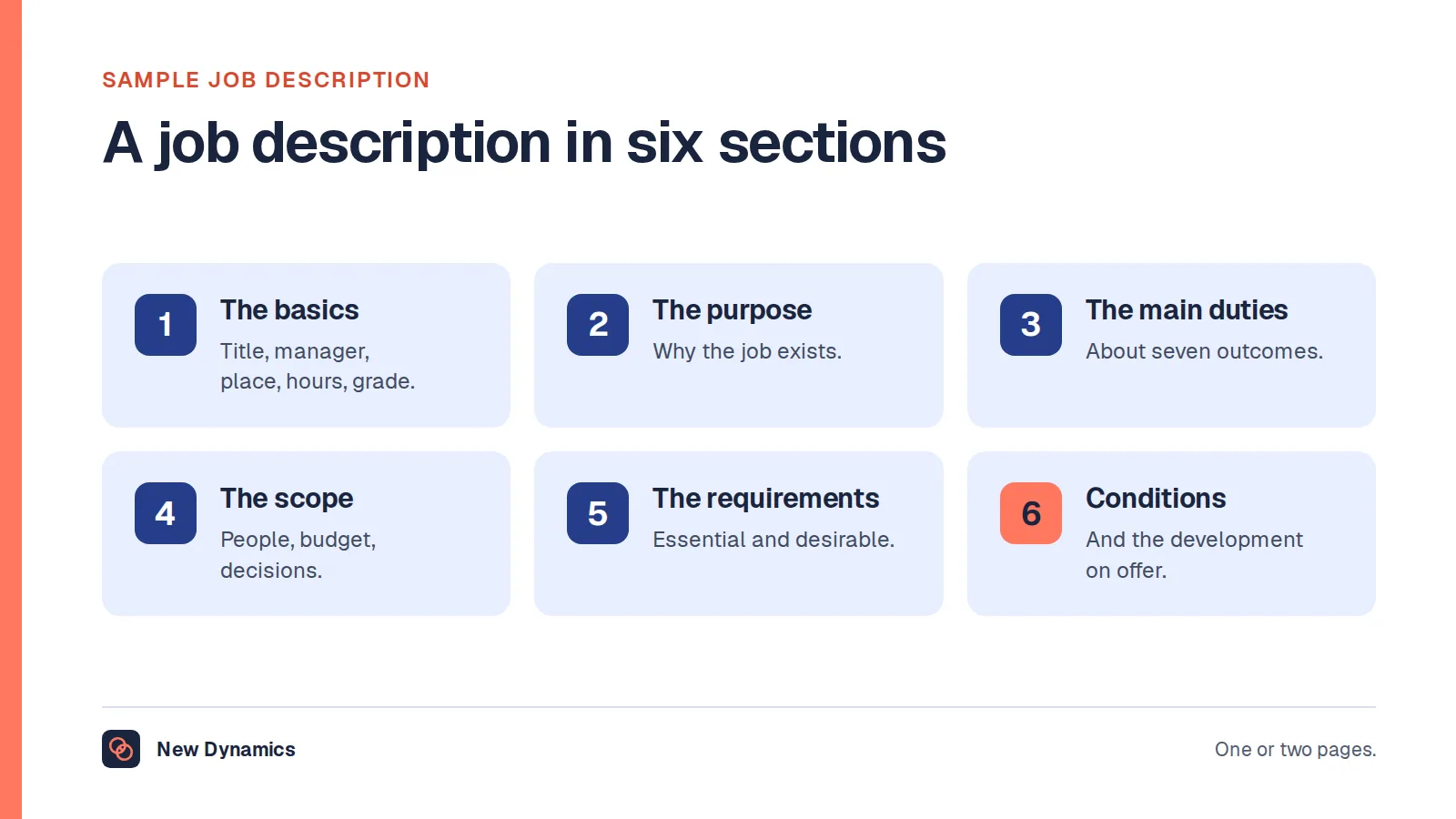
Accountant position description template
Adapt the template to your organisation. Keep every line true.
Job title: Accountant
Reports to: Financial controller or finance manager
Location and hours: [Office or hybrid], full-time, with longer hours at month-end and year-end
Purpose of the role: To keep accurate financial records, produce reliable accounts and reports on time, and give managers the financial information they need to decide well.
Main duties:
- Maintain the general ledger and prepare monthly management accounts
- Prepare the annual financial statements and support the external audit
- Prepare and file [tax returns and statutory filings that apply]
- Produce budgets, forecasts and variance analysis with department heads
- Maintain financial controls and investigate irregularities
- Improve accounting systems and processes
- Supervise [an assistant accountant or accounts clerks]
Skills and experience:
- Qualified or part-qualified accountant [name the qualifications you accept], or CPA licence [required or preferred] in [state]
- Experience of [the sector, systems and reporting standards that matter to you]
- Methodical, accurate and comfortable with deadlines
- Clear communication with non-financial colleagues
- Integrity, and the confidence to raise concerns
We provide: Study support and paid study leave, a mentor for professional exams, funded CPD, and objectives reviewed each quarter.
Say which reporting standards, systems and filings the role covers. "Accountant" alone could mean a sole practitioner's assistant or a group financial accountant. Our job description template explains the structure, and our job evaluation guide shows how to grade the role fairly against others.
Common mistakes in accountant job adverts
Asking for everything. Audit, tax, management accounts and systems in one role is a finance department, not a job.
Silence on study support. Trainees choose employers on it. Say what you fund and how much leave you give.
Vague on qualification. "Qualified accountant" means different things in different countries. Name the bodies or licences you accept.
Hiding the peaks. Month-end, year-end and tax deadlines are part of the job. Say so, and say what happens to the hours.
Ignoring judgement. Software does the arithmetic. The advert should ask for the person who knows when the arithmetic is wrong.
Frequently asked questions
What does an accountant do?
An accountant keeps or examines the records of money received, paid and owed by an organisation or person. Typical duties are keeping records and preparing accounts, financial reporting, audit, tax, management information and advice, and financial controls and risk.
What is the difference between an accountant and a bookkeeper?
A bookkeeper records the day-to-day transactions. An accountant prepares accounts and financial statements from those records, examines them, and advises on tax, finance and business decisions. Many small businesses use a bookkeeper through the year and an accountant at year-end.
What is a CPA accountant?
A Certified Public Accountant is the United States professional title. Licensing is handled state by state, with education, examination and experience requirements that differ between states. In the UK the equivalent professional titles are chartered accountant and, for technicians, AAT.
What qualifications do you need to be an accountant in the UK?
Prospects says chartered training is open to graduates of all disciplines, and that the AAT route can lead to chartered status without a degree. Apprenticeship standards exist at level 4 (professional accounting technician), level 6 and level 7. Chartered titles are awarded by ICAEW, ICAS and Chartered Accountants Ireland, among other bodies.
What skills does an accountant need?
Numeracy, a methodical approach, analytical and problem-solving skills, IT proficiency, communication and interpersonal skills, organisation and time management, business awareness, leadership and teamworking, initiative, and integrity and trustworthiness.
What should an accountant position description include?
The title, who the accountant reports to, location and hours including peak periods, the purpose of the role, six or seven main duties, the qualifications and licences accepted, the systems and standards used, the skills needed, and the study support and development offered.
Your next step
If you are hiring, list the filings, reports and deadlines the accountant will own this year, and build the advert from that list. If you are applying, write one line for each of the six duties that shows what you have done, with a number where you can.
For a method that grades finance roles fairly against the rest of the organisation, read and download our job evaluation guide. The guide is free to read, and the PDF uses our short download form.
Want finance objectives, feedback and development in one place? Book a New Dynamics demo and bring your current approach. You can also email contact@new-dynamics.com.