TL;DR
- Hairdressers, hair stylists and barbers cut, shave, colour and style customers' hair, as the National Careers Service puts it in one profile covering all three titles. Skills England's standards add the point employers care about: the skills are applied to client requirements whilst providing an outstanding service.
- The hair stylist responsibilities and barber job duties fall into six groups: consult, cut and style, colour and treat, barbering (beards, shaves and clipper work), finish and retail, and run the chair: appointments, payments, stock and hygiene. Rebooking and retail are what make a stylist profitable.
- Write the description around the clientele, the services offered, the chair arrangement (employed, self-employed or rent-a-chair), the targets and the training you will give. Ask for the skills the National Careers Service lists: customer service, attention to detail, manual skill, active listening and communication.
A barber in the National Careers Service's profile puts it well: the haircut is perhaps a fifth of the job; the rest is people. A hair stylist job description, or a barber job description, that lists only cutting and colouring will attract people who can cut and colour. The ones who fill a column of the appointment book can also consult, listen, rebook and sell the shampoo.
This article gives a combined hair stylist and barber job description: what the roles are, the hair stylist responsibilities and barber job duties in six groups, the skills, the routes and apprenticeship standards in England, the chair arrangements that shape the job, and a template to adapt.
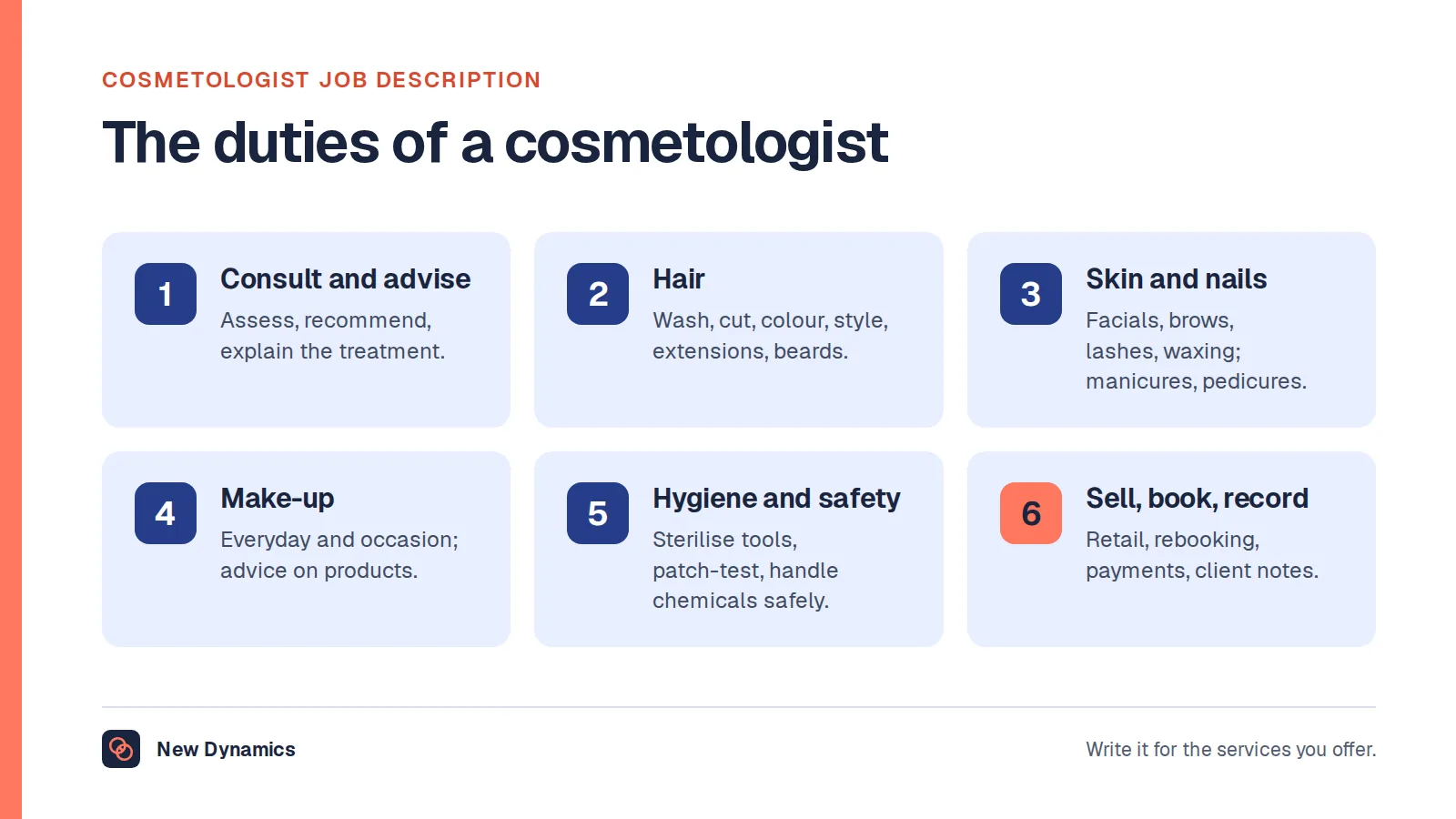
Stylists live by their column and their rebooking rate. See how New Dynamics Goals & OKRs keep targets and progress in one place. For the wider beauty field, see our cosmetologist job description.
Hair stylist, hairdresser, barber
The National Careers Service covers all three in one profile: “Hairdressers and barbers cut, shave, colour and style customers' hair”, with hairstylist and barber as alternative titles. The Cambridge Dictionary defines a barber as “someone who cuts men's hair and facial hair”.
In practice the titles mark specialism rather than rank. A hair stylist or hairdresser works mostly with women's and men's hair in a salon, including colour and chemical services. A barber works mostly with men's hair and facial hair in a barbershop, with clipper work, shaves and beard trims. Many professionals do both, and the apprenticeship standards reflect the split: Skills England's hairdressing professional standard, level 2 over 24 months, describes “The practical application of Hairdressing skills and knowledge, personalised to client requirements, whilst providing an outstanding service.”; its barbering professional standard, level 2 over 18 months, describes the ability to “Demonstrate a range of Barbering skills tailored to client requirements, whilst providing an outstanding service.” Both standards say the same thing twice: skill, tailored to the client, with service.
Hair stylist responsibilities and barber job duties
The National Careers Service lists the day-to-day tasks. In our words, a hairdresser or barber could talk to customers and discuss styling ideas; wash, cut and style hair; apply colours, tints, braids and hair extensions; trim and shape beards and moustaches; finish jobs using hair products; and order stock, take payments and make appointments.
Grouped for a job description, there are six duties.
- Consult. Talk to the client, understand what they want, assess hair type, condition and head shape, advise what will work, and agree the service and the price before starting.
- Cut and style. Wash, cut, blow-dry and style to the agreed look, to time.
- Colour and treat. Colours, tints, highlights, chemical treatments, braids and extensions, with skin tests and manufacturer instructions followed.
- Barbering. Clipper and scissor cuts, fades, beard and moustache trimming and shaping, and wet shaves where offered.
- Finish and retail. Finish with products, show the client how to maintain the look, and recommend the products that will.
- Run the chair. Make appointments and rebook, take payments, order and manage stock, keep tools and the station clean and sterilised, and follow the salon's hygiene and safety rules.

Skills to ask for
The National Careers Service lists customer service skills, thoroughness and attention to detail, the ability to work well with your hands, active listening, excellent verbal communication, the ability to work on your own, flexibility, the ability to learn through your work, and basic computer or device use.
Two matter most to the salon's income.
- Consultation and listening. The service the client wanted, not the one the stylist fancied doing, is what brings them back.
- Rebooking and retail without pushiness. A stylist who rebooks most clients before they leave and recommends the right product runs a full column; one who does not is a cost.
Add stamina, since the National Careers Service notes the environment may be physically active, and the discipline to keep to time when the book is full.
Routes in and qualifications
The National Careers Service says you can get in through a college course in hairdressing, barbering or women's and men's hairdressing, an apprenticeship, or by starting as a trainee and learning on the job with part-time study. The apprenticeships it names are the hairdressing professional and barbering professional at level 2, taking one to two years, and the creative hair professional at level 3. It notes that you may be able to work freelance and rent space in a salon or barbershop, usually supplying your own equipment.
For the description: say whether you are hiring a qualified stylist, a graduate stylist or an apprentice, and what training and assessment you provide.

Employed, self-employed or rent-a-chair
The arrangement shapes everything else in the description. An employed stylist works the salon's hours for a wage, often with commission on services and retail, and the salon supplies products and equipment. A self-employed stylist or a rent-a-chair arrangement means the stylist runs their own business from the salon's premises, pays rent or a percentage, keeps their own clients and books, and usually supplies their own tools. The National Careers Service mentions the freelance route; the legal and tax rules on employment status differ by country and are beyond this article, but a job description must say plainly which arrangement is on offer, because the duties, targets and hours follow from it.
Working pattern
The National Careers Service gives typical hours of 37 to 40 a week, with evenings and weekends on a rota, in a salon, barbershop, client's home, spa or cruise ship. State the rota, the late nights and Saturdays, the targets (column occupancy, rebooking rate, retail), the commission structure and the products and equipment supplied.
Hair stylist and barber job description template
Job title: Hair Stylist / Barber (state which, or both)
Reports to: Salon Manager or Owner
Arrangement: Employed / self-employed / rent-a-chair (state which)
Purpose: Deliver consultations, cuts, colour and styling (or barbering services) tailored to each client, to a standard and a pace that fills your column and brings clients back.
Responsibilities:
- Consult with every client: assess hair, advise, agree the service and price.
- Wash, cut, style and finish hair to the agreed look and to time.
- Carry out colour and chemical services with skin tests and manufacturer instructions (stylist).
- Clipper and scissor cuts, fades, beard and moustache work, shaves (barber).
- Recommend and sell suitable products; show clients how to maintain the look.
- Rebook clients, manage your appointments and take payments.
- Keep tools sterilised and the station clean; follow hygiene and safety rules.
- Order and manage stock; support junior staff and apprentices as trained.
Skills and experience:
- Level 2 hairdressing or barbering qualification, or equivalent experience (apprentices: enthusiasm and a willingness to learn).
- Consultation, listening and customer service skills.
- Attention to detail, manual skill and stamina.
- Rebooking and retail ability without pressure.
- Portfolio or trade test at interview.
Working pattern: Rota, evenings and Saturdays, targets, commission, products and equipment supplied.
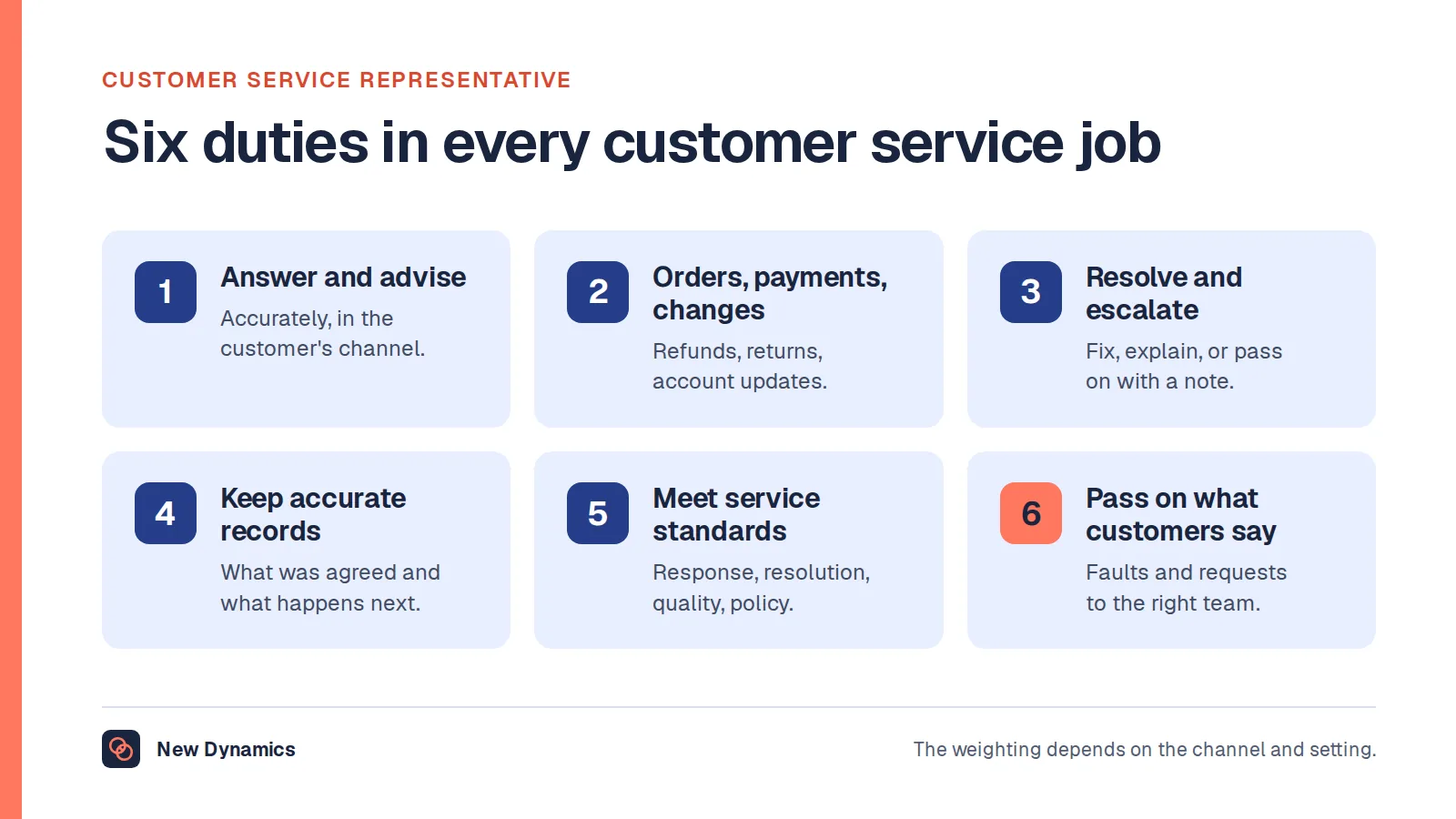
Our job description template explains each section; for the customer-facing skills, see our customer service representative job description.

Frequently asked questions
What are the responsibilities of a hair stylist?
According to the National Careers Service, a hairdresser or stylist talks to customers and discusses styling ideas, washes, cuts and styles hair, applies colours, tints, braids and extensions, finishes with products, and orders stock, takes payments and makes appointments. In a job description that is six duties: consult, cut and style, colour and treat, barbering where offered, finish and retail, and run the chair.
What is a barber job description?
A barber cuts men's hair and facial hair, as the Cambridge Dictionary puts it: clipper and scissor cuts, fades, beard and moustache trimming and shaping, shaves where offered, plus consultation, finishing, retail, appointments, payments and hygiene. Skills England's barbering professional standard describes barbering skills tailored to client requirements whilst providing an outstanding service.
What is the difference between a hair stylist and a barber?
Specialism rather than rank. A hair stylist or hairdresser works with women's and men's hair in a salon, including colour and chemical services; a barber works mostly with men's hair and facial hair in a barbershop, with clipper work, shaves and beards. The National Careers Service covers both in one profile, and many professionals do both.
What skills does a hair stylist need?
The National Careers Service lists customer service, attention to detail, manual skill, active listening, verbal communication, working alone, flexibility, learning through work and basic device use. Consultation, rebooking and retail without pushiness are what fill a column.
What qualifications does a barber need?
In England, usually a level 2 barbering qualification through a college course or the barbering professional apprenticeship, or training on the job as a trainee with part-time study. Requirements differ elsewhere; some countries and states license barbers.
What is rent-a-chair?
An arrangement in which a self-employed stylist or barber runs their own business from a salon's premises, paying rent or a percentage and keeping their own clients and books, usually with their own tools. A job description should say whether the role is employed, self-employed or rent-a-chair, because hours, targets and duties follow from it.
Your next step: describe the chair
- State the arrangement: employed, self-employed or rent-a-chair.
- List the services offered and the clientele.
- Set the targets and the commission in writing.
- Plan the first weeks: the salon's systems, products, hygiene rules and a senior stylist to shadow.
For a structured start, read and download our employee onboarding guide. The guide is free to read, and the PDF uses our short download form.
Want stylists' targets, rebooking rates and reviews in one place? Book a New Dynamics demo and bring your current job descriptions. You can also email contact@new-dynamics.com.