TL;DR
- A marketing director owns the marketing strategy and the function that delivers it: the plan and budget, the team and agencies, the brand, the pipeline the sales team depends on, the numbers reported to the executive team and the marketing voice at the table. O*NET lists marketing director among the reported titles of marketing managers, whose tasks include formulating and directing marketing activities and policies, identifying and evaluating strategy from the organisation's objectives and market characteristics, directing the hiring, training and performance evaluation of marketing staff, evaluating budgets and return on investment, developing pricing strategy and initiating market research.
- The job comes in three versions: the head of a small function who still runs campaigns; the director of a marketing function in a mid-sized company, on or beside the executive team; and the divisional, regional or product-line director under a chief marketing officer. The National Careers Service gives marketing director as the step up from marketing manager, whose work is creating strategies, managing launches, approving campaign content, budgets and targets, working with agencies and reporting on campaign effectiveness; the director owns what the manager runs.
- The director differs from the marketing manager, who runs campaigns and the team day to day, from the brand director, who owns one brand's positioning and identity, and from the chief marketing officer, who sits on the executive team of a large organisation with directors beneath. Write the position description around the version, the revenue model the marketing serves and the decisions the director owns, and set objectives on revenue influenced, pipeline created, brand measures and the function's cost and capability, not on campaigns launched.
The marketing manager launched twelve campaigns last year and the board still asked what marketing did for revenue. That gap, between activity and the answer the business wants, is the job the director of marketing exists to close. A director of marketing position description should therefore describe a job about strategy, money, people and numbers before it describes campaigns, and it should say which version of the job it is, because the head of marketing in a forty-person company and the regional marketing director of a multinational share a title and little else.
This article gives the position description using two primary sources, the US O*NET occupational database and the UK National Careers Service, describes the three versions of the job, groups the work into seven duties, separates the director from the marketing manager, the brand director and the chief marketing officer, lists the skills and qualifications, and provides a template with objectives beyond leads.
A marketing director's objectives are the ones the CEO asks about, and they should sit beside the sales team's numbers where both can see them. See how New Dynamics Goals & OKRs keep marketing's objectives, owners and progress in one place with the rest of the business's goals.
What is a marketing director?
A marketing director leads the marketing function and owns its strategy: what the organisation says to whom, through which channels, at what cost, to what commercial end. O*NET lists “Marketing Director” among the reported titles of marketing managers, an occupation it describes as planning, directing or coordinating marketing policies and programmes, “determining the demand for products and services offered by a firm and its competitors”, identifying potential customers and developing pricing strategies. Its tasks include “formulate, direct, or coordinate marketing activities or policies to promote products or services”, “identify, develop, or evaluate marketing strategy, based on knowledge of establishment objectives, market characteristics, and cost and markup factors”, “use sales forecasting or strategic planning to ensure the sale and profitability of products, lines, or services”, “direct the hiring, training, or performance evaluations of marketing or sales staff”, “evaluate the financial aspects of product development, such as budgets, expenditures, research and development appropriations, or return-on-investment and profit-loss projections”, “develop pricing strategies”, “initiate market research studies, or analyze their findings” and “negotiate contracts with vendors or distributors”.
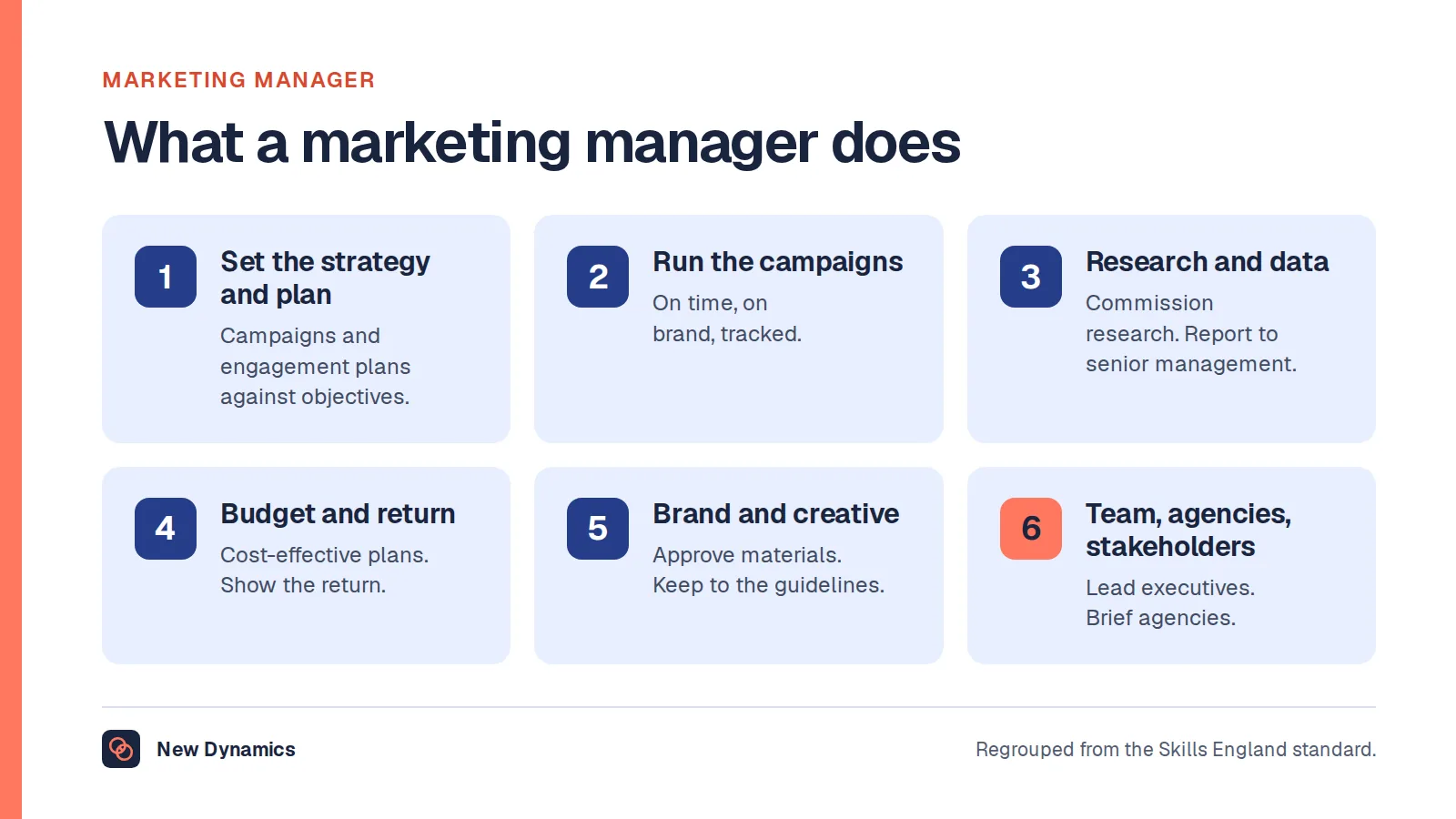
The National Careers Service describes the marketing manager's work as creating marketing and social media strategies, planning and managing the launch of new products and services, overseeing and approving campaign content, budgets and targets, working with in-house or external agencies and reporting on the effectiveness of campaigns, and gives marketing director as the step up with experience. The director owns what the manager runs.
The three versions of the job
- The head of a small function. In a smaller company the director is the marketing team's most senior person and still writes the plan, briefs the agency and runs the biggest campaigns. The job is strategy and execution in the same week.
- The director of a function. In a mid-sized company, leads marketing managers and specialists, owns the plan and budget, sits on or reports to the executive team and answers for marketing's contribution to revenue. The job is leadership and the numbers.
- The divisional, regional or product-line director. In a large company, leads marketing for a division, region or line under a chief marketing officer, applying group strategy and shaping it for the local market. The job is translation and delivery.
Say which version the advert is for, who the director reports to and what the executive team expects marketing to deliver.

Marketing director responsibilities: seven duties
Grouped from the O*NET tasks and the National Careers Service's description of the rung below, the work has seven parts.
- Strategy. Identify, develop and evaluate the marketing strategy from the organisation's objectives, the market and the economics, in O*NET's terms: the segments, the positioning, the proposition, the channels and the pricing role marketing plays.
- The plan and the budget. Turn the strategy into an annual plan with targets, a budget and a forecast; evaluate spend and return on investment; decide what to stop.
- The team and the agencies. Structure and lead the marketing team; direct hiring, training and performance evaluation, as O*NET lists; choose and manage agencies and vendors; build the capability the plan needs.
- The brand. Own the brand's positioning, identity and standards across every channel; protect it in the trade-offs between short-term leads and long-term reputation.
- The pipeline and the product. Deliver the demand the sales plan depends on and the launches the product plan needs; consult with product development on specification, packaging and pricing, as O*NET describes; agree the handover to sales and measure it.
- Research and the market. Initiate market research and analyse its findings; monitor competitors and trends; bring the customer's voice to the executive table.
- The numbers and the table. Report marketing's effectiveness and contribution to revenue; advise the CEO and executive team; represent the company to the market, partners and the press.

Marketing director vs marketing manager vs brand director vs CMO
| Role | Owns | Sits |
|---|---|---|
| Marketing manager | Campaigns, launches, content, the team day to day | Reports to the director; runs the function's work |
| Brand director | One brand's positioning, identity and plan | Beside the marketing director or under the CMO |
| Marketing director | The strategy, plan, budget, team, brand and contribution to revenue | On or beside the executive team |
| Chief marketing officer | The marketing strategy of a large organisation | On the executive team, with directors beneath |
In a smaller company the manager and the director are the same seat with different titles; the test is whether the role owns the strategy and answers for the numbers or runs the campaigns. Our marketing manager job description covers the rung below, and the creative director job description the creative lead the marketing director often works beside.
Skills employers look for
- Commercial judgement. Reading a market, a pricing question and a forecast, and saying what marketing will and will not do for revenue.
- Strategy that becomes a plan. The ability to move from positioning to a budgeted, targeted programme and back when the numbers disagree.
- Leadership of specialists. Managing people whose craft the director does not share: designers, analysts, writers, performance marketers.
- Numbers. Attribution, pipeline, cost per outcome and return on spend, explained plainly to a board.
- Brand judgement. Knowing when to spend for reputation and when for leads.
- Communication in two registers: to the team and to the executive table.
Qualifications and the route in
O*NET places marketing managers in Job Zone four, usually a bachelor's degree. Most marketing directors hold a degree, often in marketing, business or a related field, and many hold a professional marketing qualification; the evidence that matters is a record at marketing manager or head of marketing level with budgets, teams and revenue outcomes at comparable scale. The National Careers Service gives the route as marketing manager to regional manager, marketing director or brand or account director. State the evidence the company wants: budgets managed, teams led, launches delivered, pipeline or revenue outcomes.
Director of marketing position description template
Job title: Marketing Director (or Director of Marketing, Head of Marketing)
Reports to: Chief Executive Officer, Managing Director, Chief Marketing Officer or Chief Commercial Officer
Scope: State the version, the revenue model marketing serves (business to business, consumer, subscription, retail), the markets and products, the size of the team and agency roster, the budget, whether the seat is on the executive team and the relationship with sales and product.
Purpose: Set and deliver the marketing strategy that the company's plan depends on: the right positioning and brand, the demand the sales plan needs, the launches the product plan needs, a team and budget spent on what works, and an honest account of marketing's contribution to revenue.
Responsibilities:
- Identify, develop and evaluate the marketing strategy: segments, positioning, proposition, channels and marketing's role in pricing.
- Build the annual plan, targets, budget and forecast; evaluate spend and return; stop what does not work.
- Structure and lead the marketing team; direct hiring, development and performance evaluation; choose and manage agencies and vendors.
- Own the brand's positioning, identity and standards across all channels.
- Deliver pipeline to the sales plan and launches to the product plan; consult with product on specification and pricing; agree and measure the handover to sales.
- Initiate and use market research; monitor competitors and trends; bring the customer's voice to decisions.
- Report marketing effectiveness and contribution to revenue; advise the executive team; represent the company to the market.
Skills and experience:
- A record at marketing manager or head of marketing level with comparable budgets, teams and revenue outcomes.
- Degree and, often, a professional marketing qualification; state which is essential and what experience can replace.
- Commercial and analytical fluency; strategy that becomes a costed plan; brand judgement.
- Leadership of specialists and agencies; plain communication with executives and the board.
Working pattern: State location, travel and the expectations of a senior role.
Progression: Chief marketing officer or a broader commercial role; say how the company develops its directors.
Objectives beyond leads
Campaigns launched and leads generated are activity. Set the director's objectives on outcomes the executive team cares about:
- Revenue influenced. Pipeline created and revenue attributed to marketing against the plan, measured the way sales and finance accept.
- Brand. An agreed brand measure moving the right way: awareness, consideration or preference in the target segments.
- Efficiency. Cost per outcome and return on marketing spend against the budget.
- The function. Team capability built, retention of the people the function needs, and the plan delivered on time.

Frequently asked questions
What does a marketing director do?
Owns the marketing strategy and the function that delivers it: the plan and budget, the team and agencies, the brand, the pipeline the sales plan depends on, market research and the customer's voice, and the report on marketing's contribution to revenue at the executive table. The US occupational database lists marketing director among the titles of marketing managers, with tasks including formulating and directing marketing strategy, evaluating budgets and return on investment and directing the marketing team.
What is the difference between a marketing director and a marketing manager?
The manager runs campaigns, launches, content and the team day to day; the director owns the strategy, the plan and budget, the brand and the answer to what marketing did for revenue. The National Careers Service gives marketing director as the step up from marketing manager. In a small company they are the same seat.
What is the difference between a marketing director and a chief marketing officer?
Scale and seat. The chief marketing officer sits on the executive team of a large organisation with marketing directors beneath, owning the strategy across it. A marketing director may be the top marketing role in a smaller or mid-sized company, or a divisional, regional or product-line director inside a larger function.
What qualifications does a marketing director need?
Usually a degree, often in marketing or business, and frequently a professional marketing qualification, but the evidence that matters is a record at marketing manager or head of marketing level with comparable budgets, teams and revenue outcomes. The US occupational database places marketing managers in Job Zone four, usually a bachelor's degree.
How should a marketing director be measured?
On revenue influenced and pipeline created against the plan, an agreed brand measure, cost per outcome and return on spend, and the capability and delivery of the function. Campaigns launched and leads counted are activity, not outcomes.
Your next step: name the version and the number
- Decide which of the three versions the company needs and who the director reports to.
- Agree with the CEO and the sales lead the number marketing answers for and how it is measured.
- List the decisions the director owns: strategy, budget, brand, agencies, team.
- Write the objectives as outcomes and put them in the position description.
For a way to write marketing objectives the executive team can hold the function to, read and download our SMART goals guide. The guide is free to read, and the PDF uses our short download form.
Want marketing's objectives beside sales targets and the executive team's goals, with progress visible to everyone? Book a New Dynamics demo and bring your current marketing plan. You can also email contact@new-dynamics.com.