TL;DR
- A performance appraisal is a structured assessment of how well someone has done their job over a period, followed by a conversation about it. Performance review and performance evaluation mean the same thing.
- There are eight common methods, from rating scales and critical incidents to objectives and 360-degree feedback. Most organisations combine two or three, because each one sees a different part of the work.
- The method matters less than the evidence. Collect examples all year, watch for the five classic rating errors and spend most of the meeting on what happens next.
Almost everyone who has had a job has had an appraisal, and few people look forward to one. That is a pity, because the idea is sound: stop once in a while, look honestly at how the work has gone and agree what should happen next.
This article gives a plain performance appraisal definition, explains what appraisals are for, compares eight appraisal methods with examples, lists the five rating errors that spoil them and sets out how to run a fair one.
If you want goals, feedback and evidence from the whole year in front of you when you write an appraisal, see how New Dynamics performance reviews work.
What is a performance appraisal?
A performance appraisal is a structured assessment of how well an employee has done their job over a set period, usually followed by a conversation between the employee and their manager. It looks back at results and behaviour, and it looks forward to goals, support and development.
The open textbook Organizational Behavior, published by OpenStax, puts it this way in its section on performance appraisal systems: such systems “provide a means of systematically evaluating employees across various performance dimensions”.
The important word is systematically. Managers form opinions about people all the time. An appraisal asks them to form those opinions against the same standards for everyone, with evidence, and to share them with the person concerned.
Performance appraisal, review or evaluation?
The three terms mean the same thing. Appraisal is the older word, and it is still common in the UK public sector, in healthcare and in education. Performance review is now more usual in the UK, and performance evaluation is common in the United States.
Acas, the UK's workplace advisory service, uses the newer term and notes that reviews “are sometimes known as ‘appraisals’”. Its guidance on performance management describes them as a chance to discuss what someone is doing well, any areas for improvement, whether they need more support or training, and their career and development objectives.
Performance management is the wider system: goals, regular conversations, feedback, development and the appraisal itself. The appraisal is one event within it. Our performance management guide covers the whole cycle.
What is a performance appraisal for?
OpenStax lists five functions.
- Feedback. Appraisals tell people about the quantity and quality of their work.
- Self-development. They help people see where to grow.
- Reward. They may inform pay, particularly in merit-based schemes.
- Personnel decisions. They provide evidence for promotion and other decisions.
- Training needs. They help managers spot missing skills, now and for the future.
These purposes pull against each other. People are open about weaknesses when the conversation is about development. They are defensive when it is about pay. Many organisations therefore hold the pay conversation separately, or at least at a different point in the meeting.
An appraisal is also a record. If performance later becomes a formal matter, a fair history of what was discussed, and when, protects both the employee and the employer.

Eight performance appraisal methods
The first five and the last come from the OpenStax section on techniques of performance appraisal. We have added 360-degree feedback and self-appraisal, which are now widely used.
1. Graphic rating scales
The manager rates the employee on several dimensions, such as quality of work, reliability and teamwork, using a scale. Five points, from “needs improvement” to “outstanding”, is typical.
Example: quality of work: 4 out of 5.
Strengths: quick, cheap and easy to compare across people.
Weaknesses: OpenStax calls the method's “openness to central tendency, strictness, and leniency errors” one of its most serious drawbacks. A bare number also tells the employee little about what to change.
2. Critical incident technique
Throughout the year, the manager records examples of behaviour that led to unusual success or unusual failure. The appraisal is built from those examples.
Example: “12 March: noticed an error in a supplier contract before signature and saved a costly dispute.”
Strengths: specific and based on evidence. OpenStax notes that it provides useful information for appraisal interviews.
Weaknesses: it depends on the manager keeping notes. Without them, it collapses into whatever happened last month.
3. Behaviourally anchored rating scales (BARS)
Each point on the scale is described by a specific behaviour, so raters consider “verbal descriptions of specific behaviors instead of general categories”.
Example: for customer care, 1 might read “interrupts customers and passes them on without explanation”, 3 “listens, resolves routine issues and explains what happens next”, and 5 “anticipates problems, resolves complex issues and follows up unasked”.
Strengths: raters share a meaning for each score, which should reduce many rating errors.
Weaknesses: the scales take time to build and must be written for each job family. Our guide to core competencies shows how to write behaviours at several levels.
4. Behavioural observation scales (BOS)
The manager rates how often the employee shows each of a list of desired behaviours, from 1 (almost never) to 5 (almost always).
Example: “Shares information that colleagues need without being asked: 4.”
Strengths: OpenStax describes these scales as easier to construct than BARS, and the results point clearly to what to do more often.
Weaknesses: the manager must observe the person often enough to judge frequency, which is hard in remote or field roles.
5. Objectives (management by objectives)
The employee and the manager agree goals at the start of the period, and the appraisal assesses how far they were achieved.
Example: “Reduce the average time to close a month from nine working days to six by December.”
Strengths: clear, tied to what the organisation needs and agreed in advance, so there should be no surprises.
Weaknesses: OpenStax records the criticism that the method “emphasizes quantitative goals at the expense of qualitative goals”. How someone achieved a result matters too. See our performance goals examples.
6. 360-degree feedback
Feedback is gathered from several directions: the manager, peers, direct reports and sometimes customers. The employee usually rates themselves as well.
Example: five colleagues answer the same ten questions about how a team leader communicates, delegates and supports people.
Strengths: the manager sees only part of the work. Other voices fill the gaps, which matters most for people who lead others.
Weaknesses: it takes time, and it needs care over anonymity. It works best for development and is risky as a direct input to pay. Our 360-degree feedback guide explains how to run one.
7. Self-appraisal
The employee assesses their own performance before the meeting, against the same goals and criteria.
Example: “I met four of my five objectives. The fifth slipped because the system change was delayed. I want to improve at delegating.”
Strengths: it prepares the employee, surfaces evidence the manager has missed and makes the meeting a two-way conversation.
Weaknesses: some people overrate themselves, and many underrate themselves. Treat it as one input. See our self-evaluation examples.
8. Assessment centres
Candidates complete “a series of standardized evaluations of behavior based on multiple inputs”, such as exercises, interviews and group tasks, observed by trained assessors.
Example: a one-day centre for people being considered for their first management role.
Strengths: several assessors and several exercises give a rounded view of potential.
Weaknesses: expensive, so they are used mainly for selection and promotion decisions, and rarely for routine appraisal.
A note on ranking
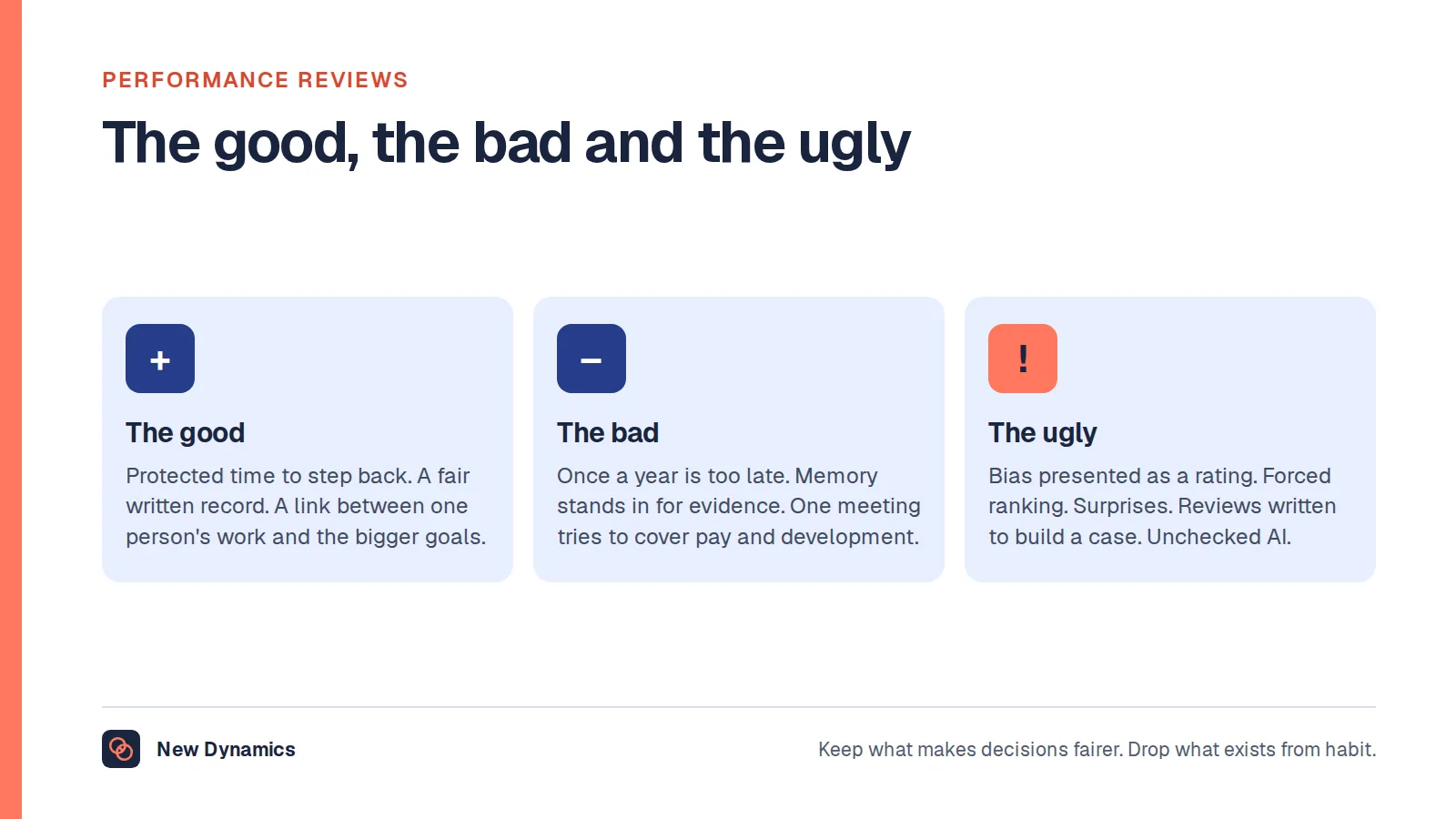
Some organisations rank employees against each other, or force ratings to fit a fixed curve. Ranking guarantees that someone comes last, however well the whole team performed. We explain the damage it does in performance reviews: the good, the bad and the ugly.
Which appraisal method should you use?
| If you need to... | Consider |
|---|---|
| Assess results against a plan | Objectives |
| Assess how the work was done | BARS or behavioural observation scales |
| Base the conversation on evidence | Critical incidents, recorded all year |
| Understand a manager's effect on their team | 360-degree feedback |
| Make the meeting two-way | Self-appraisal |
| Compare many people quickly | Rating scales, with behaviours to anchor them |
| Judge readiness for a bigger role | Assessment centre |
Most organisations combine methods. A common and sensible mix is objectives for the what, a short list of behaviours for the how, a self-appraisal beforehand and notes of real examples throughout the year.
Whatever you choose, keep it light enough that managers will do it properly. A simple method used well beats a sophisticated one that managers rush.
Five rating errors to watch for
OpenStax describes five problems that reduce the accuracy of appraisals.
- Central tendency. Everyone is rated as average. OpenStax calls this “the failure to recognize either very good or very poor performers”.
- Strictness or leniency. Some managers rate nearly everyone low, and others rate nearly everyone high, so a score depends on who your manager is.
- The halo effect. One impression colours everything, and the person gets the same rating on every factor.
- Recency. Evaluators “focus on an employee's most recent behavior”, and eleven months are forgotten.
- Personal bias. Managers let their own likes, dislikes and assumptions influence the rating.

The remedies are practical:
- Keep notes all year, so that the appraisal rests on the whole period.
- Describe behaviours on the scale, so that a 4 means the same thing to every manager.
- Use more than one voice, such as peer feedback and a self-appraisal.
- Compare ratings across managers before they are final. Our performance calibration guide explains how.
- Train managers to recognise the errors. Our article on unconscious bias examples covers the bias side in more detail.
How to run a fair performance appraisal
- Agree goals and standards at the start. Acas says that objectives “should be fair and reflect the employee's usual tasks and workload”, though they may also stretch the person.
- Talk regularly. Acas advises that managers should still talk to employees informally about their performance on a regular basis. Nothing in an appraisal should be a surprise.
- Gather evidence. Results against goals, examples of behaviour, feedback from others and the employee's own view.
- Ask for a self-appraisal a week or two before the meeting.
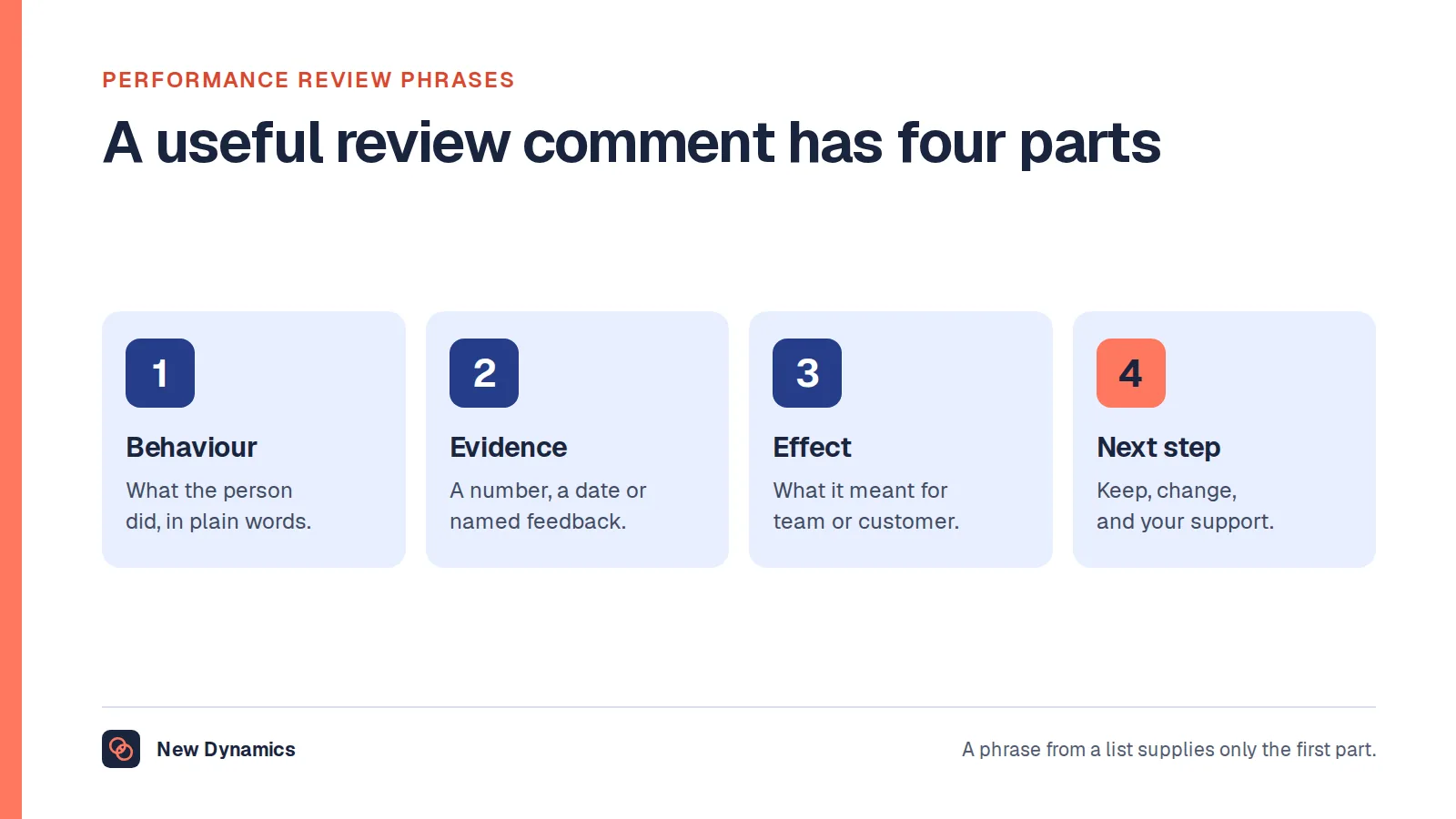
- Write the assessment from the evidence. For each judgement, ask what example supports it. Our performance review phrases can help with wording.
- Hold the conversation. Give the person time, privacy and your full attention. Start with their view. Spend at least half the time on the future.
- Agree next steps. New goals, support and a development plan.
- Record it and follow up. Share the written record, and return to the actions in your regular one-to-ones.

How often should appraisals happen?
Acas says employers should conduct regular performance reviews for employees, and that “it's a good idea to do them at least once a year”.
Many organisations now go further. The CIPD performance management factsheet describes a shift “away from annual appraisals towards ongoing, flexible review systems”. In practice, that usually means a light check-in every month or quarter and a fuller review once or twice a year. The more often people talk, the less weight the annual meeting has to carry, and the less it is feared.
Performance appraisal examples
Here is how one judgement might read under three methods. The employee and the details are illustrative.
Rating scale only: “Communication: 3 out of 5.”
Critical incident: “In the June client workshop, Sam explained the delay plainly, took the client's questions without becoming defensive and agreed a new date. The client later renewed. In two project updates this autumn, key risks were mentioned only on the last page.”
Objective: “Goal: every project update to state the top three risks on the first page by September. Achieved from October onwards.”
The first tells Sam almost nothing. The second and third tell Sam what to keep doing and what to change. That is the test of any appraisal: could the person act on it tomorrow?
For ready-made questions, see our 100 performance review questions and our performance review template.
Common mistakes
Saving everything for the appraisal. Feedback that is months old is hard to use, and it feels like an ambush.
Judging the person, not the work. “You are careless” invites an argument. “Three of the last ten reports had errors in the totals” invites a fix.
Letting the form run the meeting. The form is a record. The conversation is the point.
One voice only. A single manager's view is partial, however fair they are.
No follow-up. If the actions agreed are never mentioned again, people learn that the appraisal is a ritual.
Mixing up appraisal and formal capability action. An appraisal is not the place to begin a disciplinary or capability process. If performance is a serious concern, follow your procedure. Our performance improvement guide explains a fair approach.
Frequently asked questions
What is a performance appraisal?
A performance appraisal is a structured assessment of how well an employee has done their job over a set period, usually followed by a conversation with their manager. It reviews results and behaviour, and it agrees goals, support and development for the next period.
What is the difference between a performance appraisal and a performance review?
There is no real difference. Appraisal is the older term and is still common in the UK public sector and healthcare. Performance review is more usual today, and performance evaluation is common in the United States. All three describe the same process.
What are the main methods of performance appraisal?
Common methods are graphic rating scales, the critical incident technique, behaviourally anchored rating scales, behavioural observation scales, objectives, 360-degree feedback, self-appraisal and assessment centres. Most organisations combine two or three of them.
What is the purpose of a performance appraisal?
Appraisals give people feedback on their work, support their development, inform pay and promotion decisions and reveal training needs. They also create a fair record of what was discussed. Because these purposes can conflict, many organisations discuss pay separately.
How often should performance appraisals be done?
Acas suggests holding performance reviews at least once a year, with regular informal conversations in between. Many organisations now hold lighter check-ins every month or quarter, so that the annual appraisal contains no surprises.
What are common errors in performance appraisal?
Five classic errors are central tendency, where everyone is rated average; strictness or leniency; the halo effect; recency, where only recent events count; and personal bias. Notes kept all year, behaviour-based scales, several sources of feedback and calibration reduce them.
Your next step: improve your next appraisal
- Start a note for each person you manage, and record one real example this week.
- Check your form: does each point on the rating scale describe a behaviour?
- Ask each person for a short self-appraisal before the next review.
- Plan to spend half of the meeting on the next period.
For agendas, questions and a fair process from preparation to follow-up, read and download our performance review guide. The guide is free to read, and the PDF uses our short download form.
Want goals, feedback and evidence in one place when appraisal time comes? Book a New Dynamics demo and bring your current form. You can also email contact@new-dynamics.com.