TL;DR
- A self evaluation is your own written account of your work over the review period: what you achieved, how you worked, where you fell short and what you want next. It is also called a self appraisal, self assessment or self review.
- Strong self evaluations use a simple pattern: what you did, the evidence, and the result for the team or the customer. Replace adjectives with facts, and write about weaknesses as plans.
- Keep notes through the year, so that you are not relying on memory. Start from your goals, give credit to others, and end with what you need from your manager.
Few tasks at work are as awkward as writing about yourself. Say too little, and a year of good work goes unrecorded. Say too much, and you worry about sounding boastful. Most people put it off, then write a few vague lines the night before the deadline.
This article shows you how to write a self evaluation for a performance review, step by step. It gives you 60 example phrases grouped by skill, honest ways to write about weaknesses, a complete sample and the mistakes to avoid.
A self evaluation is easier when your goals, feedback and notes from the year are already in one place. See how New Dynamics performance reviews bring that evidence into the conversation.
What is a self evaluation?
A self evaluation is your own written account of your work over a review period. It usually covers:
- what you achieved against your goals;
- how you worked, including behaviours and skills;
- what did not go well, and what you learned;
- what you want to do and develop next;
- what support you need.
You will also see it called a self appraisal, a self assessment or a self review. Organisations use the terms interchangeably. The form may be a few open questions, a set of ratings with comments or a free-text summary.
Why your self evaluation matters
Your manager does not see everything. Much of your best work happens out of their sight: the problem you prevented, the colleague you helped, the customer you calmed down. If you do not record it, it may never reach the review.
It corrects for memory. Recent weeks are easier to remember than last spring, for managers as for everyone. Your account of the whole period is a counterweight.
It makes the conversation two-way. Acas describes performance reviews and appraisals as “a chance to discuss someone's work”, including what they are doing well, any areas for improvement, whether they need more support or training, and their career and development objectives. A good self evaluation lets you arrive with a view on each of those.
It becomes part of the record. Acas also says it is important to keep a written record of what is discussed and to share it with the employee afterwards. Your own words belong in that record.
How to write a self evaluation in six steps
1. Gather your evidence
Do not write from memory. MIT Human Resources, in its guidance on preparing for the performance review, suggests that managers and employees begin by reviewing last year's review, mid-year check-ins, the job description and “notes accumulated during the year”.
Collect your goals, project records, figures, thank-you messages and feedback. If you have not kept notes, scan your calendar and sent emails month by month. Then start a running file for next year. Ten minutes every Friday is enough.
2. Start from your goals
Take each goal in turn. Say whether you met it, partly met it or missed it, and show the evidence. If a goal changed or was dropped, say so and explain why.
3. Write action, evidence, result
For each achievement, write three things:
- Action: what you did.
- Evidence: a number, a date, a document or a named piece of feedback.
- Result: what changed for the team, the customer or the organisation.
“I improved the onboarding process” becomes “I rewrote the onboarding checklist in March. New starters now complete setup in three days instead of eight, and support tickets from new starters fell by about a third.”
4. Own the gaps
Every honest review includes things that did not go well. Name them plainly, say what you learned and say what you are doing about it. A weakness written as a plan reads as maturity. A weakness left out looks like a blind spot.
5. Look ahead
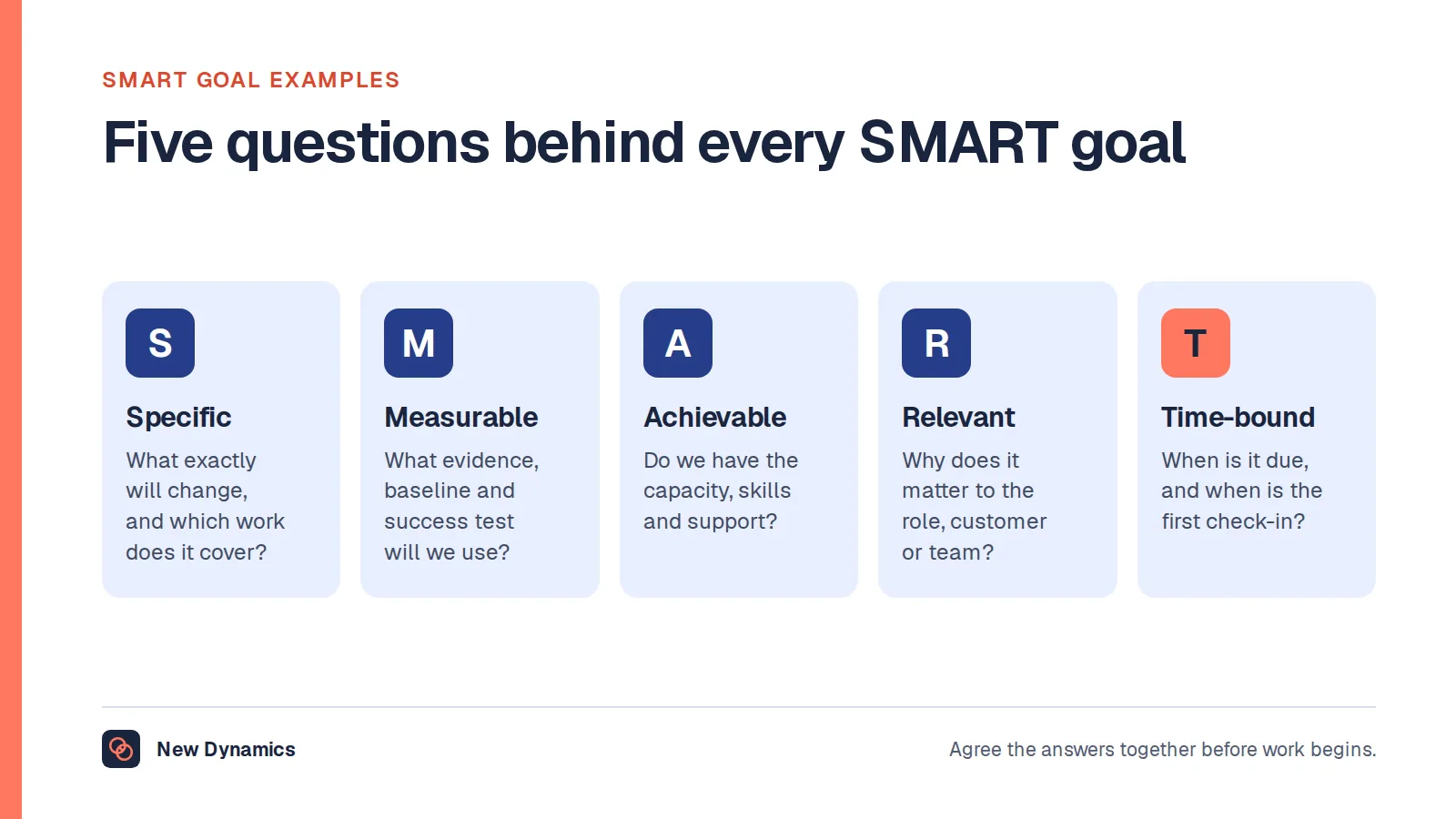
Finish with what you want next: goals for the coming period, skills to develop and the support you need. Our 50 SMART goal examples can help you to word them.
6. Edit for facts
Read it through and remove adjectives that are not backed by evidence. Check that you have given credit to colleagues. Cut anything that compares you with a named person. Then check the length: a page or two is usually plenty.

60 self evaluation examples by skill
The figures in these examples are illustrative. Replace every detail with your own facts. Never claim a result you cannot support.
Achievements and results
- I delivered the customer portal on the agreed date in June. It now handles about 40% of routine requests that used to come by phone.
- I met four of my five goals for the year. The fifth, supplier consolidation, was paused in April when priorities changed.
- I exceeded my sales target by 8%, with most of the growth coming from existing customers.
- I cleared the backlog of 120 open cases by the end of the first quarter and have kept it under 20 since.
- I reduced month-end close from nine working days to six by automating three reconciliations.
- I took over the audit preparation at short notice and we passed with no major findings.
Goals and priorities
- I agreed clear priorities with my manager each quarter and said no, with reasons, to two requests that did not fit them.
- I broke my annual goals into quarterly milestones and reviewed them in my one-to-ones.
- When the reorganisation changed our priorities, I rewrote my goals within two weeks and shared them with the team.
- I set one stretch goal, to present at the industry event, and achieved it in October.
- I was slow to raise that one of my goals had become unrealistic. I now flag risks to goals in the month they appear.
Teamwork and collaboration
- I worked with the finance team to fix the invoicing errors. Together we cut disputed invoices by half.
- I covered a colleague's accounts for six weeks during their leave, and handed them back with notes on every open item.
- I shared my reporting template with two other teams, who now use it.
- I ask quieter colleagues for their view in meetings, and two of them have told me it helped.
- I could involve other teams earlier. On the pricing project I brought in legal late, which cost us a fortnight.
- I make a point of giving credit by name when I present joint work.
Communication
- I now send a short written summary after every client meeting. Clients have commented on it in two reviews.
- I rewrote our most-used help articles in plainer language. Repeat contacts on those topics fell.
- I presented the quarterly results to the leadership team for the first time, and was asked to do it again.
- I sometimes reply too quickly to difficult emails. I now draft, wait an hour and reread before sending.
- I gave my manager early warning of the two delays this year, with options, before they became problems.
- I am working on being more concise in meetings. I prepare one main point in advance.
Problem solving and initiative
- I traced the recurring stock errors to a unit-of-measure mismatch and fixed it at source.
- I noticed that new customers were dropping out at the second setup step, proposed a simpler flow and tested it with ten customers.
- I built a simple tracker that replaced three spreadsheets and saves the team about two hours a week.
- When our supplier failed in August, I found and qualified an alternative within ten days.
- I tend to solve problems on my own. I want to involve the team sooner, so that more people learn from the fix.
Leadership and management
- I held one-to-ones with all six of my team members at least fortnightly through the year.
- Two members of my team were promoted this year, and I supported both with stretch work and regular feedback.
- I delegated the weekly report fully, including the decisions about its content. It is better than when I wrote it.
- I dealt with a conduct issue promptly and followed the procedure with support from HR.
- Our team's engagement score for “I know what is expected of me” rose from 68% to 84%.
- I still step in too quickly when work is off track. I am practising asking questions before offering answers.
For the behaviours behind these, see our guide to core competencies.
Reliability and time management
- I met every reporting deadline this year.
- I plan my week on Friday afternoon and protect two blocks of focused time. My error rate on reconciliations has fallen.
- I took on too much in the second quarter and missed one internal deadline. I now check my capacity before agreeing to new work.
- I documented my main processes, so that the team can cover for me without calling.
- I arrive prepared for meetings and send papers at least a day ahead.
Customer focus
- My customer satisfaction score averaged 4.7 out of 5 across 310 surveyed contacts.
- I retained three accounts that had given notice, by agreeing recovery plans and checking in weekly.
- I turned a formal complaint into a renewed contract by owning our mistake and fixing the cause.
- I visit two customers each quarter to see how they use the product, and I share what I learn with the product team.
- I want to improve my knowledge of the newer product lines, so that I can answer without escalating.
Learning and development
- I completed the project management qualification in May and used it to run the office move.
- I asked five colleagues for feedback in the spring and acted on the main theme, which was to delegate more.
- I shadowed the data team for a week and can now build my own reports.
- I mentored a new starter through their first three months.
- I did not make time for the presentation skills course that I planned. I have booked it for February.
- I read and summarised the new regulations for the team within a week of publication.
Areas for improvement, written as plans
- I avoid difficult conversations for too long. I have asked my manager to help me prepare for the next one, and I will practise with our negative feedback examples.
- My forecasts were too optimistic in two quarters. I now build a cautious case and have it reviewed by a colleague.
- I find it hard to switch off, and it affected my energy in the autumn. I have stopped checking email after 7pm.
- I need to build my financial knowledge for the next level. I will take the finance for non-finance-managers course by June.
- I relied on one stakeholder too much. I am building relationships with two others.
Goals for the next period
- Cut average response time from six working hours to three by the end of the second quarter.
- Lead one cross-team project from start to finish.
- Train two colleagues to cover the month-end process by March.
- Gain the professional certification by September.
- Hold a development conversation with each team member every quarter.
For more ideas, see our career goals examples.

How to answer common self appraisal questions
Most forms ask some version of these questions. Here are short sample answers that follow the action, evidence and result pattern.
| Question | Sample answer |
|---|---|
| What were your main achievements? | I delivered the portal on time in June, cleared the case backlog by March and trained two new colleagues. |
| Which goals did you not meet, and why? | Supplier consolidation was paused in April when priorities changed. I completed the analysis, which is ready to use when the work restarts. |
| What are your strengths? | Finding the cause of problems and explaining technical issues plainly. Both came up in the feedback I asked for in the spring. |
| Where could you improve? | Involving other teams earlier. Bringing legal in late cost the pricing project a fortnight. I now list the people affected at the start. |
| What support do you need? | Time for the finance course, and a chance to lead a cross-team project. |
| What are your goals for next year? | Cut response time from six hours to three by June, lead one cross-team project and train two colleagues to cover month-end. |
| How would you rate your overall performance? | Meets expectations, with two areas above. I met four of five goals, and the fifth was paused. I explain the evidence for each goal above. |
A complete self evaluation sample
Here is a short example for a customer support team leader. It is illustrative.
Summary. This was a strong year for the team and a year of learning for me as a new manager. I met four of my five goals.
Achievements. We cut median first response time from six working hours to under three by March, and held it there. Customer satisfaction rose from 4.3 to 4.6 out of 5. I recruited and trained three new agents, all of whom passed probation. I led our part of the portal launch, which now handles about 40% of routine requests.
What did not go well. I missed my goal to refresh the knowledge base. I underestimated the work and did not ask for help early enough. About half of the articles are done. I have agreed a plan to finish by February, with two agents each giving two hours a week.
How I worked. Feedback from my team in the spring said that I am approachable and clear, and that I step in too quickly when things go wrong. I have been practising asking questions first, and two people have told me they notice the difference.
Next year. I would like to finish the knowledge base, raise first-contact resolution from 71% to 80%, and lead one project outside support. I would value a mentor from another department and time for the management programme.
Notice what it does. It starts with a plain summary, gives numbers, owns a missed goal with a plan, quotes feedback and ends with requests.
Rating yourself fairly
If your form asks for ratings, keep three points in mind.
- Read the scale definitions. “Meets expectations” is a good rating in most schemes. It means you did a demanding job well.
- Rate the evidence. For each rating, ask which facts support it. If you cannot name any, reconsider.
- Do not rate tactically. Some people rate themselves low to seem modest, or high to anchor the negotiation. Managers usually see through both. An accurate rating, with evidence, builds trust.
None of us is a perfect judge of our own work, in either direction. Asking a few colleagues for feedback before you write is the simplest correction.
Common mistakes in a self evaluation
Adjectives without evidence. “I am a dedicated team player” tells the reader nothing. Show what you did.
Only the last two months. Go back to the start of the period. This is why notes matter.
A list of tasks. “I attended the weekly meetings” describes activity. Write about results.
Blaming others. Explain obstacles factually, and say what you did about them.
Hiding the misses. Your manager already knows. Leaving them out costs you credibility.
False modesty. If you led the work, say “I led”. Give others credit for their part, and claim yours.
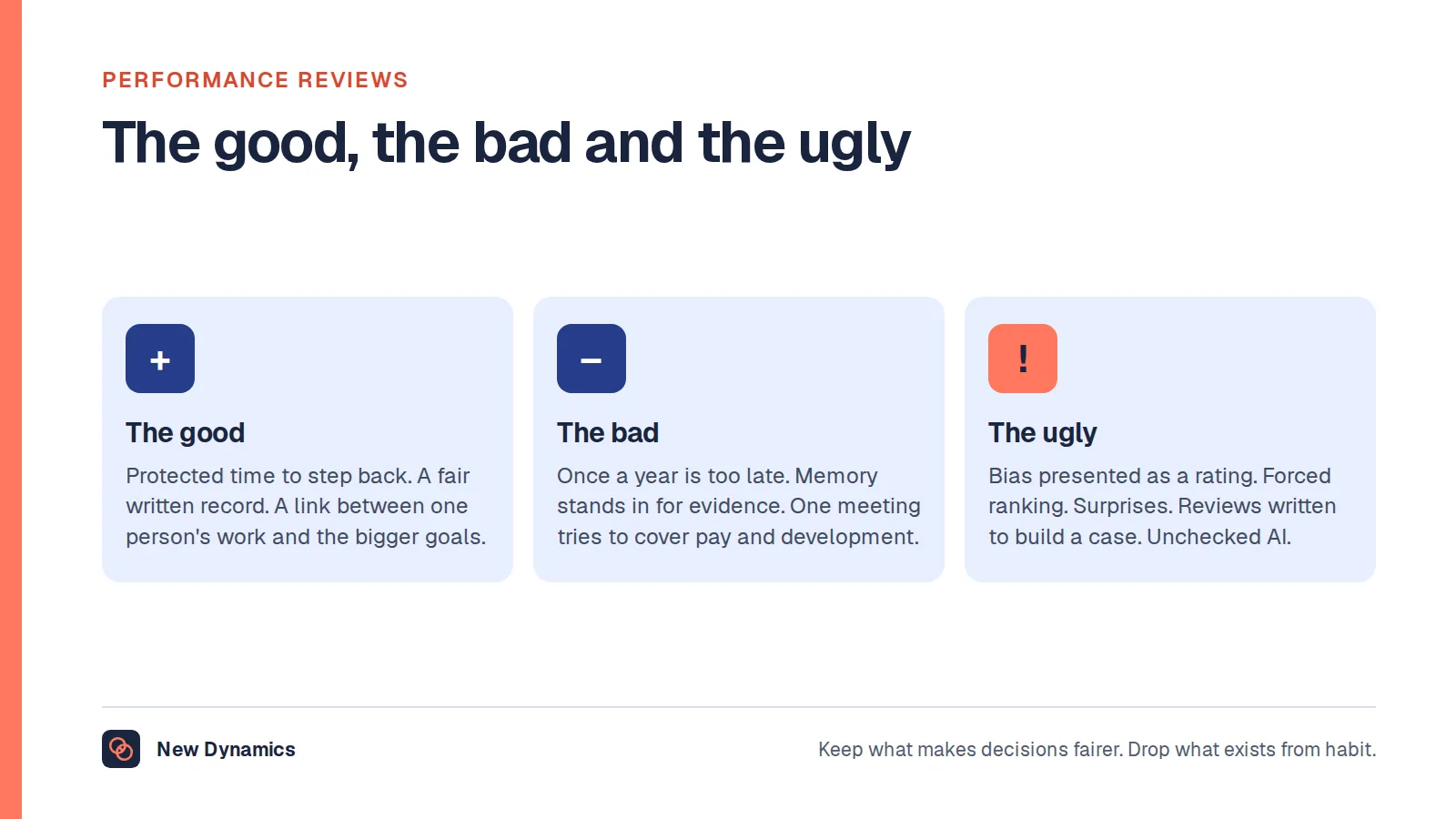
Surprises. The review is the wrong place to raise a serious grievance for the first time. Raise problems when they happen. We explain why in performance reviews: the good, the bad and the ugly.
What managers should do with a self evaluation
- Read it before you write your own assessment, and note where your views differ. Those differences are the agenda.
- Thank the person for the detail. It took effort, and it makes your job easier.
- Do not copy and paste it into your review and stop there. Add your own evidence and judgement. Our performance review phrases can help with the wording.
- Discuss differences openly. If the person rates themselves higher than you do, go through the evidence together.
- Act on the requests. If someone asks for support and hears nothing, they will write less next year.
Alongside formal reviews, Acas says managers “should still talk to employees informally about their performance on a regular basis”, through regular feedback, coaching and check-ins. Where that happens, a self evaluation holds few surprises for either side.

Frequently asked questions
What is a self evaluation?
A self evaluation is your own written account of your work over a review period. It covers what you achieved, how you worked, what did not go well, what you want to do next and what support you need. It is also called a self appraisal, self assessment or self review.
How do you write a good self evaluation?
Gather evidence from the whole period, then start from your goals. For each achievement, write what you did, the evidence and the result. Name what did not go well and what you are doing about it. Finish with goals and the support you need, then edit out unsupported adjectives.
What should I write in a self appraisal about my weaknesses?
Name one or two real areas, give a brief example and say what you are doing about each. For example: “I involved legal late on the pricing project, which cost a fortnight. I now list everyone affected at the start of a project.”
What are some examples of self evaluation comments?
“I delivered the portal on the agreed date, and it now handles about 40% of routine requests.” “I met four of my five goals. The fifth was paused when priorities changed.” “I step in too quickly when work is off track, and I am practising asking questions first.”
How long should a self evaluation be?
One to two pages is usually enough, or a few sentences for each question on a form. Put your most important achievements first. A manager with several reviews to read will thank you for being concise and specific.
Should I rate myself high or low in a self assessment?
Rate yourself accurately, and support each rating with evidence. Rating low to seem modest or high as a negotiating position rarely works. If you are unsure, ask a few colleagues for feedback before you decide.
Your next step: start a notes file today
- Create one document called “My year”.
- Add three things you have achieved in the past month, each with a piece of evidence.
- Add one thing that did not go well, and what you learned.
- Put ten minutes in your calendar every Friday to keep it up to date.
For questions and an agenda that make the review conversation fair, read and download our performance review guide. The guide is free to read, and the PDF uses our short download form. You can also use our open performance review template.
Want goals, feedback and notes from the whole year ready when review time comes? Book a New Dynamics demo and bring your current review form. You can also email contact@new-dynamics.com.