TL;DR
- A performance goal describes a result that someone will deliver in a set period. It is different from a task, which is an activity, and from a development goal, which is about growing a skill.
- These 60 examples are grouped by performance area: quality, productivity, customers, teamwork, communication, leadership, finance and improvement. Each has a measure and a date. Replace the figures with your own baseline.
- Agree three to five goals per person, make them fair for the workload, review them at least quarterly and change them openly when priorities change.
Goal-setting season arrives, and the form asks for “three to five objectives for the year ahead”. Most people open last year's form, change the dates and hope that nobody notices. The goals that result are vague, unmeasurable or simply a list of the job's duties.
This article gives you 60 performance goals examples for work, grouped by performance area, for employees and for managers. It also explains the types of goal, how many to set, how to agree them fairly and how to review them through the year.
Goals work when they stay visible after the form is filed. See how New Dynamics Goals & OKRs keeps goals, progress and check-ins in one shared place.
What is a performance goal?
A performance goal describes a result that someone will deliver in a set period. It answers the question “What will be different because of your work?”
It helps to separate three types of work goal.
| Type | What it describes | Example |
|---|---|---|
| Performance goal | A result to deliver | Cut month-end close from nine working days to six by June |
| Development goal | A skill or experience to build | Learn to build financial models well enough to own the forecast |
| Behavioural goal | How the work is done | Give every team member specific feedback at least fortnightly |
A good set for the year includes all three: mostly performance goals, with one or two of the others. For development goals, see our personal development goals examples.
A goal is also different from a task or a duty. “Produce the monthly report” is a duty. “Cut the time to produce the monthly report from three days to one, with no increase in errors” is a goal.
What makes a good performance goal?
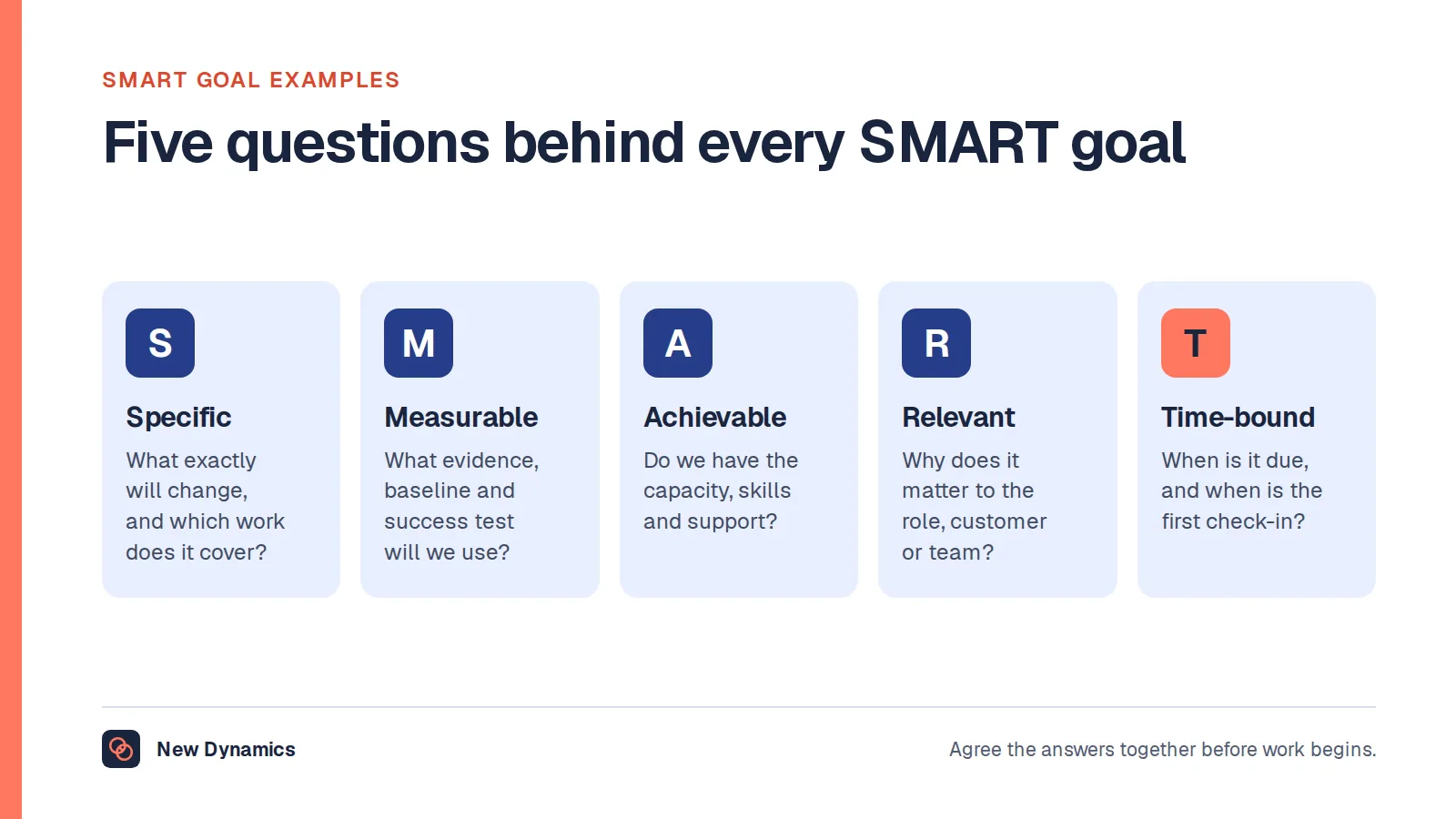
Acas, in its guidance on setting objectives, says: “Objectives should be fair and reflect the employee's usual tasks and workload. But they might also stretch them to develop in certain areas.” It recommends that objectives are specific, measurable, achievable, relevant and time-bound.
In practice, check each goal against five questions.
- Is it a result, and not an activity?
- Is there a baseline and a target? “From what, to what?”
- Is there a date?
- Is it within the person's influence, given their workload and resources?
- Is there a safeguard? Pair speed or volume with a quality measure, so that the goal cannot be met by cutting corners.
A simple formula works for most goals:
By [date], [change] from [baseline] to [target], while keeping [safeguard].
Our SMART goal template gives you a sheet to fill in.

60 performance goals examples by area
The figures are illustrative. Measure your own baseline before setting a target. For longer worked examples by job function, see our 50 SMART goal examples.
Quality and accuracy
- Cut reports returned for correction from 15% to 5% by 30 September.
- Reduce reopened support tickets from 9% to 5% by the end of the second quarter.
- Achieve zero critical findings in the November audit.
- Reduce data entry errors from 3% to under 1% by June, measured by monthly sampling.
- Cut defects found after release from twelve per quarter to four by year end.
- Pass all monthly quality checks at 95% or higher for six consecutive months.
- Document the team's five most frequent processes by 31 March, so that a colleague can complete each one unaided.
Productivity and delivery
- Deliver at least 90% of agreed tasks by the agreed date each quarter, up from 75%.
- Cut month-end close from nine working days to six by June, with no increase in audit adjustments.
- Reduce average time to fill priority roles from 60 days to 45 by December, while keeping six-month retention at 85% or higher.
- Clear the backlog of 120 open cases by 31 March, and keep it under 20 thereafter.
- Automate three manual reconciliations by the end of the half-year, saving at least ten hours a month.
- Deliver the customer portal by 30 June, within budget, with sign-off from all four stakeholder groups.
- Reduce work in progress on the team board from 25 items to 12 by May.
- Cut average order processing time from 48 hours to 24 by September, with error rates unchanged.
Customer and service
- Raise customer satisfaction after contact from 4.2 to 4.5 out of 5 by 30 September.
- Cut median first response time from six working hours to three by June, with reopened tickets at or below 5%.
- Raise first-contact resolution from 71% to 80% by year end.
- Retain 95% of key accounts through the renewal cycle.
- Reduce formal complaints from eight a quarter to three by December.
- Visit two customers each quarter, and share a one-page summary of what you learned with the product team.
- Raise the share of new customers who complete setup without help from 40% to 70% by the third quarter.
- Raise the internal customer rating of the finance helpdesk from 3.8 to 4.3 in the annual survey.
Sales and growth
- Achieve £1.2 million in new business by 31 December, with at least 30% from the healthcare sector.
- Raise the win rate on qualified opportunities from 22% to 28% by year end.
- Hold first meetings with 30 target organisations by June.
- Grow revenue from existing accounts by 10% this year.
- Publish two customer case studies, with customer approval, by September.
- Raise forecast accuracy to within 10% of actual sales each quarter.
Teamwork and collaboration
- Agree a standard handover note with the night shift by March, and cut handover errors from ten a month to three by June.
- Run a joint planning session with the operations team each quarter, and deliver two shared improvements this year.
- Mentor one new starter through their first three months, with a positive probation outcome.
- Share a reusable template or guide with other teams each quarter.
- Cut the average time a request from another team waits for a response from five days to two by June.
- Collect feedback from five colleagues by April, and act on the main theme by September.
Communication
- Send a written summary within one working day of every client meeting, from February.
- Rewrite the ten most-used help articles in plain language by May, and cut repeat contacts on those topics by 20%.
- Present the quarterly results to the leadership team from the third quarter onwards.
- Publish a fortnightly project update that stakeholders rate as useful, at 4 out of 5 or higher, in a mid-year poll.
- Raise the team's score for “I receive the information I need” from 62% to 80% in the next pulse survey.
Leadership and people management
These goals suit managers. Our guide to what makes a good manager explains the behaviours behind them.
- Hold one-to-ones with every team member at least fortnightly, with fewer than 10% cancelled.
- Agree three to five written goals with every team member by 28 February, and review them quarterly.
- Raise the team's score for “I know what is expected of me” from 68% to 85% by the autumn survey.
- Have a development conversation with every team member each quarter, with an agreed action recorded.
- Prepare two team members to cover the month-end process by March.
- Reduce voluntary turnover in the team from 18% to 12% this year.
- Fill both vacancies by April, using structured interviews, with both hires passing probation.
- Delegate one recurring decision each quarter, including the authority to make it.
- Address any performance concern within two weeks of noticing it, following the agreed procedure.
- Complete every performance review on time, with evidence from the whole year.
Finance and resources
- Deliver the department's plan within 2% of budget.
- Cut supplier costs by 8% by December, without reducing service levels.
- Reduce overtime from 300 hours a quarter to 150 by September, through better scheduling.
- Cut days sales outstanding from 52 to 45 by year end.
- Deliver dashboards to all budget holders by working day six each month, from April.
Improvement and innovation
- Propose and test one process improvement each quarter, and adopt at least two by year end.
- Cut the steps in the expense approval process from seven to four by June.
- Run one customer-tested experiment each month on the sign-up flow, and raise completion from 58% to 70% by December.
- Pilot one AI-assisted workflow within company policy by September, and report the time saved and the risks.
- Reduce recurring incidents of the top three fault types by half by year end.

How many performance goals should one person have?
Three to five is a sensible number for a year. Fewer than three can leave important work uncovered. More than five spreads attention thinly, and the review becomes a box-ticking exercise.
Google's guide to setting goals with OKRs makes a similar recommendation for objectives, “three to five”, and warns that more can lead to over-extended teams.
If some goals matter more than others, say so. A simple weighting, such as 40%, 30%, 20% and 10%, prevents arguments at review time.
How to agree goals fairly
- Start from the team's priorities. Each goal should connect visibly to something that the team or the organisation is trying to achieve. See how to cascade goals at work.
- Ask the employee to draft first. People commit to goals that they helped to write.
- Check the workload. Acas says that objectives should reflect the employee's usual tasks and workload. If a new goal is added, discuss what will be dropped.
- Agree the measure and the data source. Decide now how you will both know.
- Agree the support: time, training, budget or access.
- Write it down, and put review dates in the calendar.
Be careful with goals that depend heavily on others, or on events outside the person's control. Make the dependency explicit, or choose a measure that is closer to the person's own work.
How to review goals through the year
- Monthly, in one-to-ones: a quick check on progress and obstacles. See our one-to-one meeting guide.
- Quarterly: a fuller review. Is each goal still the right one? Acas suggests discussing progress in regular check-ins, and arranging a meeting to review an objective after a set period.
- When things change: update the goal openly, and record why. A goal that everyone knows is obsolete damages the credibility of the whole process.
- At year end: assess the result, the context and what was learned. A missed stretch goal with good reasons is different from a missed routine target.
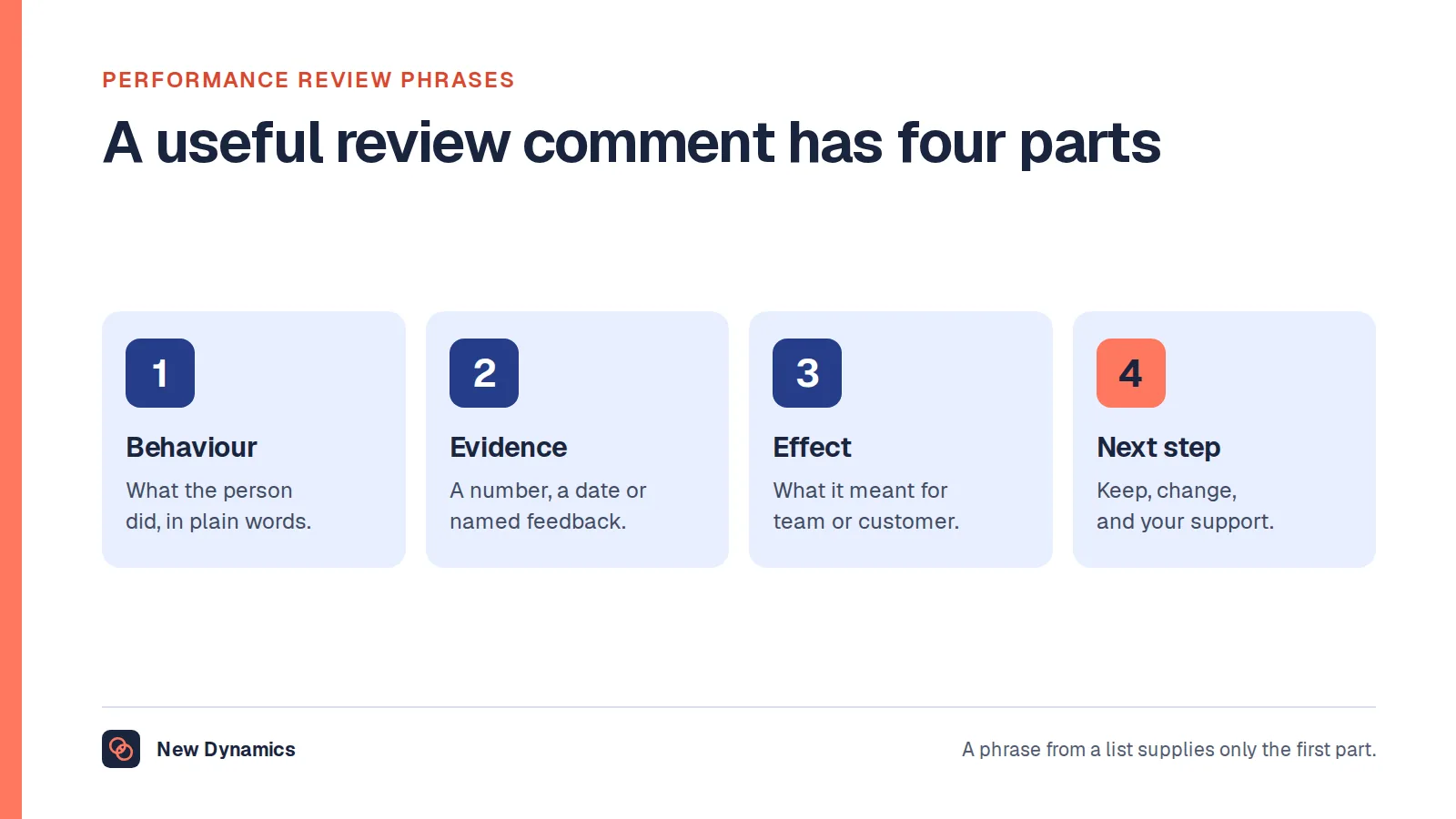
Our performance review phrases help with writing the assessment, and our self evaluation examples help employees to describe their own results.
Common mistakes with performance goals
Duties presented as goals. “Manage the accounts” describes the job. Ask what will be better by the end of the year.
No baseline. “Improve customer satisfaction” cannot be assessed.
Too many goals. Eight goals mean that none is a priority.
Goals set in January and ignored until December. Review them at least quarterly.
Only numbers. Some important work is hard to count. Use a clear qualitative standard, such as “signed off by all four stakeholder groups”.
No safeguard. Speed without quality, or sales without retention, invites corner-cutting.
Goals imposed without discussion. People own what they help to shape.
Tying every goal rigidly to pay. It encourages safe targets and arguments about decimal points. Use goals as evidence in a rounded conversation.

Frequently asked questions
What are examples of performance goals?
Examples include: cut reports returned for correction from 15% to 5% by September; raise customer satisfaction from 4.2 to 4.5 by the third quarter; deliver 90% of agreed tasks on time each quarter; and hold one-to-ones with every team member at least fortnightly.
What are good work goals for a performance review?
Good goals describe a result, with a baseline, a target and a date, and sit within the person's influence. Choose three to five that reflect the team's priorities, mix performance goals with one or two development goals, and add a quality safeguard to any speed or volume measure.
How do you write a performance goal?
Use the formula: by a date, change something from a baseline to a target, while keeping a safeguard. For example: “By 30 June, cut first response time from six working hours to three, with reopened tickets at or below 5%.”
What is the difference between a performance goal and a development goal?
A performance goal is about a result you will deliver, such as cutting month-end close to six days. A development goal is about a skill you will build, such as learning financial modelling. Most people need both.
How many goals should an employee have?
Three to five for a year suits most roles. That is enough to cover the main priorities without spreading attention too thinly. If goals differ in importance, agree a simple weighting at the start.
What are examples of performance goals for managers?
Examples include: agree written goals with every team member by the end of February; hold fortnightly one-to-ones with fewer than 10% cancelled; raise the team's score for “I know what is expected of me” from 68% to 85%; and reduce voluntary turnover from 18% to 12%.
Your next step: rewrite one goal
- Take one goal from your current review form.
- Check it against the five questions: result, baseline and target, date, influence and safeguard.
- Rewrite it using the formula.
- Agree it with your manager, and put the first review date in the calendar.
For the full method, with a worksheet and review prompts, read and download our SMART goals guide. The guide is free to read, and the PDF uses our short download form.
Want every goal visible, owned and reviewed in regular check-ins? Book a New Dynamics demo and bring the goals you are working on. You can also email contact@new-dynamics.com.