TL;DR
- A core competency is a combination of skills, knowledge and behaviour that matters most for success. For people, it describes how good work gets done. For a company, it is what the organisation does distinctively well.
- Useful competencies are written as observable behaviours. “Communicates well” is a label. “Explains a decision so that people know what to do next” is a behaviour.
- Keep the list short: five to eight core competencies, each with a plain definition and examples at two or three levels. Then use them in hiring, feedback and development.
Ask a manager what they want from a new hire and you will often hear a list of adjectives: proactive, resilient, a team player. Ask what those words mean in practice, and the answers vary widely. Core competencies are an attempt to close that gap, by writing down what good work looks like in terms people can observe.
This article explains what a core competency is, gives 30 examples with behaviours, shows a sample with levels and sets out six steps for defining your own.
Competencies earn their keep in feedback and review conversations. See how New Dynamics performance reviews bring goals, feedback and evidence into one conversation.
What is a core competency?
The term has two meanings, and it helps to separate them.
For people, a core competency is a combination of skills, knowledge and behaviour that matters most for success in a role or an organisation. It describes how good work gets done, where a goal describes what gets done. Problem solving, collaboration and customer focus are typical examples.
For organisations, a core competency is something the company as a whole does distinctively well, which competitors find hard to copy. The idea was popularised by C.K. Prahalad and Gary Hamel in their Harvard Business Review article The Core Competence of the Corporation, published in 1990, which urged executives to identify, cultivate and exploit the core competencies that make growth possible.
Most HR conversations use the first meaning, and so does most of this article. We return to the organisational meaning near the end.
Competency, skill, behaviour and value: the differences
| Term | What it means | Example |
|---|---|---|
| Skill | A learned ability to do a task | Building a financial model |
| Knowledge | What someone knows | Understanding of tax rules |
| Behaviour | What someone does that others can observe | Asks questions before offering a solution |
| Competency | A cluster of skills, knowledge and behaviours that leads to good performance | Problem solving |
| Value | A principle the organisation expects everyone to uphold | We tell the truth, including when it is awkward |
The UK Civil Service makes the behavioural part explicit. Its Success Profiles framework defines behaviours as “the actions and activities that people do which result in effective performance in a job”, and assesses them alongside strengths, ability, experience and technical skills.

30 core competencies examples
Each example comes with one observable behaviour. The behaviour is the useful part. Adapt the wording to your own organisation.
Working with others
- Collaboration: shares information early and helps colleagues without being asked.
- Customer focus: checks what the customer needs before proposing a solution.
- Building relationships: keeps in touch with stakeholders between projects as well as during them.
- Inclusion: makes sure quieter colleagues are heard in meetings.
- Managing conflict: raises disagreements directly with the person concerned, and promptly.
Communication
- Clear writing: writes messages that a busy reader can act on after one reading.
- Listening: summarises what the other person said before responding.
- Presenting: explains a complex topic so that non-specialists understand the decision required.
- Giving feedback: describes what happened and its effect, without labelling the person. See our negative feedback examples.
- Influencing: wins support by understanding what others need, without relying on rank.
Delivery
- Planning and organising: breaks work into steps, and flags risks to deadlines early.
- Accountability: owns mistakes and fixes them without being chased.
- Attention to detail: checks work against the source before it leaves their hands.
- Results focus: can say what outcome the work is for, and how it will be measured.
- Adaptability: changes approach when the facts change, and explains why.
Thinking
- Problem solving: finds the cause of a problem before choosing a fix.
- Decision-making: decides in good time with the information available, and records the reasoning.
- Analytical thinking: uses data to test an assumption before acting on it.
- Commercial awareness: understands how the organisation makes and spends money.
- Innovation: proposes and tests small improvements to how work is done.
Leadership
- Setting direction: makes priorities clear enough that the team can decide without asking.
- Coaching: asks questions that help people find their own answers.
- Delegation: hands over the decision as well as the task.
- Developing others: gives stretching work and specific feedback.
- Leading change: explains the reason for a change, and listens to concerns.
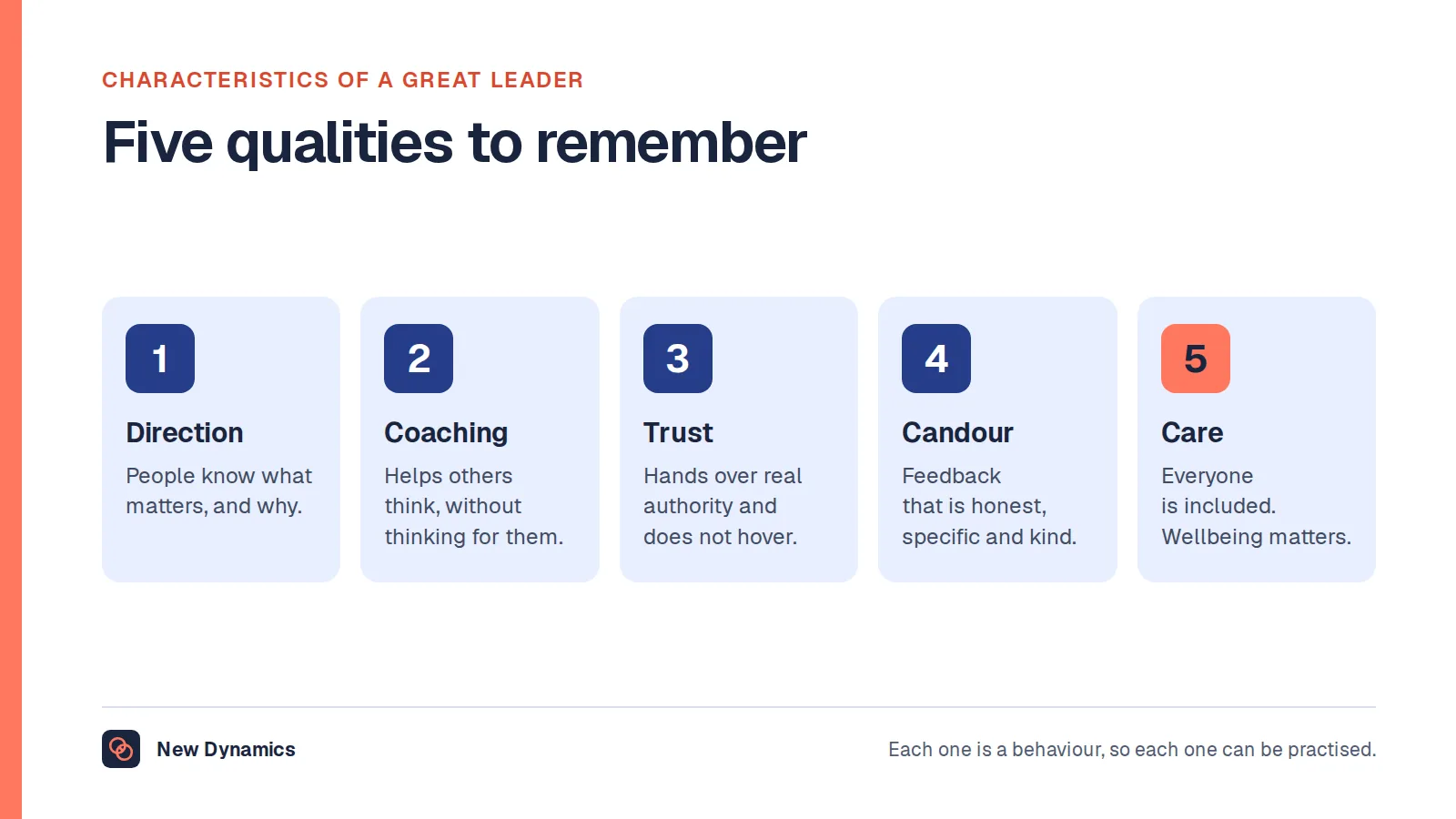
For more on these, see the characteristics of a great leader.
Personal effectiveness
- Learning agility: seeks feedback and applies it quickly.
- Resilience: recovers from setbacks and asks for support when needed.
- Integrity: does what they said they would, and says so early when they cannot.
- Initiative: acts on a problem they notice, within their authority.
- Self-awareness: can describe their own strengths and blind spots accurately.
A sample competency with levels
A competency becomes useful when it shows how expectations rise with seniority. Here is a sample for problem solving.
| Level | What it looks like |
|---|---|
| Team member | Spots problems in their own work, finds the likely cause and proposes a fix to their manager |
| Senior professional | Solves problems that cross team boundaries, tests the cause with data and shares the fix so that others benefit |
| Manager | Helps the team to solve problems themselves, removes causes that lie outside the team and decides priorities |
| Senior leader | Sees patterns across many problems, changes systems and structures, and invests in prevention |
Notice that each level describes behaviour someone could observe. Words such as “excellent” and “strategic” are avoided, because people interpret them differently.

How to define core competencies in six steps
- Start from the strategy and the work. Ask what the organisation needs people to be good at in the next few years. Then ask what your best people do differently.
- Keep the list short. Five to eight core competencies for everyone is plenty. Add a few for specific job families or for leaders if you need them.
- Write behaviours, not adjectives. For each competency, write a plain definition and three or four observable examples.
- Show how it grows. Describe two to four levels, so that people can see what the next step requires. Our list of job titles by level shows typical ladders.
- Test the wording with a mix of employees. If two people read a line differently, rewrite it.
- Review it every year or two. The work changes, and the list should follow.
The CIPD notes in its factsheet on competence and competency frameworks that frameworks, when done well, “can increase clarity around performance expectations and establish a clear link between individual and organisational performance”. It also advises organisations to “balance detail with flexibility and avoid an overly prescriptive and non-inclusive approach”.
That second point matters. A framework that describes one narrow style of success will screen out capable people who work differently.
How to use core competencies
- Hiring. Turn each competency into interview questions about past behaviour, and score every candidate against the same descriptions.
- Goals and reviews. Goals cover what someone will achieve. Competencies cover how. A fair review looks at both. See performance reviews: the good, the bad and the ugly.
- Feedback. Competencies give people shared words for feedback. Our competency-based feedback guide shows how to collect examples in place of adjectives.
- Development. People can assess themselves against the next level and choose where to grow. The same behaviours are what candidates describe as soft skills on a CV. Our career goals examples can help.
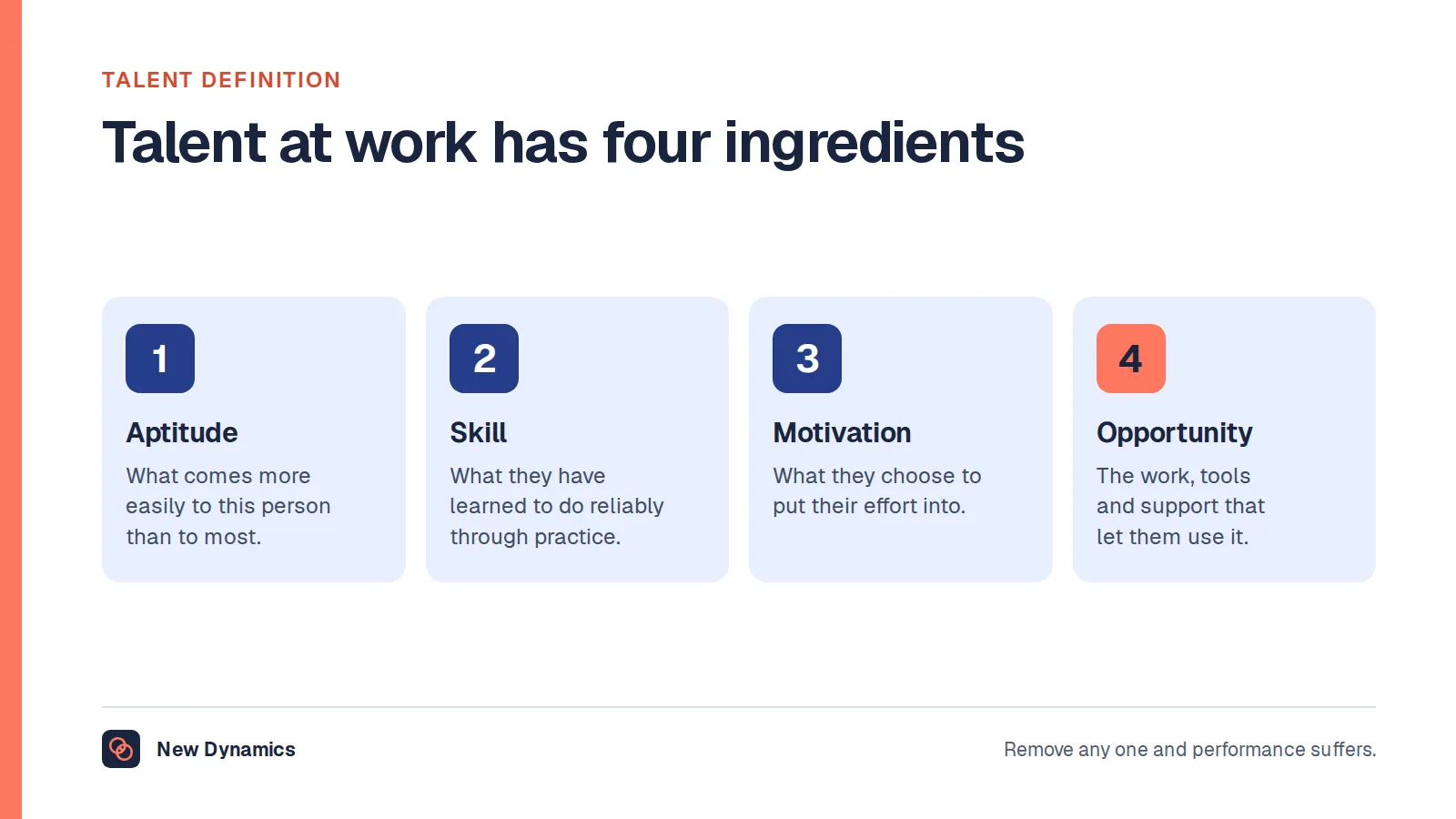
- Succession. Compare potential successors against what the role really requires. See what talent means at work.
Common mistakes with competency frameworks
Too many competencies. Twenty competencies with five levels each is a hundred descriptions that nobody will read.
Adjectives without behaviours. “Shows leadership” cannot be observed or discussed.
Copying another organisation's list. Generic frameworks describe generic organisations.
Using it only once a year. A framework that appears only at review time feels like a test. Use it in everyday feedback.
Rating personality. Competencies should describe what people do. They should never be a judgement of who people are.
Ignoring results. Someone who behaves beautifully and delivers nothing is not performing. Assess the what alongside the how.
Core competencies of an organisation
The organisational meaning is about strategy. An organisation's core competencies are the few things it does distinctively well, which are valuable to customers, hard for others to copy and useful across more than one product or market.
Illustrations might include a retailer's skill at logistics, a manufacturer's precision engineering or a software company's ability to make complex tasks feel simple. These are collective capabilities, built up over years across many teams.
The two meanings connect. If your organisation's advantage depends on, say, exceptional customer service, then customer focus and problem solving belong among your people competencies, and your hiring, feedback and development should reinforce them.

Frequently asked questions
What is a core competency?
For people, a core competency is a combination of skills, knowledge and behaviour that matters most for success in a role or organisation, such as problem solving or collaboration. For a company, it is something the organisation does distinctively well that competitors find hard to copy.
What are examples of core competencies?
Common examples include collaboration, customer focus, clear communication, planning and organising, accountability, problem solving, decision-making, adaptability, coaching and learning agility. Each should be defined with observable behaviours, so that people interpret it the same way.
What is the difference between a skill and a competency?
A skill is a learned ability to do a specific task, such as building a spreadsheet model. A competency is broader. It combines skills, knowledge and behaviours that together lead to good performance, such as analytical thinking.
How many core competencies should an organisation have?
Five to eight core competencies that apply to everyone is usually enough. You can add a few for leaders or for particular job families. Long lists are rarely read or used, which defeats the purpose.
How do you write a competency?
Give it a plain name and a one-sentence definition. Add three or four behaviours that someone could observe, and describe how expectations rise across two to four levels. Avoid adjectives such as excellent or strategic, which people interpret differently.
What are key competencies for managers?
Key competencies for managers usually include setting direction, coaching, delegation, giving feedback, developing others, decision-making and leading change. These add to, and do not replace, the core competencies expected of everyone.
Your next step: rewrite one adjective as a behaviour
- Pick one word you use about good performers, such as proactive.
- Write three things a proactive person does that you could observe.
- Check the wording with two colleagues.
- Use those behaviours in your next piece of feedback.
For a worksheet that turns competencies into development actions, read and download our competency-based feedback guide. The guide is free to read, and the PDF uses our short download form.
Want goals and behaviours reviewed together, with evidence from the whole year? Book a New Dynamics demo and bring your competency framework. You can also email contact@new-dynamics.com.